Stanford Seminar - Blending Data-Driven CBF Approximations with HJ Reachability
Skills:
Agent Foundations90%Tool Use & Function Calling80%Multi-Agent Systems70%Autonomous Workflows60%ML Maths Basics50%
October 20, 2023
Sylvia Herbert of University of California, San Diego
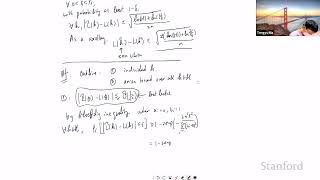
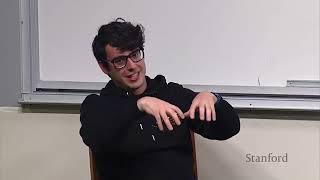
In this talk I will discuss recent joint work with Professor Sicun (Sean) Gao on using data-driven CBF approximations for safe control of autonomous systems. First I will discuss how we blend CBF approximations and HJ reachability for systems with modeled dynamics. The data-driven CBF approximation provides an efficient initial estimate of the true CBF, which is then refined using HJ reachability analysis. This work was presented at IROS 2022, with some new additions. Next I will discuss our recent work on how we use data-driven CBFs for hard-to-model dynamics (e.g. interaction behavior among pedestrians). Our approach exploits an important observation: the spatial interaction patterns of multiple dynamic obstacles can be decomposed and predicted through temporal sequences of states for each obstacle. Through decomposition, we can generalize control policies trained only with a small number of obstacles, to environments where the obstacle density can be 100x higher. We have no guarantees on safety (at least so far), but we empirically show significant improvements to dynamic collision avoidance (compared to other learning methods) without being overly conservative (compared to control theoretic methods). This work won the Robocup best paper award this month at IROS 2023.
About the speaker: https://sylviaherbert.com/
► Check out our entire catalog of courses and programs: https://online.stanford.edu/explore
Watch on YouTube ↗
(saves to browser)
Sign in to unlock AI tutor explanation · ⚡30
Playlist
Uploads from Stanford Online · Stanford Online · 0 of 60
← Previous
Next →
1
 2
2
 3
3
 4
4
 5
5
 6
6
 7
7
 8
8
 9
9
 10
10
 11
11
 12
12
 13
13
 14
14
 15
15
 16
16
 17
17
 18
18
 19
19
 20
20
 21
21
 22
22
 23
23
 24
24
 25
25
 26
26
 27
27
 28
28
 29
29
 30
30
 31
31
 32
32
 33
33
 34
34
 35
35
 36
36
 37
37
 38
38
 39
39
 40
40
 41
41
 42
42
 43
43
 44
44
 45
45
 46
46
 47
47
 48
48
 49
49
 50
50
 51
51
 52
52
 53
53
 54
54
 55
55
 56
56
 57
57
 58
58
 59
59
 60
60

Statistical Learning: 13.2 Introduction to Multiple Testing and Family Wise Error Rate
Stanford Online
Statistical Learning: 13.1 Introduction to Hypothesis Testing II
Stanford Online
Statistical Learning: 12.R.3 Hierarchical Clustering
Stanford Online
Statistical Learning: 12.R.2 K means Clustering
Stanford Online
Statistical Learning: 12.R.1 Principal Components
Stanford Online
Statistical Learning: 13.R.1 Bonferroni and Holm II
Stanford Online
Statistical Learning: 12.6 Breast Cancer Example
Stanford Online
Statistical Learning: 12.5 Matrix Completion
Stanford Online
Statistical Learning: 12.4 Hierarchical Clustering
Stanford Online
Statistical Learning: 12.3 k means Clustering
Stanford Online
Statistical Learning: 13.1 Introduction to Hypothesis Testing
Stanford Online
Stanford Seminar - Introduction to Web3
Stanford Online
Stanford Seminar - Designing Equitable Online Experiences
Stanford Online
Stanford CS330: Deep Multi-Task & Meta Learning I 2021 I Lecture 1
Stanford Online
Stanford Seminar - Perceiving, Understanding, and Interacting through Touch
Stanford Online
Stanford CS330: Deep Multi-task & Meta Learning I 2021 I Lecture 2
Stanford Online
Stanford CS330: Deep Multi-task & Meta Learning I 2021 I Lecture 3
Stanford Online
Stanford CS330: Deep Multi-Task & Meta Learning I 2021 I Lecture 4
Stanford Online
Stanford CS330: Deep Multi-task & Meta Learning I 2021 I Lecture 5
Stanford Online
Stanford Seminar - Evolution of a Web3 Company
Stanford Online
Stanford CS330: Deep Multi-task & Meta Learning I 2021 I Lecture 6
Stanford Online
Stanford CS330: Deep Multi-task & Meta Learning I 2021 I Lecture 7
Stanford Online
Stanford CS330: Deep Multi-task & Meta Learning I 2021 I Lecture 8
Stanford Online
Stanford Seminar - Designing Human-Centered AI Systems for Human-AI Collaboration
Stanford Online
The Sh*tFixers: Bob Sutton Interviews David Kelley, Design Thinking Superstar
Stanford Online
Stanford CS330: Deep Multi-task & Meta Learning I 2021 I Lecture 9
Stanford Online
Women Rise: Sheri Sheppard
Stanford Online
Stanford CS330: Deep Multi-task & Meta Learning I 2021 I Lecture 10
Stanford Online
Stanford CS330: Deep Multi-task & Meta Learning I 2021 I Lecture 11
Stanford Online
Stanford CS330: Deep Multi-task & Meta Learning I 2021 I Lecture 12
Stanford Online
Stanford CS330: Deep Multi-task & Meta Learning I 2021 I Lecture 13
Stanford Online
Stanford CS330: Deep Multi-task & Meta Learning I 2021 I Lecture 14
Stanford Online
Stanford Webinar - Cloud Computing: What’s on the Horizon with Dr. Timothy Chou
Stanford Online
Stanford CS330: Deep Multi-task & Meta Learning I 2021 I Lecture 15
Stanford Online
Stanford Seminar - Multi-Sensory Neural Objects: Modeling, Inference, and Applications in Robotics
Stanford Online
Stanford CS330: Deep Multi-task & Meta Learning I 2021 I Lecture 16
Stanford Online
Stanford Seminar - Toward Better Human-AI Group Decisions
Stanford Online
Stanford CS330: Deep Multi-Task & Meta Learning I 2021 I Lecture 17
Stanford Online
Stanford CS330: Deep Multi-Task & Meta Learning I 2021 I Lecture 18
Stanford Online
Stanford Webinar - Web3 Considered: Possible Futures for Decentralization and Digital Ownership
Stanford Online
Stanford Seminar - Ethics Governance-in-the-Making: Bridging Ethics Work & Governance Menlo Report
Stanford Online
Stanford Seminar - Towards Generalizable Autonomy: Duality of Discovery & Bias
Stanford Online
Stanford Seminar - ML Explainability Part 1 I Overview and Motivation for Explainability
Stanford Online
Stanford Seminar - ML Explainability Part 2 I Inherently Interpretable Models
Stanford Online
Stanford Seminar - ML Explainability Part 3 I Post hoc Explanation Methods
Stanford Online
Kratika Gupta talks about Stanford's Product Management Program
Stanford Online
Stanford Seminar - Making Teamwork an Objective Discipline - Sid Sijbrandij CEO & Chairman of GitLab
Stanford Online
Stanford Seminar - ML Explainability Part 4 I Evaluating Model Interpretations/Explanations
Stanford Online
Stanford Seminar - Adaptable Robotic Manipulation Using Tactile Sensors
Stanford Online
Stanford Seminar - ML Explainability Part 5 I Future of Model Understanding
Stanford Online
Meet Joe Lapin, Innovation and Entrepreneurship Program Completer
Stanford Online
Stanford Seminar: Social Media Scrutiny of Frontline Professionals & Implications for Accountability
Stanford Online
Stanford Seminar - Alphy and Alphy Reflect: creating a reflective mirror to advance women
Stanford Online
Stanford Webinar - The Digital Future of Health
Stanford Online
Stanford CS229M - Lecture 1: Overview, supervised learning, empirical risk minimization
Stanford Online
Stanford CS229M - Lecture 2: Asymptotic analysis, uniform convergence, Hoeffding inequality
Stanford Online
Stanford CS229M - Lecture 3: Finite hypothesis class, discretizing infinite hypothesis space
Stanford Online
Stanford Seminar - Decentralized Finance (DeFi)
Stanford Online
Stanford CS229M - Lecture 4: Advanced concentration inequalities
Stanford Online
Stanford Seminar - Bridging AI & HCI: Incorporating Human Values into the Development of AI Tech
Stanford Online
More on: Agent Foundations
View skill →





Related AI Lessons
⚡
⚡
⚡
⚡
93 Agents. One OS. Under a Grand. Google I/O 2026 Wasn’t a Keynote — It Was a Warning.
Medium · AI
Everyone’s Becoming an “AI Generalist.” I Bet My Career on Being Boring Instead.
Medium · AI
AI-Assisted Galactic Anisotropy Mapping: ICM, Galaxy Morphology and Cosmic Medium Vectors
Medium · AI
AiFinPay: Autonomous Payments for ruvnet/ruflo
Dev.to AI
🎓
Tutor Explanation
 DeepCamp AI