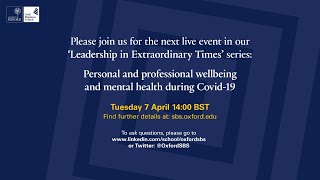
Personal and professional wellbeing and mental health during Covid-19
Saïd Business School, University of Oxford
·
Intermediate
·🧘 Mental Health & Wellbeing Practice
·6y ago
Skills:
UX Research60%
Key Takeaways
The video discusses personal and professional wellbeing and mental health during the Covid-19 pandemic, highlighting the importance of social support, communication, and resilience. It provides actionable steps for individuals and leaders to promote mental health and wellbeing in the workplace and beyond.
Full Transcript
hello and welcome to leadership and extraordinary times brought to you by the side business school at the university of oxford i'm professor andrew stephen i'm the associate dean of research here at the side business school and also l'oreal professor of marketing uh i want to welcome you to our live broadcast uh today we're going to be talking about personal and professional well-being and mental health during the time of the covert 19 crisis uh i'm joined by three of my faculty colleagues whom i'll introduce uh in in a moment um all of whom are doing research and are experts on on various facets of this topic our hope is that we can we can share some of the evidence-based advice uh around the the big issues of well-being and professional and um and uh and and mental health um professionally and personally um that are relevant to you as individuals but also relevant to you as leaders and and business people for your uh in your business professional lives um so we can be practical and we can we can help you out with some of the insights from our research here at the side business school um so i'm joined uh by three colleagues um dr cammy crowley who is an associate professor of marketing uh dr yana melanie is an associate professor of economics and strategy and dr mike gill associate professor of organization studies welcome to the three of you uh thanks for for joining us today um and uh for joining everyone who's listening in uh from around the world so i want to dive right in and and sort of start thinking about the situation now and before we get into uh thinking about the sort of leadership aspects of of this which we will get to um let's just think about people think about human beings think about sort of the human aspects of this crisis certainly there is a public health crisis from a disease spreading standpoint but i also think there's a public health crisis perhaps more salient than ever before on a global scale when we think about um mental health and well-being and i know all three of you do research related to this so so i'm looking forward to hearing more from from each of you today but how about we start with you yarn and because some of your research has been about factors that both enhance as well as detract from uh well-being and happiness and life satisfaction so kind of what's happening at the moment uh the way that you see it um and what what things could you suggest might actually be helpful to people uh in times of this crisis well thank you andrew for this question and um hello to everyone on this call um well in terms of the impact on well-being more generally to kick us off in this conversation there's a in terms of drivers there's a number of positives also coming out of this uh so we find social support volunteering this notion of fellow feeling that the queen alluded to is up um and so we will hopefully see positive and lingering positive effects from that but needless to say that the um the impact on health and especially the economics when you think about the larger more broad social impact is not necessarily going to be undone by just fellow feeling and so our research is really focused in on for example when people lose their jobs and we do have a lot of people uh losing their jobs these days so we're looking at about 950 000 individuals who are now claiming uh universal credit in the uk we're looking at about 10 million people in the united states over the last two weeks who've had the claim for for welfare benefits and so the well-being impact of this group in our society i think is maybe should be emphasized even further and the reasons are pretty uh are pretty stark as comes through our research is not just the lost income when people are being made redundant um half of the impact really comes through losing social identity and some self-esteem comes through losing a daily routine and especially comes through losing part of your social network because for a lot of people that does come through their work and so when people lose their job we find that essentially we find a drop about 20 in their life satisfaction of which as i explained half is only explained through income losses and so my my first thoughts in terms of the impact on well-being from this crisis really really is with the people that are being made redundant at this point and and maybe as a follow-up to that yarn as well i mean obviously that's a you know a serious problem and a particularly vulnerable uh subset of the population who are going through those times but what about others who are just adjusting to new ways of of going about their daily lives being on lockdown uh dealing with the sort of fear and uncertainty what what does the research on well-being suggest that they're going through is it just sort of a a less intense version of what you were talking about with respect to people who have been laid off or or is it something different well what we see is uh a morphing of the the way that people connect socially uh needless to say so rather than doing it physical it's now obviously you go through virtual networks just like what we're doing now um and that also brings me to i think an important point that we'll hopefully all emphasize on this panel is that from a well-being perspective the notion of social distancing could obviously not be chosen more poorly what we should be practicing is physical distancing and putting in a special effort to connect socially more than ever even if it is through zoom or themes or something else so my senses there is a risk in this crisis for even people within staying in their drops that we move towards social isolation for some um and and other related issues and so we all need to put in a special effort to reach out reconnect reconnect with people that we may not have connected with recently and shift that all online um uh as uh as fast as we possibly can and then i think we'll definitely come to the digital aspects of of this way of life a little bit later in in the show i to want to ask you mike though about sort of mental health um in in this sense because a lot of your researchers has looked at mental health and and being about people talking more openly about mental health um what's your take on the situation in in light of the work that you've been doing um on that front sure okay it's probably helpful just to unpack and define mental health in the first place this is um a feature um of well-being um but it's its own unique phenomenal degree so by mental health we mean something that we all have and it's how we cope with the normal stresses of life mental health doesn't mean mental ill health it means the mental health that we all have just like we all have physical health so just as we sometimes have problems with our physical health you might sprain an ankle or injury yourself we have challenges to our mental health and our well-being so you might feel down or stressed and that can be normal and it's a spectrum so everyone is somewhere along the mental health spectrum and having good mental health doesn't mean that you're happy and confident all of the time or ignoring problems it means that you're living and coping well despite problems so mental health is something we all have and it's distinct from mental illness so mental illness could for example be clinical depression or something that's diagnosed by a psychiatrist or a clinical psychologist so we're talking about mental health here and if we think about mental health in the workplace to total agreement with yam this is something that's going to be hit quite hard so the context where we do our work is vitally important that's a lot of the research i do and we know that there are many different models of stress or what drives stress those are things like a lack of control a lack of support lack of relationships lots of change and at the minute we're seeing all those boxes being ticked a really limited amount of control very isolated socially from each other lots of blurring boundaries many people who have children having to look after their children as well as balance their job all that means incredible amounts of pressure on people much more stress so it's really going to be transforming and impacting people's mental health very significantly and i think it's part of it also is perhaps a sort of a monotony of of life i mean we don't we just we have constrained options now um and you know i sort of if if i check my twitter feed you know at any point in time there's people you know talking about how tight they feel after a day of you know sitting in their home office for instance uh on video conferencing or um you know this this term zoombies as in sort of zoom zombies um and so on which is kind of cute but um you know i think all of these factors could impact but perhaps you know cami this is a good point to bring you into conversation because you've studied uh well one of the areas that you study is is repeated consumption of things you know over time um and and i know you've looked at that you know more more particularly into the food consumption uh and maybe a lot of us are consuming more food uh at the moment um not speaking from personal experience but um i'm just curious what you think in light of what yarn and mike was saying around sort of the new the new lifestyles that we're finding ourselves leading and how that might impact sort of the hedonic enjoyment of life um you know to sort of extrapolate your findings a little bit into the current situation yeah so i think that kind of what you were saying about this exhaustion that we feel by doing the same thing over and over again the research speaks to this we often when we have these repeated experiences our enjoyment of the experiences declines so we see that we are getting or extracting less enjoyment and less value over time but i do look at factors that can increase our enjoyment of experiences and or sustain our enjoyment of these activities so unfortunately variety is a really great way to sustain enjoyment but we have less variety available to us now so what else can we do and we have a number of options we can kind of change uh the way we think about our activities so when we think of the activities as really monotonous or repetitive it's going to decrease our enjoyment more quickly than if we look at it as an opportunity to engage in learning or to dig deeper and kind of discover the nuances or become an expert in the area so some things that i would recommend is based on my research is that we need to start framing this as a way to discover new and exciting things about the activities that we already enjoy use it as an opportunity to be an expert or we could pick up complex activities so use this as a time to do something challenging like perhaps learning a new language or picking up an instrument that you've always wanted to do or at least mastering a new task that's available to you like painting or cooking things that we can do while we're physically distancing ourselves from each other and focusing on that complexity and learning something new will sustain enjoyment for us thank you i mean that so i'm gonna bring in an audience question right now because um we've got um you know almost 500 people uh across youtube and linkedin um watching right now um so so exactly picking up on on what we were just talking about with all three of you actually is a question from kagila which is what would you suggest to those who are at home and feeling vulnerable right now um patian we we start with you on that well andrew i'm uh i'm inspired by the comments just made by cammy um try and break the uh the mold and do something special um whether it's trying an instrument or a new language or doing something that you're not usually doing it does seem um to be a good advice but otherwise more on the on on more traditional avenues at that daily routine do try and get structured your day like you would normally if you are working outside out of home definitely also try and stay socially connected and one silver lining perhaps of this of this crisis is that it allows you to be perhaps a bit more vulnerable and open up um to other people or maybe reconnect with people you haven't spoken with for a long time so i think the um i mean camus advice is very good and then i would definitely also had to try and connect more meaningfully and perhaps reconnect with people you haven't spoken with for a while so reach out to people as well and speak and be vulnerable if need be i think it's fair to say that this is a global shared experience obviously people experience in that in their lives different versions of what we're going through but there is a probably more than than perhaps ever in at least our lifetimes a a commonality of experience which could be making us feel more vulnerable or um anxious about life so that that hopefully is a is a an opportunity to kind of come together and talk about those those sorts of issues even though you know sometimes talking about um mental health and and related concerns might be hard for people um but at least there's a i think at least i personally feel a sense of uh we're all in the same boat uh and and i think that that can increase some solidarity um you know another thought i i had with this and sort of related to that question but maybe expanding a little bit into the um the professional lives aspect um and mike i'm going to come come to you with this is it's not just say vulnerability from sort of the more extreme consequences of an economic downturn that yarn spoke of earlier but it's you know people maybe not being quite sure if their job's going to be the same or are they doing a good job working from home are they you know they're not getting the same feedback that they would necessarily always get or it's harder to do that but from i think a team leader side as well as a sort of a team member side um or maybe they're being asked to take on new responsibilities because one way to to protect people's jobs uh is to get them to you know if you're in a less busy role to get you to go and help out in a more busy part of an organization mike how would you suggest people sort of deal with that type of change because it's perhaps not quite as as um as visceral in terms of an experience as as being laid off um but it's it's it's i imagine still pretty hard to handle for people going through it yeah i think in on that point one of the key things here which i think everyone else has touched on is the importance of communication whether that's with people who are close to you and loved ones but absolutely also with co-workers colleagues and employees we on the point of leaders as well it's massively beneficial for leaders to communicate we did a study with some colleagues at cambridge we looked at the role of mentoring in the police force we found that through frequent communication you could reduce anxiety across senior and junior offices and crucially it was the senior police officers who were leading the mentoring who got a bigger boost to managing their anxiety so this idea of communication can actually be profoundly beneficial to both parties so if you have a team i would encourage you to reach out to them and if you're an employee i would encourage you to reach out you both stand to benefit in terms of your mental health so let's let's continue with communication now and obviously that's very much uh digital communication uh in in the times of physical distancing and being locked down um so we're leading our lives more you know digitally than ever before work and personal lives um you know we're having you know house party and these sorts of experiences hopefully to keep in touch with people and and usage of social media and messaging apps has also gone up um and so cami i want to come to you first around this uh so you can share some of the research um around and social media and well-being social media use and well-being because i think that's perhaps more more relevant than than ever as we're probably finding ourselves using uh these applications um much more yes so um with my colleagues i was motivated by this idea that we are seeing in popular press about how social media is bad for us so uh we're seeing that it's impacting our attention spans and our self-esteem and so all of these negative impacts but we know that for billions of people uh they're using it on a daily basis so really motivated by this fact that is social media negatively impacting our well-being and so that's really what got us started on the question um and so we basically wanted to address the simple question of how does time spent using social media affect our psychological well-being and psychological well-being um is a general um kind of subjective appraisal of of how well we're doing it it embodies things like happiness and life satisfaction and positive emotions um so we wanted to look at how this general kind of cognitive and emotional uh appraisal of how well we're doing is impacted by social media so in the work that i did we recruited over 1800 participants and the study lasted for some participants between four to six months and what we did was we had participants essentially download an app onto their phone that tracked their social media use and so we measured how much social media they were using on their phones and we pinged them periodically every two weeks and asked them about their psychological well-being and what we found is that time spent using social media luckily has a small but significant positive impact on our psychological well-being and what this is really being driven by is kind of i'm i'm sure as mike and jan would also kind of reiterate and have alluded to time spent on meaningful social connections so time spent connecting with friends and family even co-workers or colleagues people that matter to us this uh has the most positive benefit for our psychological well-being so time spent in a truly social manner on social media uh has this positive benefit but when we looked at the apps that were primarily used for non-social social media that makes sense uh maybe following influencers or celebrities or connecting with brands this did not impact our psychological well-being so we didn't find either a positive or a negative relationship so luckily we did find that this connecting with truly you know in a truly social manner uh positively impacted our psychological well-being so it's not that so just to be clear that it's not that those other things that are sort of just following people that you know might be entertaining or informative it's not it's not hurting us it's just not having this sort of detectable boost the way that using social media and messaging to connect with with people where we care about i suppose is is going to have um mike uh i want to put pivot this into sort of a workplace context um because we're now using these tools to to communicate with our colleagues um you know a lot more than than you know perhaps we we did uh when we're you know all physically in the same space so so what what what would your take be on on things there or we or do we need to be worried about a fatigue aspect as well um from our digital work life i think absolutely and i think what kami said is aligns very much so with what we would find in the organizational studies literature which is that if you can have meaningful contact and communication with other people that has an incredible uplift on your mood and therefore indirectly in your behavior and your performance one of the key challenges um with any kind of workplace and particularly in times of great uncertainty or anxiety is what we would call checking behaviors so we can seek to check and keep abreast if we think of the minute of the news it's tempting to keep logging in i presume on social media to see what's happening but the real value here is not doing that not using social media or any kind of communication work platform to check and reinforce that anxiety matching or checking behavior but to use it as a platform to communicate and build and maintain those relationships from an organizational point of view that's absolutely essential because as anyone who works knows it's not just formal conversations to get things done it's the informal conversations and you have to have the communication and it must continue to flow for those to be effective and yeah there's some other aspects of sort of our digital lives that have increased in scope and scale let's say um that we need to be mindful of good or bad from from some of the research the tracking research that you're uh involved with uh yes thank you andrew well um building on cami and mike's points needless to say so we we're starting to get a good sense for how um social media can help uh well-being and in a way we've now talked from the perspective of individuals and organizations but in a way that's also i think a challenge now and an opportunity and a responsibility for the actual social media platforms to now that everybody's turning to them to really leverage the insights coming out of this research and for example tweak the algorithms slightly if they can to have the meaningful connections which they tend to pick up by way whether or not you've ever tagged people into pictures for example as part of your family also try perhaps promote these kind of posts so to accentuate meaningful connections and make it easier for people to do so we also know from research on on on social media of course that they have the the power uh to nudge people into action uh so for example there's wilderness studies about getting people into uh uh actually to get out to vote for example in the us context and so here too um maybe not to get out to vote but to get out and volunteer so people are able able and capable and willing at the time um can be nudged into actual positive behavior through their social media platforms so here too it's really an appeal to social media to try and do the best they possibly can on this front and then finally i was thinking um a lot of us and increasingly so especially younger generations yet get their news through social media and so here again and i see some social media platforms doing a really good job at this having essentially a banner of covet 19 helpful information on top of the screens etc so trying to in a way um curate positive information and helpful information relative to the crisis and and and hopefully not too polarizing because that is a slight risk that some of these walls whether it's twitter or facebook can have anyway so i think this is really uh so critical ever more critical and in a way an opportunity and a responsibility for social media platforms to uh help and leverage the research by cammy and others to do a best possible job in helping people at this point yeah no i mean it's a good point actually there's just a question here that's come up from uh from jesus which is actually about fake news and this information about cover 19 which of course can can spread um you know let's say relatively easily across platforms like uh facebook and twitter and and and the others um so you know we're actually going to have an episode on in this series with an expert on on digital misinformation in in a couple weeks time hopefully but but just for for now since since it's come up um you know is it just you know and i'll maybe bring this back to kami is it is it really just about the social media platforms doing what what yarn was talking about which is you know banners and and sort of here's the the curated news of of today about covert 19 or or i mean what else um might the user be mindful of because obviously there could be algorithmic solutions to this but as a user of social media um who wants to get sort of the beneficial dose of of well-being enhancement out of their their meaningful connection time on on facebook and the likes how do we kind of keep an eye you know off that other stuff um particularly misinformation fake news and so on do you have any advice on on that front because i think it's a it's a it's it's this double-edged sword of social media that we have lived with for you know a long time now yeah i i think that that's a very good question it's um not my expertise area but kind of using some of my work to inform my response is really um if if the platform isn't offering you a solution algorithmically then you might look at there are ways that you can set your settings so that you stop seeing posts um potentially by people who are being very divisive so that would be something that would would increase your well-being is trying to remove some of that content and as well as generally focus on sensational headlines and potentially even exaggeration or misinformation it's always good to double check that information before you let it kind of inform your actions but in general try carefully to uh use the platforms to curate the type of content that you'd like to see specifically more friends uh kids and more of your parents uh dinners um and chatting with one another and and less perhaps the things that you find stressful and and even potentially threatening information i think i i agree i mean i think that there's power in the hands of the users to to be responsible in how we we approach using social media as well uh in these times it is very helpful while we're on questions from from our audience um switching gears a little bit and mike i'm gonna come to you with this um erica has asked about um sort of essentially are there any tips for supporting frontline workers um in sort of this digital working environment i mean you talked about the clear lines of communication and mentoring based on your your police force work earlier but do you have any other suggestions around uh around that well i think i mean a lot of it depends on the context of the individual but if we just broad brushstrokes say most people who are front-line workers let's say for example in the uk at the nhs or all around the world health workers are going to be under a huge huge pressure with their jobs they're going to need a lot of support if you're line managing those people or responsible for them or you're looking after them at home in various capacities that one of the most valuable things you can do is beyond just merely talking to them try and understand how they're feeling are there specific things you can do and offer them for help try not to make assumptions particularly around mental health people may be taking things very differently in their experiences than you might so the key is to understand their perspective and to try and respond to that and i mean i mean someone else is also us here on uh sarah would it be helpful for hr to bring in psychologists um like i guess now but also maybe into the future um do you have any thought mike again just yeah i i i would say yes absolutely and i think it doesn't necessarily have to be psychologists although many organizations do have them you could simply provide training on mental health so for example there are training courses on mental health first aid or mental health awareness at work the idea here is not to create psychologists or psychiatrists in the workplace because that's a very specialized skill set and i don't think managers can take years to develop it but that is not to excuse an absence of basic understanding of when people are suffering or struggling at work and to be able to pick up on those cues those signs can be done quite quickly and that could be a massive massive support to other workers so yes it would be great to bring psychologists but there are more small scale steps that could be taken that would also be very beneficial and then jan there's a question that's just come in from um swaga which is is actually kind of questioning the business as usual approach um so saying you know is it not a sign of unbalanced mental health to continue business as usual when and and work as usual when when the context has changed it makes me think about what you said sort of in your opening remarks about um people who were laid off and and and and the research you've done around sort of the the the well-being uh impact of of work and meaningful work so i i'm guessing you probably have a perspective on on on that that question because i think it is it's a leadership issue right do we do we just kind of keep on doing what we do um or or not um what is right for our people um yeah what would your thoughts be well thank you uh for uh a good question indeed um and so the thinking is the following here or at least i'll give one example um business as usual in times of crises leaders will quickly go to the notion of we need to lay off a number of people in our organization for good or bad reasons and so i think where this crisis will hopefully show us a different alternative to this is to and you allude to this notion of rolling this boat together um i remember seeing qualitative work on well-being and approaches to a situation like this coming out of the financial crisis 2008-2009 for some only a handful of companies really rather than laying off say 20 of their stuff they look for original ways of not doing what is business as usual in these situations but rather sticking together and perhaps um offering people to go four fifths or essentially forcing everyone on four fifths and take a 20 pay cut rather than laying off twenty percent of their staff and so it's these kind of i think original innovative ways of uh or more creative ways if you of dealing with the situation that can help on the well-being front uh for the obvious reasons that you're not laying off people which is obviously terrible for people being made redundant but there's also something that people tend to forget so say if you lay off 20 of your stuff that's horrible for the people being made redundant but it's also horrible for the 80 of people to stay in your firm because who is going to be laid off the anxieties are not just with the people that are being made redundant they also travel and work their way throughout the organization um and so back to the analogy if we're on this boat together if we if leaders can hold off or some somehow find creative ways to stick together throughout this crisis this storm that we will all weather to keep with to keep with the boat analogy uh and we should come out on the other side hopefully in a few months i think those organizations that will have kept the teams together rather than calling their people will come out stronger and so this anecdotal evidence from these handful of firms throughout the financial crisis kind of shows this this was a particular law firm and as compared to the other law firms that did the traditional business as usual approaching the crisis this this law firm who went to put everybody on four fifths came out stronger morale for employees well-being was much higher coming out of the crisis and as we know and mike also alluded to this before there is a very strong connection and we know because our evidence shows its causal between employee well-being and morale engagement and productivity so if you can leverage this crisis into some kind of opportunity to think creatively stick together write out the storm together you will come out stronger on the other side which will then have a productivity and performance benefits uh in in the uh hopefully not to this future thanks and i just want to do one more audience question and then i want to ask the the three of you a few more things um but this this comes from nigel who's sort of he's saying a big issue is the stress and fatigue that's caused um by spending a lot of time coordinating and not actually getting work done um and you know i i i'm sure you know a number of us uh you know uh speaking today as well as uh those of you um tuning in probably have this experience um i maybe go to um mike and then cami just just for your personal thoughts on this what how have you been finding working um versus coordinating or you know being organized um during during this time um just just you know based on your own experiences i'm curious mike perhaps you you'd like to go back sure uh so i think uh other people who have children will have also experienced this uh you are now doing child care and trying to do your job so and i speak to many of my friends very similar experiences and a lot of organization goes on uh behind the scenes if you like of work and that obviously impacts on your mental health you'll get behind on your work you can't keep up so the challenges that we face now are not just about having to do work in a different environment but having to transform how we do work how we manage our personal lives and the blend between the two so i think it's a very different skill set that is required now and even more management and therefore even less time doing the true work as it were again cami do you have anything to add to that from your perspective yeah i mean i think i can also sympathize with mike about the coordination of the children and and now there's a lot of other kind of things being uh added on to our normal day-to-day jobs that take a lot of time and energy out of what we would spend actually doing the work i think another danger that we're all experiencing is this tendency to have our personal and our professional lives blend into each other so there's no uh clear stepping away from your desk and being done for the day and i think not taking that time to totally disconnect and and unwind at the end of the day or at the start of the day however uh your schedule typically goes you know it's it's easy to feel kind of caught in this rat race or or constantly managing and so i think being very careful to take the time to completely disconnect and reconnect with your family and and completely focus on the you know the social interactions around you the best you can and and really avoid letting [Music] it lead one day into the next i think is is really helpful yeah i can certainly certainly um sort of uh sort of sympathize with that um so i want to talk about the future now um because this will end um life will return to to normal whether that's you know just back to old normal or into some kind of new normal or probably a combination uh of those things um so sort of then what happens uh you know i'm kind of thinking about this if i'm to be a little bit pessimistic you know we've gone through this adjustment period we'll get through that um and then you know we get used to the sort of the current way of working we're in now and the way of living our lives and then you know so the world has opened up again or our towns and cities and countries you know gradually have that happen um and then we go through another adjustment period so is this you know how do we how do we sort of think about that um you know not not necessarily building you know massive sort of hr policies or corporate throws around it but but what might we want to start to be thinking about in the the weeks or months to come about in essence the return to to life as we as we knew it uh jan dude do you want to kick off there um with some thoughts please uh yes andrew absolutely so i think there's a few silver linings throughout this crisis even if obviously uh generally it's not been uh it's it's it's it's miserable for most but there's a number of silver linings one is that fallow feeling these these social connections and i think with colleagues but also outside of work life a work in larger life we've reconnected with lots of people in a more vulnerable way you mentioned we're all in this together this this has strengths and ties so i'm hoping that and i know from from past sort of qualitative studies of crisis that this will hopefully linger so this strong communities will come out stronger in a way and i hope that we will benefit from this moving forward now on the technology front so i think the real well let me first say something else about changing potential changes in behavior so people like us on the call here and i suppose many of people listening or asking questions are frequent travelers um in a way the benefits of having a lot of our trips cancelled makes me also think and having replaced this by conference or video calls makes me think do we really really need to say yes to every single trip that's being offered or suggested can we can we really not hold some of these as webinars or online conferences and the silver lining here so when we launch the world happiness report normally we're at the united nations there's a hundred people it's all very fancy and great but having moved it to a webinar we suddenly had thousands of people zooming in as compared to 100 people listening and being part of the lounge so i'm thinking well not only are we saving ourselves time and travel and no pollution and flying uh it could also benefit and do more so i think some of these technological uh changes or this travel behavior could could benefit and not one specific item on work life balance and the the ict the communication technology that we've now set up so all of our it departments have worked day and night to try and set everyone up in the firm who can work from home to be able to work from whether it's zoom or microsoft teams so in a way that this has accelerated i think the deployment of this kind of technology and it'll be very hard for senior managers to say no uh to people who say look can i work a friday morning from home because it works much better for work-life balance can i take this meeting from home using zoom or teams or what have you it'll be very difficult to say no to these kind of requests because we've all lived through this and we now know it's possible and we're set up for it so my senses and my hope in this in some way is that work-life balance or flexible working hours or at least some cutting in the commute which we know how bad that is for well-being can be done thanks to having set up and accelerated the deployment of this kind of technology and maybe just on the commute thing so we have i looked it up the other day very specific particular coefficients about just how bad commute is for well-being we can even detail this to like the psychological cost of an additional minute minute to your commute is as a pound um in terms of income if you were to do the income equivalents and so being able to say hopefully reduce or communicate one day a week and work the afternoon or the day from home and hopefully i think um positions will now or firms or organizations will allow for this which will hopefully be a positive coming out of this uh out of this cobit 19 situation so so you know and your research does show that that there are there are clear benefits from a well-being standpoint with work from home and flexible working arrangements um and you're right this this hopefully um in a lot of organizations this this proves the the point um that it can be done what about though this sort of cultural aspect sort of the again within the context of organizations uh mike um how do we once we go back though to the office uh or to our places of work and you know i've i've been seeing you know with our teams here and in the business school um you know increased camaraderie basically i i sort of was you know likening it almost to a um you know almost a cultural um organizational culture reset button um not that it necessarily needed it but but you know how do we make sure when people go back to those you know familiar locations um they don't also slip into maybe some of their their you know less positive habits in terms of the workplace which might bring down the the culture so are there any any any tips that you would you would suggest from that standpoint absolutely so the question you're asking is really one about culture and if we change the culture how we get that to stick most attempts to change cultures of organizations fail because it's really difficult to do and it's deeply rude assumptions of that organization that people hold i would argue the scope of change that has happened in the last couple of weeks around the world is absolutely tremendous and exactly as jan pointed out it's proven that we can do things differently the world won't end we can still operate we can still function and that really gets at the heart of the assumptions that underpin most organizational cultures so the key would be if we wanted to try and enforce or embrace this change in an ongoing basis we need to clarify in each organization these changes be very vocal about them very clear about them and explain how these changes still allow us to complete our mission how it's going to not negatively affect productivity etc and then ride on the wave of this if nothing has changed in three or four months then it will very quickly fall back if the changes to the assumptions of a culture can be solidified and encouraged now then there's a massive opportunity for change which rarely exists and and i think we could probably expand that a bit to um you know relationships between businesses uh and caming i'm going to come to you on this um from sort of a marketing perspective um you know also we've been seeing quite a lot of um you know relationships that are you know very business contractual you know business to business type relationships being far more human now because you know you're sitting in your kitchen and talking to them on zoom and they're in their living room and the kids running around all the cats climbing over the the laptop or you know whatever it might be so it it does add this sort of informal human aspect to otherwise sort of business relationships um how might we preserve that from a you know into organizational standpoint as well because i think mike's points on on internal culture are well taken but obviously in a business ecosystem we might want to think about that too do you have any thoughts very good question i think that uh the one perhaps downside of what jan was saying is sometimes zoom can feel a little bit cold or just even kind of scrolling through your feed on social media will feel a little bit cold so technology lends itself to distancing in a way that when you're in the same room as somebody uh it feels different so i think that um the fact that you're pointing out that like when children or pets jump on to calls and suddenly it's not business as usual and sort of a just strictly professional front uh it does change the relationship and can lend itself to a lot more coordination and collaboration i think how that can change going forward um i think that mike's point is well taken that any time we try to implement behavior change it's kind of like dragging a donkey along down the road it's like it's a very hard thing to do in times of crisis we can move really rapidly but we like to return to normal so a lot of our behaviors um once this is over we'll find ourselves falling back into routine so i think that just reiterating what he was saying about this being very specific and very clear to all parties involved about how you want to conduct business going forward and i think that um opening those lines of communication uh will help humanize business to business relationships that's right so um conscious of of time and we've just got a little bit of time left um today so i thought what we would do to wrap things up is i i go to each of our panelists um and ask them for sort of their top tips um for dealing with the current situation and i think um you know we just heard about sort of being more resilient as we move forward um but but we are living in this right now as well so i want to kind of bring it back to the now uh if if i may um so uh mike i don't want to put you on the spot but what would your sort of final thoughts or tips be for for people out there going through this um i have three main tips and if it's okay i'll just very briefly unpack each of them my three recommendations would be having healthy routines making sure you're taking breaks regularly and i don't just mean for lunch or food other breaks and that you're communicating and connecting with other people so in terms of healthy routines most organizations uh in the healthcare space so the british psychological society as well world health organization will tell people that they should follow a structure and develop a team and they're really vital because they give us a sense of security they reduce our anxiety they just help us routines enable us to get our work done so they're vital for you and for organizations and that means now especially if you have a change of circumstance so most of us are going to be stuck at home and you may have other responsibilities you need to think about how that's all going to fit together but my key point in this first idea around having a healthy routine is that a routine in and of itself is not necessarily a good thing you need to develop and maintain routines that promote good mental health good physical health so you need to think about your priorities what you can do how are you going to think about and protect your mood your overall mental health and some ways to do that are to make sure or bake into your routines breaks so this is my uh next recommendations around breaks again everyone including the government will tell you that you should exercise or socialize or take breaks we know absolutely clearly that if you have a break you lower your heart rate you get calmer it has a positive effect on your effect at work um but also it's really important at work we know that if you relax or socialize or even have what they call micro breaks so even less than two minutes the evidence is mixed here but that can improve the performance in your work so breaks are also good for you and the organization but the key point here again is not all breaks are created equally so we know from the evidence that if you take lunch it doesn't impact your mood as positively as doing something else like socializing with other people so a key point that you need to reflect on is when are you going to take breaks and how are you going to take them now typically i would suggest something like exercise and although you can still do that that is somewhat circumscribed at the minute so my last recommendation here is around communication so this is social creatures we've all spoken about this yan and kamin myself it's vital that you communicate and as we've mentioned having any kind of break can improve your productivity at the work but it's absolutely essential that you and the people around you so if you have children you need to think about how are they communicating how they're communicating with friends or family in a meaningful way to cami's point earlier if you're using social media so i'll stop there but those are my three main recommendations have a healthy routine take breaks outside of eating and communicate regularly thank you mike yarn how about your thoughts um so i would like to obviously second uh the three wonderful tips that mike has just uh laid out i'll uh let me add a slight uh twist on the third one about social connectedness and then add two tips so maybe together or even maybe three types um together we can make six and maybe cami will add some more practical ones so in terms of uh connecting with others um the point mike was making is couldn't be more true let me add a spin which is connect with others and help others if possible we find over and over again these positive feedback loops between if you help others and are essentially pro-social behavior as we tend to call it it pays dividends for yourself as well through the eyes and the gratitude that you see in other people it pays back multiples and i think this this helping others in a time of crisis counts double so my senses we see we'll probably see coefficients on pro-social behavior and how it feeds back into your own well-being would be even stronger as people appreciate it that need it so i think that's absolutely critical so i think that was mike's point three so i'm emphasizing that one let me add a fourth one which is related to discussions we've had as much as social media can be forced for good or news more generally we do have to switch it off from time to time and so taking breaks from news media including social media is important and for the very basic reason that we have deep evolutionary tendencies to spot big bad news um um and we can go in this for at length but we won't but we have a tendency to look at negative news more than we do good news so for example our eyes will spot how many deaths uh how many people have not survived the day because of coronavirus we will be less attuned to looking for news around how many people have actually come out of the hospital positively so how many people are coping and surviving fine and so obviously newspapers have to sell uh news uh and so they tend to cater to uh our instincts of negative news so we need to switch it off from time to time uh a fifth uh general point if i'm adding cumulatively on mike's would be to definitely look on the bright side so as always an optimistic perspective on things some things are better i mean i'm seeing andrew sitting out there in the beautiful sun and so we will hopefully all have some time today to go out for a walk and a jog so we're lucky in a way that this uh lockdown happens at the beginning of spring and that we've had an interrupted good weather so that's just me trying to look on the positive side of things but look also for silver linings i'd argue um we discussed this throughout the the this call today um we there are a number of things that will accelerate um so ict technology advances uh uh technology advances that will enable work-l
Original Description
Please join us for the next live event in our 'Leadership in Extraordinary Times' series
Subscribe to our channel ➤ https://www.youtube.com/channel/UCHIqMEje_NFJ2u24CVaNQvg
Visit our website ➤ https://www.sbs.ox.ac.uk/?utm_source=Youtube&utm_medium=SubscribeEndSlate
Follow us on social media:
LinkedIn: https://www.linkedin.com/school/oxfordsbs | https://www.linkedin.com/showcase/oxford-answers/
Twitter: https://twitter.com/OxfordSBS | https://twitter.com/Oxford_Answers
Instagram: https://www.instagram.com/oxfordsbs/
Facebook: https://www.facebook.com/OxfordSBS
#OxfordSBS #LifeAtSBS #OxfordAnswers
Watch on YouTube ↗
(saves to browser)
Sign in to unlock AI tutor explanation · ⚡30
Playlist
Uploads from Saïd Business School, University of Oxford · Saïd Business School, University of Oxford · 10 of 60
1
 2
2
 3
3
 4
4
 5
5
 6
6
 7
7
 8
8
 9
9
 ▶
▶
 11
11
 12
12
 13
13
 14
14
 15
15
 16
16
 17
17
 18
18
 19
19
 20
20
 21
21
 22
22
 23
23
 24
24
 25
25
 26
26
 27
27
 28
28
 29
29
 30
30
 31
31
 32
32
 33
33
 34
34
 35
35
 36
36
 37
37
 38
38
 39
39
 40
40
 41
41
 42
42
 43
43
 44
44
 45
45
 46
46
 47
47
 48
48
 49
49
 50
50
 51
51
 52
52
 53
53
 54
54
 55
55
 56
56
 57
57
 58
58
 59
59
 60
60

Oxford Impact Investing Webinar - Ask the Expert
Saïd Business School, University of Oxford
Alice Kettle: Telling stories through stitches
Saïd Business School, University of Oxford
Webinar - Private Equity’s Roaring 20s - A Peek Around the Corner
Saïd Business School, University of Oxford
Peter Drobac
Saïd Business School, University of Oxford
Becoming a more effective and impactful leader | Women Transforming Leadership Programme
Saïd Business School, University of Oxford
The Oxford Chicago Valuation Programme - Subtitles
Saïd Business School, University of Oxford
Ideas in Motion with Dr. Judy Dlamini and Moderated by Shukri Toefy.
Saïd Business School, University of Oxford
Oxford Impact Measurement Programme - The Landscape of Impact Measurement for Impact Investing
Saïd Business School, University of Oxford
Leadership in extraordinary times
Saïd Business School, University of Oxford
Personal and professional wellbeing and mental health during Covid-19
Saïd Business School, University of Oxford
Oxford Saïd Entrepreneurship Forum 2020, 7 March 2020
Saïd Business School, University of Oxford
Covid-19: Preparedness, resilience and the future of public health
Saïd Business School, University of Oxford
Oxford Chicago Valuation Webinar - The Rise of Private Debt
Saïd Business School, University of Oxford
Peter Tufano in conversation with Hiro Mizuno
Saïd Business School, University of Oxford
Webinar - The Macro Effects of Covid-19 | Oxford Real Estate Programme
Saïd Business School, University of Oxford
Leading and organising for impact in times of crisis
Saïd Business School, University of Oxford
Misinformation, media and trust
Saïd Business School, University of Oxford
Oxford Social Impact Webinar - What is the New Normal for Impact Investing During Covid-19
Saïd Business School, University of Oxford
COVID-19: The view from Mexico
Saïd Business School, University of Oxford
How can entrepreneurs not just recover from the crisis but actually rejuvenate the economy?
Saïd Business School, University of Oxford
Leadership in a New Retail Landscape
Saïd Business School, University of Oxford
The future of advertising
Saïd Business School, University of Oxford
R:ETRO webinar - Transformation in networked whistleblowing
Saïd Business School, University of Oxford
R:ETRO webinar - Shaping the new sustainability agenda online
Saïd Business School, University of Oxford
Post-covid-19 scenarios for the real estate industry
Saïd Business School, University of Oxford
R:ETRO webinar - Circular economy and the social
Saïd Business School, University of Oxford
Financing the COVID Crisis
Saïd Business School, University of Oxford
Keeping the sparkle: a global perspective on luxury retail
Saïd Business School, University of Oxford
Oxford Saïd and the Education & Training Foundation's portfolio of leadership programmes
Saïd Business School, University of Oxford
R:ETRO webinar - Beyond COVID-19: the case for human rights in business
Saïd Business School, University of Oxford
Capitalism The Great Debate - Stakeholder v Shareholder
Saïd Business School, University of Oxford
An Inconvenient Fact: Private Equity Returns vs The Billionaire Factory
Saïd Business School, University of Oxford
Marketing leaders, crisis management and future growth plans
Saïd Business School, University of Oxford
The future of banking - opportunities and challenges for banks in a post Covid-19 world
Saïd Business School, University of Oxford
Designing and Measuring Impact Investing Portfolios
Saïd Business School, University of Oxford
What does it take to get a job in Private Equity?
Saïd Business School, University of Oxford
A call to action from the MBA class of 2020 to the Oxford Saïd community #BlackLivesMatter
Saïd Business School, University of Oxford
After hours case study sessions - ENEL
Saïd Business School, University of Oxford
After hours case study sessions - Welsh Water
Saïd Business School, University of Oxford
After hours case study sessions - The Motley Fool
Saïd Business School, University of Oxford
After hours case study sessions - Royal Canin
Saïd Business School, University of Oxford
Reputation Symposium Series 2020 – Covid-19 and Global Business
Saïd Business School, University of Oxford
Can social impact survive the crisis?
Saïd Business School, University of Oxford
Executive Coaching | Oxford Advanced Management & Leadership Programme
Saïd Business School, University of Oxford
R:ETRO webinar - #NoMorePage3 and the Replenishment of Emotional Energy
Saïd Business School, University of Oxford
R:ETRO webinar - Structural injustices, social connection, and corporate political responsibility
Saïd Business School, University of Oxford
Covid19 Economics: Myths, Markets and Policy
Saïd Business School, University of Oxford
The future of the office
Saïd Business School, University of Oxford
The Challenges of Bank ESG Investment Strategy (webinar)
Saïd Business School, University of Oxford
Intersectionality and Inclusion
Saïd Business School, University of Oxford
Investing in Procurement Builds Resilience
Saïd Business School, University of Oxford
Youth setting the agenda - Transport and Fossil Fuels
Saïd Business School, University of Oxford
Intersectionality and Inclusion - Vodcast with Jim Carrick-Birtwell
Saïd Business School, University of Oxford
Investing in Procurement Builds Resilience
Saïd Business School, University of Oxford
Banking on Failure: Cum-Ex and Why and How Banks Game the System
Saïd Business School, University of Oxford
The Entrepreneurship Project at Saïd Business School
Saïd Business School, University of Oxford
Trailblazer Chronicles. A conversation with Yancey Strickler
Saïd Business School, University of Oxford
Pillars 1 & 2: Are We Close to a Deal? Views from the Inclusive Framework Steering Group
Saïd Business School, University of Oxford
Pillars 1 & 2: Are We Close to a Deal? Other Views
Saïd Business School, University of Oxford
Intersectionality and Inclusion - Women Entrepreneurs
Saïd Business School, University of Oxford
More on: UX Research
View skill →


![Brutally Honest UI/UX Reviews [LIVE]](https://i.ytimg.com/vi/-Rr2J16orfA/mqdefault.jpg)

![Refactoring YOUR Designs [LIVE]](https://i.ytimg.com/vi/NG_NgSDCOi8/mqdefault.jpg)
🎓
Tutor Explanation
 DeepCamp AI