Alice Kettle: Telling stories through stitches
Key Takeaways
Artist Alice Kettle discusses her textile-based artworks and exhibition Threads of Change
Full Transcript
well welcome everybody and it's a great thrill for me to be here talking to and without us and according to my timetable the way we're going to do this is that we will talk between now and about 20 past six and Alice will show some slides and we're going to then stop talking and allow plenty of time for questions which one of us will answer Oh maybe both of us will answer so I think we start off Alice you are going to speak a little bit with the help of the screen about well let me put it this way there are two groups of work that we'd like to discuss what the first group is the group is a series of works that Alice did basically by herself in her studio under her own steam which she will talk about some of you may know about already from the website or exhibitions and then there's another group which is much more participatory and as Alice will explain the method of working with other people to produce these extraordinary works we'd like to touch upon a number of important questions including the relationship between the embroidery tradition and the tradition of so-called fine art principally painting and drawing and we'd also like to touch upon the question of the collaborative nature of this enterprise in the more recent works and what that implies for the identity of the work the appearance of the work the ownership of the work and the the artistic thinking behind the appearance of the work itself so Alice immediately over to you Thank You Brandon and thank you all for inviting me here it feels a really important site to be showing and talking about my work so as Brandon says I'm going to initially show you really what has defined the way that I think about my own practice and that's a picture of me so that kind of how I spend my days which is my trade tool so to speak and what I suppose is happening in that process is a kind of storytelling but it's really informed by the process of making so it evolves and develops so it's relatively unpredictable in terms of its evolution but they tend to be very big in scale and I'm not quite sure why that is I think this kind of abundance of fabric is something about storytelling making a world or a story that I can be part of so that tend to be human so it's about four meters wide I'm going to show you three that are a sort of sequence which repeat the interweaving of my personal story and mythological stories and event based sort of contemporary narratives and that seems to be a consistent theme so this one they're all based around Greek mythology but I have a relationship with Greece because I live there so this one is based on Homer's Odyssey and it's telling a narrative left to right of Odysseus on the Left going through the very story but if those of you who know the story Penelope is very instrumental in the story as as Odysseus his wife and so I think there's a lot of sort of metaphorical resonance in terms of text our references because Penelope she it's about this notion of faithfulness that she was she believed in Odysseus retreat return home and she wove a nun whoa her father-in-law's shroud in order to capture time in order to kind of elongate the time that she could sustain for Odysseus's return and so textiles is implicit in that story and for me I suppose I am both Penelope because I'm making it but it's also about this idea of self-discovery so and I would say that having seen the first picture where I'm trying to sort of battle with the fabric there's something about discovering yourself through the process of making and the imagery is very sort of representative of myself but also of the story itself so it kind of interweaves those those aspects and then I thought the scale yes so this this one is one I think nearly two meters high by four meters across so if you imagine me sitting at that sewing machine I can't see very much of it whilst I'm making and so in terms of the story which is about this act of faith this is kind of certainty that you will discover yourself and arrive back in this is histones in Ithaca it's about this faith that I will make this piece work and it feels quite epic in its in its fabrication and the the little sort of rhythmic stitches a part of that process I think because they're kind of they're they're the the ways that it's made in the sewing machine but they also keep the narrative from left to right because they all move across from left to right that's great I think it's quite a good idea later if we can talk about the way these works are made those of you who what everyone knows what that sewing machine is like it's based on the lockstitch principle top and bottom thread and they're they're balanced at the center point so that there's a relationship between the tensions well I'm sort of sorry the versing or playing with that balance between the two and I want to use thicker threads because I want to change the value of the line all the time so I think if I go on to the next one there you can see so when I use so if I'm doing a drawing I need to use a thicker thread and that means it has to go underneath in the bobbin so a loss of the drawing is done from the back with the piece upside down so it's very different from painting because I can't see what I'm doing I can't stand back unless I physically take it out so the whole nature it being about textiles and fabricating and making is kind of set central to it and then I thought I should go on to the next one yep so this is a more recent piece again similar proportions slightly bigger than the last one and it is adapting the technique partly because it's such a labor-intensive and difficult technique to do and physically demanding so this one is printed on the back cloth and then stitched over the top and it tells this tells a political story about the rise of the Golden Dawn party in Greece quite recently in the early to to 2000s and there were marches in Greece against the fascist party so it kind of was pre brexit but you can see there's a minor tour in the center and so the head of that party who was expulsed from the Parliament I've represented with the mythological as the mythological beast but oh if you know the story of which everyone does of the minor tour Ariadne gets Theseus the threat the gold I like to think at the golden thread but I'm not absolutely sure whether it is a golden thread but it gives the golden thread is what allows Theseus to come out of the labyrinth so it's the threads that has agency so again it's implicated metaphorically and physically in the story and that's how I see my life that my life is empowered through stitching so Ariadne is in this piece me the maker although she's not actually represented so what I think I was trying to say in both cases is that thread can change the world which is very apt for the title of this exhibition that thread can actually change things which I truly believe and there is that's the miner tour and if you notice he's in a very a very nice brocade suit a bit like a onesie and that's because he's been tamed by embroidery he's been he's been in his wearing embroidery so I think the red said the way I've used the mark-making which is what you were sort of introducing at the beginning is really to kind of resolve some of these questions about life you know about but within the context of a story and my own art history and then the third in this sequence is a much bigger piece which was I there were all the austerity protests at the beginning of the kind of fragmentation of Europe so again we're talking about free brexit and you can see all this is how this was actually what happened and all of the police there are tied up with a golden thread and the dog in the center is called Luke Annie cause he's a real dog he was at the front of all the protests and new Kanako's means sausage which is a rather strange name but and he but you know there lots of strange dogs in stray dogs in greece but he became that he's he symbolized the guy the sense of the the mass the populace against authority say and of course the dog is very symbolic in in mythology and stories and then on the left of the three girls and if you noticed the girls the repetition of three is quite persistent and that's about and that's a homage to my myself and my three daughters and my two sisters three three and three is quite a kind of thing significant number anyway isn't it and they're playing cat's cradle so the thread appears twice both in terms of the cat's cradle and in the thread binding the police so it's about this notion that thread can restrain but also it can empower and cat's cradle is about a line being animated into a figure so yes very good that's laconically yeah yeah now just just for those of us who like dates satis when were they done oh well the first one the Odyssey was done in 2003 and the second one this is like a test I think it was done 2012 and the third one was done 2015 so they do kind of map both my evolution and the kind of history of politics in that in that place in fact much a great many of the works you're going to show us today in fact a lot of your working over all has to do with relations between you and some other place or you and people in from some other place yes that seems to be a pretty well affixed quality of of the work you do so you're not going to go on - should I go on - the threat bearing witness where I absolutely yes yes so this is the piece that so this is part of the big project which so we have the other piece on exhibition here called ground and this is a big project that I launched called thread bearing witness which obviously is a slight play on words but it came about in a very so it's a very different kind of mechanism of authorship and collaboration but essentially it's about making textiles in the same way that I've described and I will so this piece is called see it's a very big piece it's about eight meters by three meters and it's part of a triptych again so there's ground sea and sky and I wonder if you could could you go sorry I'm just going to jump through can you do while you're looking at it can you see can everybody see what the image contains or is it difficult I think you need to know that there are bodies in the water yes so this so this project came about because of the proliferation of the migrant crisis the refugee crisis so do you remember all those images that we were saturated with through the media Oh when refugees started to cross through the channel and through and across other other you know parts of Europe and that was really the the kind of increase in people movement in 2014 15 and these images baquette were daily we were kind of we don't see them anymore and and yet it's still happening and so that is in my interpretation of those images a kind of homage to those people and so all of them are so in a lot of you have said oh it looks a little bit like Monet's water lilies because it has that scale and it has that water equality and actually it has it's meant to represent the notion of human dignity and beauty but it's also about death and that tried to makes reference to that tragedy it's giovani with a difference yeah because you you have actually bodies not only in the water that's struggling having just been deposited in the water mm-hmm and one's impression is of being above the water looking down upon this mass of people probably in the dark or the seminar I'm just being a bit over narrative izing it but it's important that you know that this is the this is the this is the scene basically I'm just gonna go back so this was the installation with those three works I'll go back another one so this and this was when it was in the Whitworth so there you can see it on the wall and the one that we had that has its back to us as the piece that's here in the side which is ground and then in the distance is C so this was an installation that was meant to kind of create a universal sight that we are all part that humanity is all a part of but created through these sort of three key works and it came about much later shall I describe some background hmm could you go to number 22 so in about two thousand fourteen fifteen when this people movement was really you know so pursuit so reaching crisis what this this image shows a piece on the right which is a kind of manifesto or a document that was produced by my daughter one of my three daughters who like many young people at that time gave up her job and went out to Dunkirk to volunteer in what in the refugee camps and she ended up setting up a her own charity as young people do age 23 because she said all of the other charities aren't doing enough and she took the government to court doing a crowdfunded justice campaign and so I became very personally involved in this whole circumstance and very closely connected to very individual stories but also I saw my daughter profoundly affected and changed and traumatized by this so had what do you do as an artist you know how do you respond to the kind of immediacy of this and the responsibility and I felt I had to and a lot of people were saying you know what how can I help what can I do and I felt there's something really interesting about textiles which has always had this notion of migration so historically it's been trade it's about our contemporary economies you know I work in Manchester which is founded on the textile industry and there's been this great sort of transactional aspect to textiles in terms of its production a lot of that's very problematic but also in terms of its imagery a kind of rich wealth of shared imagery so it's very ubiquitous we all have something from Asia India you know in our homes and we wear something about so there's something about this the way that textiles migrates could act as a kind of repository for this more difficult scenario about people so I started to work on this project inviting so this I had those three sites I had produced the see one myself as a response to that media all of that media imagery and then the other two I opened up to asked to invite contributions from refugees and so I can and that came in many different forms so it was quite a complicated structure which I can I can describe but if I just show you the kind of people because it's about people so this is Sami who is from Afghanistan he came through with my daughter's project and you can see what a beautiful painting that is on the left and I invited them to just draw and contribute drawings into the the ground or the sky with at which what I would produce because it was too complicated to to get them to stitch I had to you know with all these numerous people contributing and could you just play it just maybe a few seconds of this and Sami was a young refugee who had left his mother and his family in Kandahar and he was incredibly talented very academic and he produced this he asked his mother and his family to produce this film and he did a whole research little project on Afghani embroidery and he asked them to stitch up a piece of work that he designed as well so he was his his contribution was really particular and very important and I unfortunately I have lost touch with him so I have a feeling that he has been deported and of so having seen him every week pretty much over a year I've now lost contact with him so that's there are very challenging stories within this but this is truly beautiful so I had this beautiful piece of embroidery so it kind of embodied this whole notion that textiles can be come to come migrate because his family made the piece and sent it to me and it came through the post and he had spent many months and had to get permission to enter this country and seen many people fail to do so so that so that's the kind of personal story I was hearing and if I go on so this just shows how in many ways I was receiving drawings from refugee camps in Greece where I went out to from Calais from men individual groups in this country multiple groups I met lots of different individuals so there was lots of kind of infrastructure around it and then all of the and the lots of other associated projects a lots of making lots of stitching and it became a way that we could converse with each other because we didn't need to have a common language this was in paper camp where I went and spent some time and we work with the life jacket material so some of that is in the pieces here so that's the beach is on in less force and they are making these bags and products and so I keep in touch with them they send me pictures three or my phone constantly that's where the refugees were coming from Turkey - yes that is the kind of really kind of key border between you know across into Europe so you can see Turkey you can see the yeah across the the sea and it looks you know beguiling ly close but of course it's much further and much more dangerous yeah so this so here these are all the drawings which then became reproduced in the stitching so as this is the beginning of the of your idea of incorporating little bits of work not by yourself but done done through your work with the with the refugee community and their creative traditions really or their self-taught in some cases some of them had never done any training yes some of you can see that I tried to be as authentic as I possibly could because I felt I had a responsibility to their voice entering the work with authenticity all of them kind of understood but there was a there was lots of anxiety attached to my me thinking whose work is this and Who am I doing it responsibly and effectively because what and I resolved that by thinking well I'm like the narrator I'm here to receive the stories or the drawings and reproduce them as the collective narrative and what was interesting those those who saw I so I kept checking out sending pictures back so this kind of ongoing dialogue was constant and if I could I will - I would take the work out to them and show them to check and they genuinely regard it as their work which pleases me you know it's right leadership and you're very careful aren't you others too when you exhibit these works you're you're very careful to exhibit to to make sure you include their authorship then any statements you make which is tricky because many of them don't want their names reproduce so you're having to deal with each each individual contribution separately and I it feels quite a huge responsibility to be authentic about that but nevertheless and I've had lots and also you know the whole question about it's got my handprint on it it's clearly my work so how and it's not my lived experience so all of those questions are implicit in the work but have been checked out with those contributing so and I think those are the people who are important in this so I hope that it kind of presents an image of human dignity but also it was very important the work was well-made it was aesthetically strong because it showed the value of human life and the way that we can actually collectively create something important and what was very interesting about the ground piece was that I thought I'd get all the imagery of horror and disaster but I mainly got hearts and flowers so and you'll see that when you see the ground one I think I forgot her picture the next one no no no what we should do because it's twenty five six yeah I think we can't ever pause now and we have questions and between now and the end of a question time will include some reference to the okay portraits yes yes good so you can have a break and we'll respond to questions so I'm just trying to respond to people who put their arm at first yes by the whole piece of course yes well embroidery is very slow there's no way of you know speeding up that process and so it required a huge investment of time and particularly because I was meet when the latest piece where I was meeting and working with others I felt it was very important spend time making collectively so that that's kind but I had a deadline with the Whitworth so those three large pieces I in effect made in two years but that was a very accelerated period of time and that included all the visits and my other role that I have at the University so it's not a speedy process but I think that's where it's really it's really important that it takes time because you you reflect and you absorb you know yourself into that process and it allows time to when you when we've been working collectively to have conversations while you're doing it so is there any paint in that no that's all stitch so it's tiny little stitches over the whole background so that took it that took a fair amount of time and if you can imagine you I'm squashing it under the arm of the sewing machine so it is a kind of duration of test and it gets very heavy as well very very heavy so and it's I put two threads in the needle so it's all full of it so it's got silver running through it and gold alongside the other colors and again that makes it have a different resonance from paint because it has this this relationship with light so when you see them you'll see that the whole thing is about we talked about this before didn't worry about kind of entering the kind of dimensions of the space because it's textiles this kind of depth of surfaced it I just need to say here that um if you think this is a big work analysis terms it's quite small this this is what three at three or four meters wide there's a working there's a work in the public library Winchester which is not far away from here which is sixteen meters across its vast in the sky have said that nearly killed me and I'd never do that again you wouldn't do it again but it's there too it's there as proof that no I mean the scale is enormous and actually that's interesting because I made that one in public yes so though I made it myself it had the public coming in and contributing in terms of discussions yeah but and this is correct to emphasize you asked about the appearance of paint the color richness remember it's done from the reverse side largely yeah Holly but yeah so you can't this is this is something that astonishes everybody including me you can't really understand your you're not really aware of you're guessing where the weather what the outcome is going to be then you're checking and then you're going back again aren't you yeah but I you see I think that's I've discovered that's a really helpful way of working because you can't see what you're doing so it doesn't matter if you make a mistake so you just do it and then it gives you something to work back into but also there's something about retaining information so I think I kind of developed a way of thinking where I know I have a good eye so and I think looking and we don't spend enough we spend a lot of time seeing things but we don't actually absorb information or as I'm I've trained myself to look and and and acquire information really effectively so and hold it so that I remember things visually really powerfully so that I can have a look in the morning at something and then have a of knowing where things are without seeing them through the day and these are no ordinary sewing machines are they well they kind of are they've got big motors because they otherwise I'd burn motors up but they're essentially the same yeah yes they have the same dimensions as a normal sewing machine but I also have so where you've thought the the brocade suit by that the my little was wearing that is a digital a digital machine because one of the things in one of my roles at the university is to keep abreast of technology to understand how we have thread and stitch in its widest aspect is part of our ancestral knowledge but also part of our kind of future knowledge and how we acquire that and we work with it so I work with new technologies as well so that's been really interesting and it was really key to doing the collaborative work because it was the only way that I could be authentic to those drawings because I could scan them in and then put this I have a digital embroidery program so I would then put the stitches in according to the handprint of the individual drawing you know so if there's a very subtle bit of watercolor I would just put the stitches that were equivalent and then I could store it in a file and reproduce it so it's a very so there are kind of analog and digital aspects to this work and that for me that's very important because I think as artists we have to embrace new skills new materials actually that's another thing I could talk about materials because people always say oh it's the moth going to get it you know and I work with modern materials I couldn't do what I'm doing without contemporary materials which had died fast and they go through the machine obviously with all of the notion of climate change I'm reconsidering a lot of this so a lot of the work that we do with recycled materials and ends of lines and using up stuff that people would discard and because I think that's the responsible way of going forward take it take a couple of questions yes I was interested to hear that you referred to the thread bearing witness the Whitworth as an installation when they're you know like flat thread paintings in a way and I really like I did go to the exhibition and I remember spending a lot of time looking at the backs or the fronts depending on how you think of it but the back of the stretcher and but the ce-1 was flat on the wall so as I guess I'm asking what difference you think that makes interpreting question installation versus yeah thank you yeah it was very important in there Whitworth they were we had them away from the wall so you could see the backs in the Front's and that's I think there's various answers I could give to that firstly it was about creating an environment that those who wouldn't normally go into an art gallery could go into it was their space so it was unconventional in terms of it was a space they could occupy and go in and it created a new space and also it needed a relationship between those three works so it's like creating their world and we had lots of activities and brought them in where we could and then secondly because it's embroidery lots of people think it's painting and actually embroidery is about having a ground so it's different from tapestry technically because it's about having a ground that you then respond to on the whole that's very generalized but and so that kind of mediating between front and back is really important but it's also a metaphor for boundaries and barriers and walls and you know who on one side news on the other and which is the back and which is the front and which side do we want to be on which is kind of what that was all about so and if you looked closely at the facts you'll see there was little bits of hand stitching on some of the patches and things which some of the the refugees did there just spontaneously stitched on to them so and some some people liked the backs more than the Front's so so and I do think it's about having a three-dimensional presence it's not it's about having the sort of spatial three you know two sides and I see the back when I'm working so so it's quite a kind of complicated question but in the Whitworth we had all the other work because those were just the primary sort of things and then we had all the other satellite things all the other things they'd made quilts and other drawings and lots and lots of other made objects and things which were around the exhibition so we wanted to not to have those as part of the space as well and there's a lot of activity still going on so maybe I should talk about those portraits yes because this is supposed to be our question time and there are people wanting yes how do you physically get that amount of cloth under the sewing machine I made costumes okay and comparing to that they're really tiny yes so is it like a patchwork or do you actually have a piece of cloth that Bay to start off as yeah as a painting background that you start off and well I use a fireproof fabric and it comes in about 140 centimeter width so I so in terms of an eight metre piece I would make it in seven pieces and then I would try and join them all together no I do all the stitching on them uh separately and then I gradually join them together so of course it gets more and more difficult and then I have to work back into it but it's a so that's why three metres is about the maximum height I can squash under it and I can go anywhere yes if I got add them on gradually but I just can't go any higher because I can't get them under the machine because it and someone has given me a long-arm machine but I just don't I can't do all of the kind of expressive embroidery on it in the same way because I'm playing with the tensions all the time and so I just I just manage our tussle with that space it's surprising what you can get in so I have taped tables all around me as well cuz it gets very heavy you mentioned the embroidery Alice it's always fascinated me if you and I recommend this when when you go out or where if you are looking at a piece in the exhibition you you you try and work out the the difference when it won't it'll be obvious after a while there's so much to see if you stand quite close to the work and yet the appearance changes if you move backwards and the surface itself is very rich physically and technically what's the word texture texturally in a tactile way and and you then retreat as it were to let the larger image come into view and that gives you a different sensation again I mean materially this is one of the wonderful things about embroidery and this tradition of work as distinct from the from the tradition of painted paint on canvas that it does contain an enormous range of focus you might always almost call it between them too close to and the far away you can test that against your own observations when you're in the exhibition itself but we'll have a few more a question or two and then we'll just get Alice to talk a little bit about the collaborative portraits that is question yeah sorry yes you mentioned about narrative and I think it was in connection with the Odyssey series yeah and how the story goes from left to right I've set myself a bit of a challenge I would if you've got any advice I'm illustrating a poem I've translated English into urdu and I imagine that you've you've worked with different scripts as well so the challenge there is one script Latin goes from left to right and the Arabic family of scripts go from right to left but I want to somehow give equal weight to the meaning of both how would you tackle something like that oh well in it's an interesting question because I had exactly this problem so alongside that's the thread bearing witness I launched a public participation project and I bet there's someone in here who stitched me a tree if not more anyway I I produced these two little booklets so the one on the left is English and the other one is Arabic and of course one is left to right and one is right to left and so I was very mindful of giving the same information but in a really different way I'm in it inside that booklet I've got it in my suitcase here was really interesting because we had to describe the same kind of stitches with the authentic name which is different and in the throat in the three big panels I the the bit that is my bit arrows which are about the direction of Travel and I tried to change the direction of travel so that it was mainly right-to-left because that was but in and there is some scripting in I think you'll see it in the ground piece it's quite hidden because a lot of people gave me text and so I was very nervous about that because I can't you know I need someone to to copy edit excite want to get it wrong so I know they're very and it's very important to get it right so I think I tried to avoid using too much text because anyway it was about finding a visual imagery and the way that textiles and embroidery kind of evokes that but but I think all of that is so interesting because it's a part of how we function with these kind of different conventions these different protocols these different stitch traditions as a collective whole and how we exchange those and how we mediate those and I think that is what to me that's what stitch does really well because it's about things that are ubiquitous but then could be transposed into a kind of cut that they have a connection with cultural identity so so I can't I haven't answered your question specifically but I've I hope that's helped so can I just quickly show you how this then became look it became we had I think we had about 6,000 trees in the end there we are and children went into schools a lot and it went all around the world I had them from all over the world and it's become a collective forest and then the same one was made in Pakistan but with a real you know you can see a very different palette so this huge forest of trees and in a way that's about collective unity solidarity and community making this beautiful thing we we've we've got about five minutes according to the schedule which were trying to keep to and that it would be great if you can talk about the collaborative portraits in the exhibition yeah well they kind of spring from this project which is in Karachi this is the three in Karachi and the threat bearing witness so I've been working with so many groups and individuals and I was invited out to Karachi to work with three groups of women in cooperatives and collectives and they produced this extraordinary piece this tree piece which is in the Karachi Biennale in November but I as a consequence of working with these extraordinary people you you hear their stories you see their expertise and you share knowledge and you get very close to them and I always felt that there must be some sustainable you know ongoing sense of making collective making but also what you know there lots are kind of emergent personal stories and narratives that will come through this and much of it is about how creativity is about resilience it kind of deals with trauma and actually it's about kind of positive sense of the world you want to be in and this idea that making more making good making better that we can actually translate we can change the world we want to be in by stitching so that's kind of where I started so some of the women I've got very very close to and so we decided to work together so this one this is Susan Kamara she's from Uganda and she is just a creative tour de force search their some of her pieces outside and I think she is a truly original artist and you can see the imprint of her African you know heritage but also she's a truly contemporary artist and she is very proud so that's a piece she made for the original exhibition and then she's done some other work so these women that I had worked with I was I wanted to continue this relationship so we've done this idea of kind of focusing back on ourselves so portraits of ourselves and Kerr and working collaboratively so there's been a kind of exchange through either made me starting out and then continuing or then starting out and me continuing on the same piece of work so you'll see those outside and here are two pieces further pieces so there's one there on the left by Asma who's from Syria and so you can see that she's done a lot of stitching on that and it's again for me it's fascinating because it's very distinct in terms of its theory and iconography and the way she's using stitch it's very particular and I've done I was very reluctant to do it but the whole premise was that we would do this exchange and so I've done a portrait on there and then on the right that is one of the groups in Karachi where they started out so the so the the what we were doing was describing our everyday lives celebrating the fact that we stitch and that we are we see it as kind of part of how we describe our everyday lives and use it and they they haven't done this before normally they're making products or they're making you know utilitarian things so this was about making something pictorial and then I had to stitch her face onto it which I again I was quite reluctant to do because it's so beautiful but I actually think that was really important that we showed that we were unified so that has been a really extraordinary kind of development beyond the bigger project and it's ongoing now can you see the in one case the Alice's portrait is superimposed on the left on the stitching that that was sent to her by the by the stitcher on the other case in on the one of the right Alice has done the portrait in the space that was left the other stitching having been done absolutely yeah so that was partly because we evolved this through discussion but also I was very respectful of that so it there's a lot of discussion about whether these Muslim women were happy representing figures and so in a way we've negotiated that and sometimes they do sometimes I don't but I've taken the lead on that because that's something I can do without compromising them and that's where in a way we found a kind of shared space and they're just the most extraordinary embroideries and I have learnt so much from them which is and we have this community of practice which I think crosses boundaries and is kind of evolving and growing so I'm going back there as a as part of this you know evolution and I just feel really proud that the hair here just feels absolutely right that they are here and that I can support this I don't when I say support I'm not really supporting them but I feel like I'm opening up the world for to to them kind of thing so I constantly have to kind of question my role in this it's a complex role as as we can as we can see and it in a way it throws into question are most of our assumptions about authorship ownership absolutely identity ya know it's between the two are the more in this series I think that's the last one so you can go and see the rest outside I think that's the end other questions in in the in the time between now and when we go and have a drink we're happy to help all you can so what I could say is that these are all hand stitch but I've done machine stitch so you can have a look at that um yes that's right cuz we did you know so I don't tend to do hand stitch I can but I felt I had to remain true to my my practice and they do do machine stitch but they chose not to so I think we say a very big thank you to Alice and thank you or to you all for coming thank you very much thanks [Music] [Applause] yes I just wanted to thank you very much and to welcome everybody to the drinks which are going to be through the corridor so you get to see the work and more this wonderful work thank you so much for opening this for us thank you
Original Description
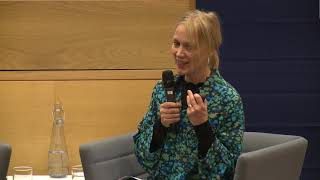
Textiles artist Alice Kettle discusses her new exhibition, Threads of Change, at Saïd Business School with Brandon Taylor, Professor Emeritus of History of Art, University of Southampton, and Visiting Tutor in History and Theory of Art at the Ruskin School of Art, University of Oxford.
Alice’s large-scale, textile-based artworks challenge assumptions about the textile medium. Her works include a large, collaborative project that Kettle launched in response to the refugee crisis in Europe and a series of portraits that were co-created with women from Pakistan – work that has been co-funded by Saïd Business School and Candida Stevens Gallery.
Subscribe to our channel ➤ https://www.youtube.com/channel/UCHIqMEje_NFJ2u24CVaNQvg
Visit our website ➤ https://www.sbs.ox.ac.uk/?utm_source=Youtube&utm_medium=SubscribeEndSlate
Follow us on social media:
LinkedIn: https://www.linkedin.com/school/oxfordsbs | https://www.linkedin.com/showcase/oxford-answers/
Twitter: https://twitter.com/OxfordSBS | https://twitter.com/Oxford_Answers
Instagram: https://www.instagram.com/oxfordsbs/
Facebook: https://www.facebook.com/OxfordSBS
#OxfordSBS #LifeAtSBS #OxfordAnswers
Watch on YouTube ↗
(saves to browser)
Sign in to unlock AI tutor explanation · ⚡30
Playlist
Uploads from Saïd Business School, University of Oxford · Saïd Business School, University of Oxford · 2 of 60
1
 ▶
▶
 3
3
 4
4
 5
5
 6
6
 7
7
 8
8
 9
9
 10
10
 11
11
 12
12
 13
13
 14
14
 15
15
 16
16
 17
17
 18
18
 19
19
 20
20
 21
21
 22
22
 23
23
 24
24
 25
25
 26
26
 27
27
 28
28
 29
29
 30
30
 31
31
 32
32
 33
33
 34
34
 35
35
 36
36
 37
37
 38
38
 39
39
 40
40
 41
41
 42
42
 43
43
 44
44
 45
45
 46
46
 47
47
 48
48
 49
49
 50
50
 51
51
 52
52
 53
53
 54
54
 55
55
 56
56
 57
57
 58
58
 59
59
 60
60

Oxford Impact Investing Webinar - Ask the Expert
Saïd Business School, University of Oxford
Alice Kettle: Telling stories through stitches
Saïd Business School, University of Oxford
Webinar - Private Equity’s Roaring 20s - A Peek Around the Corner
Saïd Business School, University of Oxford
Peter Drobac
Saïd Business School, University of Oxford
Becoming a more effective and impactful leader | Women Transforming Leadership Programme
Saïd Business School, University of Oxford
The Oxford Chicago Valuation Programme - Subtitles
Saïd Business School, University of Oxford
Ideas in Motion with Dr. Judy Dlamini and Moderated by Shukri Toefy.
Saïd Business School, University of Oxford
Oxford Impact Measurement Programme - The Landscape of Impact Measurement for Impact Investing
Saïd Business School, University of Oxford
Leadership in extraordinary times
Saïd Business School, University of Oxford
Personal and professional wellbeing and mental health during Covid-19
Saïd Business School, University of Oxford
Oxford Saïd Entrepreneurship Forum 2020, 7 March 2020
Saïd Business School, University of Oxford
Covid-19: Preparedness, resilience and the future of public health
Saïd Business School, University of Oxford
Oxford Chicago Valuation Webinar - The Rise of Private Debt
Saïd Business School, University of Oxford
Peter Tufano in conversation with Hiro Mizuno
Saïd Business School, University of Oxford
Webinar - The Macro Effects of Covid-19 | Oxford Real Estate Programme
Saïd Business School, University of Oxford
Leading and organising for impact in times of crisis
Saïd Business School, University of Oxford
Misinformation, media and trust
Saïd Business School, University of Oxford
Oxford Social Impact Webinar - What is the New Normal for Impact Investing During Covid-19
Saïd Business School, University of Oxford
COVID-19: The view from Mexico
Saïd Business School, University of Oxford
How can entrepreneurs not just recover from the crisis but actually rejuvenate the economy?
Saïd Business School, University of Oxford
Leadership in a New Retail Landscape
Saïd Business School, University of Oxford
The future of advertising
Saïd Business School, University of Oxford
R:ETRO webinar - Transformation in networked whistleblowing
Saïd Business School, University of Oxford
R:ETRO webinar - Shaping the new sustainability agenda online
Saïd Business School, University of Oxford
Post-covid-19 scenarios for the real estate industry
Saïd Business School, University of Oxford
R:ETRO webinar - Circular economy and the social
Saïd Business School, University of Oxford
Financing the COVID Crisis
Saïd Business School, University of Oxford
Keeping the sparkle: a global perspective on luxury retail
Saïd Business School, University of Oxford
Oxford Saïd and the Education & Training Foundation's portfolio of leadership programmes
Saïd Business School, University of Oxford
R:ETRO webinar - Beyond COVID-19: the case for human rights in business
Saïd Business School, University of Oxford
Capitalism The Great Debate - Stakeholder v Shareholder
Saïd Business School, University of Oxford
An Inconvenient Fact: Private Equity Returns vs The Billionaire Factory
Saïd Business School, University of Oxford
Marketing leaders, crisis management and future growth plans
Saïd Business School, University of Oxford
The future of banking - opportunities and challenges for banks in a post Covid-19 world
Saïd Business School, University of Oxford
Designing and Measuring Impact Investing Portfolios
Saïd Business School, University of Oxford
What does it take to get a job in Private Equity?
Saïd Business School, University of Oxford
A call to action from the MBA class of 2020 to the Oxford Saïd community #BlackLivesMatter
Saïd Business School, University of Oxford
After hours case study sessions - ENEL
Saïd Business School, University of Oxford
After hours case study sessions - Welsh Water
Saïd Business School, University of Oxford
After hours case study sessions - The Motley Fool
Saïd Business School, University of Oxford
After hours case study sessions - Royal Canin
Saïd Business School, University of Oxford
Reputation Symposium Series 2020 – Covid-19 and Global Business
Saïd Business School, University of Oxford
Can social impact survive the crisis?
Saïd Business School, University of Oxford
Executive Coaching | Oxford Advanced Management & Leadership Programme
Saïd Business School, University of Oxford
R:ETRO webinar - #NoMorePage3 and the Replenishment of Emotional Energy
Saïd Business School, University of Oxford
R:ETRO webinar - Structural injustices, social connection, and corporate political responsibility
Saïd Business School, University of Oxford
Covid19 Economics: Myths, Markets and Policy
Saïd Business School, University of Oxford
The future of the office
Saïd Business School, University of Oxford
The Challenges of Bank ESG Investment Strategy (webinar)
Saïd Business School, University of Oxford
Intersectionality and Inclusion
Saïd Business School, University of Oxford
Investing in Procurement Builds Resilience
Saïd Business School, University of Oxford
Youth setting the agenda - Transport and Fossil Fuels
Saïd Business School, University of Oxford
Intersectionality and Inclusion - Vodcast with Jim Carrick-Birtwell
Saïd Business School, University of Oxford
Investing in Procurement Builds Resilience
Saïd Business School, University of Oxford
Banking on Failure: Cum-Ex and Why and How Banks Game the System
Saïd Business School, University of Oxford
The Entrepreneurship Project at Saïd Business School
Saïd Business School, University of Oxford
Trailblazer Chronicles. A conversation with Yancey Strickler
Saïd Business School, University of Oxford
Pillars 1 & 2: Are We Close to a Deal? Views from the Inclusive Framework Steering Group
Saïd Business School, University of Oxford
Pillars 1 & 2: Are We Close to a Deal? Other Views
Saïd Business School, University of Oxford
Intersectionality and Inclusion - Women Entrepreneurs
Saïd Business School, University of Oxford
Related AI Lessons
🎓
Tutor Explanation

 DeepCamp AI