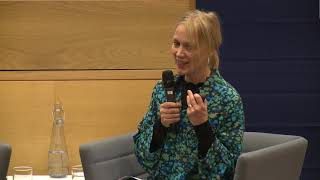
Rachel Botsman interviews Dr Eleanor Murray
Skills:
Systems Design Basics80%AI Systems Design70%Delivery Management60%Project Management Foundations50%
Key Takeaways
The video features Rachel Botsman interviewing Dr Eleanor Murray, discussing her experiences in organizational resilience, systems design, and healthcare management, as well as her approaches to leadership, feedback, and decision-making. Dr Murray shares her insights on the importance of building good relationships with stakeholders, embracing dissenting voices, and balancing evidence and intuition in decision-making.
Full Transcript
good morning everyone and welcome to international women's day i'm delighted to be with you this morning to be in conversation with eleanor murray as many of you know eleanor has recently taken up the challenging position of associate director sorry associate dean for executive education at the school the theme for international women's day is choose to challenge so ellen and i thought we'd have a conversation around embracing the power of being challenged just to introduce eleanor her background is absolutely fascinating and her work research and interests couldn't be more relevant than they are now she spent over 20 years looking into organizational resilience in systems with a focus in healthcare management so how can we take systems and make them more resilient over the long term i really encourage you to look into her work i was looking at some of the papers around perceptions of risk safety in icu which are absolutely fascinating so eleanor i am delighted to be in conversation with you this morning welcome thank you and as i mentioned we discussed what we could really focus on and share with people in the university and we've chosen this theme of embracing the power of being challenged and where i'd love to start is going back in your life to a moment or a situation that we're challenging that you are proud to have overcome yes so i think uh one of my work-related challenges was when i started as an executive director of a hospital board that was very much a situation that was new to me i hadn't worked at director level before and i hadn't really appreciated what a big step up it was from an associate director role that i'd i've been in previously and when i started i'd probably not done sufficient due diligence about the nature of the organization and where it was at and i found out that the hospital was under threat of closure and it had a 19 million deficit and i so really i was one of a small number of executive directors on the board there were about four four or five of us who had to work together to try to address this situation and we worked really hard to uh over a two year two and a half year period to manage to overcome the threat of closure by working with a huge range of stakeholders mps and local population local groups and people to make the case for why the hospital should stay open and we also managed to turn around the financial situation which uh from a 19 million deficit through to a small surplus without um with only making i think one person redundant over that time because originally we were expecting to have to make a much larger number of people redundant and we managed through various different approaches to actually prevent that happening so that for me was a was a really big achievement i think to have managed to overcome those and working very much working with the other team of directors to achieve that when you first found out you were in that situation so that the role that you've taken maybe was slightly different from the one that you had been sold or thought you walked into how did you how did you feel about that because it takes real composure to say okay this is it is what it is let's move on how did you deal with that situation yes i mean i i rang a few friends um who've worked at that sort of level and and talked to them about it and the other thing i did which i think really helped me was i actually went on a program run by cranfield at the time which was about being a first director and then i realized that going on that program and talking to um my peer group as it were of other people taking on a directorship for the first time that the feelings that i was having the feelings of apprehension and concern and you know worrying thinking what on earth have i done um were very similar with uh my peer group and they were feeling the exactly the same feelings it helped be able to talk it through and recognize that quite a few of our challenges were similar um and just in different different contexts so being able to discuss that and explore you know how to approach it really did help and then i built on that network really going forward we were we kept in touch were able to share ideas and you know talk through issues really in a confidential way i want to i want to come back to that the idea of a support network versus a challenge network but um another moment early on in my career that i remember very distinctly was the first time i challenged someone more senior to me and it actually took days of preparation to pluck up the courage to to have that kind of voice um do you remember a situation where you had to challenge someone who was more senior to you and how you went about it yes i do i mean i i remember this situation where um one of the professors i was working with um who also was in charge of the clinical service that i was managing at the time um had told one set of people one thing and then had told me something else so that we basically had you know differing a different perspectives on the situation which actually was very problematic it caused a number of subsequent problems um going forward um and it did take a lot of courage to go and sort of challenge him about that and explore why he'd given us different information and approached us differently and i remember yes being in trepidation as i was i had to catch the bus to the other hospital site to go and have the conversation i remember being sort of very nervous about it but i found that once i was um once i had the conversation i was reasonably upfront about it and open to hearing his side of the story as well we managed to talk it through and overcome it and i think he had more respect for me subsequently having had that having challenged him and him being aware that i wasn't happy about that situation and that i'd actually raised it with him and addressed it with him i think gave me more credibility in the longer term yeah it can really create a shift in the dynamic between two people once the conversation has been had um so you've taken on this new role as associate dean for executive education before that you were a senior fellow in practice so it's it's a real shift um i thought it's actually an opportunity and i'd love to hear this why you took the role i mean it's a challenging role at the best of times but especially right now when executives can't travel and there's so much change happening around executive education so what poured you into this role i do love a challenge so i think um i sometimes maybe take things on and then they have second thoughts afterwards but not that i have in this case i should say but um but yeah i do really enjoy a challenge i enjoy working with um teams to try and overcome challenges as well um i really i really enjoy working collaboratively i think that's a real key to how i work and i felt really re-energized in this role because it's meant that i've had the opportunity to work with a fantastic team who you know are really enthusiastic and really keen to see how we can innovate and really meet um the requirements of clients as they're changing in this current period so for me um that was that was really exciting to have that opportunity um i also really enjoy working in complexity and this role is extremely complex there's many different stakeholders both internal and external um there's the challenge um and drawing on jonathan trevor's work here there's a challenge of achieving alignment across all those different stakeholders and across across the sort of structures and organization that we're working with and i love i love having that opportunity to try to align things uh in complex situations so that uh we're sort of working in a common direction of travel really and why do you not everyone loves complex situations so what is it about the complexity that you it sounds like you enjoy that you actually thrive in that type of environment yes i i am i i it's hard to express i think i find people working with people endlessly fascinating um i love you know hearing what people have to say how how they work um i really enjoy hearing from clients you know their challenges they face in organizations and then thinking with the team i'm working with you know how can we address those challenges how can we keep executive education really relevant so all of those elements i think come into it in terms of getting that enjoyment from it and you've got a large team that across different departments many moving pieces and then sort of a very wide range of clients how do you encourage people to challenge you so now that you're in the leadership position how do you really open that door so you hear what you need to need to hear yeah i mean i've always i've always welcomed challenge um i think it's a really health it's a healthy way to operate is to have be you know if you're willing to challenge others being open to challenge yourself i invite challenge so i invite people to you know say what do you think of this idea this is this is an idea i've had but what do you think about it would it work what do you think would be the problems with it you know what are the barriers potentially that we'd have to overcome to achieve it um why wouldn't it work i think when you're working when you're a leader working through change posts you know going through a process of change it's i've learned over the years it's really important to hear the dissenting voices and to hear from people who who maybe worked in the area a long time and they know from experience what what will and won't work or what will be very difficult to address um so i've learned to embrace those dissenting voices really and um listen to people hear from the critics you know seek almost seek out the most ardent critics in a situation and invite their feedback and invite their perspective on the situation and i think then you can it's much you know at least then you you clear what what you're working with um in moving the chain trying to move the change forward i find it interesting with those dissenting voices that often can be the loudest critics um what they can't initially come forward with might not be the real reason sort of the root cause of what they're finding disappointing or upsetting or what's really going wrong with the system itself or the culture how do you how do you dig beyond sort of the initial response the emotional there to really understand where they're coming from and the problem that needs to be solved yes i i do although it's time consuming i do always try and take the time to meet with people um and talk to them and just hear their perspective on the situation um and try to understand what you know the deeper issue that is making them feel this sort of sense of friction um and tension about the situation and it can take time especially when you're dealing with a lot of stakeholders so a sort of really important element of that is building good relationships and building and maintaining good relationships so that people feel they can come and approach you about a situation um and have that opportunity to have that video and honest discussion about about what the problem is or what might be a problem um so that you know you can jointly talk about how it could be resolved and so in terms of managing um conflict um and you mentioned criticism um often people say they love feedback and they they love to hear criticism but then when people are brave enough to give it to them you get a defensive reaction how have you learned to really give tough feedback and also receive it in a useful and constructive way yeah so um i have to admit in terms of receiving feedback i think i i think i i'm always keen to understand what what could have gone better sometimes too much so i think um sometimes i sort of like dig into it too much and try to really try to understand what what i could have done differently um and sometimes i think i should just maybe not do that quite to the extent i do but um i do i do really like to understand how what i could change what i could improve and i suppose i'm driven quite strongly by um that sense of sort of lifelong learning you know how how can i continually learn and improve as i go along what could i what what new information or new experiences could i take on board so i'm strongly driven by that in terms of giving feedback um i think the people i work as i work with teams and get to know them i try to be honest and upfront with them about what's working really well and i try to really you know take time to give people positive feedback about what's going going well um and sometimes that's balanced with you know what could have been done differently or how we could have done it differently i always i do my best to try and have a conversation about that um so that we can explore it together um and you know often i i've i've learned over the years to to be in listening mode and recognize that there might be a whole range of issues around the situation that might have influenced why people did something in a particular way that it's important to understand and not make assumptions about that so i'm well i i do my best to try to um ensure that i've listened and once i've given some feedback i listen and understand why people feel it might have happened it's it's amazing how um dangerous assumptions can be in feedback situations i think that's something i've definitely learned over the years often the hard way um when we were physically together in the school we were actually a few doors down from one another and we didn't always um get to see each other that much but my experience of you your door was often always open um you are always warm and empathetic and very present and you've used the words collaborative to describe yourself but i'm interested what is something that people get wrong about you um i think sometimes because i'm fairly easy going um people sometimes don't realize that i do have quite a sort of steely core and i can be i've got quite strong values and i think if those values are challenged um they see a different maybe a different side i mean more sort of determined um direct side of me um so i i sort of yes do have a strong set of values that i believe in and sometimes if those values are sort of challenged in any way then i do people maybe see a more determined direct approach um but that doesn't come out very often but um because normally i find i can move things forward pretty collaboratively most of the time and is there a value in particular that if someone steps on that or oversteps it that you you can feel that response coming on yes i mean i i suppose like it's a sort of core of feeling like um about being about honesty you know and um being being being consistent and fair across the board um with people in the same way um and being honest about situations and not saying well i think that would be that's the that's the core that um they get more direct response from me in that situation and um i'm intrigued uh andrew white was in this role previously um how many years was he in that role i've forgotten over 10 years i think over 10 years so you're stepping into a role where someone was in it a long time a relatively long time and it was led by a male um is there any think you are really trying to shift in the culture of executive education and the organization that you think might be more driven by sort of a female leader well it's a really difficult one because andrew has left an ex amazing legacy you know and he um has built executive education up and developed the digital um element of executive education which is what we're really like relying on and developing now um so he's left a very good legacy um i don't i don't tend to think of necessarily uh female qualities particularly because i think in some ways andrew and i have got some similarities you know the way we work um i think we both tend to be quite entrepreneurial in the way we operate um so i think i mean for me i enjoy being i enjoy being quite entrepreneurial and looking ahead and seeing what opportunities there are and then thinking how we can maybe you know how we can deliver on those opportunities um so i enjoy i mean when i'm working with a good team which i am at the moment really a really i've got a fantastic team you know we we can really innovate we can really think widely about you know how we might work and what what's on the horizon and um be flexible about how we how we move towards that and i think um when you're in that situation um with a with a really strong team then that's uh that's something that you can really aim to achieve so yeah so i i don't know i don't i mean maybe maybe you might class being collaborative as a female quality um sometimes that's referred to but i mean uh i don't know i i would say i do i do work in a pretty collaborative way so if that is a female quality then that would probably be it it's probably another question because i actually hate those gender stereotypes of qualities and i think it is um andrew had this very powerful combination of compassion and strength and showed how these things can go hand in hand and that they they aren't this female quality and i think there is a similar combination in you so um you mention this idea of um people who challenge you people that you can turn to in difficult difficult situations to talk things through and i think this is a really important concept i first heard it from adam grant who's an organizational psychologist at wharton where he said um he feels with his students they are encouraged too much to have a support network and a mentor whereas he's found the most valuable thing in his life is a challenge network um now we all define them slightly differently i think of my challenge network as the people that tell you where you're not quite where you need to be um so they actually you have this very deep trust that they can be incredibly honest with you even if it's something that is really hard to hear i'm interested in how you think about who your own challenge network and if you're happy to share who might be in it and the role that they play in your life yeah so i've i've always been fortunate that i've managed to negotiate at most points in my career having a coach and one of my coaches was guy lubitz who now who works for ashridge um and he coached me for a while um and i do feel that enabled me to i mean he was he was uh very he was willing to be critical you know in a image in a helpful constructive challenging way um and that really helped me shift my thinking in quite a big way um in terms of probably thinking about how to work more strategically how to think more independently how to take control really of my own career and what i wanted from it so he was very influential in that respect i have another coach now andrew constable um who uh worked worked at raffy park and um so knows the executive education scene and um he has been i you know trust him to provide me with that sort of critical questioning to enable me to sort of think about things differently and to reflect different perspectives back to me and i i personally really value that i really value having that really honest feedback um so that's been really helpful that coaching network and that coaching approach and then another um challenge network that i really appreciated um when i started in the health sector i was part of a peer group of junior managers who were all working in the nhs at the time and we were going through a master's qualification together and that network has grown with we've been we've had that network now for 25 years we started off as action learning sets um where we used to have regular action learning sets and that was all about asking critical questions to elicit an appropriate sort of response so that was very much a critical approach and we've continued to support each other and and challenge each other a lot of them are now ceos and directors of um charities and other organizations and we have a whatsapp group now and if if any of us sort of need some support or challenge they are always willing to weigh in and um you know provide that and we often phone each other up or have conversations um where when we need some challenge or support um going forward have you found that the type of support or the type of challenge that you've needed in your career in your life has changed as you've developed uh that's a good question um it probably has changed yes i think um when i was when i was in my 20s i was almost like trying to find myself and try to work out what my direction of travel was i didn't know myself as well then so i was i think i was still trying to discover what my strengths were and what i could bring to a role whereas i think i'm much clearer now probably what my strengths are although i did i did have to ask my team this morning what my leadership and properties were in preparation for this but um but i think generally i i do i feel like i have a better sense of myself and so really when i'm i'm working with my coach it will be for them to challenge me to think um take different perspectives on situations or the context i'm in as much as what i'm how you know what i how i understand myself really and what i bring to it because i'm clearer about that now it's it's kind of you know it takes a great sense of self to be able to then step out of it and where you want the awareness to be more on context and situation than your own self i've found is where my i need the challenge now that it's not in me it's in what's going on yeah and in that situation so um i can really relate to that um what did you what did your team say when you asked them about your leadership qualities well they mentioned collaborative um and they also mentioned interestingly political you know being able to navigate a political environment because usually sort of complex multi-stakeholder situations like we're in in the school and executive education and the health sector you know they they they are generally quite political organizations and um being able to navigate the politics is is quite an important skill i think um being able to understand what all the constituent parties have to bring to a situation and their different views um and you i work quite as much on intuition around the politics as i do on evidence you know i sort of balance evidence and intuition in navigating and trying to understand those situations to talk more about that because i think that's really interesting because um often you're something you're told early on in your career you're incredibly intuitive um which i think can actually get in the way because you start to make decisions based on your gut and your intuition and it takes time to realize that actually no you need information you need evidence to make a really good decision even if it's what your gut and your intuition really originally was telling you how have you learned to balance those two things someone who is very intuitive with finding the right evidence and information yeah so it's a really interesting one actually because i was probably a bit impulsive when i was in my 20s you know i would yeah feel you know have intuition about something and then maybe act on it too soon and i've learned to just take time to actually build up a really good base of evidence and in fact that's something we're doing in the team at the moment in executive education is we're developing performance reports and other reports that um enable us to really sort of have have the evidence to hand to help with the decision making so nowadays even if i feel something intuitively i always check it back against the evidence and um make sure that you know i'm making a decision on the sound footing um i mean intuition can often be very valuable but it it really is as you say it's about that balancing element um so i've i think i've as i've got older i've sort of embraced evidence and embraced data a lot more and really seen the value in data and i've worked on quite a few quantitative research projects as well where i've really actually enjoyed the whole data process i'm working on a research project at the moment around nhs boards with renee adams and ken nakamura and another colleague and we're working based on the evidence on a lot of data and i'm i'm i mean even now i'm learning what what how much you can get from that data by working with colleagues who have that sort of quantitative perspective it gives you new insights that maybe you didn't do before so yeah it's definitely a balancing them i think the hard ones are when um you make the wrong decision based on your intuition you go back and you look at the evidence or the information you're like how did i not see that and then it's so interesting to think of the signals that you tuned into either because they were very loud or because you wanted to see that in that personal situation so um we're coming to the top of the half an hour so i thought i'd end uh with a few rapid fire questions um so it is international women's day so we are going to do a little bit on advice and i'd love to hear three things so the best advice you were given the advice that you'd give and what you wish you'd know so the the best advice i've been given um i think is probably to follow my interest rather than a traditional career path um i got to a point in my career where i could have become and i was being advised to become a ceo um from a director role um but i actually really took a step off the that traditional career path and um did a phd um which was seen by everyone around me is quite risky but actually that's led to a whole new career path really interesting exciting career path um that's led to this role so i'm really glad i did that so i would i would say definitely follow your interests because that if you know that that's what really motivates and makes you passionate about what you do and so i think that's really important i think advice i'd give is definitely to build a challenge network it's a really valuable thing to have is it support's important but challenge is really important as well and having someone who can be a critical friend and really offer offer up honest genuine you know challenge um can really help you develop personally and to help you develop in your career and something i wish i'd known i i think i'd i think i wish maybe when i was in my 20s i've been a bit more expansive in my career ambitions and considered i would have loved to work internationally i mean this is international women's day i wish i'd maybe looked at um opportunities for working internationally um and more broadly i think i would have really enjoyed that um so yeah so anyone who's at that stage in their lives where that's a possibility i would definitely recommend can be expansive in your career ambitions you can probably achieve a lot more than you think you can and working internationally given that we work so globally nowadays is i think a really important element of that i would 100 agree with that and um i love this idea really welcoming challenge into our life and it's something i think takes time to realize that sometimes the people that push you the hardest in the right way it's because they really care about you and that's what challenge can really mean is it's it's not just finding the right challenges but finding the right challenges can be really powerful so um thank you for being so open and sharing uh not just sort of experiences in your new role but going back in your career i really enjoyed speaking with you this morning ellen i feel like i know you just a little bit better as well which is lovely and to everyone watching um i don't like saying happy international women's day but maybe to leave you with this thought um if you could think about someone in your life that you'd bring into your challenge network who would that be thank you very much thank you you
Original Description
International Women's Day - Morning break in conversation with ...
Subscribe to our channel ➤ https://www.youtube.com/channel/UCHIqMEje_NFJ2u24CVaNQvg
Visit our website ➤ https://www.sbs.ox.ac.uk/?utm_source=Youtube&utm_medium=SubscribeEndSlate
Follow us on social media:
LinkedIn: https://www.linkedin.com/school/oxfordsbs | https://www.linkedin.com/showcase/oxford-answers/
Twitter: https://twitter.com/OxfordSBS | https://twitter.com/Oxford_Answers
Instagram: https://www.instagram.com/oxfordsbs/
Facebook: https://www.facebook.com/OxfordSBS
#OxfordSBS #LifeAtSBS #OxfordAnswers
Watch on YouTube ↗
(saves to browser)
Sign in to unlock AI tutor explanation · ⚡30
Playlist
Uploads from Saïd Business School, University of Oxford · Saïd Business School, University of Oxford · 0 of 60
← Previous
Next →
1
 2
2
 3
3
 4
4
 5
5
 6
6
 7
7
 8
8
 9
9
 10
10
 11
11
 12
12
 13
13
 14
14
 15
15
 16
16
 17
17
 18
18
 19
19
 20
20
 21
21
 22
22
 23
23
 24
24
 25
25
 26
26
 27
27
 28
28
 29
29
 30
30
 31
31
 32
32
 33
33
 34
34
 35
35
 36
36
 37
37
 38
38
 39
39
 40
40
 41
41
 42
42
 43
43
 44
44
 45
45
 46
46
 47
47
 48
48
 49
49
 50
50
 51
51
 52
52
 53
53
 54
54
 55
55
 56
56
 57
57
 58
58
 59
59
 60
60

Oxford Impact Investing Webinar - Ask the Expert
Saïd Business School, University of Oxford
Alice Kettle: Telling stories through stitches
Saïd Business School, University of Oxford
Webinar - Private Equity’s Roaring 20s - A Peek Around the Corner
Saïd Business School, University of Oxford
Peter Drobac
Saïd Business School, University of Oxford
Becoming a more effective and impactful leader | Women Transforming Leadership Programme
Saïd Business School, University of Oxford
The Oxford Chicago Valuation Programme - Subtitles
Saïd Business School, University of Oxford
Ideas in Motion with Dr. Judy Dlamini and Moderated by Shukri Toefy.
Saïd Business School, University of Oxford
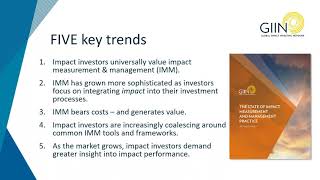
Oxford Impact Measurement Programme - The Landscape of Impact Measurement for Impact Investing
Saïd Business School, University of Oxford
Leadership in extraordinary times
Saïd Business School, University of Oxford
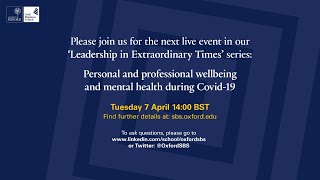
Personal and professional wellbeing and mental health during Covid-19
Saïd Business School, University of Oxford
Oxford Saïd Entrepreneurship Forum 2020, 7 March 2020
Saïd Business School, University of Oxford
Covid-19: Preparedness, resilience and the future of public health
Saïd Business School, University of Oxford
Oxford Chicago Valuation Webinar - The Rise of Private Debt
Saïd Business School, University of Oxford
Peter Tufano in conversation with Hiro Mizuno
Saïd Business School, University of Oxford
Webinar - The Macro Effects of Covid-19 | Oxford Real Estate Programme
Saïd Business School, University of Oxford
Leading and organising for impact in times of crisis
Saïd Business School, University of Oxford
Misinformation, media and trust
Saïd Business School, University of Oxford
Oxford Social Impact Webinar - What is the New Normal for Impact Investing During Covid-19
Saïd Business School, University of Oxford
COVID-19: The view from Mexico
Saïd Business School, University of Oxford
How can entrepreneurs not just recover from the crisis but actually rejuvenate the economy?
Saïd Business School, University of Oxford
Leadership in a New Retail Landscape
Saïd Business School, University of Oxford
The future of advertising
Saïd Business School, University of Oxford
R:ETRO webinar - Transformation in networked whistleblowing
Saïd Business School, University of Oxford
R:ETRO webinar - Shaping the new sustainability agenda online
Saïd Business School, University of Oxford
Post-covid-19 scenarios for the real estate industry
Saïd Business School, University of Oxford
R:ETRO webinar - Circular economy and the social
Saïd Business School, University of Oxford
Financing the COVID Crisis
Saïd Business School, University of Oxford
Keeping the sparkle: a global perspective on luxury retail
Saïd Business School, University of Oxford
Oxford Saïd and the Education & Training Foundation's portfolio of leadership programmes
Saïd Business School, University of Oxford
R:ETRO webinar - Beyond COVID-19: the case for human rights in business
Saïd Business School, University of Oxford
Capitalism The Great Debate - Stakeholder v Shareholder
Saïd Business School, University of Oxford
An Inconvenient Fact: Private Equity Returns vs The Billionaire Factory
Saïd Business School, University of Oxford
Marketing leaders, crisis management and future growth plans
Saïd Business School, University of Oxford
The future of banking - opportunities and challenges for banks in a post Covid-19 world
Saïd Business School, University of Oxford
Designing and Measuring Impact Investing Portfolios
Saïd Business School, University of Oxford
What does it take to get a job in Private Equity?
Saïd Business School, University of Oxford
A call to action from the MBA class of 2020 to the Oxford Saïd community #BlackLivesMatter
Saïd Business School, University of Oxford
After hours case study sessions - ENEL
Saïd Business School, University of Oxford
After hours case study sessions - Welsh Water
Saïd Business School, University of Oxford
After hours case study sessions - The Motley Fool
Saïd Business School, University of Oxford
After hours case study sessions - Royal Canin
Saïd Business School, University of Oxford
Reputation Symposium Series 2020 – Covid-19 and Global Business
Saïd Business School, University of Oxford
Can social impact survive the crisis?
Saïd Business School, University of Oxford
Executive Coaching | Oxford Advanced Management & Leadership Programme
Saïd Business School, University of Oxford
R:ETRO webinar - #NoMorePage3 and the Replenishment of Emotional Energy
Saïd Business School, University of Oxford
R:ETRO webinar - Structural injustices, social connection, and corporate political responsibility
Saïd Business School, University of Oxford
Covid19 Economics: Myths, Markets and Policy
Saïd Business School, University of Oxford
The future of the office
Saïd Business School, University of Oxford
The Challenges of Bank ESG Investment Strategy (webinar)
Saïd Business School, University of Oxford
Intersectionality and Inclusion
Saïd Business School, University of Oxford
Investing in Procurement Builds Resilience
Saïd Business School, University of Oxford
Youth setting the agenda - Transport and Fossil Fuels
Saïd Business School, University of Oxford
Intersectionality and Inclusion - Vodcast with Jim Carrick-Birtwell
Saïd Business School, University of Oxford
Investing in Procurement Builds Resilience
Saïd Business School, University of Oxford
Banking on Failure: Cum-Ex and Why and How Banks Game the System
Saïd Business School, University of Oxford
The Entrepreneurship Project at Saïd Business School
Saïd Business School, University of Oxford
Trailblazer Chronicles. A conversation with Yancey Strickler
Saïd Business School, University of Oxford
Pillars 1 & 2: Are We Close to a Deal? Views from the Inclusive Framework Steering Group
Saïd Business School, University of Oxford
Pillars 1 & 2: Are We Close to a Deal? Other Views
Saïd Business School, University of Oxford
Intersectionality and Inclusion - Women Entrepreneurs
Saïd Business School, University of Oxford
More on: Systems Design Basics
View skill →







Related Reads
📰
📰
📰
📰
Durable Workflows Are Great, and the Wrong Choice for Short Pipelines
Dev.to · Ben Witt
How Senior Engineers Untangle Deeply Nested if Statements
Medium · JavaScript
Hexagonal architecture in Rust, and why it makes your codebase legible to coding agents
Dev.to · LLMGraph
Building TypeScript-Native Observability: Async Context and Execution Flow
Dev.to · Raju Dandigam
🎓
Tutor Explanation
 DeepCamp AI