Robot Learning with a Biologically-Inspired Brain (BECCA), The Sequel
Skills:
Agent Foundations80%
Key Takeaways
The video demonstrates the capabilities of BECCA, a brain-emulating cognition and control architecture, in enabling robots to learn basic tasks through exploration and reward-based learning, with applications in robotics and artificial intelligence.
Full Transcript
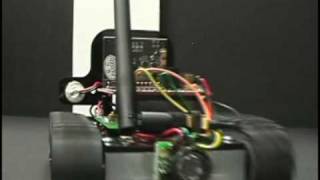
Becca stands for brain emulating cognition and control architecture. It is a general purpose brain for robots. These are Coroware Corobots, mobile robots that each have one arm, one hand, two fingers, and one eye. They are named Remis and Romulus, and they each are using a copy of Becca as a brain. When Remis and Romulus do the right thing, they get rewarded. This is like when a dog behaves well and it gets a treat. At first, the robots don't know what they're supposed to do, so they try wiggling their arms and wandering around until they learn how to get rewards. Here, Reheis and Romulus are getting rewards for holding their arms with their elbows halfway bent. If their arms are all the way bent or straight, they get no reward. But they don't know what they will get rewarded for, so they try lots of different things. They drive forward and backward. They open and close their hands. They move their shoulders and spin their wrists. Eventually, they figure out what they are supposed to do and they get pretty good at it. They still try other things sometimes just to experiment, but mostly they sit still and keep their elbows halfway bent. This is a whole arm manipulator or WHAM for short. It lives at the University of New Mexico. It has seven different joints and can move about the same way as a human arm. The wham is also using Becca for a brain. Becca doesn't know anything about its body before it starts moving around. It learns like a baby by trying things and remembering what happens. Here, the wham is learning that same elbow task that Remis and Romulus learned. The difference is that a human is giving it rewards and punishments instead of a computer program. The human trainer could teach the whim to do lots of different tricks the same way they might teach a dog. Here's an example of a task that's just a little bit harder. Instead of just moving the elbow, the wham is moving three separate joints. And instead of three different positions, the wham can be in any one of 50 different positions. It takes a little longer, but the wham with its Becker brain can learn to do this task, too. These aren't very hard tricks for Remis and Romulus and the Wham to learn. As Becca gets better, they will get smarter. Eventually, they should get smart enough to be able to find things and even fetch them. For more videos, papers, or to download a copy of Becca, please visit www.sandia.gov. Gov/roar. [Music]
Original Description
Code and documentation: https://github.com/brohrer/
BECCA users group: https://groups.google.com/forum/?fromgroups#!forum/becca_users
BECCA community: http://www.openbecca.org
Robots learn some of the basics of their environments by exploring. Their software "brain" is BECCA, a brain-emulating cognition and control architecture. BECCA gives the robots the ability to learn from their experience and to develop very simple problem solving strategies. Video released as SAND report # 20011-9079 P.
Playlist
Uploads from Brandon Rohrer · Brandon Rohrer · 3 of 60
1
 2
2
 ▶
▶
 4
4
 5
5
 6
6
 7
7
 8
8
 9
9
 10
10
 11
11
 12
12
 13
13
 14
14
 15
15
 16
16
 17
17
 18
18
 19
19
 20
20
 21
21
 22
22
 23
23
 24
24
 25
25
 26
26
 27
27
 28
28
 29
29
 30
30
 31
31
 32
32
 33
33
 34
34
 35
35
 36
36
 37
37
 38
38
 39
39
 40
40
 41
41
 42
42
 43
43
 44
44
 45
45
 46
46
 47
47
 48
48
 49
49
 50
50
 51
51
 52
52
 53
53
 54
54
 55
55
 56
56
 57
57
 58
58
 59
59
 60
60

Robot Learning with a Biologically-Inspired Brain (BECCA)
Brandon Rohrer
BECCA talk at AGI 2011
Brandon Rohrer
Robot Learning with a Biologically-Inspired Brain (BECCA), The Sequel
Brandon Rohrer
BECCA listens to The Hobbit
Brandon Rohrer
Learning the building blocks of speech: BECCA extracts a hierarchy of audio features
Brandon Rohrer
BECCA listens for sound effects in The Hobbit
Brandon Rohrer
BECCA finds movie trailers while watching the Big Bang Theory
Brandon Rohrer
Listening for unexpected sounds: BECCA detects anomalies in audio data
Brandon Rohrer
Learning the building blocks of vision: BECCA extracts a spatio-temporal hierarchy of features
Brandon Rohrer
Watching for the unexpected: BECCA detects anomalies in video data
Brandon Rohrer
BECCA finds a stationary target
Brandon Rohrer
BECCA finds a stationary target at 3X speed
Brandon Rohrer
BECCA watches the X-men and Bruce Lee
Brandon Rohrer
BECCA plays Quidditch
Brandon Rohrer
BECCA chases a ball
Brandon Rohrer
BECCA chases a ball, part 2
Brandon Rohrer
Becca chases a ball, part 3
Brandon Rohrer
BECCA creates features from MNIST
Brandon Rohrer
How reinforcement learning works in Becca 7
Brandon Rohrer
Deep Learning Demystified
Brandon Rohrer
How Data Science Works
Brandon Rohrer
How Convolutional Neural Networks work
Brandon Rohrer
How Bayes Theorem works
Brandon Rohrer
How Deep Neural Networks Work
Brandon Rohrer
Recurrent Neural Networks (RNN) and Long Short-Term Memory (LSTM)
Brandon Rohrer
How Support Vector Machines work / How to open a black box
Brandon Rohrer
How autocorrelation works
Brandon Rohrer
Getting closer to human intelligence through robotics
Brandon Rohrer
A minimalist's guide to slicing and indexing pandas DataFrames
Brandon Rohrer
How decision trees work
Brandon Rohrer
Data scientist archetypes
Brandon Rohrer
How to use python's datetime package
Brandon Rohrer
How optimization for machine learning works, part 1
Brandon Rohrer
How optimization for machine learning works, part 2
Brandon Rohrer
How optimization for machine learning works, part 3
Brandon Rohrer
How optimization for machine learning works, part 4
Brandon Rohrer
How convolutional neural networks work, in depth
Brandon Rohrer
How to pick a machine learning model 4: Splitting the data
Brandon Rohrer
How to pick a machine learning model 3: Choosing a loss function
Brandon Rohrer
How to pick a machine learning model 2: Separating signal from noise
Brandon Rohrer
How to pick a machine learning model 1: Choosing between models
Brandon Rohrer
How to pick a machine learning model 5: Navigating assumptions
Brandon Rohrer
What do neural networks learn?
Brandon Rohrer
Interview with iRobot's Director of Data Science Angela Bassa
Brandon Rohrer
How Backpropagation Works
Brandon Rohrer
Evolutionary Powell's method: A discrete optimizer for hyperparameter optimization
Brandon Rohrer
1D convolution for neural networks, part 1: Sliding dot product
Brandon Rohrer
1D convolution for neural networks, part 2: Convolution copies the kernel
Brandon Rohrer
1D convolution for neural networks, part 3: Sliding dot product equations longhand
Brandon Rohrer
1D convolution for neural networks, part 4: Convolution equation
Brandon Rohrer
1D convolution for neural networks, part 5: Backpropagation
Brandon Rohrer
1D convolution for neural networks, part 6: Input gradient
Brandon Rohrer
1D convolution for neural networks, part 7: Weight gradient
Brandon Rohrer
1D convolution for neural networks, part 8: Padding
Brandon Rohrer
1D convolution for neural networks, part 9: Stride
Brandon Rohrer
The Four Grand Challenges of Robots in the Home
Brandon Rohrer
How Convolution Works
Brandon Rohrer
The Softmax neural network layer
Brandon Rohrer
Batch normalization
Brandon Rohrer
Getting ready to learn Python, Mac edition #1: Files and directories
Brandon Rohrer
More on: Agent Foundations
View skill →



![Build a RAG Agent in n8n | Vector DB Pinecone + WhatsApp + Gmail [2026]](https://i.ytimg.com/vi/4eJsZBgwFJ4/mqdefault.jpg)



🎓
Tutor Explanation
 DeepCamp AI