Robot Learning with a Biologically-Inspired Brain (BECCA)
Key Takeaways
BECCA, a brain-emulating computer program, enables a tracked robot named Ral to learn its environment through exploration and rewards, demonstrating robot learning with a biologically-inspired brain.
Full Transcript
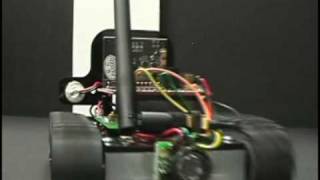
[Music] directed robots run by themselves but can be trained like dogs they learn the meaning of commands by getting rewards in the directed robots Lab at Sandy National laborator stories a surveyor srv1 robots named Ral is learning to hide and seek hide means to find a picture that is either all light or all dark for him seek means to find a picture with lots of light and dark when he first starts up Ral doesn't know how moving will change what he sees [Music] he just tries different movements and remembers what happens each time eventually he learns that moving forward toward the wall is a good way to hide and that backing up is usually a good way to seek sometimes roal gets bored or curious and tries something different this helps him figure out the best way to do what he is trying to do most robots know a lot about themselves like the size of the room they're in and whether they have wheels or arms Ralph doesn't know any of that he doesn't even know that his eye is an eye and not a nose he doesn't know how far he'll turn when he spins he only remembers what his sensors tell him and what rewards he gets for hiding and seeking ral's brain is a computer program called s learning s learning doesn't care what kind of robot it is connected to it can be a brain for lots of different kinds of robots s learning learns whatever it gets rewarded for like a baby s learning uses all its past experiences whenever it has to learn to do something new it might even be able to help a robot do hard things like run on two legs or learn to talk but for now Ralph is still learning kind of fetch [Music]
Original Description
Code and documentation: https://github.com/brohrer/
BECCA users group: https://groups.google.com/forum/?fromgroups#!forum/becca_users
BECCA community: http://www.openbecca.org
A tracked robot learns some of the basics of its environment by exploring. It software "brain" is BECCA, a brain-emulating cognition and control architecture. BECCA gives the robot the ability to learn from its experience and to develop very simple problem solving strategies. Video released as SAND report # 2009-2734 P.
Playlist
Uploads from Brandon Rohrer · Brandon Rohrer · 1 of 60
← Previous
Next →
▶
 2
2
 3
3
 4
4
 5
5
 6
6
 7
7
 8
8
 9
9
 10
10
 11
11
 12
12
 13
13
 14
14
 15
15
 16
16
 17
17
 18
18
 19
19
 20
20
 21
21
 22
22
 23
23
 24
24
 25
25
 26
26
 27
27
 28
28
 29
29
 30
30
 31
31
 32
32
 33
33
 34
34
 35
35
 36
36
 37
37
 38
38
 39
39
 40
40
 41
41
 42
42
 43
43
 44
44
 45
45
 46
46
 47
47
 48
48
 49
49
 50
50
 51
51
 52
52
 53
53
 54
54
 55
55
 56
56
 57
57
 58
58
 59
59
 60
60

Robot Learning with a Biologically-Inspired Brain (BECCA)
Brandon Rohrer
BECCA talk at AGI 2011
Brandon Rohrer
Robot Learning with a Biologically-Inspired Brain (BECCA), The Sequel
Brandon Rohrer
BECCA listens to The Hobbit
Brandon Rohrer
Learning the building blocks of speech: BECCA extracts a hierarchy of audio features
Brandon Rohrer
BECCA listens for sound effects in The Hobbit
Brandon Rohrer
BECCA finds movie trailers while watching the Big Bang Theory
Brandon Rohrer
Listening for unexpected sounds: BECCA detects anomalies in audio data
Brandon Rohrer
Learning the building blocks of vision: BECCA extracts a spatio-temporal hierarchy of features
Brandon Rohrer
Watching for the unexpected: BECCA detects anomalies in video data
Brandon Rohrer
BECCA finds a stationary target
Brandon Rohrer
BECCA finds a stationary target at 3X speed
Brandon Rohrer
BECCA watches the X-men and Bruce Lee
Brandon Rohrer
BECCA plays Quidditch
Brandon Rohrer
BECCA chases a ball
Brandon Rohrer
BECCA chases a ball, part 2
Brandon Rohrer
Becca chases a ball, part 3
Brandon Rohrer
BECCA creates features from MNIST
Brandon Rohrer
How reinforcement learning works in Becca 7
Brandon Rohrer
Deep Learning Demystified
Brandon Rohrer
How Data Science Works
Brandon Rohrer
How Convolutional Neural Networks work
Brandon Rohrer
How Bayes Theorem works
Brandon Rohrer
How Deep Neural Networks Work
Brandon Rohrer
Recurrent Neural Networks (RNN) and Long Short-Term Memory (LSTM)
Brandon Rohrer
How Support Vector Machines work / How to open a black box
Brandon Rohrer
How autocorrelation works
Brandon Rohrer
Getting closer to human intelligence through robotics
Brandon Rohrer
A minimalist's guide to slicing and indexing pandas DataFrames
Brandon Rohrer
How decision trees work
Brandon Rohrer
Data scientist archetypes
Brandon Rohrer
How to use python's datetime package
Brandon Rohrer
How optimization for machine learning works, part 1
Brandon Rohrer
How optimization for machine learning works, part 2
Brandon Rohrer
How optimization for machine learning works, part 3
Brandon Rohrer
How optimization for machine learning works, part 4
Brandon Rohrer
How convolutional neural networks work, in depth
Brandon Rohrer
How to pick a machine learning model 4: Splitting the data
Brandon Rohrer
How to pick a machine learning model 3: Choosing a loss function
Brandon Rohrer
How to pick a machine learning model 2: Separating signal from noise
Brandon Rohrer
How to pick a machine learning model 1: Choosing between models
Brandon Rohrer
How to pick a machine learning model 5: Navigating assumptions
Brandon Rohrer
What do neural networks learn?
Brandon Rohrer
Interview with iRobot's Director of Data Science Angela Bassa
Brandon Rohrer
How Backpropagation Works
Brandon Rohrer
Evolutionary Powell's method: A discrete optimizer for hyperparameter optimization
Brandon Rohrer
1D convolution for neural networks, part 1: Sliding dot product
Brandon Rohrer
1D convolution for neural networks, part 2: Convolution copies the kernel
Brandon Rohrer
1D convolution for neural networks, part 3: Sliding dot product equations longhand
Brandon Rohrer
1D convolution for neural networks, part 4: Convolution equation
Brandon Rohrer
1D convolution for neural networks, part 5: Backpropagation
Brandon Rohrer
1D convolution for neural networks, part 6: Input gradient
Brandon Rohrer
1D convolution for neural networks, part 7: Weight gradient
Brandon Rohrer
1D convolution for neural networks, part 8: Padding
Brandon Rohrer
1D convolution for neural networks, part 9: Stride
Brandon Rohrer
The Four Grand Challenges of Robots in the Home
Brandon Rohrer
How Convolution Works
Brandon Rohrer
The Softmax neural network layer
Brandon Rohrer
Batch normalization
Brandon Rohrer
Getting ready to learn Python, Mac edition #1: Files and directories
Brandon Rohrer
More on: Agent Foundations
View skill →



![Build a RAG Agent in n8n | Vector DB Pinecone + WhatsApp + Gmail [2026]](https://i.ytimg.com/vi/4eJsZBgwFJ4/mqdefault.jpg)


Related Reads
📰
📰
📰
📰
Best AI Courses in India: A Criteria-Based Comparison for Working Professionals
Medium · AI
Ask Maps Is Quietly Interviewing Every Business in Your City
Medium · AI
The AI Spending Free-for-All Is Ending.
Medium · AI
The most valuable professional skill is a system for continuous learning
Dev.to AI
🎓
Tutor Explanation

 DeepCamp AI