BECCA listens for sound effects in The Hobbit
Key Takeaways
The video demonstrates BECCA, a machine learning model, listening for sound effects in an audio clip from The Hobbit, showcasing its ability to recognize and respond to specific sounds.
Full Transcript
The Bodyguard of bulg came howling against them and drove in upon their ranks like waves upon Cliffs of sand their friends could not help them for the assault from the mountain was renewed with redoubled force and upon either side men and elves were being slowly beaten down on all this bbo looked with misery he had taken his stand on Raven Hill among the elves partly because there was more chance of escape from that point and partly with a more tokish part of his mind because if he was going to be in a last desperate stand he preferred on the whole to defend the Elven King Gandalf too I may say was there sitting on the ground as if in deep thought preparing I suppose some last blast of magic before the end that did not seem far off it will not be long now thought Bilbo before the Goblins win the gate and we're all slaughtered or driven down and captured really it's enough to make one weep after all one's gone through I would rather old smug had been left with all the wretched treasure than that these vile creatures should get it poor old bomber and Bar daring and fely and key and all the rest come to a bad end and Bard too and the lake men and the merry misery me I've heard songs of many battles and I've always understood that defeat may be glorious it seems very uncomfortable not to say distressing I wish I was well out of it the clouds were torn by the wind and a red sunset slashed the West seeing the sudden gleam in the Gloom Bilbo looked round he gave a great yes what is it cry he had seen a sight that made his heart leap dark shaped small yet Majestic against the distant glow the Eagles wow the Eagles he shouted the Eagles are coming Bilbo's eyes were seldom wrong yikes the Eagles were coming down the wind line after line in such a host as must have gathered from all thees of the north the Eagles the E Eagles Bilbo cried dancing and waving his arms if the elves could not see him him they could hear him soon they too took up the cry and it echoed across the valley many wondering eyes looked up though was yet nothing could be seen except from the southern shoulders of the mountain the Eagles cried Bilbo once more but at that moment a stone hurtling from above smote heavily on his Helm and he fell with a crash and knew no more
Original Description
Video abstract: http://www.youtube.com/watch?v=EV7Rg1Jono4&list=PLF861CC4C40439EEB
Full audio feature set: http://youtu.be/rmv6Pox_8CI
Code and documentation: https://github.com/brohrer/
BECCA users group: https://groups.google.com/forum/?fromgroups#!forum/becca_users
BECCA community: http://www.openbecca.org
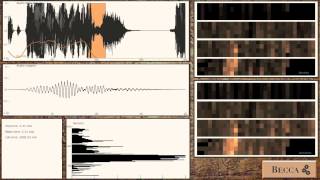
A general machine learning algorithm processed the audio data from a narrated version of The Hobbit, interspersed with sound effects. Because it had previously listened to 48 hours of The Hobbit without the sound effects, it was able to identify them as anomalies. It created a hierarchy of tonal-temporal features unsupervised, as well as a model of their occurrence. Based on this, BECCA determined the novelty of the input and identifies unusual audio events.
Playlist
Uploads from Brandon Rohrer · Brandon Rohrer · 6 of 60
1
 2
2
 3
3
 4
4
 5
5
 ▶
▶
 7
7
 8
8
 9
9
 10
10
 11
11
 12
12
 13
13
 14
14
 15
15
 16
16
 17
17
 18
18
 19
19
 20
20
 21
21
 22
22
 23
23
 24
24
 25
25
 26
26
 27
27
 28
28
 29
29
 30
30
 31
31
 32
32
 33
33
 34
34
 35
35
 36
36
 37
37
 38
38
 39
39
 40
40
 41
41
 42
42
 43
43
 44
44
 45
45
 46
46
 47
47
 48
48
 49
49
 50
50
 51
51
 52
52
 53
53
 54
54
 55
55
 56
56
 57
57
 58
58
 59
59
 60
60

Robot Learning with a Biologically-Inspired Brain (BECCA)
Brandon Rohrer
BECCA talk at AGI 2011
Brandon Rohrer
Robot Learning with a Biologically-Inspired Brain (BECCA), The Sequel
Brandon Rohrer
BECCA listens to The Hobbit
Brandon Rohrer
Learning the building blocks of speech: BECCA extracts a hierarchy of audio features
Brandon Rohrer
BECCA listens for sound effects in The Hobbit
Brandon Rohrer
BECCA finds movie trailers while watching the Big Bang Theory
Brandon Rohrer
Listening for unexpected sounds: BECCA detects anomalies in audio data
Brandon Rohrer
Learning the building blocks of vision: BECCA extracts a spatio-temporal hierarchy of features
Brandon Rohrer
Watching for the unexpected: BECCA detects anomalies in video data
Brandon Rohrer
BECCA finds a stationary target
Brandon Rohrer
BECCA finds a stationary target at 3X speed
Brandon Rohrer
BECCA watches the X-men and Bruce Lee
Brandon Rohrer
BECCA plays Quidditch
Brandon Rohrer
BECCA chases a ball
Brandon Rohrer
BECCA chases a ball, part 2
Brandon Rohrer
Becca chases a ball, part 3
Brandon Rohrer
BECCA creates features from MNIST
Brandon Rohrer
How reinforcement learning works in Becca 7
Brandon Rohrer
Deep Learning Demystified
Brandon Rohrer
How Data Science Works
Brandon Rohrer
How Convolutional Neural Networks work
Brandon Rohrer
How Bayes Theorem works
Brandon Rohrer
How Deep Neural Networks Work
Brandon Rohrer
Recurrent Neural Networks (RNN) and Long Short-Term Memory (LSTM)
Brandon Rohrer
How Support Vector Machines work / How to open a black box
Brandon Rohrer
How autocorrelation works
Brandon Rohrer
Getting closer to human intelligence through robotics
Brandon Rohrer
A minimalist's guide to slicing and indexing pandas DataFrames
Brandon Rohrer
How decision trees work
Brandon Rohrer
Data scientist archetypes
Brandon Rohrer
How to use python's datetime package
Brandon Rohrer
How optimization for machine learning works, part 1
Brandon Rohrer
How optimization for machine learning works, part 2
Brandon Rohrer
How optimization for machine learning works, part 3
Brandon Rohrer
How optimization for machine learning works, part 4
Brandon Rohrer
How convolutional neural networks work, in depth
Brandon Rohrer
How to pick a machine learning model 4: Splitting the data
Brandon Rohrer
How to pick a machine learning model 3: Choosing a loss function
Brandon Rohrer
How to pick a machine learning model 2: Separating signal from noise
Brandon Rohrer
How to pick a machine learning model 1: Choosing between models
Brandon Rohrer
How to pick a machine learning model 5: Navigating assumptions
Brandon Rohrer
What do neural networks learn?
Brandon Rohrer
Interview with iRobot's Director of Data Science Angela Bassa
Brandon Rohrer
How Backpropagation Works
Brandon Rohrer
Evolutionary Powell's method: A discrete optimizer for hyperparameter optimization
Brandon Rohrer
1D convolution for neural networks, part 1: Sliding dot product
Brandon Rohrer
1D convolution for neural networks, part 2: Convolution copies the kernel
Brandon Rohrer
1D convolution for neural networks, part 3: Sliding dot product equations longhand
Brandon Rohrer
1D convolution for neural networks, part 4: Convolution equation
Brandon Rohrer
1D convolution for neural networks, part 5: Backpropagation
Brandon Rohrer
1D convolution for neural networks, part 6: Input gradient
Brandon Rohrer
1D convolution for neural networks, part 7: Weight gradient
Brandon Rohrer
1D convolution for neural networks, part 8: Padding
Brandon Rohrer
1D convolution for neural networks, part 9: Stride
Brandon Rohrer
The Four Grand Challenges of Robots in the Home
Brandon Rohrer
How Convolution Works
Brandon Rohrer
The Softmax neural network layer
Brandon Rohrer
Batch normalization
Brandon Rohrer
Getting ready to learn Python, Mac edition #1: Files and directories
Brandon Rohrer
More on: Supervised Learning
View skill →




Related Reads
📰
📰
📰
📰
Investors and Venture Capital #216 - Autonomous AI Engineering Resource Breakdown
Dev.to AI
Why Enterprise AI Needs A New Approach To Evals
Forbes Innovation
How Industrial AI Can Turn Factory Data Into Actionable Intelligence
Medium · Machine Learning
The Model Wasn’t the Problem: What Skewness and Kurtosis Revealed in Our Production Data
Medium · Machine Learning
🎓
Tutor Explanation
 DeepCamp AI