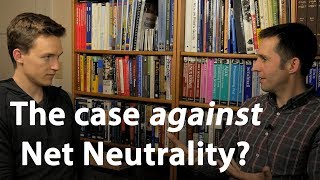
The case against Net Neutrality?
Key Takeaways
The video discusses the concept of Net Neutrality, its implications, and the arguments against it, providing a nuanced view of the issue beyond the common perception of it being purely evil to oppose it.
Full Transcript
I want to share an interesting conversation I just had about net neutrality specifically some of the technical motivations both both for metro travel T as well as against net neutrality and if you're looking for just an overview of net neutrality this is maybe not the right video to start with I would recommend a quick video from CGP Grey which I'll link to somewhere over there and I have to say I generally agree with the sentiment in in that video and actually many of the the similar videos that are out there that they're kind of give an overview of net neutrality but I was recently chatting with that friend and fellow youtuber grant from the channel three blue one Brown which by the way you should definitely check out he does a phenomenal job of explaining all sorts of complex mathematical concepts and in a way that will really make anyone love math but but anyway we were talking recently about why if it seems so obvious that net neutrality is such a good thing why is it so contentious so anyway we decided to record the conversation it's totally unscripted so if if we got any details wrong I'm sure you can read all about it in the comments so I definitely think I can play the role of someone who kind of knows what net neutrality is but still has a lot of dumb questions to ask to help you maybe Illustrated for people but okay just for me right we just get a broad overview what what is net neutrality I'm actually curious what you think net neutrality is because I think because it's one of these things that I think I mean there's a lot of videos there's a lot of things out on the internet that talk about it and it's slightly different depending on who who you're listening to okay my understanding is if my computer asks the server on the internet for a packet right now from someone write that when it goes through the routers and like my internet service provider to me um it is not like it's not allowed in some legal sense to offer more resources more routing resources towards packets from some service versus packets from another service and instead it has to be completely neutral to where they're coming from or what data they consist of in terms of the resources that that rather that the Internet service providers resources get allocated yeah yeah that's that's pretty good pretty good where am I wrong I think I think that's actually a pretty good definition of net neutrality is done we're now you're done yeah so I know I think what's interesting is is the question of whether you actually want that why wouldn't you suppose that you are requesting a bunch of packets from the network that are harmful new to the to the network at large or cause harm to your neighbors let's say that they use shared infrastructure and the network what's it like is this like a virus type thing what's an example of me so I think so I think a good example is something that actually happened which was when BitTorrent came out as a peer-to-peer file sharing system Comcast was limiting or in some cases blocking in some cases actually aggressively shutting down traffic can you give a little overview of what BitTorrent is and why it's distinct from other sure so people might be familiar with yes a bit torn is a peer-to-peer file sharing system which is so if I have a large file that I want to share with a bunch of other people I can create a little piece of information and put that all on the internet that says like hey I have this file you can come to me and there's a tracker that sort of tracks who who has pieces of that file and originally it's just going to be me you can connect me and you can start to download that file for me and then other people that want to download it can connect to me and you download part for me apart from you and as more and more people download the same file may become part of this you know shared distribution so that when you know an additional person comes along and wants to download that file they could connect to potentially hundreds of people that all have that file and download a little piece from each and the nice thing about that is that the constraint is no longer the end-to-end connection between a server and a client but it is the essentially just the connection between the client and that client service provider because from that point they could be pulling in from multiple different sources so as long as all my nature neighbors have the movie that I want to bootleg what could be your neighbors it could be other other people on different parts of the Internet that are connected different providers you could pull down all sorts of pieces of that so there's a couple of things that are unusual about that one is you know when you're downloading a large file you know that's fine there's lots of cases use cases for that and your necessary writer to know the people will occasionally want download large files say the engineer their networks to support that but what's different about this is once you've downloaded that large file you're now serving that large file and if it's a very popular file and one of the biggest use cases of this was you know you know stealing copyrighted movies so very large files lots of people want it sort of the black market type thing and everyone's downloading pieces then so once you've downloaded that you're now a server and so you are now pumping out copies of that file kind of as fast as you can and that's harmful in the sense that it's costing you more it's costing the internet service provider more because they have they have made the bet when they engineered their network that you're going to be uploading and downloading occasionally sort of in a bursty fashion and this new protocol when icky when it you know sort of became popular now meant that you are downloading continuously and uploading continuously and their network just wasn't engineered to to support that and and so the assumptions that they made about you know being able to aggregate your traffic with your neighbors traffic yeah no longer held okay that make sense and so now what you're doing is you know one sends harmful to your neighbors but the other sense you probably feel some need a sense of entitlement so while paying for this connection that I ought to be able to use it mm-hmm and I think that's you know a reasonable thing to think and this is an example you were putting up in an isp in the past heads so comcast actually did this so they so what they what they did is they said okay this is harmful to our network most of our customers aren't using BitTorrent the ones that are probably are using it for illegal movie sharing and things not everyone there's there's legitimate uses for BitTorrent but you know they sort of made the assumptions not many customers it's not the bulk of our customers if we slow this down by you know identifying what try like his baton traffic and throttling it or one thing they were doing is they were actually sending they were injecting packets that terminated the connection oh really and spoofing the source address of those packets really and so it would shut down yeah huh so they were doing that she just like aggressively just stopped the tart traffic so that's not just like it's not constraining the pipeline's for that particular service right they're aggressively just like trying to get it off the network it was an attack yeah it was an attack against their customers in a sense to back up to where when I give a definition I definitely wasn't positive is it a legal thing net neutrality is that's something that Comcast is required by law to abide by so the network Allah is this concept that is essentially what you describe that package shouldn't be differentiated or slowed down there shouldn't be you know talk about this fast lanes versus slow lanes so some traffic's throttled some traffic's not or some traffic is you know queued more generously and so forth so it's sort of this principle and there have been attempts to put it in regulations okay and so the FCC made several attempts to do this that were challenged in court and ultimately overturned by the the DC Circuit appeals court that said like you can't do this the way that in our service providers the regulatory framework that they're in the FCC can't can't actually enforce these net neutrality principles unless they were to recategorize Internet service providers as title 2 which would then sort of categorize them as a public utility Inc because I really don't know a lot here yeah what are they currently categorized as well actually they're currently today I mean in a couple days we'll see but today they're currently categorizes as title - no it's not was something that was a few years ago and the FCC did but prior to that they were categories of title one which meant their information service providers they weren't they work like public utilities I recognize I'm revealing a certain level of ignorance and even asking that about what is going on so hopefully that's reflective of people watching so that it's kind of the questions it's pretty yes pretty wonky yeah right right but so that very likely could change yeah it's very likely that they're going to go back to this title one where you know it essentially can't be regulated so to the birds at the time when Comcast was treating BitTorrent differently huh that was that was legal that was that was legal for them to do that was legal it was kind of sketchy I mean I would I would say it's kind of catchy cuz they were welcoming they were spoofing packets they were shutting down connections and they were telling anyone that's like a slippery slope thing right like you can start with that with BitTorrent if you want sure there's a certain trust that everyone using Comcast then has that that's the only right like what else are they shutting down and what are ya and what other things and in their cases of you know I think AT&T for example this is an in the mobile space you know they they prevented I think it's FaceTime from working on iPhones hmm or maybe Skype I think both of different occasions so so these voice over IP applications on the phone AT&T said yeah you can't use that on an AT&T iPhone because we would prefer you to use the phone services of competition it's constrained competition yeah and you're like well instead of getting the thousand minute plan I'll get the 500 minute plan and I'll use this voice over IP and I'll pay less and and so-and-so 18t said yeah we're not gonna we're not gonna allow that traffic and again that's that was legal that was legal and then right now yeah today today yeah December what is it 11th December 12 12 yeah it's not and then potentially December 15 that could become legal again okay and so that's kind of what's what's at stake here here's what I want to hear from you I feel like if you're on the internet and you're at all familiar with net neutrality every single person is telling us like it is a good thing this is there is no question about it right it is only for purely nefarious evil incarnate reasons that anyone would ever vote against net neutrality right right if I was to ask you to just put on your devil's advocate of dazzled advocate shoes here and actually kind of voice and that someone would not want a net neutrality does that exist is there a case to be made yeah there is and actually the BitTorrent one is an interesting example because the one hand it's sounds very nefarious they're shutting down this traffic this is things that users want but they were I think Comcast when they were doing that they were looking at this as you know we are trying to protect the vast majority of our customers because if if you are the one person in your neighborhood who's using BitTorrent you could be you know sort of choking off the service to all of your neighbors it could be you know 200 of your neighbors who are sharing the same bandwidth in your neighborhood and you know you're using all that up because the the assumptions that they made when they engineered the network is that no one would be doing that so here I am trying to just like watch Netflix or something like that and because some neighbor of mine is bit torrenting and just uploading and downloading way more than anyone expected to I'm just getting crappy er service right right good and so and so the thing that Comcast would then need to do to remedy that would be to expand the number capacity in that neighborhood and someone's got to pay for that right so that would mean the bill for everyone in the neighborhood goes up so that the one person who's who is like way off the charts in their usage gets the same service or they push you into another plan right now this isn't that the case right why isn't it that the person who's just uploading downloading way more than usual that his bill is enough to 2-foot the extra costs that this is this is incurring on the ISP yes this is tricky because you're let's say you're paying for a hundred megabit per second connection your neighbors paying for a hundred megabit per second connection Comcast is engineering the network with the assumption that you're not not everyone is going to use a hundred megabits per second at the same time so there's a sort of a there's sort of a lack of understanding on the part of consumers as to what they're actually buying when they buy that hundred megabit per second connection because they're not actually getting guaranteed hundred megabit per second every single neighbor was trying to at one you're not gonna get it interesting yeah now you can buy dedicated Internet access mmm and it'll cost you about $1,000 a month mmm and that's with a three year contract and it's very expensive to actually get our megabits per second you need guaranteed infrastructure is you need guaranteed infrastructure to carry that exactly so that's very expensive and so you probably don't want to pay $1,000 a month to get hundreds per second you probably rather pay $50 a month to get hundred acres per second most of the time why would the solution then I mean obviously I'm asking you to make this devil get it yeah it is what devil's advocacy case but why would the solution be to violate net neutrality as opposed to just making it transparent to people like your plan is a hundred megabits per second except if you were legitimately using that for like 12 hours of the day like there's some kind of calf all right like how much you can be exercising that maximum rate because realistically you're not expected to and they should just be forward and honest about that rather than yeah that's a that's another approach that they they could take and I think there was there hasn't there has been discussion about that I mean consumers basically don't want caps mm-hmm the idea that you'd have a cap of you know 500 gigabits per month there's I don't know whatever kind of cap you might have you know consumers kind of want an unlimited service or we want to believe we want to believe you have a concluded service it's essentially guaranteed that we'll never exercise that right need and and the you know the one or two people way off on the on the end that are that are abusing the providers are call it abusing I think the customers would say they're you think what they they're paying for but the ones that are really off the charts you know the bride is like yeah we'll just limit the traffic we'll give them will slow them down or slow down the applications not to interrupt but veteran seems like an interesting example just because this is a peer-to-peer type thing and then there's a whole pile of hype around decentralized possibilities with like blockchain and whatnot and to the extent that that is an aspect of the future of the internet that you have a little bit more possibility for some services to be a decentralized in this way and I think there's even a lot of things that just have a straight-up BitTorrent type flavor when it comes to file sharing and things of that sort like do you see that as a little bit more on the horizon and would you see that as an example of like potentially harmful harmful things that come about when you are very strict about net neutrality about abiding by it I wouldn't necessarily categorized as a peer-to-peer I think the I also I understand what yeah that you're not saying that it was like necessarily dangerous to abide by it strictly I'm sort of eking that out of you but no yeah I mean I think the thing the thing that happened with BitTorrent and yeah we were going a little bit too far down that rabbit hole but the thing that happened with BitTorrent was this was an unusual thing this is an unusual new phenomenon on the network and at the time it was causing problems and the providers chose to deal with it in a particular way that once it became public you know the look pretty bad and arguably was bad and and you could say well if you want to introduce new technologies and you want them to be successful like you kind of need the providers to be able to step up and and deliver those packets fairly otherwise it's like well you know there's there some cost to innovating or some cost to introducing some new protocol is there I mean this is that's one example that it seems kind of compelling in its own way but like compeltely which way I'm actually curious I had never heard even in a devil's advocacy way a case for we're violating that neutrality might be an okay thing to do right it's still my clearance I think I mean there's a strong argument that that's not an okay thing to do because there's the BitTorrent users that are like hey I'm paying for service and I want to use BitTorrent mm-hmm and like why can't I do that you know this is this is a pipe I'm paying for it I want to send packets like let me send packets what was what was compelling to me or like maybe in the direction of that was in as it's now a public cost to their neighbors right the right I'm sure they're paying for that service but unbeknownst to them they actually are throttling the bandwidth for their neighbors in a way that they don't want to be right and maybe you could just say well like dice P just has to pony up and actually provide what they claim that they're providing right and that which is gonna cost more in the bill it almost seems analogous to me like in the case of a banking says like a reserve banking system where like you might ask that a bank has the cash on hand and everyone sees in their accounts but realistically that's actually just gonna sort of slow things for everyone else and you know people that's obviously other side yeah but there's a an oversubscription over subscription I guess yeah yeah reserve system versus over subscription yeah there's there's an alligator so we'll call that like a sort of a partial case against net neutrality yeah just cuz it's a lot more I don't know interesting if I hear you make more cases against net neutrality for the safe yeah well I think another interesting thing to talk about it's not necessarily a case for or against okay is there was this this sort of conflict that came up between Netflix and I think it was comcast where Comcast subscribers we're seeing Netflix slow down and that was because you had comcast per season yet you had Netflix who was connected to a different service provider I think it was level 3 was the ISP that that they were using and so Netflix's servers or connected to level 3 and then you know Comcast's customers were connected to Comcast and then level 3 and Comcast were connected together okay and the the arrangement by which Comcast in level 3 these two ISPs are connected together is sort of traditionally been a mutually beneficial arrangement right because level 3 has customers in this case Netflix Comcast has customers in this case their subscribers and there's a benefit to Comcast if their subscribers can access Netflix there's a benefit to Netflix if they can access Comcast subscribers so there's a mutually beneficial arrangement and so there's you know the the connection between those two networks is called a peering connection because the networks are seen as peers and in particular these are generally referred to as like settlement free peering settlement free meaning no one's changing there's no money changing hands so Comcast and level-3 just have this like handshake agreement like we're providing each other this thing Yap hopefully the value is kind of even out right so if we're sending a gig in you know a gig a bit of traffic between us I'm gonna put it install a gigabit port on my router you're gonna you know pay to install a gigabit port on your router and we're gonna plug a fiber in between the two of them and we're gonna send traffic back and forth and the traffic that that you send me you know benefits you and the per traffic that I said you benefits me and vice versa and so this is sort of mutually beneficial thing now with the rise of Netflix and other like big video streaming services you've had the situation where now the traffic coming from Netflix through level 3 was significantly more and it's a definitely different character of traffic so similar to the BitTorrent where a BitTorrent it wasn't just that it's a lot of traffic it's a lot of traffic continuously which is something that the network was not engineered for because it's just a different route traffic profile I mean I think I've heard Netflix it's like a third of the internet measured in terms of bandwidth and yeah tube is like another six Yeah right there 50% of the Internet as the data flying around is this type of proof transfer and it didn't exist right then tell very recently right you know you know five 10 years ago that wasn't the case and so all of this traffic just like pops up because Netflix and other video providers become you know very very large and so now Comcast is looking at this it's like well we can upgrade this port but you're just going to put tons of traffic on our network and we're not just gonna have to upgrade the port between us we're gonna have to upgrade our network we're gonna have to upgrade our distribution and and the connections are scriber subscribers so if before they may have been over subscribing you know we're talking about that over subscription of maybe two hundred to one so if you're paying for 100 megabit connection you might have two hundred customers all pay 400 mega connection that are actually sharing a single hundred megabits that over subscription factor no longer works and so the infrastructure costs the Comcast would have go up significantly as a Comcast is looking at this and saying like this is no longer this peering relationship was no longer mutually beneficial this is gonna cost us a lot of money now on the one hand that's benefit that's still beneficial to Comcast customers because if Comcast customers can't get to Netflix they're gonna be unhappy but it's also very beneficial to Netflix because if Comcast customers can't get to Netflix Netflix is not going to be happy so essentially that set up this kind of standoff where Comcast is like we're not upgrading this port unless the Netflix you pay us ah so this is a different this is not them purposefully throttling Netflix traffic right it's that the onus would have been on them to add a lot more infrastructure because the times have changed Netflix came along and and to distribute Netflix is expensive mm-hmm and Comcast is like we're not paying for this ourselves but is that a violation of net neutrality because it's not as if they see that the packet is coming from Netflix and therefore do something different it's just that the no but not directly a third of the packets coming from Netflix and and it's it is a little bit discriminatory in the sense that all of the traffic coming from Netflix is coming through Netflix is is P and so the period connection to Netflix is ISP Comcast can say like if I can upgrade that and so it disproportionately impacts Netflix negatively well walk me through that just a little bit so because Comcast it's making these deals not just with Netflix is ISP but with a lot of hundreds of eyespace yeah so they can they can purposely choose to upgrade as needed or mm actually abide by this usual settlement free Pierceton right all of the others or negotiate some other settlement situation and so if there's you know you know another connection to let's say Google who's you know sending that YouTube traffic YouTube is maybe less and Comcast like yeah we can handle this or like this is you know our customers want access to YouTube more or whatever decision they might make that that's easier for them they may negotiate or they may negotiate with Google and Google's like yeah we'll pay you because you know this isn't a completely fair [Music] situation Aloha of this peering arrangement I don't know all of those all of those like peering agreements are are private so you can only speculate unless things kind of bubble out to the public so it's kind of like a higher-level form of neutrality that implicit in this is that they're being neutral to all of the people they're making these agreements with and then if one of them is serving a different traffic type just by virtue of how they negotiate those agreements they can treat a certain traffic type differently is that an accurate some upper I don't know that it's necessarily different traffic I in this case it just sort of I think in any of those periodic payments like it's always negotiated in some cases it turns out that it's settlement free and there's no money to changes hands it's mutually beneficial to both sides in other cases it's not and it is more beneficial to one side than the other and that's just a negotiated agreement between the two ISPs and then money changes hands based on whatever that agreement is and in this case in this particular case that I'm thinking of there was kind of a stalemate where you know Netflix kind of went public with this situation I think even level three went public because they were you know trying to upgrade this connection and Comcast was sort of saying no we we want to get paid because this is gonna cost us a lot right yeah to support this now that the resolution what ended up happening to contest upgrade eventually Comcast did upgrade and then eventually Netflix paid there was Netflix who paid I think so fascinating I had no idea yeah hmm what are some of the other okay so that but I guess that's not really case for that's just a thing that you might not have thought about the influences net neutrality type topics yeah and you can I mean I think I'm actually not sure I think you couldn't argue that that's not really an epic allottee question as much different flavor because you're not you're not necessarily providing a different level of service you're just charging you know market rate for the transport mm-hm you know where it gets weird at least and where it sort of like drummed up some of the the passions are around that neutrality is that while this is going on of course Comcast also has their own video service Xfinity and that's working fine and so there is this potential conflict of interest there or are you saying like well you know Comcast gets to gets to use their own network for free why can't everyone else and I mean is that the case you would make that yeah that's a tough one because I mean you you would you wouldn't cuz you could say that like I mean Comcast as a video provider just you know I get to kind of play that side huh they paid for the infrastructure that they need that is adding value to them as a video provider on that end right and then something to ask that they pay for that same extra value to add value to other people as video providers right right um it's kind of they also and this this is the other argument that people make who are against net neutrality and it's it's a pretty convincing argument although it's not the whole argument so I'm just taking clear there's more to it but Comcast and other cable providers by and large built out their IP infrastructures in part to support their own video products and so a lot of the expectation when they built the infrastructure was that that would be paid back to them over time through their own video products because remember Comcast started as a cable company mm-hmm and so they were already delivering essentially differentiated service right because you had cable as a completely separate service from IP as it goes and it was it was not video over IP it was just video over RF mm-hmm along with IP over RF on a different channel essentially was how it was delivered and then Comcast other cable companies said hey we can save costs by getting rid of this video over RF infrastructure to get rid of all of that consolidate on just a single IP infrastructure mm-hmm using our existing cable plant and then stream our previous video service that was you know over RF over our own IP network and the whole plan there was will carve out you know some amount of bandwidth for on our IP network to stream our video service and so they made this big infrastructure investment with the expectation that they would be able to provide this sort of you know multiple service sort of called triple play because voice as well as video and Internet all on the same IP service and so they made that investment and and so that's sort of the argument of net neutrality might stifle innovation because it was it was this idea that we can convert our network to an IP network so in some future instance where there's going to require a lot of infrastructure investment in order to provide a totally different type of Internet experience and you're asking who's going to be paying for that yeah I mean I think the hypothetical think about is like if you had if net neutrality have been in place from the start and and then you you know and so you said to Comcast okay you have a separate video pipe into everyone's home which is the your traditional legacy cable network you also have IP if you expand your IP network and start delivering your video over IP you need to provide that same level of service to all your competitors Comcast may never have made that investment the first place and they may have kept their IP stream much smaller we do not think that they still would have ended up growing it because of the demand from streaming from other services it might not have been commercially viable for other services to even hmm so you like it could be the case that the youtubes out there and the Netflix is out there starting up we're dependent upon Comcast and other cable providers bet that if they switch to an all IP infrastructure and expense ignore I so 2005 Internet goers like going out what's this new site youtube.com there's just extremely slow for them to actually see the skateboarder crash huh there's like ah this I'm going back to reading articles yeah possibly is a little contrived to actually paint it like that because hindsight's 2020 almost feels inevitable that this is what consumer demand asks for that ISPs are gonna need to bend over backwards to provide it yeah another interesting analogy is DSL Oh so-so DSL digital subscriber line was or is you know a pack of service over traditional copper telephone lines so old-school 100 year old telephone technology you know dry comp repair coming into your house you can put packets over that and because that was part of the old telephone network that was that was originally regulated under title 2 and so from the start so from the you know from the 90s when the internet was your residential internet was starting to get built out DSL was regulated and to be competitive part of the way that that regulation worked was if a phone company builds out a DSL infrastructure to build a DSL access to someone's house they have to call unbundle that which is they have to be able to take that DSL connection from their central office to the customer's house and provide that piece of infrastructure to competitive ISPs mm-hmm and so you had this proliferation of they were called seelix competitive local exchange carriers which were you know competing with the ilex which are the incumbent local exchange carriers that we're coming in putting equipment into you know the traditional Bell central offices and offering Internet access across the Bell System DSL lines and so that was this that wasn't very regulated I mean that was that was net neutrality essentially like this DSL line is here and it is I think there was even like a regulated price that was there was there and I think the the reason the fact that that was regulated is potentially one of the reasons the why cable modems and and things like fiber to that to the home like Verizon's FiOS took off and and really that technology grew much more than DSL because if you're the if you're the phone company you own that DSL line you're incentive to upgrade that technology and say oh how can we get you know faster encoding and and you know more efficient and go further distances or or build out like a hybrid fiber system is just one slower it's much lower because as soon as you build that and you make that investment all your competitors have access to it too as well whereas if you say we're gonna build a completely different like FiOS for example instead of Verizon saying and we're gonna build out this DSL so all our competitors can use at this that we're gonna build a fiber network something that doesn't yet have the same thing that doesn't like do it exactly and so they build and they cable companies didn't have those rules either and so they rarely did and then I think in 2005 the the DSL unbundling requirement went away but and so there are competitive DSL offerings out there now but that wasn't an early success so that's a that's you know potentially an argument against net neutrality does that is that kind of an inevitable little cat-and-mouse game there as something new comes up where there's not rules surrounding how that is a new way to send data around right the rules don't yet apply and the natural market forces are gonna take place before it can be treated well I mean that's what happened with the internet yeah and a lot of things yeah like do you see that as a cycle that will continue I mean that requires innovation new technologies and things the Internet like that kind of unleashed a lot of new technologies so you had things like DSL and fiber and hybrid fiber cable networks and all these other things that could be explored and you know DSL you had this strict regulation and my hypothesis is it wasn't successful because of that mm and these other other things sort of one out but that's because those other things existed they were viable you know as the as the technology and the industry matures you know you can't just pull a new innovation out of thin air you're saying you've got to make sure that there is gonna be the return on that investment for whoever puts it in right there's a risk that an enforcement a lot of these things like even if it is the case that they're like yeah these should be treated like public utilities and there's a certain like people have the right to their each packet be treated equally we have to acknowledge that that is a potential cost on innovation maybe it's worth it but that's a potential cost yeah that's a potential cost in that and that's the interesting thing I mean there's definitely like I I've been kind of talking anti net neutrality for a while and I don't want and yeah I don't there's and we can't been either as well known to be against net neutrality no no no that'd be his reputation that persists on the internet from this point forward thank you for that no I mean there's I mean we could go on and on about the things I mean the I think any other the other example I gave about uh you know AT&T mmm-hmm you know not allowing Skype yeah on their phones like that's terrible clearly like just that's anti innovation everything right yeah an adversarial exactly yeah and and then there's you know all these other questions I think one of the big concerns that people have is around censorship it's like you know you could have your ISPs you know kind of making calls on what you can and can't see and that's that's the the big fear there hasn't been content-based censorship that I'm aware of but but that's certainly a possibility yeah I mean a lack of precedence is no right that's not comforting yeah right so I mean part of the reason that it's a little more interesting for me to hear from you because you do have such a strong background the networking and you're gonna be able to speak about this more than a lot of others if there's even a devil that advocacy is is I think people like watching this and going around on the internet they already know the cases for net neutrality and they're all and I don't I don't disagree with any of them they're all valid but in any any circumstance where there is like a thing that a lot of people feel very fervently about mmm there's a little light bulb that goes off my mind that says should we just should we check what the other cases and should we put aside the tendency to let go what their peers my people that really dressed and kind of give this a critical eye and say you know if someone's going get this is it for purely selfish reasons yeah maybe that's a lot of notice behind it but you know is there is there may be a little more nuance to this story and that that becomes a lot more interesting one because it actually becomes a more compelling way to convince people right if they look there's probably people legitimately against net neutrality for a couple of reasons II turn that right and and the way to the way to turn them to your side is not to put a big black bar on the top of your website that's like call your Congressman right now like right well that's even if you effective the effective to get people a cup yeah get people to call their congressmen but I don't think that changes minds right I don't think acts like that or kind of internet getting the mob together to do a thing I don't know that changes minds it amplifies the minds that are already in one direction yeah the only might actually change someone's mind is be very clear that you understand what the avianna point is articulate it as intelligently as you can be as a strong man and that and there are valid points on both sides like all the arguments that everyone's well aware of for net neutrality are true the arguments against it are true to you know networks there is there's value in giving networks the ability to you know to do some of these limiting things for you know network management purposes - you know allocate costs appropriately you know so if Netflix comes along maybe Netflix oughta be paying some share of the distribution costs for their product because there are significant distribution costs for their product and then you know there's a concern that that's like anti-competitive there's anything competitor but there's also the concern that there's anti innovation because if some new startup comes along they're gonna have to pay that same cost well I mean but if the cost is tied to usage yeah then that seems fair to me it feels like a trade-off like it is anti innovation potentially unlike the isp side like the image that you painted if net neutrality existed from the start right fair hum and given that there's a cost that has to be incurred feels like whoever has to front that cost you can always point into whatever that industry is like it's anti into innovation for that industry yeah someone's paying the cost and it's just like we gotta be we gotta acknowledge who we are giving a leg up to and who we are mmm forcing to pay that right right it's probably worth it right like my personally I would be for net neutrality and that seems like as you're allocating okay where do I want innovation to happen as I'm pulling the levers here and there for which ones am i okay slowing down just a little bit so that these others can like race ahead yeah they balance out but it's not but if you have some service like like that toy let's say yeah Victoria yeah bit turns actually good example where there's a very small number of users who want it mmm most people don't want it but it raises the cost you know the distribution cause for everyone well I feel like this is the solution that just has to be that like that I don't pay for a hundred megabits per second no cap the I just like that I'm given a cap and then I'm also totally this is how much you could like the ISPs would love to to do that after my game Kevin naive here their consumers don't want that mmm you don't want a cap on clean I don't know I mean if you as a consumer are very aware that like your normal usage and even your extreme usage doesn't even approach that cap unless you're using BitTorrent there is something psychological about having a cap and I mean my guess if an ISP started rolling out pricing models like that there would be a revolt mmm and they know that and that's why they don't do it and they do these other traffic management things or would like to be able to do traffic meant to to sortie that but it has the negative effect right of tamping down something like the torrent or Netflix that could become very popular right so there's like things like that on the horizon more I mean episode oh I hope there are cool new innovative things that potentially require you know different engineering of the network to support and then yeah then there's that question who pays for it mmm under net neutrality it's like well the ISP pays for it so it's distributed among all of the the providers customers even if it's a small number of people who use it mmm and if that's the case then you know what happens that's true yeah well I don't I don't know how that feels actually it feels like we've been if you like being faced with the truth that I don't really want to think about it well I think the family I think at the end it's like it's nuanced right which is why if you look at both sides so there's the there's the title to side where it should be you know you know a service writer should be titled - which gives the FCC lots of ability to regulate them so all of the attempts that the FCC did before they were titled - were you know shot down in court it's a title to give them all this room - to regulate however the FCC has not done a lot they have not they have not used their enforcement power so they've kind of taken a light touch they said yes your title - so be careful but yeah and so we're not going to enforce everything we could do under - like if so you could do all sorts of draconian things under title 2 and they're choosing not to because a lot of it just doesn't even make sense because title 2 is I mean as a title 2 of the Telecommunications Act I think 1939 or something so gives you some sense of how applicable it is to the Internet but that's like a joke yeah yes so it's not like super and it gives them all sorts of weird powers that lawyers could leave read all kinds of power into that they could do all kinds of things - is peace and basically what the FCC did under you know Tom wheeler who I think that's right could be misremembering but when whenever they stay switched to to title to they said look at the title - but we're gonna take a light touch we have this enforcement power but you know you know you know the deal with net neutrality what a GP is saying with this change back to title one is Internet service providers like you understand the market issues you know that the people want net neutrality be nice but we're gonna we're gonna like loosen the leash a little bit but we kind of expect you to you know to to use your new freedom wisely I don't know that he's exploitable he said that but he yes said like you know we we kind of you know that the ISPs have have committed to net neutrality principles which is kind of weaselly it's like well maybe they have maybe they haven't like they say they have because like why wouldn't they someone could easily respond like if that's what if that's what you want to happen what would be wrong about just enforcing that to happen rather than letting it right on right well we're following principles right but that's the thing it's like both sides of it are actually kind of hedging mm-hmm so the put them title too and we have all this enforcement authority but we're not going to use it mm-hmm unless we need to yeah versus the we're not gonna do anything but we're gonna trust them not to not to overstep yeah when you use the word trust and ISP in the same sentence very sketchy yep and that's that makes a lot of people nervous which is why people are very very insistent on the you know a little bit tighter control my I don't know personally I'm not super worried about the reclassification as title one because of the ISPs are kind of on notice hmm if they go too far the political pressure to reclassify as title 2 again is gonna be so strong well people are looking for them impetus at that point yeah and it could swing national politics and you know you could get another president that comes in who is more favorable maybe yeah that's the main thing like people have that lever mmm and so is peas recognize like if you know yes we have the they'll they'll have this freedom to potentially do things that are not completely in line with net neutrality but I think they recognize assume that the highest peace would recognize that if they go too far and they do things like block Skype on your iPhone well it's like the regulators are going to come in and come down hard on them that's not tonight that's my hope hmm so we're just gonna sit in this Mexican standoff indefinitely which doesn't feel bad to me because there's like computer I mean there's who's competing interests on both sides there's value to this there's value to that I like yeah everyone should be a little bit nervous and watching their back and hopefully everyone does the right thing and I mean I don't know it's all right yes how is that side of accuracy we really have a better understanding of the Mexican standoff we're putting ourselves in and the reasons why you might want to be comfortable with it I mean that's why yeah it helps me sleep at night I don't know all right that's fair honestly and it's different it's very different I think from the take that at least that I've heard from a lot of other online creators yeah it's necessarily that different to conclusion right you're not I don't I don't disagree with any of any of the extreme positions on either side I think there's I think there's a lot of credibility to to both of those positions which is which is why there's this conflict right yeah it's like if if it were obvious that one side were right then we wouldn't be having a debate easy to lose out of that I think though should we call it an end let's do it thanks for doing this yeah thanks it's fun
Original Description
Everyone seems to want net neutrality, yet it remains a contentious issue. Is pure evil the only reason anyone would oppose it, or is it a bit more nuanced?
CGP Grey’s intro to Net Neutrality: https://youtu.be/wtt2aSV8wdw
Grant’s channel: https://www.youtube.com/c/3blue1brown
------------------
Social media:
Website: https://www.eater.net
Twitter: https://x.com/beneater
Patreon: https://patreon.com/beneater
Reddit: https://www.reddit.com/r/beneater
Playlist
Uploads from Ben Eater · Ben Eater · 29 of 60
1
 2
2
 3
3
 4
4
 5
5
 6
6
 7
7
 8
8
 9
9
 10
10
 11
11
 12
12
 13
13
 14
14
 15
15
 16
16
 17
17
 18
18
 19
19
 20
20
 21
21
 22
22
 23
23
 24
24
 25
25
 26
26
 27
27
 28
28
 ▶
▶
 30
30
 31
31
 32
32
 33
33
 34
34
 35
35
 36
36
 37
37
 38
38
 39
39
 40
40
 41
41
 42
42
 43
43
 44
44
 45
45
 46
46
 47
47
 48
48
 49
49
 50
50
 51
51
 52
52
 53
53
 54
54
 55
55
 56
56
 57
57
 58
58
 59
59
 60
60

KA 60 Minutes Sep 2013 rerun (10x speed)
Ben Eater
Frame formats | Networking tutorial (6 of 13)
Ben Eater
TCP: Transmission control protocol | Networking tutorial (12 of 13)
Ben Eater
Clock synchronization and Manchester coding | Networking tutorial (3 of 13)
Ben Eater
TCP connection walkthrough | Networking tutorial (13 of 13)
Ben Eater
Lower layers of the OSI model | Networking tutorial (7 of 13)
Ben Eater
Hop-by-hop routing | Networking tutorial (11 of 13)
Ben Eater
Sending digital information over a wire | Networking tutorial (1 of 13)
Ben Eater
ARP: Mapping between IP and Ethernet | Networking tutorial (9 of 13)
Ben Eater
Analyzing actual Ethernet encoding | Networking tutorial (4 of 13)
Ben Eater
Intro to fiber optics and RF encoding | Networking tutorial (2 of 13)
Ben Eater
The Internet Protocol | Networking tutorial (8 of 13)
Ben Eater
Looking at ARP and ping packets | Networking tutorial (10 of 13)
Ben Eater
The importance of framing | Networking tutorial (5 of 13)
Ben Eater
Programming my 8-bit breadboard computer
Ben Eater
Programming Fibonacci on a breadboard computer
Ben Eater
Connecting to a mystery signal | Digital electronics (4 of 10)
Ben Eater
Using a transistor to solve our problem | Digital electronics (8 of 10)
Ben Eater
Inverting the signal with a transistor | Digital electronics (9 of 10)
Ben Eater
8-bit computer update
Ben Eater
Bus architecture and how register transfers work - 8 bit register - Part 1
Ben Eater
RAM module build - part 2
Ben Eater
Using an EEPROM to replace combinational logic
Ben Eater
Build an Arduino EEPROM programmer
Ben Eater
Build an 8-bit decimal display for our 8-bit computer
Ben Eater
8-bit CPU control logic: Part 2
Ben Eater
Reprogramming CPU microcode with an Arduino
Ben Eater
Update and PODCAST ANNOUNCEMENT!
Ben Eater
The case against Net Neutrality?
Ben Eater
Making a computer Turing complete
Ben Eater
CPU flags register
Ben Eater
Conditional jump instructions
Ben Eater
“Hello, world” from scratch on a 6502 — Part 1
Ben Eater
What is a stack and how does it work? — 6502 part 5
Ben Eater
RAM and bus timing — 6502 part 6
Ben Eater
Subroutine calls, now with RAM — 6502 part 7
Ben Eater
Why build an entire computer on breadboards?
Ben Eater
How assembly language loops work
Ben Eater
Binary to decimal can’t be that hard, right?
Ben Eater
Hardware interrupts
Ben Eater
What is error correction? Hamming codes in hardware
Ben Eater
Installing the world’s worst video card
Ben Eater
World's worst video card gets better?
Ben Eater
Breadboarding tips
Ben Eater
So how does a PS/2 keyboard interface work?
Ben Eater
Keyboard interface hardware
Ben Eater
Keyboard interface software
Ben Eater
How does a USB keyboard work?
Ben Eater
How does USB device discovery work?
Ben Eater
How does n-key rollover work?
Ben Eater
SPI: The serial peripheral interface
Ben Eater
Why was Facebook down for five hours?
Ben Eater
How do hardware timers work?
Ben Eater
The RS-232 protocol
Ben Eater
Hacking a weird TV censoring device
Ben Eater
Let's build a voltage multiplier!
Ben Eater
6502 serial interface
Ben Eater
RS232 interface with the 6551 UART
Ben Eater
Fixing a hardware bug in software (65C51 UART)
Ben Eater
Running Apple 1 software on a breadboard computer (Wozmon)
Ben Eater
Related Reads
📰
📰
📰
📰
What Building ML and LLM Projects Has Thaught Me
Medium · LLM
Can AI Learn Without Retraining Its Model?
Medium · Machine Learning
The Economics of Intelligence: Compute vs. Architecture
Medium · Machine Learning
Your Model Isn’t Undertrained. Your Data Is Underlabeled.
Medium · Data Science
🎓
Tutor Explanation

 DeepCamp AI