GNS3 switching setup and options Part 2: GNS3 unmanaged built-in switch
Key Takeaways
GNS3 switching setup and options using the built-in unmanaged switch, with links to free software and VIRL image downloads for advanced networking configurations.
Full Transcript
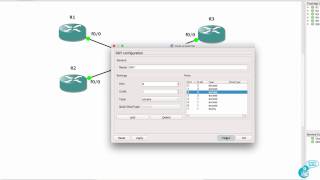
[Music] in a previous video which I've linked below I discussed the various switching options available in gns 3 also demonstrated the configuration of Cisco iOS V layer 2 switches in this video I'm going to discuss the junus 3 bolt-in switch this is an unmanaged switch in other words you can't configure it through the CLI it provides basic switch functionality to connect devices in a Jus 3 topology even though you can't configure the switch through the CLI you can configure the number of ports on the switch and other basic settings such as making some ports access ports and other ports 82.1 Q ports now note it's not running a switch operating system everything is emulated from scratch this means that some protocols could be buggy so only use this for basic operations don't try and set up a vtp domain or a complex spanning tree domain with the switch it's not going to support those protocols but if all you want to do is connect devices to one another in a Genus three topology this is a good choice the switch is available a under the switches category so select The Ether switch and drag it to the workspace now in this example I'm using Jus 32.0 so I can select where I want to host the ethernet switch I'm going to specify the gns3 VM and click okay so once again in this example I'm using gns 32.0 now for my host devices I'll simply use routers running in the junice 3 VM and we'll do some tests here to see if the ether switch works properly I'll also bring another router in which we can use for intervlan routing so here's my basic topology the first thing I'll do before I connect the devices is configure the switch so right click on the switch click configure and that shows you the various options for configuring the switch so you could configure the name you can add additional ports to the switch so as an example I could add Port 8 which would give me a nine Port switch or I could delete that Port so I'm back to an eight Port switch with port numbers 0 to 7 by default all ports are access ports in VLAN 1 now there is incorrect information on the internet some people will tell you that you can't change the port type through this interface that is incorrect it is possible to change the port type from access to editor1 Q as an example so all you do to make that change is double click on the port number change the type to editor1 Q as an example and click add so the port type is now changed in this example I'm going to leave port Z and Port one in VLAN 1 but to change Port two to another VLAN I'm going to double click on the port that changes the details over here I'm going to change the VLAN to VLAN 2 but leave it as an access port and click add I'll do the same with Port three double click on it Port numberers changed to three change the VLAN to two click add and the VLAN has not changed so notice we have VLAN one on Port zero and one VLAN 2 on ports two and three and we are using a native VLAN of one on our 802.1q trunk so perhaps we want to move the hosts to a separate VLAN so we could put that port in vline 2 this port on vline 2 and then simply change the other ports [Music] to another VLAN as desired click apply to apply your configuration changes and click okay now when you hover your mouse over the switch you'll see the ports that are configured at the moment the ports are empty but we could now start connecting devices to the switch and I'll put router one and router two on ports Zer and one and router three and four on ports ethernet 2 and ethernet 3 just remember that the port numbers start at zero on the switch so I have eanet zero ethernet one eanet 2 ethernet 3 and in this example I've got eanet 7 connected to router 5 which we could use for intervine riding when I hover my mouse over any connection I can see how it's connected and hovering over the switch once again we can see how devices are connected but I could once again right click on the switch click configure and I'll be able to see the configuration of the switch so you can make your topology look pretty I'm not going to worry about doing that here what I'll do now is start up the devices The Ether switch is by default on so just to show you that again if I power down the routers they all powered down and we can see that in the topology summary but the switch is powered on it's not a managed device so you can't power it on and power it off like you would with a normal device notice there's no power options here but on this device we do have a power option there's also no console available on the switch whereas we do have consoles available on The Cisco I'll open up a console to all the routers so as an example we can see that router one has booted so is router 2 and so have the other routers now one of the reasons I wanted to use susco routers rather than a device like vpcs is I want to show you what happens when a broadcast is sent so on the first router we can configure an IP address and then no shut to the interface the interface has now come up so the rouer as an example will be able to Ping itself on router 2 I'll also configure an IP address on the fast ethernet interface and I'll no shut the interface and hopefully R 2 will be able to Ping r one so there you go so if you're remember r 1 and R 2 are in the same VLAN they both in VLAN 2 if you have a problem where your devices can't ping each other other people would tell you that you have to reboot the entire topology now that may be required in some cases but otherwise just delete the connection and then reconnect the connection it's become a lot easier to do those kind of things in Gs 3 version 2 so by simply doing that now notice router 2 can ping router one but if I deleted that cable router 2 would no longer be able to Ping router one so I'll connect the router back again and rer 2 can ping r one we could do a debug IP icmp to prove that and notice now we see the debugs for the Ping now what I'm going to do here is do something you shouldn't typically do I'm going to put router 3 and router 4 in the same subnet as router 2 and router 1 and send a broadcast so that we can prove that the layer 2 switch is working and also see where traffic actually goes when a broadcast is sent so router 3 has got an IP address of 10113 router 4 IP address 10114 router four should be able to Ping router three and there we go so now let's do a test of a broadcast these four routers are in the same net but we've configured the switch with the first two ports in VLAN 2 and the second two ports in vline 3 so rou of 4 when it sends a broadcast should only get a reply back from router 3 but let's test that so ping 101. 255 notice we're getting a reply back from 10113 we are not getting a reply back from router 1 or router 2 if we do the same test on router one paying 10.1 255 we get a reply back from router 2 because I'm running a debug we see additional information I'll turn off debugging and notice now we simply get a reply from router 2 so broadcasts are contained by this gns3 layer 2 switch r one when sending a broadcast only gets a reply back from router two so router one can ping router two but can't ping router 3 because they're in different VLS and by the same token router 1 can't paying R of four now one limitation you have with this switch is you can't move ports from one VLAN to another while the ports are connected so what you could do if you want to move ports from one VLAN to another is remove the ports and then configure the switch so as an example if I want to move Port two to vline 2 I can double click on the port change the vline number number click add click apply and click okay and now I can recable the switch so it doesn't give you a nice easy option to move ports from one VLAN to another like you would have with a CLI switch but in a simple topology like this it doesn't take very long to to recable the topology so now on router one when I send a broadcast we're getting a reply from router 2 and router 3 because I've moved rer 3 from vline 3 to vline 2 so r 1 can ping R 3 and notice previously router 4 was getting a reply from router three when a broadcast was sent and it was able to Ping router fre directly but now we're not getting any replies to broadcast traffic and rer 4 is not able to Ping rer 3 and again it's because we've moved R 3 to VLAN 2 so that's a simple example of how to configure a layer 2 switch you can also set up inter VLAN routing between theay layer 2 switch and a router on a stick so you could simply configure this router for inter vline routing I hope you've enjoyed this video if it was of benefit to you please like it and please subscribe to my YouTube channel I wish you all the very [Music] best
Original Description
Learn how to configure advanced switching in GNS3. There are multiple ways to support layer 2 switching in GNS3.
Free software worth $200: https://goo.gl/613TUF
Switching options in GNS3: https://youtu.be/zYaljXNfBdc
VIRL image downloads: https://virl.mediuscorp.com/my-account/
Cisco IOS Software Download: https://software.cisco.com/download/navigator.html
GNS3 Download: https://gns3.com/
GNS3 Support (Go here if you need help): https://gns3.com/community
Playlist
Uploads from David Bombal · David Bombal · 29 of 60
1
 2
2
 3
3
 4
4
 5
5
 6
6
 7
7
 8
8
 9
9
 10
10
 11
11
 12
12
 13
13
 14
14
 15
15
 16
16
 17
17
 18
18
 19
19
 20
20
 21
21
 22
22
 23
23
 24
24
 25
25
 26
26
 27
27
 28
28
 ▶
▶
 30
30
 31
31
 32
32
 33
33
 34
34
 35
35
 36
36
 37
37
 38
38
 39
39
 40
40
 41
41
 42
42
 43
43
 44
44
 45
45
 46
46
 47
47
 48
48
 49
49
 50
50
 51
51
 52
52
 53
53
 54
54
 55
55
 56
56
 57
57
 58
58
 59
59
 60
60

RYU SDN Controller Part 4: Graphical User Interface (GUI): Practical GNS3 SDN and OpenFlow
David Bombal
HPE Network Protector SDN Application Part 1 - Introduction
David Bombal
HPE Network Protector SDN Application Part 2 : DNS Interception using OpenFlow
David Bombal
HPE Network Protector SDN Application Part 3 - Lab Setup using Physical Switches
David Bombal
HPE Network Protector SDN Application Part 4 - Demo of malicious websites blocked
David Bombal
HPE Network Protector SDN Application Part 5 - Demo OpenFlow table interception flows
David Bombal
HPE Network Protector SDN Application Part 6 - Demo of Physical Switch configuration
David Bombal
HPE Network Protector SDN Application Part 7 - Demo Service Insertion Tunnel / GRE Tunnel
David Bombal
HPE Network Protector SDN Application Part 8 - Demo SDN OpenFlow Reporting
David Bombal
HPE Network Protector SDN Application Part 9 - Demo switches interception of DNS traffic
David Bombal
GNS3 Talks: GNS3 version 1.5.X Appliance Tips
David Bombal
CCNA 200-125 Exam: AAA demo: TACACS+ with GNS3
David Bombal
GNS3 2.0.0 beta 2 install
David Bombal
CCNA #012: Learn SNMP with GNS3, Wireshark and Solarwinds NPM - CCNA 200-125 exam
David Bombal
CCNA #013: Spanning Tree CCNA Exam Questions: Know the answer? CCNA 200-125 exam
David Bombal
GNS3 2.0.0 beta : GNS3 VM integration with GNS3 GUI
David Bombal
CCNA #018: Routing exam questions: Who wins? OSPF, EIGRP or RIP? Sure? CCNA 200-125 exam
David Bombal
CCNA #019: Spanning Tree CCNA Exam Questions: Root Bridge, Root Port and more: CCNA 200-125 exam
David Bombal
GNS3 Download, installation and configuration - GNS3 1.5.3 and Windows 10
David Bombal
CCNA #023 EIGRP Neighbor Troubleshooting (DUAL Issues) for the CCNA 200-125 Exam
David Bombal
GNS3 2.0 Architecture and schema Part 1: What is the GNS3 Controller?
David Bombal
GNS3 2.0 Architecture and schema Part 2: Emulators and virtualization
David Bombal
CCNA #028 VTP Troubleshooting for the CCNA 200-125 Exam
David Bombal
CCNA #029 VTP & DTP Troubleshooting for the CCNA 200-125 Exam
David Bombal
CCNA #030 VTP Troubleshooting for the CCNA 200-125 Exam
David Bombal
GNS3 : How to download Cisco IOS images and VIRL images. Which is the best? How do you get them?
David Bombal
GNS3 ASA setup: Import and configure Cisco ASAv with GNS3
David Bombal
GNS3 switching setup and options: Cisco and other switching options in GNS3
David Bombal
GNS3 switching setup and options Part 2: GNS3 unmanaged built-in switch
David Bombal
GNS3 switching setup and options Part 3: Router on a sick with GNS3 unmanaged built-in switch
David Bombal
GNS3 switching setup and options Part 4: Etherswitch Router for Cisco Dynamips Part 1
David Bombal
GNS3 switching setup and options Part 5: Etherswitch Router for Cisco Dynamips Part 2
David Bombal
GNS3 switching setup and options Part 6: Etherswitch, Wireshark, 802.1Q, InterVLAN routing
David Bombal
GNS3 Talks: Docker, Open vSwitch, SDN and OpenFlow Part 1: GNS3 Switching Part 7
David Bombal
GNS3 Talks: Docker, Open vSwitch, SDN and OpenFlow Part 2: GNS3 Switching Part 8
David Bombal
GNS3 Talks: Docker, Open vSwitch, SDN and OpenFlow Part 3: GNS3 Switching Part 9
David Bombal
GNS3 Talks: Docker, Open vSwitch, SDN and OpenFlow Part 4: GNS3 Switching Part 10
David Bombal
GNS3 Talks: Docker, Open vSwitch, SDN and OpenFlow Part 5: GNS3 Switching Part 11
David Bombal
GNS3 Nexus (NX-OSv) switch setup and configuration Part 1: GNS3 switching options Part 12
David Bombal
GNS3 Nexus (NX-OSv) switch setup and configuration Part 2: GNS3 switching options Part 13
David Bombal
GNS3 Talks: Docker, Open vSwitch, SDN and OpenFlow Part 6: GNS3 Switching Part 14
David Bombal
GNS3 Talks: Docker, Open vSwitch, SDN and OpenFlow Part 7: GNS3 Switching Part 15
David Bombal
GNS3 Cisco CSR 1000v setup and configuration Part 1: GNS3 NFV
David Bombal
GNS3 Cisco CSR 1000v setup and configuration Part 2: GNS3 NFV
David Bombal
GNS3 Talks: Use the NAT node to connect GNS3 to the Internet easily!
David Bombal
GNS3 Talks: GNS3 2.0 RC1 is now available
David Bombal
GNS3 Talks: GNS3 2.0 Portable Projects - easily export and import GNS3 projects
David Bombal
GNS3 Talks: Multiple clients sharing projects in real time, plus console session shadowing!
David Bombal
CCNA #035 NAT Troubleshooting Scenario 1 - Can you find the issue? CCNA Exam 200-125 troubleshooting
David Bombal
CCNA #036 NAT Troubleshooting Scenario 2 - Can you find the issue? CCNA Exam 200-125 troubleshooting
David Bombal
GNS3 Talks: ESXi, GNS3 VM and KVM support Part 1: leverage servers and the cloud
David Bombal
CCNA #037 OSPF Troubleshooting - can you find the issue? CCNA Exam 200-125 troubleshooting
David Bombal
GNS3 Talks: ESXi, GNS3 VM and KVM support Part 2: leverage servers and the cloud
David Bombal
CCNA #038 NAT Troubleshooting Scenario 3 - Can you find the issue? CCNA Exam 200-125 troubleshooting
David Bombal
CCNA #039 - OSPF DR, BR and DROTHER Election - do you know the answers?
David Bombal
CCNA #040 NAT Troubleshooting Scenario 4 - Can you find the issue? CCNA Exam 200-125 troubleshooting
David Bombal
GNS3 Talks: Arista vEOS GNS3 import and configuration Part 1
David Bombal
CCNA #041 - OSPF DR, BR and DROTHER Election - do you know the answers?
David Bombal
GNS3 Talks: Arista vEOS GNS3 import and configuration Part 2
David Bombal
GNS3 Talks: ipterm: Linux, Docker, Python, SDN and more! Part 1
David Bombal
More on: Linux & CLI
View skill →



![b00t2root19 CTF: Groot (3/3) [LINUX Post-Exploitation]](https://i.ytimg.com/vi/RmGl1mje1Ho/mqdefault.jpg)



Related Reads
📰
📰
📰
📰
Stop Writing Fragile SSH Scripts: Scaling Cisco Network Automation with Python and Nornir
Medium · DevOps
Containers vs VMs vs Bare Metal — Part 2
Medium · DevOps
Can freshers apply for a DevOps role?
Dev.to · kavin.dev
Two writers, one append-only ledger: the git conflict one .gitattributes line fixed, and the files it would have corrupted
Dev.to · Rulestack
🎓
Tutor Explanation
 DeepCamp AI