Build a 2D convolutional neural network, part 4: Model overview
Key Takeaways
This video demonstrates building a 2D convolutional neural network in Python to classify handwritten digits from the MNIST dataset, covering the overall structure of the approach.
Full Transcript
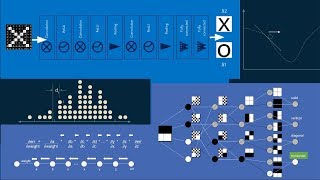
so here's the model that we build in this first pass example we go for just good enough to get the job done this isn't fancy this is definitely not pushing any limits of performance or challenging any of the leaderboard winners but it is enough to illustrate the operation and the concepts of a convolutional neural network so you can see we start with a layer that has our data feed it into a convolution block and then another block that finds a bias term often that's combined with the convolution block but in cottonwood those are two separate operations they don't lose anything from being separated and it lets us be more explicit about whether or not we're including it then a non-linear activation function which in this case is hyperbolic tangent then another convolution layer another bias layer another hyperbolic tangent and then a max pooling layer which shrinks that image down flattens it and then going through a linear layer so a standard dense neural network layer is a linear plus a bias plus a nonlinear activation function in this case we use logistic because it goes to gives you something between 0 and 1 which is a nice way to match then with the original data the original data goes through a one hot representation so instead of having a single label you have an array of size 10 one for each of the different classes and then depending on what label that is that element gets a one the rest of them are zeros the prediction then is also ten elements between zero and one that get compared to that one hot representation and those two get compared in the loss function which then turns around and back propagates that loss the prediction also gets fed to a hard maximum function which says hey of all of my guesses which one is the largest if i had to choose a single class for this example that's the class i would assign it to so that lets us then compare the predicted label to the actual label we'll go through in much more detail each of these pieces but here's the overall structure of the approach that we use
Original Description
Get the full course experience at https://e2eml.school/322
Put all the pieces together implementing a two dimensional convolutional neural network in Python to classify handwritten digits from the MNIST data set.
The remainder of the course dives into the implementation in detail and shows how to extend this example to the more challenging CIFAR-10 data set.
Watch on YouTube ↗
(saves to browser)
Sign in to unlock AI tutor explanation · ⚡30
Playlist
Uploads from Brandon Rohrer · Brandon Rohrer · 0 of 60
← Previous
Next →
1
 2
2
 3
3
 4
4
 5
5
 6
6
 7
7
 8
8
 9
9
 10
10
 11
11
 12
12
 13
13
 14
14
 15
15
 16
16
 17
17
 18
18
 19
19
 20
20
 21
21
 22
22
 23
23
 24
24
 25
25
 26
26
 27
27
 28
28
 29
29
 30
30
 31
31
 32
32
 33
33
 34
34
 35
35
 36
36
 37
37
 38
38
 39
39
 40
40
 41
41
 42
42
 43
43
 44
44
 45
45
 46
46
 47
47
 48
48
 49
49
 50
50
 51
51
 52
52
 53
53
 54
54
 55
55
 56
56
 57
57
 58
58
 59
59
 60
60

Robot Learning with a Biologically-Inspired Brain (BECCA)
Brandon Rohrer
BECCA talk at AGI 2011
Brandon Rohrer
Robot Learning with a Biologically-Inspired Brain (BECCA), The Sequel
Brandon Rohrer
BECCA listens to The Hobbit
Brandon Rohrer
Learning the building blocks of speech: BECCA extracts a hierarchy of audio features
Brandon Rohrer
BECCA listens for sound effects in The Hobbit
Brandon Rohrer
BECCA finds movie trailers while watching the Big Bang Theory
Brandon Rohrer
Listening for unexpected sounds: BECCA detects anomalies in audio data
Brandon Rohrer
Learning the building blocks of vision: BECCA extracts a spatio-temporal hierarchy of features
Brandon Rohrer
Watching for the unexpected: BECCA detects anomalies in video data
Brandon Rohrer
BECCA finds a stationary target
Brandon Rohrer
BECCA finds a stationary target at 3X speed
Brandon Rohrer
BECCA watches the X-men and Bruce Lee
Brandon Rohrer
BECCA plays Quidditch
Brandon Rohrer
BECCA chases a ball
Brandon Rohrer
BECCA chases a ball, part 2
Brandon Rohrer
Becca chases a ball, part 3
Brandon Rohrer
BECCA creates features from MNIST
Brandon Rohrer
How reinforcement learning works in Becca 7
Brandon Rohrer
Deep Learning Demystified
Brandon Rohrer
How Data Science Works
Brandon Rohrer
How Convolutional Neural Networks work
Brandon Rohrer
How Bayes Theorem works
Brandon Rohrer
How Deep Neural Networks Work
Brandon Rohrer
Recurrent Neural Networks (RNN) and Long Short-Term Memory (LSTM)
Brandon Rohrer
How Support Vector Machines work / How to open a black box
Brandon Rohrer
How autocorrelation works
Brandon Rohrer
Getting closer to human intelligence through robotics
Brandon Rohrer
A minimalist's guide to slicing and indexing pandas DataFrames
Brandon Rohrer
How decision trees work
Brandon Rohrer
Data scientist archetypes
Brandon Rohrer
How to use python's datetime package
Brandon Rohrer
How optimization for machine learning works, part 1
Brandon Rohrer
How optimization for machine learning works, part 2
Brandon Rohrer
How optimization for machine learning works, part 3
Brandon Rohrer
How optimization for machine learning works, part 4
Brandon Rohrer
How convolutional neural networks work, in depth
Brandon Rohrer
How to pick a machine learning model 4: Splitting the data
Brandon Rohrer
How to pick a machine learning model 3: Choosing a loss function
Brandon Rohrer
How to pick a machine learning model 2: Separating signal from noise
Brandon Rohrer
How to pick a machine learning model 1: Choosing between models
Brandon Rohrer
How to pick a machine learning model 5: Navigating assumptions
Brandon Rohrer
What do neural networks learn?
Brandon Rohrer
Interview with iRobot's Director of Data Science Angela Bassa
Brandon Rohrer
How Backpropagation Works
Brandon Rohrer
Evolutionary Powell's method: A discrete optimizer for hyperparameter optimization
Brandon Rohrer
1D convolution for neural networks, part 1: Sliding dot product
Brandon Rohrer
1D convolution for neural networks, part 2: Convolution copies the kernel
Brandon Rohrer
1D convolution for neural networks, part 3: Sliding dot product equations longhand
Brandon Rohrer
1D convolution for neural networks, part 4: Convolution equation
Brandon Rohrer
1D convolution for neural networks, part 5: Backpropagation
Brandon Rohrer
1D convolution for neural networks, part 6: Input gradient
Brandon Rohrer
1D convolution for neural networks, part 7: Weight gradient
Brandon Rohrer
1D convolution for neural networks, part 8: Padding
Brandon Rohrer
1D convolution for neural networks, part 9: Stride
Brandon Rohrer
The Four Grand Challenges of Robots in the Home
Brandon Rohrer
How Convolution Works
Brandon Rohrer
The Softmax neural network layer
Brandon Rohrer
Batch normalization
Brandon Rohrer
Getting ready to learn Python, Mac edition #1: Files and directories
Brandon Rohrer
More on: Supervised Learning
View skill →






Related Reads
📰
📰
📰
📰
Help Choosing Neural Network Architecture for Matrix Classification
Reddit r/deeplearning
How to Choose the Best Deep Learning Model for Medical Imaging
Medium · Deep Learning
Another Way to Read Neural Geometry
Medium · Data Science
Another Way to Read Neural Geometry
Medium · Deep Learning
🎓
Tutor Explanation
 DeepCamp AI