Early Indicators of the Effect of the Global Shift to Remote Work on People with Disabilities
Key Takeaways
The video discusses the impact of the global shift to remote work on people with disabilities, highlighting the need for inclusive design in remote collaboration technologies, with a focus on Microsoft Research's study on early indicators of this effect.
Full Transcript
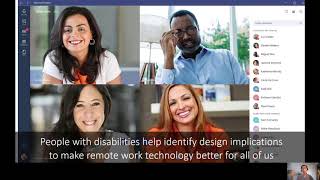
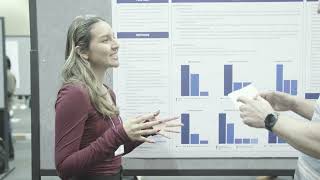
hi my name is john tong and i'm going to talk about early indicators of the effect of the global shift to remote work on people with disabilities i'm a member of the ability research team and our group explores how to make technology accessible to people of all abilities so my position is that people with disabilities are the extreme users that can help us design remote collaboration technologies that are better for everyone and the way we explore this is a study uh that involved 25 interviews of people with disabilities who regularly tell it work that is at least weekly and this happened even before the pandemic response but since the interviews occurred in march and april of 2020 and all the participants were in the united states it occurred during the first month of the pandemic response and so it gave us an early indication of what their reaction was like it's a qualitative study so the data could be used to explore other areas of interest but this chart shows the distribution of folks that we talk to people who are blind or low vision with limited mobility or dexterity people are neurodiverse or deaf or hard of hearing and those with chronic health issues and so you see there's a spread of people of various abilities that we heard from during the interviews so i want to share just one example from our findings um i encourage you to look at the paper for more details but that's the question of not sharing video when you're in a meeting so people with disabilities have a range of reasons why they choose not to share video while they're in a meeting the first quote talks about uh someone who is blind in low vision who obviously being visually impaired the camera doesn't mean very much to them and so they don't turn on their video or maybe even call in on the phone typically and the second quote talks about someone who's neurodiverse who says you know they have to be in the right frame of mind to be able to focus on video in a meeting people who are neurodiverse often need to manage their cognitive effort that they're expending in a meeting and so may choose to not turn on their video even cover the video window so they don't have to spend the effort to manage what's going on now but the thing to point out is that when you turn off your video the digital representation in our remote collaboration tools goes to something like this where if you have a profile picture maybe you would show that picture but otherwise you have a static blank screen and if you don't have a picture maybe you'd only show these generic initials or if you're calling in on the phone you get this very generic phone icon and so this representation of people who don't share their videos in online meetings is a very static and could be interpreted as being not very engaged in the meeting and that creates kind of a barrier that they need to overcome in participating in the meeting especially after the pandemic response where there was more social pressure to turn on video uh this first comment that talks about people wanting to uh have video and so you have to be camera ready more and the second quote talks about you know being on teams meetings everyone wants that human connection so there's an ask that we should all have our video on even though for this person who's blind or low vision that's not what they would normally do so the design and locations is maybe we can create more engaging avatars for when people choose not to share their video so perhaps we could augment like an audio representation that way that we're familiar with on radio programs or other audio editing tools and use the camera as a sensor to perhaps detect uh the emotional expression that's going on and use that to modify the audio signal so that you get a more dynamic and lively and engaging representation of participation even when not sharing the video or there are other sensor driven avatars some of you may remember avatar connect back in 2012 and a recent startup has come up with something called lumi live which has these avatars that mask what's going on behind the scenes and present an image of being fully engaged and meeting i think now that we're all working from home we can relate to these scenarios where things may be going on in the background that we don't really want to share with our collaborators but we do want to stay fully engaged in the conversation and so i hope this shows you some example of how people with disabilities can help identify design implications to make remote work technology better for all of us thank you
Original Description
This video accompanies my accepted paper for the New Future of Work Symposium 2020. The paper is entitled "Early Indicators of the Effect of the Global Shift to Remote Work on People with Disabilities." You can read my full paper at http://aka.ms/nfw2020.
See more at https://www.microsoft.com/en-us/research/video/early-indicators-of-the-effect-of-the-global-shift-to-remote-work-on-people-with-disabilities-2/
Watch on YouTube ↗
(saves to browser)
Sign in to unlock AI tutor explanation · ⚡30
Playlist
Uploads from Microsoft Research · Microsoft Research · 5 of 60
1
 2
2
 3
3
 4
4
 ▶
▶
 6
6
 7
7
 8
8
 9
9
 10
10
 11
11
 12
12
 13
13
 14
14
![Microsoft Urban Futures Summer Workshop | Data Driven Urban Transformation [Day 1]](https://i.ytimg.com/vi/-5Cx8cUQRfY/mqdefault.jpg) 15
15
![Microsoft Urban Futures Summer Workshop | Sensors and Data [Day 2]](https://i.ytimg.com/vi/Q5HBThuj4bY/mqdefault.jpg) 16
16
![Microsoft Urban Futures Summer Workshop | Policy and Social Impact [Day 3]](https://i.ytimg.com/vi/zMmsXTcuYlQ/mqdefault.jpg) 17
17
 18
18
 19
19
 20
20
 21
21
 22
22
 23
23
 24
24
 25
25
 26
26
 27
27
 28
28
 29
29
 30
30
 31
31
 32
32
 33
33
 34
34
 35
35
 36
36
 37
37
 38
38
 39
39
 40
40
 41
41
 42
42
 43
43
 44
44
 45
45
 46
46
 47
47
 48
48
 49
49
 50
50
 51
51
 52
52
 53
53
 54
54
 55
55
 56
56
 57
57
 58
58
 59
59
 60
60

Frontiers in ML: Learning from Limited Labeled Data: Challenges and Opportunities for NLP
Microsoft Research
Frontiers in Machine Learning: Climate Impact of Machine Learning
Microsoft Research
Frontiers in Machine Learning: Security and Machine Learning
Microsoft Research
Hope Speech and Help Speech: Surfacing Positivity Amidst Hate
Microsoft Research
Early Indicators of the Effect of the Global Shift to Remote Work on People with Disabilities
Microsoft Research
Remote Work and Well-Being
Microsoft Research
Challenges and Gratitude of Software Developers During COVID-19 Working From Home
Microsoft Research
Towards a Practical Virtual Office for Mobile Knowledge Workers
Microsoft Research
Impact of COVID-19 crisis on the future of work in India
Microsoft Research
Empowering and Supporting Remote Software Development Team Members through a Culture of Allyship
Microsoft Research
How Work From Home Affects Collaboration: Information Workers in a Natural Experiment During COVID19
Microsoft Research
Phong Surface: Efficient 3D Model Fitting using Lifted Optimization
Microsoft Research
Managing Tasks Across the Work-Life Boundary: Opportunities, Challenges, and Directions
Microsoft Research
Microsoft Urban Futures Summer Workshop | Data Driven Urban Transformation [Day 1]
Microsoft Research
Microsoft Urban Futures Summer Workshop | Sensors and Data [Day 2]
Microsoft Research
Microsoft Urban Futures Summer Workshop | Policy and Social Impact [Day 3]
Microsoft Research
Directions in ML: Algorithmic foundations of neural architecture search
Microsoft Research
MineRL Competition 2020
Microsoft Research
Can we make better software by using ML and AI techniques? With Chandra Maddila and Chetan Bansal
Microsoft Research
From Paper to Product
Microsoft Research
SkinnerDB: Regret Bounded Query Evaluation using RL
Microsoft Research
From SqueezeNet to SqueezeBERT: Developing Efficient Deep Neural Networks
Microsoft Research
Programming with Proofs for High-assurance Software
Microsoft Research
Platform for Situated Intelligence Overview
Microsoft Research
Directional Sources & Listeners in Interactive Sound Propagation using Reciprocal Wave Field Coding
Microsoft Research
Galactic Bell Star Music Demo
Microsoft Research
Importing Animations in Microsoft Expressive Pixels (9 of 9)
Microsoft Research
Welcome to Microsoft Expressive Pixels (1 of 9)
Microsoft Research
Getting Started with Microsoft Expressive Pixels (2 of 9)
Microsoft Research
Creating an Image in Microsoft Expressive Pixels (3 of 9)
Microsoft Research
Creating Animations in Microsoft Expressive Pixels (4 of 9)
Microsoft Research
Managing Animation Galleries in Microsoft Expressive Pixels (5 of 9)
Microsoft Research
Creating Fragments in Microsoft Expressive Pixels (6 of 9)
Microsoft Research
Using Layers in Microsoft Expressive Pixels (7 of 9)
Microsoft Research
Exporting Animations with Microsoft Expressive Pixels (8 of 9)
Microsoft Research
What Kind of Computation is Human Cognition? A Brief History of Thought (Episode 2/2)
Microsoft Research
What Kind of Computation is Human Cognition? A Brief History of Thought (Episode 1/2)
Microsoft Research
Planeverb: Interactive sound propagation for dynamic scenes using 2D wave simulation
Microsoft Research
Making cryptography accessible, efficient, and scalable with Dr. Divya Gupta and Dr. Rahul Sharma
Microsoft Research
Beyond the mega-data center: networking multi-data center regions (SIGCOMM 2020 Talk)
Microsoft Research
Optics for the cloud – Light at the end of the tunnel? (SIGCOMM 2020 Workshop)
Microsoft Research
Beyond the mega-data center: networking multi-data center regions (SIGCOMM 2020 short talk)
Microsoft Research
Sirius: A Flat Datacenter Network with Nanosecond Optical Switching (SIGCOMM 2020 short talk)
Microsoft Research
Novel Image Captioning
Microsoft Research
Forest Sound Scene Simulation and Bird Localization with Distributed Microphone Arrays
Microsoft Research
Decoding Music Attention from “EEG headphones”: a User-friendly Auditory Brain-computer Interface
Microsoft Research
How does holographic storage work?
Microsoft Research
The physics of hologram formation in iron doped lithium niobate
Microsoft Research
Introduction to coax: A Modular RL Package
Microsoft Research
Directions in ML: "Neural architecture search: Coming of age"
Microsoft Research
Microsoft Research AI Breakthroughs 2020: 20 minute research talks + Q&A panel
Microsoft Research
Fireside Chat with Johannes Gehrke during Microsoft Research AI Breakthroughs 2020
Microsoft Research
Fireside Chat with Susan Dumais during Microsoft Research AI Breakthroughs 2020
Microsoft Research
Microsoft Research AI Breakthroughs 2020: 20 minute research talks, Q&A panel, and event wrap-up
Microsoft Research
Clinical Research with FHIR
Microsoft Research
Soundscape Street Preview
Microsoft Research
Tilt-Responsive Techniques for Digital Drawing Boards
Microsoft Research
SurfaceFleet: Exploring Distributed Interactions Unbounded from Device, Application, User, and Time
Microsoft Research
Haptic PIVOT: On-Demand Handhelds in VR
Microsoft Research
SurfaceFleet Supplemental Video Demonstration (UIST 2020)
Microsoft Research
More on: Research Methods
View skill →




Related AI Lessons
⚡
⚡
⚡
⚡
I Spent Weeks Looking for a Research Gap Before I Realized I Was Searching the Wrong Way
Medium · AI
ICMI 2026 Reviews [D]
Reddit r/MachineLearning
Workshop submission for main conference paper under review [D]
Reddit r/MachineLearning
Kept context-switching between arxiv, OpenReview, GitHub, and HuggingFace for every paper, so I built this. Chrome extension + website with everything inline, plus citation graph + SPECTER2 neighbors. 3M papers, free, feedback welcome [P]
Reddit r/MachineLearning
🎓
Tutor Explanation
 DeepCamp AI