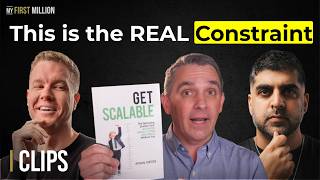
Avoid These Common Scaling Mistakes & Make Millions | Ryan Deiss
Skills:
PM Basics80%
Key Takeaways
Discusses common scaling mistakes made by CEOs and entrepreneurs, and how to avoid them by identifying constraints and building systems
Full Transcript
Let's first kind of talk about like the hiring com component because that is one of the things that I see entrepreneurs as they're scaling screw up and they they t they make one of two really big mistakes. Um the first is they hire helpers or they want to try to hire somebody just like them and like it's these two opposite ends. It's like so they they either try to hire a bunch of helpers to just do the stuff that that they don't want to do. Um or they're like a if only I could hire somebody just like me. if I could hire like a quote unquote integrator. That is one of the biggest lies ever perpetrated on the entrepreneurial community is this concept of I as the visionary snowflake can just hire this like one magical integrator who'll just do all the crap that I don't want to do. It just does not freaking work. It makes for a very good book. It just doesn't work ever in practice. So, it's not about you changing necessarily. What it's about you doing is getting really good at identifying what is the single biggest constraint right now in my business right what is that right now in my business today for us to grow to the next level and it's never ideas and this is the thing as as entrepreneurs as business owners what we do in the beginning what what gets us going is I got an idea and and so like that's the freaking hammer that that that we take to every single nail because I got a new idea and the last thing at some point that your business needs is another new idea. It doesn't need another new thing to implement. What it needs to figure out is what is the thing that is holding us back from the level you know of growth that you need. So the the first shift that needs to happen is shifting from I got an idea to shifting from con to constraint identification. Once you have shifted from idea generation to constraint identification then the answer becomes okay what's the best way to solve for this constraint and it's almost always system and people related but it's almost never hire a bunch of helpers because when you hire helpers what you actually did is you gave yourself a new job called management which is even harder or let me hire somebody just like me because somebody just like you done doesn't work want to work for you what you need to typically do is realize realize that that constraint is solved by a functional leader. And so what you need to get good at is hiring very very very good and talented functional leaders. So head of sales, head of marketing, head of product. And this is the thing that most entrepreneurs aren't as good at as they're scaling. They're good at hiring a bunch of little helpers. They think they're good at hiring a quote unquote COO, although nobody actually knows what that is. If you can get really good at hiring a functional leader and building a team of those, now team leadership becomes a lot easier when you have really when you have three or four actually talented skilled people working for you. They have massive capacity because they'll build the teams under them to execute all your ideas. >> Sean, two years ago, you were like, I just hired this I think I think you said I just hired this VP of marketing or CM I forget exactly. It was a marketing position. I forget the title. And you're like, what was it? Was it a CMO? and you were like, "Why didn't I do this sooner?" And I remember thinking, "Oh man, you found a winner." Like that's like the the highest leverage thing that we can do is just like find winners and it's so challenging. But I remember you like talked about finding this this this person and your like frame was broken. >> Yeah. There's a new test for is this person a good hireer or not? uh which is you basically you switch from uh I I wish this would happen or I hope this would happen or I want this to happen to basically fear that uh will this person leave because oh my god this person is so good and they are like they're so transformative to the business and I just don't have to worry about that if they ever left I would have to worry about that area of the business again. Uh I think we had John Morgan on last last week and he has this phrase called send and delete people. He's like, "There's people in your company that you could just send them the email, you can forward them the email, and then you can delete the email cuz you know it's going to get handled." And um you know, Brian, this thing you just said is is so true. I I actually was talking about this last week about helpers. I was like talking to somebody on my team. I was like, "Are you going to be a helper?" Like, so far this has worked because I needed you as my helper, but now I'm asking you to drive, but you still are acting like a helper. And like, [clears throat] but you want to be a driver and we need a driver, so like it's time to be a driver. Now whether that person can can make that adjustment or not I think is is is always just about that person and their their own kind of goals and self-improvement and self-development their their self-image. But uh it's so true that it's very very tempting to hire other just kind of entrepreneurial people like me. Great. Now I got another sort of like shiny object syndrome idea guy in the room that doesn't help. Or I got a helper who as long as I'm directing everything, they help me get stuff done. But that means I always have to keep my eye on that area because I'm the one coming up with the plan. and I'm the one driving the execution and they're just, you know, there to help. So, I've I've definitely felt this problem firsthand. >> The the biggest mistake that people make when they when they map their their business process maps is they will map what they wish were true instead of mapping what actually is. And and so you have to map what actually is happening today, not like well what we should be doing is this. Like that's generally unhelpful. You need to see all of those as points of future optimization because we've got to get a picture of what it is today because that's what's going to inform what are all of the people actually doing or what should they be doing? Um what are the metrics that that we do need to track. The other kind of thing that you want to make sure that you're doing is that you are starting from the audit of those value engines. So you you you don't want to just say I'm going to build out my scorecard cuz that looks cool. Okay. But what are the metrics that you're picking? Because if the metrics don't that that you're tracking, if they don't all link back to a step or stage, you know, on one of those business process maps, then you could very well be tracking something that doesn't matter. I'll give you an example. When we rolled out our scorecards to our team, we had somebody on at at our company who was like, "Hey, we don't currently have any metrics for this was at at uh at digital marketer, one of our companies. We don't we don't currently have any metrics for our email newsletter. Why don't we have that?" I was like, "Well, where where show me where the show me where the newsletter feeds into anything?" like, "Oh, well, you know, it's it's good for awareness and engagement of the list." I'm like, "Okay, but how does it drive into anything?" And the answer was it didn't because the newsletter didn't show up as a sticky note on any of our growth engine because at no point in the newsletter did we ever link off to anything that was meaningful. It never showed up. It never wound up as a sticky note on anything. Like that's that's why it never showed up on on one of our, you know, growth engines, which is why it never showed up on the scorecard. We're not tracking the metrics. So I had to say to the person like look if you can show us where this actually has an impact on one of our uh you know on on our growth engine then then you'll get some metrics to track and until then you won't and if you don't then we're going to stop doing it completely. There's so many orphaned activities that companies are doing that it's because you're doing things that don't have a a sticky note that's represented anywhere. And so that's the other kind of mistake I'd say that people are making. >> I think I read somewhere that someone said like I think it was Jason Lumpkin. He was like, "If you get to a 10 million in revenue, it's you 100% your business can 100% get to 100 million in revenue." Do you think that what stops people from growing from 10 to 100 million or whatever this arbitrary um like it's kind of working to it's a huge home run is like being better operators like being systemized and things like this. >> Yeah, it's almost always systems at the at the end of the day. I think it happens earlier like really this swamp of scale happens at kind of 4 to 6 million. That's no man's land. That's when you probably need three people that you absolutely can't possibly afford, right? There's like three, you know, VP level kind of roles that that you can't afford yet, but if you could get them, they would take you up to 20 million. At that point, you would have the the margin, you would have the cash flow to be able to get the rest of the people to then be able to scale to the next level. And the only way that you can bridge that gap is through systems. You're not going to be able to bridge it through through just brute force through just chewing rocks. Like that's what's going to get you from a million to two million. Like you said, maybe for for really, you know, motivated people up to 7 8 10, but it is not going to get you beyond that. You're going to have to get really really really talented people. And really talented people are expensive. And the only way you're going to be able to create that margin is through systems. Also, really talented people want to work for good companies. One of my like least favorite pieces of advice is like, "Oh, just go hire talented people." That's like saying to like your sad, lonely, pathetic friend, just like, "Oh, just only date tens." [laughter] That's not helpful. You have to become the kind of person that a 10 would want to date. And it's the same if you want to attract talent at as a business. You have to become the kind of business that a players want to come and work for. It's why I say like my goal is not to hire like rock stars and a players. My my my goal is to build a company that doesn't require them because I know that that's the kind of company that rockstars and a players want to come and work for. So that happens through better systems. If you can put those in place, then great people want to come and work there. It's it's why you know big companies get even bigger. >> Is the company of um selling this like license of of scalable of the scalability company is that going to be the best business that you've ever founded? I mean, is it it's sort of going to be like EOS? I heard EOS, which is like, you know, an operational framework. I heard that company sold for like I think $90 million. >> Yeah, it won't be from that perspective because we we talked about doing the licensed practitioner model with it. We don't want to. So, our model is when when we work with clients, we do it all internally. And so, we're somewhat limited in terms of what we can do. But that's because again for us this is us getting paid to do due diligence because we want to basically have access to the deal flow. And so if we were to license our model to other kind of coaches and consultants like EOS did it would be a simpler business. It would arguably be more scalable but we would lose out on all the deal flow. And so we talked about it but we don't do it. So on um on one hand I mean scalable this year is going to do just right at about $10 million in revenue which is good and it's really good healthy margins but what we generate from the deal flow is way better than that. There's there's one deal that we're going to have that we got from it that it won't happen this year but it should be this next year. $300 million company. It's not we're not going to get 20% of it. We it'll be a much smaller percentage of that with a baseline. But if this business winds up going public in a couple of years, let's just say that's that's a couple EOS's for me. >> Dude, this is why you're fascinating to me when you I think that when you have like I think Sean uses this phrase generative. Uh I use the phrase prolific. You've been like doing stuff for like 30 or 20 years now. >> Yeah. No. And look, a lot of it's just being old, having done having been around for, you know, for 20 plus for 20 plus years and being and being in the being in the game for a long time. And that's why I tell people like so much of this is is is is patience and and just allowing, you know, just getting in the stuff and doing it. I mean, again, the first thing that I sold online was an ebook on how to make your own baby food for $14. So, your first thing does not have to be, I went out there, I had an idea, I flew out to San Francisco, I got, you know, it was in the YC batch and, you know, next thing you know, I'm a a billionaire. Like, that's not how it it has to be. It's not how it is for most people. It can start pretty humbly.
Original Description
Get Sam and Shaan's hard-won CEO lessons in one guide: https://clickhubspot.com/41da31
In this clip Shaan and Sam talk to Ryan Deiss about the most common mistakes CEOs and Entrepreneurs make while scaling their businesses.
Watch the Full Episode: https://www.youtube.com/watch?v=kEK5CZy17Ng
Shownotes: https://www.mfmpod.com/videos/how-to-build-systems-so-your-business-runs-without-you/
—
Check Out Shaan's Stuff:
* Follow Shaan on X - https://x.com/ShaanVP
* Shaan's weekly email - https://www.shaanpuri.com
* Visit https://www.somewhere.com/mfm to hire worldwide talent like Shaan and get $500 off for being an MFM listener. Hire developers, assistants, marketing pros, sales teams and more for 80% less than US equivalents.
* Mercury - Need a bank for your company? Go check out Mercury (mercury.com). Shaan uses it for all of his companies!
Mercury is a financial technology company, not an FDIC-insured bank. Banking services provided by Choice Financial Group, Column, N.A., and Evolve Bank & Trust, Members FDIC
* I run all my newsletters on Beehiiv and you should too + we're giving away $10k to our favorite newsletter, check it out:
beehiiv.com/mfm-challenge
—
Check Out Sam's Stuff:
* Follow Sam on X - https://x.com/theSamParr
* Hampton - https://www.joinhampton.com/
* Ideation Bootcamp - https://www.ideationbootcamp.co/
* Copy That - https://copythat.com
* Hampton Wealth Survey - https://joinhampton.com/wealth
* Sam’s List - http://samslist.co/
My First Million is a HubSpot Original Podcast // Brought to you by HubSpot Media // Production by Arie Desormeaux // Editing by Ezra Bakker Trupiano
Watch on YouTube ↗
(saves to browser)
Sign in to unlock AI tutor explanation · ⚡30
Playlist
Uploads from My First Million Clips Official · My First Million Clips Official · 59 of 60
1
 2
2
 3
3
 4
4
 5
5
 6
6
 7
7
 8
8
 9
9
 10
10
 11
11
 12
12
 13
13
 14
14
 15
15
 16
16
 17
17
 18
18
 19
19
 20
20
 21
21
 22
22
 23
23
 24
24
 25
25
 26
26
 27
27
 28
28
 29
29
 30
30
 31
31
 32
32
 33
33
 34
34
 35
35
 36
36
 37
37
 38
38
 39
39
 40
40
 41
41
 42
42
 43
43
 44
44
 45
45
 46
46
 47
47
 48
48
 49
49
 50
50
 51
51
 52
52
 53
53
 54
54
 55
55
 56
56
 57
57
 58
58
 ▶
▶
 60
60

"More, Better, New" Method for Scaling Ads | Alex Hormozi
My First Million Clips Official
"All my customers come from referrals - how do I get leads?" | Alex Hormozi
My First Million Clips Official
The Truth About Growing on Youtube | Alex Hormozi & My First Million
My First Million Clips Official
"Why don't leads from organic content convert?" | Alex Hormozi
My First Million Clips Official
"I have no idea what to sell my huge audience" | My First Million
My First Million Clips Official
Make Millions in Any Business with Hormozi's 4 Money Models | My First Million
My First Million Clips Official
Alex Hormozi Builds My Business a $100M Money Model | My First Million
My First Million Clips Official
How to Vibe Code a Billion Dollar Startup | My First Million
My First Million Clips Official
“I rick rolled Sam Altman and got funded” - Replit Founder
My First Million Clips Official
Don't Chase Your Passion, Do This Instead | Scott Galloway
My First Million Clips Official
It's Boring, But I'll Make You a Millionaire | Scott Galloway
My First Million Clips Official
The Two Businesses I'd Start in 2026 to Make Millions
My First Million Clips Official
The Dark Truth About Work Life Balance | Scott Galloway
My First Million Clips Official
Palantir co-founder - This is What Separates the Top 1% Performers
My First Million Clips Official
Scott Galloway's Stoic Advice for Founders & Entrepreneurs | My First Million
My First Million Clips Official
The Truth About Prediction Markets | My First Million
My First Million Clips Official
The Next AI Business Trend is Weirder Than You Think | My First Million
My First Million Clips Official
Are Podcasts Just Clip Farms Now? | My First Million
My First Million Clips Official
Tony Robbins: In Life You're Rewarded For THIS
My First Million Clips Official
What's Replacing the Alcohol Industry? | My First Million
My First Million Clips Official
What Chocolate CEOs Said to Mr Beast That Changed Everything
My First Million Clips Official
Mr Beast's Insane"Rule of 100" Process for Viral Ideas
My First Million Clips Official
How Mr Beast Makes Millions By Cloning Himself
My First Million Clips Official
Mr Beast's Brutal Business Lessons
My First Million Clips Official
India’s Warren Buffet Shares $1M Investing Strategy | Mohnish Pabrai
My First Million Clips Official
How to Pick 100X Stocks Like Warren Buffet | My First Million
My First Million Clips Official
India's Warren Buffet Shares All You Need to Know About Investing
My First Million Clips Official
3 Tells Your Teen Will Be A Millionaire | Mohnish Pabrai
My First Million Clips Official
Why The Best Entrepreneurs HATE Risk | Mohnish Pabrai
My First Million Clips Official
The #1 Trait That Makes Fantastic Investors | Mohnish Pabrai
My First Million Clips Official
Warren Buffet's Advice for Entrepreneurs Becoming Investors | Mohnish Pabrai
My First Million
If You Have No Customers & No Revenue You Need This | My First Million
My First Million
What to Ask Your Early Customers for Hyper Growth | My First Million
My First Million
People Are Making Billions Investing in Little Caesar's
My First Million Clips Official
How to Make So Much Money Your Accountant Asks Questions | My First Million
My First Million
These Simple Tactics Compound to Millions | My First Million
My First Million
Becoming Rich is Just the First Step | Scott Galloway
My First Million
Why I'm Selling American Stocks | Scott Galloway
My First Million
How to Become a Great Communicator | Scott Galloway
My First Million
Do This With Money to 10X Your Quality of Life | Scott Galloway
My First Million Clips Official
Unfair Life Advice I'm Teaching My Sons | Scott Galloway
My First Million Clips Official
The Truth About "Think and Grow Rich" | My First Million
My First Million Clips Official
Watch These 12 Minutes to Understand OpenClaw
My First Million Clips Official
Why the Self-Help Industry Is Built on Lies | My First Million
My First Million Clips Official
How to Stop Letting Money Run Your Life | Tim Ferriss
My First Million Clips Official
A Blueprint to Become More Adventerous & Creative | Tim Ferriss
My First Million Clips Official
How to Write Seriously Well | Tim Ferriss
My First Million Clips Official
How to Avoid Money Traps & Get What You Want in Life | Tim Ferriss
My First Million Clips Official
Why Your Greatest Strengths Create Your Weaknesses | Tim Ferriss
My First Million Clips Official
FBI Negotiator: The 5 Steps to a Win-Win Business Negotiation | Christopher Voss
My First Million Clips Official
FBI Negotiator: "Avoid the Most Common Negotiation Mistakes" | Christopher Voss
My First Million Clips Official
FBI Negotiator: How to Prepare for Any Negotiation in Life | Christopher Voss
My First Million Clips Official
Master Your Mind & Watch What Happens | Robert Greene
My First Million Clips Official
How to Discover Who You Really Are | Robert Greene
My First Million Clips Official
Be a Master of Silence & Gain Immense Power | Robert Greene
My First Million Clips Official
What 50 Cent Taught Me About Power & Courage | Robert Greene
My First Million Clips Official
Robert Greene Teaches the Laws of Power & Art of Seduction
My First Million Clips Official
The More Valuable You Are The Worse Your Business Is | Ryan Deiss
My First Million Clips Official
Avoid These Common Scaling Mistakes & Make Millions | Ryan Deiss
My First Million Clips Official
Legendary Investor - How To Escape a Career You Hate | Bill Gurley
My First Million Clips Official
More on: PM Basics
View skill →




Related Reads
📰
📰
📰
📰
Claude vs ChatGPT for Copywriting: I Tested Both with 10 Real Prompts
Medium · ChatGPT
Mastering the Art of Writing: Effective Techniques for Freelance Writers
Dev.to AI
Your site gets six words to convince me. It just used five of them to say nothing.
Medium · SEO
5 Copywriting Tricks Hidden Inside Warren Buffett’s Shareholder Letters
Medium · Programming
🎓
Tutor Explanation

 DeepCamp AI