How to Pick 100X Stocks Like Warren Buffet | My First Million
Skills:
AI Trend Analysis60%
Key Takeaways
Warren Buffett's value investing strategy and methods for spotting great investment opportunities, including using Moody's manual and Value Investors Club, are discussed by Mohnish Pabrai with Shaan Puri.
Full Transcript
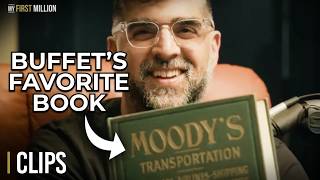
How do I even know where to look? And so is what is that process for you? Do you take do you pick one industry and look at a 100 companies in it? Do you read books on 50 industries? Do you look at what other investors are doing and try to reverse engineer? Like where do you even know where to look? >> I'm going to lay it out for you. [laughter] It's going to be so easy. But but it takes a certain temperament. >> Okay? >> So first I want to talk about the temperament. Okay? So if we go back to Warren Buffett when he was a teenager, he used to go to the racetrack in Omaha. And one of the things he did at the racetrack, he was like 14 years old or something, is after all the races had been done, he'd pick up all the tickets that people had left, thrown on the ground, right? These are mostly losing tickets, right? They just kind of toss them from the garbage cans. He'd pull them all out. Then he'd go home and one by one look at every ticket. He would find now sometimes a horse would come in second and the ticket was for win or place. It was actually a winning ticket but they didn't understand they were drunk or whatever. >> So he'd always find a bunch of tickets which were actually in the money >> but they had been discarded. >> So now he was underage. He couldn't go to the counter to collect the money. So he gave it all to his aunt Alice, his favorite aunt. She used to go to the counter, collect the money and give it to him. Okay. So when Warren when Warren became older let's say when he was let's say 24 or 25 years old he went through the Moody's manual and what he was doing with the Moody's manual and you know uh for nostalgia I bought these on eBay and I want you to see the Moody's manual. Okay. >> So so this is Buffett was 23 years old. >> This was his nighttime casual reading. This was his. So what he did now with the Moody's manual, they were there were a number of these that came out. So like in the year 1953, this is just railroads, airlines, shipping, traction, brass, and truck. >> I don't even know what this is. Is this the earnings reports of >> So this is the value line of that day. >> Okay. >> Okay. So if you if I open the Moody's manual to any random page, okay, what what it's doing is it's got like um two or three companies per page. You can see how fine the print is. >> Yeah. >> Okay. All right. >> It needs like a magnifying glass. >> And it's basically giving you a summary of every company. All right. Now, Buffett went through. Now, this is just one of them in 1953. For 1953, there were probably about seven or eight of these books that came out in 53. Similar number in 54, 55, so on. So, you're talking about a big stack of these, right? He went through the these books two or three times. He went through what he did is he read each one page by page, right? And he was looking what he was looking for he was looking for anomalies. So he used to host these MBA students and actually he brought he brought for them printouts from the Moody's manual to the ones that he made an investment in. So he would find something like Western Insurance for example where the stock price was 15 and the earnings last year were 25. Okay. The stock is $15 a share, earnings at $25 a share. Book value is $80 a share, >> right? >> Okay. That's what we call an anomaly, right? Hitting you by the head head with a 2x4. Makes no sense, right? He would make a list of all these companies which made no sense in the positive direction. Okay? And then he'd study them and then he would make investments. Right? Now, in order for Warren to find Western insurance, he would he might have had to spend 14 hours a day, okay, nonstop reading these for 3 months before he finds one or two of them. but he only needs very few of them. And Warren's mind uh you know he's he's a prodigy. So his mind was programmed to have this intense the the work never bothered him just like no other teenagers were going and collecting all those tickets on the floor and then going through each one with the optimism that I am going to find something that is basically a free lunch. Right. Right. And so he went through the Moody's manual and basically started finding the anomalies and then started making investments in them and did well etc. Now we have a shortcut you know because I know that your listeners are not going to do what Buffett did. [laughter] Okay. I cannot do what Buffett did. I do not have the wherewithal and the ferocious uh intensity that Warren does. Almost no one does. I think that he's just a extreme anomaly on that front. So for example, there's a website called value investors club. >> Okay. Now if you go to value investors club, it's free. You don't have to pay anything. Whatever. If you give them your email, you can see all ideas that are 60 days or older. Okay? It's very difficult to become a member of value investors club posting ideas. So it's like a curated website, >> right? Okay, the members have to submit two ideas a year which get a decent rating in order to keep their membership. So you have what I have found is the value investors club has a lot of brain power. It has brain power coming out of the ears. Okay, it's all free. So all someone has to do is sit down and read the writeups on value investors club. So there may be I don't know 6 or 700 800 writeups maybe 500 writeups in a year. Each writeup may be around 10 15 pages max. Then there's comments and whatever. But what I'm saying is that >> uh it's much easier than the Moody's manual because someone is actually digesting the information for you >> and you could do one of those a day. >> You could easily do one of one of those a day is pathetic. >> I'm saying even but even you said if there's 300 total. >> Yeah. But I'm just saying it would be easy for someone >> without getting putting too much work into it to read four or five ideas a day. >> I mean, they could have a full-time job and easily do that. That's not a difficult thing to do. And you don't need to read the whole idea. What I would say is you read >> the first few paragraphs and see if this is something that's interesting you or not or something that's grabbing you or not. Right? And what I do is I look at every idea that's posted, right? And I don't I don't care to really look at them right when they're posted because they actually uh those ideas will work even 5 years from now. Uh like recently I started uh investing in a in a company where the original write up was in 2021. Okay, it's 2025 still valid. [laughter] Okay, now what you still have to do is you should use it only as an input to ideas. Just like the Moody's manual is not telling you what to buy and sell. >> Once you see the idea, you do all your own work. Do your research, do everything. Make sure it's something you understand well. Make sure it's within your circle of competence. Uh whether you buy into the idea or not, etc. And Buffett Buffett is still doing this. So his Japanese bets. So there's a there's another uh book called the Japan Company Handbook. >> Okay. >> And and I'm going to bring the Japan company handbook. [laughter] Okay. >> Okay. >> All right. Here we have it. And I'm excited about this because you hear a lot about Buffett's, you know, Seas Candy, Coke, Geico, like those kind of well-known Buffett's best bets. >> Yeah. >> But as I understand it, Buffett made some incredible investments in Japan. >> So, let me explain how no-brainer >> the total no-brainer nature of that bet, right? >> Okay. So these uh five Japanese trading companies had a 8% dividend yield. Okay. So they were paying a 8% dividend. It was very cheap. Japan has the index has not gone anywhere for like 30 years. And Warren actually um got a insane return on these. So what he did is he borrowed the entire amount in yen at half a percent a year >> and it was not a small amount. It was like 5 billion. >> Yeah. Yeah. He put 5 billion but he borrowed the 5 billion at half a percent. The whole thing >> in yen in Japan. Right. So now he's bought a Japanese company paying dividends in yen which he's bought in yen. Right. the dividend coverage is 16 times his interest payment. So he put no equity, >> right? >> And he's instantly making 7 12% on 5 billion which is like you know what about uh 350 400 million out of nothing, right? It's just coming to him. Now what happens is because these companies are so cheap in about 3 or 4 years they all doubled in price, right? So now the 5 billion has become 10 billion. Okay. The equity that went in is nothing. So it's infinite return. They all raise the dividend. The dividend based on the original purchase price is about 15%. [laughter] Okay. So basically and then after that what he did is he increased the bet. So he was he was under 5% of all of them. He's now approaching 10% on all of them. And anyone could have looked at the Japan government handbook. Basically, I think it's it's a matter of how hungry are you. It's the same as any entrepreneur, right? I mean, basically, uh, anyone who starts a business or whatever, they've they got to go all in, you know, intense passion, 18 hours a day, all in, very strong belief. It's the same thing here. If you >> truly are focused on it, you can do very well. I mean, the universe is going to conspire to help you with whatever your passion is. And it's just a matter of whether you want it. >> By the way, does he use Excel? >> Well, no, he does not use Excel for sure. Okay. He uses his computer now. Now he uses Google and all that, but he uses his computer mainly to pray bridge. I mean, Warren wouldn't be caught dead using Excel. [laughter] Okay. And um well, because the thing is that he's looking for things that hit you in the head with a 2x4, right? So, when he's going through the Japan company handbook or the Moody's manual, there is no Excel needed. What? What what will Excel help you with? When the earnings are $25 a share and the stock is $15, you don't need Excel, >> right? >> Okay. [laughter] When when the dividend deal is 8% and you're borrowing at half%, you don't need Excel, right? >> Okay. In fact, if you need Excel, it's an automatic pass because it means that there's something complicated there which is not fitting in. Did I need Excel for frontline? No, I didn't need Excel for front line. I mean I look up the liquidation price of the ships. I look up the where the ships are at. I look at all I mean the thing is all these things are very basic numbers. You don't need Excel for it, >> right? >> You know, uh recently I was talking to a friend of mine looking he's looking at some international stock exchange. Okay, this international stock exchange uh trades at a trailing PE of like 30. Okay, it's growing at 15 20% a year. Very rapid growth. Okay, 60% of revenue is profit. Okay, and as they grow that 60% might become 70%, because they got operating leverage. So if you just forward two or 3 years, the P becomes less than 10. Okay, there is no need for Excel, >> right? >> You can just do it all in your head. Okay, it's got $10 of hurings today. is going to have $12 a year from now, $14, $15 2 years from now, maybe 17 or $18 3 years from now, stocks at $30. Now, when you're at 18, you're already at a 15 multiple, right? You already cut it in half, but it's growing by that time. It may be trading, it should be trading at even more than 30 times earnings. So, the stock may be at like, you know, 6 or 700 by then, right? It's just an just just the math of all of that. So what I'm saying is that if you can't do the math in your head, it's an automatic pass >> because that means there's something complicated. So another important thing is you should be able to explain your thesis of a stock in about four or five sentences to a 10-year-old. Okay? And if you can't do that, it's a pass. You can't sit down with a 10-year-old with an Excel spreadsheet. Okay? They're not going to like you and they're not going to be interested. >> Right? >> Einstein used to say there's like four levels of intelligence. Smart, intelligent, genius, simple. [laughter] Okay. The highest level of in intellect is simplicity. >> Right? >> And the other thing about investing is that you have to have conviction. It's very difficult to have conviction if you keep needing to go back and look at your Excel model, >> right? >> You need it in your head. So Buffett never needs to go anywhere. It's in his head. He knows what the dividend yield is. He knows what he paid. He knows what the yen is. He knows all of that. It's pre-programmed.
Original Description
Get our free database with 140+ business ideas: https://clickhubspot.com/vmk
In this clip, Shaan Puri speaks with Mohnish Pabrai about the method he learned from Warren Buffet for spotting great investment opportunities.
Watch the Full Episode: https://www.youtube.com/watch?v=TN5aKByr3Rs
Show Notes: https://www.mfmpod.com/videos/asking-a-billionaire-investor-how-to-turn-10000-into-1m/
—
Check Out Shaan's Stuff:
• Shaan Puri on X - https://x.com/ShaanVP
• Shaan's weekly email - https://www.shaanpuri.com
• Visit https://www.somewhere.com/mfm to hire worldwide talent like Shaan and get $500 off for being an MFM listener. Hire developers, assistants, marketing pros, sales teams and more for 80% less than US equivalents.
• Mercury - Need a bank for your company? Go check out Mercury (mercury.com). Shaan uses it for all of his companies!
Mercury is a financial technology company, not an FDIC-insured bank. Banking services provided by Choice Financial Group, Column, N.A., and Evolve Bank & Trust, Members FDIC
• I run all my newsletters on Beehiiv and you should too + we're giving away $10k to our favorite newsletter, check it out:
beehiiv.com/mfm-challenge
—
Check Out Sam's Stuff:
• Sam Parr on X - https://x.com/theSamParr
• Hampton - https://www.joinhampton.com/
• Ideation Bootcamp - https://www.ideationbootcamp.co/
• Copy That - https://copythat.com
• Hampton Wealth Survey - https://joinhampton.com/wealth
• Sam’s List - http://samslist.co/
My First Million is a HubSpot Original Podcast // Brought to you by HubSpot Media // Production by Arie Desormeaux // Editing by Ezra Bakker Trupiano
Watch on YouTube ↗
(saves to browser)
Sign in to unlock AI tutor explanation · ⚡30
Playlist
Uploads from My First Million Clips Official · My First Million Clips Official · 26 of 60
1
 2
2
 3
3
 4
4
 5
5
 6
6
 7
7
 8
8
 9
9
 10
10
 11
11
 12
12
 13
13
 14
14
 15
15
 16
16
 17
17
 18
18
 19
19
 20
20
 21
21
 22
22
 23
23
 24
24
 25
25
 ▶
▶
 27
27
 28
28
 29
29
 30
30
 31
31
 32
32
 33
33
 34
34
 35
35
 36
36
 37
37
 38
38
 39
39
 40
40
 41
41
 42
42
 43
43
 44
44
 45
45
 46
46
 47
47
 48
48
 49
49
 50
50
 51
51
 52
52
 53
53
 54
54
 55
55
 56
56
 57
57
 58
58
 59
59
 60
60

"More, Better, New" Method for Scaling Ads | Alex Hormozi
My First Million Clips Official
"All my customers come from referrals - how do I get leads?" | Alex Hormozi
My First Million Clips Official
The Truth About Growing on Youtube | Alex Hormozi & My First Million
My First Million Clips Official
"Why don't leads from organic content convert?" | Alex Hormozi
My First Million Clips Official
"I have no idea what to sell my huge audience" | My First Million
My First Million Clips Official
Make Millions in Any Business with Hormozi's 4 Money Models | My First Million
My First Million Clips Official
Alex Hormozi Builds My Business a $100M Money Model | My First Million
My First Million Clips Official
How to Vibe Code a Billion Dollar Startup | My First Million
My First Million Clips Official
“I rick rolled Sam Altman and got funded” - Replit Founder
My First Million Clips Official
Don't Chase Your Passion, Do This Instead | Scott Galloway
My First Million Clips Official
It's Boring, But I'll Make You a Millionaire | Scott Galloway
My First Million Clips Official
The Two Businesses I'd Start in 2026 to Make Millions
My First Million Clips Official
The Dark Truth About Work Life Balance | Scott Galloway
My First Million Clips Official
Palantir co-founder - This is What Separates the Top 1% Performers
My First Million Clips Official
Scott Galloway's Stoic Advice for Founders & Entrepreneurs | My First Million
My First Million Clips Official
The Truth About Prediction Markets | My First Million
My First Million Clips Official
The Next AI Business Trend is Weirder Than You Think | My First Million
My First Million Clips Official
Are Podcasts Just Clip Farms Now? | My First Million
My First Million Clips Official
Tony Robbins: In Life You're Rewarded For THIS
My First Million Clips Official
What's Replacing the Alcohol Industry? | My First Million
My First Million Clips Official
What Chocolate CEOs Said to Mr Beast That Changed Everything
My First Million Clips Official
Mr Beast's Insane"Rule of 100" Process for Viral Ideas
My First Million Clips Official
How Mr Beast Makes Millions By Cloning Himself
My First Million Clips Official
Mr Beast's Brutal Business Lessons
My First Million Clips Official
India’s Warren Buffet Shares $1M Investing Strategy | Mohnish Pabrai
My First Million Clips Official
How to Pick 100X Stocks Like Warren Buffet | My First Million
My First Million Clips Official
India's Warren Buffet Shares All You Need to Know About Investing
My First Million Clips Official
3 Tells Your Teen Will Be A Millionaire | Mohnish Pabrai
My First Million Clips Official
Why The Best Entrepreneurs HATE Risk | Mohnish Pabrai
My First Million Clips Official
The #1 Trait That Makes Fantastic Investors | Mohnish Pabrai
My First Million Clips Official
Warren Buffet's Advice for Entrepreneurs Becoming Investors | Mohnish Pabrai
My First Million
If You Have No Customers & No Revenue You Need This | My First Million
My First Million
What to Ask Your Early Customers for Hyper Growth | My First Million
My First Million
People Are Making Billions Investing in Little Caesar's
My First Million Clips Official
How to Make So Much Money Your Accountant Asks Questions | My First Million
My First Million
These Simple Tactics Compound to Millions | My First Million
My First Million
Becoming Rich is Just the First Step | Scott Galloway
My First Million
Why I'm Selling American Stocks | Scott Galloway
My First Million
How to Become a Great Communicator | Scott Galloway
My First Million
Do This With Money to 10X Your Quality of Life | Scott Galloway
My First Million Clips Official
Unfair Life Advice I'm Teaching My Sons | Scott Galloway
My First Million Clips Official
The Truth About "Think and Grow Rich" | My First Million
My First Million Clips Official
Watch These 12 Minutes to Understand OpenClaw
My First Million Clips Official
Why the Self-Help Industry Is Built on Lies | My First Million
My First Million Clips Official
How to Stop Letting Money Run Your Life | Tim Ferriss
My First Million Clips Official
A Blueprint to Become More Adventerous & Creative | Tim Ferriss
My First Million Clips Official
How to Write Seriously Well | Tim Ferriss
My First Million Clips Official
How to Avoid Money Traps & Get What You Want in Life | Tim Ferriss
My First Million Clips Official
Why Your Greatest Strengths Create Your Weaknesses | Tim Ferriss
My First Million Clips Official
FBI Negotiator: The 5 Steps to a Win-Win Business Negotiation | Christopher Voss
My First Million Clips Official
FBI Negotiator: "Avoid the Most Common Negotiation Mistakes" | Christopher Voss
My First Million Clips Official
FBI Negotiator: How to Prepare for Any Negotiation in Life | Christopher Voss
My First Million Clips Official
Master Your Mind & Watch What Happens | Robert Greene
My First Million Clips Official
How to Discover Who You Really Are | Robert Greene
My First Million Clips Official
Be a Master of Silence & Gain Immense Power | Robert Greene
My First Million Clips Official
What 50 Cent Taught Me About Power & Courage | Robert Greene
My First Million Clips Official
Robert Greene Teaches the Laws of Power & Art of Seduction
My First Million Clips Official
The More Valuable You Are The Worse Your Business Is | Ryan Deiss
My First Million Clips Official
Avoid These Common Scaling Mistakes & Make Millions | Ryan Deiss
My First Million Clips Official
Legendary Investor - How To Escape a Career You Hate | Bill Gurley
My First Million Clips Official
More on: AI Trend Analysis
View skill →






Related Reads
📰
📰
📰
📰
AI Theatre: The Gap Between Talking About AI and Actually Using It
Medium · Cybersecurity
How to Structure Content for AI-First Indexing: 7 Rules That Get You Cited
Medium · AI
The Last Premium: What Stays Expensive When Thinking Gets Free
Medium · Data Science
Microsoft said the patches would get bigger. I measured how much bigger.
Dev.to · Erik Rekola
🎓
Tutor Explanation

 DeepCamp AI