Hydrographic Printing | Two Minute Papers #7
Skills:
Reading ML Papers80%
Key Takeaways
Explains hydrographic printing, a technique for creating colored patterns on 3D surfaces using a film, water, and chemical activator spray
Full Transcript
dear fellow scholars this is two minute papers with károly failure so many of you were sharing the previous episode for the first time I just couldn't keep up and write a kind message to every single one of you but I'm trying my best it really means a lot and again just thanks so much for sharing so delighted to see that people are coming in checking out the series and expressing that they liked it the feedback has been absolutely insane you fellow scholars seem to love the show quite a bit and it really makes my day it's also fantastic to see that there is a hunger out there for science people want to know more on what is happening inside the labs that's really amazing thank you and let us continue together on our scholarly journey 3d printing is a technique to create digital objects in real life it has come a long way in the last few years there has been excellent work done on designing deformable characters mechanical characters and characters of varying elasticity you can even scan your teeth and print copies of them and these are just a few examples of a multitude of things that you can do with 3d printing however this technology is mostly focused on the geometry itself colored patterns that people call textures still remains a challenge and we only have very rudimentary technology to do them so check this out this is going to be an immersive experience hydrographic printing on 3d surfaces is a really simple technique you place a film in water use a chemical activator spray on it and shove the object in the water so far so good however since these objects start stretching the film the technique is not very accurate it only helps you putting repetitive patterns on these objects computational hydrographic printing is a technique that simulates all of these physical forces that are exerted on the film when your desired object is immersed into the water then it creates a no image map taking all of these distortions into account and this image you can print with your home inkjet printer the results will be really accurate close to indistinguishable from the digitally designed object the technique also supports multiple emergence that helps putting textures on a non planar object with multiple sites to be colored so as you can see 3d printing is improving at a rapid pace there's tons of great research going on in this field it is a technology that is going to change the way we live our daily lives in ways that we cannot even imagine yet and what would you print with this do you have any crazy ideas let me know in the comment section and for now thanks for watching and I'll see you next time
Original Description
3D printing is a technique to create digital objects in real life. This technology is mostly focused on reproducing the digital geometry itself - colored patterns (textures) still remains a challenge, and we only have very rudimentary technology to do that.
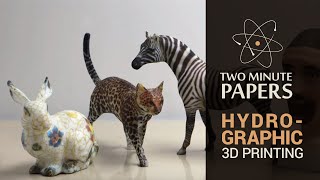
Hydrographic printing on 3D surfaces is a really simple technique: you place a film in water, use a chemical activator spray on it, and shove the object in the water.
However, since these objects start stretching the film, the technique is not very accurate, and it only helps you putting repetitive patterns on these objects.
Computational Hydrographic Printing is a technique that simulates all of these physical forces that are exerted on the film when your desired object is immersed into the water. Then, it creates a new image map taking all of these distortions into account, and this image you can print with your home inkjet printer. The results will be really accurate, close to indistinguishable from the digitally designed object.
The paper "Computational Hydrographic Printing" is available here:
http://www.cs.columbia.edu/~cxz/publications/hydrographics.pdf
Disclaimer: I was not part of this research project, I am merely providing commentary on this work.
The splash screen background was taken from "Computational Hydrographic Printing" by Zheng et al.
Splash screen/thumbnail design: Felícia Fehér - http://felicia.hu
Flickr: Wonderlane
Link: https://flic.kr/p/atCLXr
Music:
Soul Groove by Audionautix - it is licensed under a Creative Commons Attribution license (https://creativecommons.org/licenses/by/4.0/)
Artist: http://audionautix.com/
Subscribe if you would like to see more of these! - http://www.youtube.com/subscription_center?add_user=keeroyz
Károly Zsolnai-Fehér's links:
Patreon → https://www.patreon.com/TwoMinutePapers
Facebook → https://www.facebook.com/TwoMinutePapers/
Web → https://cg.tuwien.ac.at/~zsolnai/
Twitter → https://twitter.com/karoly_zsolnai
Watch on YouTube ↗
(saves to browser)
Sign in to unlock AI tutor explanation · ⚡30
Playlist
Uploads from Two Minute Papers · Two Minute Papers · 8 of 60
1
 2
2
 3
3
 4
4
 5
5
 6
6
 7
7
 ▶
▶
 9
9
 10
10
 11
11
 12
12
 13
13
 14
14
 15
15
 16
16
 17
17
 18
18
 19
19
 20
20
 21
21
 22
22
 23
23
 24
24
 25
25
 26
26
 27
27
 28
28
 29
29
 30
30
 31
31
 32
32
 33
33
![Artificial Superintelligence [Audio only] | Two Minute Papers #29](https://i.ytimg.com/vi/08V_F19HUfI/mqdefault.jpg) 34
34
 35
35
![Randomness and Bell's Inequality [Audio only] | Two Minute Papers #31](https://i.ytimg.com/vi/674DL39dOOQ/mqdefault.jpg) 36
36
 37
37
 38
38
 39
39
![Peer Review #1 [Audio only] | Two Minute Papers](https://i.ytimg.com/vi/zzwCbhI2iOA/mqdefault.jpg) 40
40
 41
41
 42
42
 43
43
 44
44
 45
45
 46
46
 47
47
 48
48
 49
49
 50
50
 51
51
 52
52
 53
53
 54
54
 55
55
 56
56
 57
57
 58
58
 59
59
 60
60

Fluid Simulations with Blender and Wavelet Turbulence | Two Minute Papers #1
Two Minute Papers
Capturing Waves of Light With Femto-photography | Two Minute Papers #2
Two Minute Papers
Artificial Neural Networks and Deep Learning | Two Minute Papers #3
Two Minute Papers
Blender Rendering - Top 7 LuxRender Features
Two Minute Papers
Simulating Breaking Glass | Two Minute Papers #4
Two Minute Papers
Time Lapse Videos From Community Photos | Two Minute Papers #5
Two Minute Papers
AI Learns Van Gogh's Art
Two Minute Papers
Hydrographic Printing | Two Minute Papers #7
Two Minute Papers
Announcing LuxRender 1.5
Two Minute Papers
Digital Creatures Learn To Walk | Two Minute Papers #8
Two Minute Papers
Manipulating Photorealistic Renderings | Two Minute Papers #9
Two Minute Papers
Adaptive Fluid Simulations | Two Minute Papers #10
Two Minute Papers
Building Bridges With Flying Machines | Two Minute Papers #11
Two Minute Papers
Reconstructing Sound From Vibrations | Two Minute Papers #12
Two Minute Papers
Creating Photographs Using Deep Learning | Two Minute Papers #13
Two Minute Papers
Adaptive Cloth Simulations | Two Minute Papers #14
Two Minute Papers
Synthesizing Sound From Collisions | Two Minute Papers #15
Two Minute Papers
Metropolis Light Transport | Two Minute Papers #16
Two Minute Papers
3D Printing a Glockenspiel | Two Minute Papers #17
Two Minute Papers
Modeling Colliding and Merging Fluids | Two Minute Papers #18
Two Minute Papers
Recurrent Neural Network Writes Music and Shakespeare Novels | Two Minute Papers #19
Two Minute Papers
Gradients, Poisson's Equation and Light Transport | Two Minute Papers #20
Two Minute Papers
Real-Time Facial Expression Transfer | Two Minute Papers #21
Two Minute Papers
Automatic Lecture Notes From Videos | Two Minute Papers #22
Two Minute Papers
Be a Part of Two Minute Papers on Patreon!
Two Minute Papers
Recurrent Neural Network Writes Sentences About Images | Two Minute Papers #23
Two Minute Papers
How Does Deep Learning Work? | Two Minute Papers #24
Two Minute Papers
Cryptography, Perfect Secrecy and One Time Pads | Two Minute Papers #25
Two Minute Papers
Terrain Traversal with Reinforcement Learning | Two Minute Papers #26
Two Minute Papers
Multiple-Scattering Microfacet BSDFs with the Smith Model
Two Minute Papers
Google DeepMind's Deep Q-Learning & Superhuman Atari Gameplays | Two Minute Papers #27
Two Minute Papers
Are We Living In a Computer Simulation? | Two Minute Papers #28
Two Minute Papers
Artificial Superintelligence [Audio only] | Two Minute Papers #29
Two Minute Papers
Automatic Parameter Control for Metropolis Light Transport | Two Minute Papers #30
Two Minute Papers
Randomness and Bell's Inequality [Audio only] | Two Minute Papers #31
Two Minute Papers
OpenAI - Non-profit AI company by Elon Musk and Sam Altman
Two Minute Papers
How Do Genetic Algorithms Work? | Two Minute Papers #32
Two Minute Papers
Painting with Fluid Simulations | Two Minute Papers #33
Two Minute Papers
Peer Review #1 [Audio only] | Two Minute Papers
Two Minute Papers
Neural Programmer-Interpreters Learn To Write Programs | Two Minute Papers #34
Two Minute Papers
9 Cool Deep Learning Applications | Two Minute Papers #35
Two Minute Papers
Designing Cities and Furnitures With Machine Learning | Two Minute Papers #36
Two Minute Papers
Designing 3D Printable Robotic Creatures | Two Minute Papers #37
Two Minute Papers
3D Printing Objects With Caustics | Two Minute Papers #38
Two Minute Papers
Interactive Editing of Subsurface Scattering | Two Minute Papers #39
Two Minute Papers
Simulating Viscosity and Melting Fluids | Two Minute Papers #40
Two Minute Papers
What Do Virtual Objects Sound Like? | Two Minute Papers #41
Two Minute Papers
How DeepMind Conquered Go With Deep Learning (AlphaGo) | Two Minute Papers #42
Two Minute Papers
Breaking Deep Learning Systems With Adversarial Examples | Two Minute Papers #43
Two Minute Papers
Extrapolations and Crowdfunded Research (Experiment) | Two Minute Papers #44
Two Minute Papers
Biophysical Skin Aging Simulations | Two Minute Papers #45
Two Minute Papers
What is Impostor Syndrome? | Two Minute Papers #46
Two Minute Papers
Should You Take the Stairs at Work? (For Weight Loss) | Two Minute Papers #47
Two Minute Papers
Artistic Manipulation of Caustics | Two Minute Papers #48
Two Minute Papers
Deep Learning Program Learns to Paint | Two Minute Papers #49
Two Minute Papers
Interactive Photo Recoloring | Two Minute Papers #50
Two Minute Papers
How To Get Started With Machine Learning? | Two Minute Papers #51
Two Minute Papers
Awesome Research For Everyone! - Two Minute Papers Channel Trailer
Two Minute Papers
10 More Cool Deep Learning Applications | Two Minute Papers #52
Two Minute Papers
How DeepMind's AlphaGo Defeated Lee Sedol | Two Minute Papers #53
Two Minute Papers
More on: Reading ML Papers
View skill →






Related Reads
📰
📰
📰
📰
Why CitedEvidence Believes Great Researchers Read Less Than You Think
Medium · AI
How to Write a Literature Review That Actually Argues Something
Medium · Machine Learning
I Built a Personal Paper Engine to Stop Losing Research Papers
Dev.to · Ethan
First time ARR users - some questions [D]
Reddit r/MachineLearning
🎓
Tutor Explanation
 DeepCamp AI