Message Brokers 101 in 3 Minutes: Queues, Pub‑Sub & Competing Consumers Explained
Key Takeaways
Message brokers, queues, pub-sub pattern, and competing consumers are explained using a visual diagram to help viewers understand how to wire them into their own systems.
Full Transcript
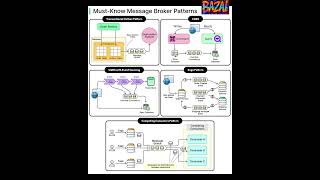
Yo yo, welcome back to the Bazai channel. In this video, let's break down message brokers using this message brokers 101 diagram so you can actually wire them into your own systems, not just memorize buzzwords. Message brokers sit between producers and consumers and handle storage, replication, and delivery of messages so services can talk to each other asynchronously without being online at the same time. What is a message Q? Think of a message queue as a buffer between a producer and a consumer. The producer drops messages into the queue and moves on while the consumer pulls messages out later at its own pace which smooths traffic spikes and prevents downstream services from getting overloaded. Publish subscribe pattern. In the pub sub pattern, producers publish events to a topic and multiple services subscribe to that topic to get their own copy of each message. In the diagram, the order service emits an order created event to the new order topic and inventory, shipping and notification services all react independently without tight coupling. Steps in a messaging system. A typical flow has five steps. Production, ingestion, consumption, processing, and acknowledgement. First, the producer creates a message. The broker ingests it, stores it, and usually replicates it. Then, a consumer fetches it, processes the work, and finally sends an acknowledgement. So the broker knows it is safe to remove or mark that message as done. Competing consumers pattern. The competing consumers pattern uses multiple consumers reading from the same queue to scale out processing. Each message goes to exactly one consumer and the broker load balances messages across consumer A C which increases throughput but can affect strict ordering guarantees. Why this matters for builders? For your own systems, message brokers help you decouple services, absorb traffic bursts, and isolate failures so one slow consumer does not take the whole app down. If you want a follow-up video, comment which part you want to see in code first. basic cues, pub subtopics, or a full competing consumer setup wired into a real micro
Original Description
Yo yo, welcome back to the Bazai channel.
In this video we break down Message Brokers 101 using a clean visual diagram so you can actually plug queues and topics into your architecture, not just memorize theory. We’ll look at what a message broker is, how a message queue decouples producers and consumers, and why this gives you reliability and back‑pressure control in real systems.
Then we jump into the publish–subscribe pattern: an Order service emits events once, and Inventory, Shipping, and Notification services each get their own copy without tight coupling. After that, we walk the five core steps in a messaging flow—production, ingestion, consumption, processing, and acknowledgment—so you understand exactly what happens to a message from send to done.
Finally, we talk about the competing consumers pattern: spinning up multiple workers on the same queue to scale throughput, how load balancing works, and the trade‑offs around ordering guarantees. If you’re building microservices, AI agents, or any backend that needs to handle spikes without falling over, this episode will give you a mental model you can reuse across RabbitMQ, Kafka, SQS, and more
Playlist
Playlist UUOthur5d9OxdqEh08Swtirw · BazAI · 28 of 49
1
 2
2
 3
3
 4
4
 5
5
 6
6
 7
7
 8
8
 9
9
 10
10
 11
11
 12
12
 13
13
 14
14
 15
15
 16
16
 17
17
 18
18
 19
19
 20
20
 21
21
 22
22
 23
23
 24
24
 25
25
 26
26
 27
27
 ▶
▶
 29
29
 30
30
 31
31
 32
32
 33
33
 34
34
 35
35
 36
36
 37
37
 38
38
 39
39
 40
40
 41
41
 42
42
 43
43
 44
44
 45
45
 46
46
 47
47
 48
48
 49
49
How LLM Agents Actually Do Deep Research (Planning, Tools & Citations Explained
BazAI
Kafka vs RabbitMQ Explained: Which One Should You Use?
BazAI
#NOVER Explained: How AI Learns to Judge Its Own Reasoning (No Reward Model Needed)
BazAI
The State of Enterprise AI 2025: How Workers Save 60 Minutes Daily & Adoption Explodes 9X
BazAI
NVIDIA Nemotron 3: 1M Context, Hybrid MoE Architecture, and Open Source AI Agents
BazAI
How Service Mesh Works: Data Plane, Control Plane & Observability
BazAI
How to Design Safe Retries in Microservices (No Duplicates, No Overload)
BazAI
Step-GUI: The Self-Evolving AI Agent for Android & PC (SOTA Performance!)
BazAI
NVIDIA's NitroGen: The First Generalist AI Trained to Play 1,000+ Games by Watching
BazAI
How AI Agents Remember: The Evolution of Agentic Memory (2025 Guide)
BazAI
Automate Your AI Data Pipelines: Introducing DataFlow & DataFlow-Agent
BazAI
Nemotron 3 Explained: Hybrid Mamba + MoE for 1M Token Agents
BazAI
Build Your Own AI Voice Agent (LangChain + OpenAI + AssemblyAI + Cartesia)
BazAI
Langflow 1.7 Explained: CUGA, ALTK, MCP & the Death of Prompt Engineering
BazAI
HuatuoGPT-o1: The First Medical AI That "Thinks" Before It Answers
BazAI
Molmo2: Open-Source Vision-Language Models with State-of-the-Art Video Grounding
BazAI
MAI-UI: Alibaba’s New Foundation GUI Agents Outperforming Gemini & GPT-4o
BazAI
Seamless AI Object Insertion: Bridging 4D Geometry and Diffusion Models
BazAI
5 AI Agentic Workflow Patterns-Reflection, Tools, ReAct, Planning, Multi‑Agent
BazAI
#NVIDIA's New #SurgWorld: How AI is Learning Autonomous Surgery
BazAI
CQRS Explained in 3 Minutes: How Modern Systems Scale Reads vs Writes
BazAI
Docker Explained in 3 Minutes: How Containers Actually Work
BazAI
6 Practical AWS Lambda Patterns in 3 Minutes (Real‑World Serverless Guide)
BazAI
Containerization Explained in 3 Minutes: From Dockerfile to Running Containers
BazAI
Science Context Protocol (SCP)- Global Web of Autonomous Scientific Agents
BazAI
Youtu-Agent: Scaling LLM Agent Productivity via Automated Generation and Hybrid RL
BazAI
#DeepSeek’s #mHC Breakthrough: Stabilizing Hyper-Connections for Large-Scale LLM Training
BazAI
Message Brokers 101 in 3 Minutes: Queues, Pub‑Sub & Competing Consumers Explained
BazAI
Must‑Know Message Broker Patterns: Outbox, CQRS, Saga & More
BazAI
Confucius Code Agent-Scalable Scaffolding for Large-Scale Repositories
BazAI
#nvidia Just Fixed #GRPO! Meet #GDPO: The New Standard for Multi-Reward RL
BazAI
NVIDIA Alpamayo-R1: Real-Time Reasoning for Level 4 Autonomy
BazAI
The Future of AI Memory: Meet #AtomMem’s Learnable CRUD System
BazAI
Database Sharding Explained | Range vs Hash vs Directory Sharding
BazAI
12 Architecture Concepts Every Developer Must Know | System Design Explained
BazAI
5 Rate Limiting Strategies Explained | Protect Your System at Scale
BazAI
How Live Streaming Works | System Design Explained
BazAI
5 Leader Election Algorithms Explained | Distributed Systems & Databases
BazAI
6 Prompting Techniques to Get Better Results from ChatGPT
BazAI
Complete Guide to Storage Systems: RAM, SSD, SAN, Cloud & Databases
BazAI
Top 4 Authentication Mechanisms Explained | SSH, OAuth, SSL & Passwords
BazAI
Common Network Protocols Explained | TCP, UDP, HTTP, DNS & More
BazAI
Microservices Best Practices | 9 Rules Every Architect Must Know
BazAI
8 Network Protocols Every Engineer Must Know | HTTP, TCP, UDP & More
BazAI
Distributed Systems in 3 Minutes: CDNs, APIs, TCP & Idempotency Explained
BazAI
Must‑Know Message Broker Patterns in 3 Minutes (Outbox, CQRS, Saga & More)
BazAI
Is OpenClaw Safe? The "Security Nightmare" Behind the Viral AI Agent
BazAI
JWT vs Sessions vs PASETO — Which Authentication Should You Use?
BazAI
Recursive LLMs vs Big Context Windows: Why RLM Wins
BazAI
More on: Systems Design Basics
View skill →





![Node.js & Express From Scratch [FINAL] - Deploying Our App](https://i.ytimg.com/vi/_GSOnHRYSS0/mqdefault.jpg)


Related Reads
📰
📰
📰
📰
Cell-Based Architecture for Real-Time Systems
Dev.to · Nainik Mehta
I Thought Loop Engineering Was Impractical. Then I Found a Use for It
Dev.to · tom-takeru
Our Fallback Worked. It Returned Yesterday’s Prices During Checkout.
Medium · Programming
System Design: Order Management System
Medium · Programming
🎓
Tutor Explanation
 DeepCamp AI