Must‑Know Message Broker Patterns in 3 Minutes (Outbox, CQRS, Saga & More)
Key Takeaways
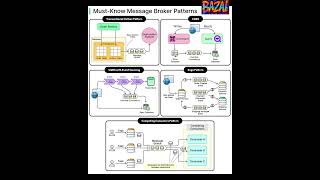
The video covers five essential message broker patterns for building reliable and scalable microservices, including Transactional Outbox, CQRS, Event Sourcing, Saga, and Competing Consumers, using message brokers to decouple producers from consumers.
Full Transcript
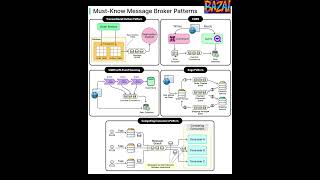
Microervices love message brokers, but only if you use the right patterns. In this three-minute crash course, let's break down five essential patterns. Outbox, CQRS, event sourcing, saga, and competing consumers. Why message broker patterns matter? In distributed systems, services need to communicate reliably even when parts of the system fail or scale independently. Message brokers decouple producers from consumers. But without the right patterns, you can still lose messages, duplicate work or corrupt data. First, the transactional outbox. The problem, your order service writes to its database and also sends an event to the broker. One can succeed while the other fails. The fix is to write both the order row and an outbox row in the same database transaction. A separate process reads the outbox table and publishes messages to the broker, ensuring events are only sent if a transaction committed. Next, CQRS command query responsibility segregation. Instead of a single model for everything, write requests hit a write optimize model while reads hit a separate read model tune for queries. Updates are propagated via messages. So, the read side is eventually consistent but much faster and more flexible. Add event sourcing and you store every change as an event like order created, order shipped, order cancelled in an event store. You rebuild current state by replaying events and those same events are published message brokers. So downstream read models and services stay in sync. Four longunning multi-ervice workflows you use the saga pattern. When a user places an order, the order service emits order created. The payment service handles payment and publishes payment process. Then shipping consumes that and emits shipping arranged. Instead of one big distributed transaction, the saga coordinates local transactions via messages and uses compensating actions like refunding payment or cancelling the order. If any step fails to scale processing, use the competing consumers pattern. Multiple consumers read from the same queue, but each message goes to exactly one consumer. This automatically load balances work such as sending emails or processing images. During traffic spikes, you just add more consumers to increase throughput. Transactional outbox, CQRS, event sourcing, saga, and competing consumers form a core toolkit for building reliable, scalable, event-driven systems. Learn these once and you'll keep reusing them across microervices, fintech, e-commerce, and any serious distributed architecture.
Original Description
Modern microservices rely on message brokers to keep services loosely coupled, resilient, and scalable. In this 3‑minute video, we break down five must‑know patterns every backend or system design engineer should understand.
What you’ll learn:
Transactional Outbox pattern for safe database + message publishing
CQRS for separating write and read models
CQRS with Event Sourcing for full history and rebuilding state
Saga pattern for long‑running, multi‑service workflows
Competing Consumers for scaling message processing horizontally
These patterns show up in real‑world systems, from e‑commerce order pipelines to fintech transaction processing, and are common in system design interviews. Watch this short explainer to upgrade your mental model of event‑driven architecture.
Timestamps:
0:00 – Why message broker patterns matter
0:15 – Transactional Outbox
0:45 – CQRS
1:05 – CQRS with Event Sourcing
1:35 – Saga pattern
2:10 – Competing Consumers
2:45 – Wrap‑up
👉 Subscribe for more system design, distributed systems, and AI‑powered architecture videos.
Playlist
Playlist UUOthur5d9OxdqEh08Swtirw · BazAI · 46 of 49
1
 2
2
 3
3
 4
4
 5
5
 6
6
 7
7
 8
8
 9
9
 10
10
 11
11
 12
12
 13
13
 14
14
 15
15
 16
16
 17
17
 18
18
 19
19
 20
20
 21
21
 22
22
 23
23
 24
24
 25
25
 26
26
 27
27
 28
28
 29
29
 30
30
 31
31
 32
32
 33
33
 34
34
 35
35
 36
36
 37
37
 38
38
 39
39
 40
40
 41
41
 42
42
 43
43
 44
44
 45
45
 ▶
▶
 47
47
 48
48
 49
49
How LLM Agents Actually Do Deep Research (Planning, Tools & Citations Explained
BazAI
Kafka vs RabbitMQ Explained: Which One Should You Use?
BazAI
#NOVER Explained: How AI Learns to Judge Its Own Reasoning (No Reward Model Needed)
BazAI
The State of Enterprise AI 2025: How Workers Save 60 Minutes Daily & Adoption Explodes 9X
BazAI
NVIDIA Nemotron 3: 1M Context, Hybrid MoE Architecture, and Open Source AI Agents
BazAI
How Service Mesh Works: Data Plane, Control Plane & Observability
BazAI
How to Design Safe Retries in Microservices (No Duplicates, No Overload)
BazAI
Step-GUI: The Self-Evolving AI Agent for Android & PC (SOTA Performance!)
BazAI
NVIDIA's NitroGen: The First Generalist AI Trained to Play 1,000+ Games by Watching
BazAI
How AI Agents Remember: The Evolution of Agentic Memory (2025 Guide)
BazAI
Automate Your AI Data Pipelines: Introducing DataFlow & DataFlow-Agent
BazAI
Nemotron 3 Explained: Hybrid Mamba + MoE for 1M Token Agents
BazAI
Build Your Own AI Voice Agent (LangChain + OpenAI + AssemblyAI + Cartesia)
BazAI
Langflow 1.7 Explained: CUGA, ALTK, MCP & the Death of Prompt Engineering
BazAI
HuatuoGPT-o1: The First Medical AI That "Thinks" Before It Answers
BazAI
Molmo2: Open-Source Vision-Language Models with State-of-the-Art Video Grounding
BazAI
MAI-UI: Alibaba’s New Foundation GUI Agents Outperforming Gemini & GPT-4o
BazAI
Seamless AI Object Insertion: Bridging 4D Geometry and Diffusion Models
BazAI
5 AI Agentic Workflow Patterns-Reflection, Tools, ReAct, Planning, Multi‑Agent
BazAI
#NVIDIA's New #SurgWorld: How AI is Learning Autonomous Surgery
BazAI
CQRS Explained in 3 Minutes: How Modern Systems Scale Reads vs Writes
BazAI
Docker Explained in 3 Minutes: How Containers Actually Work
BazAI
6 Practical AWS Lambda Patterns in 3 Minutes (Real‑World Serverless Guide)
BazAI
Containerization Explained in 3 Minutes: From Dockerfile to Running Containers
BazAI
Science Context Protocol (SCP)- Global Web of Autonomous Scientific Agents
BazAI
Youtu-Agent: Scaling LLM Agent Productivity via Automated Generation and Hybrid RL
BazAI
#DeepSeek’s #mHC Breakthrough: Stabilizing Hyper-Connections for Large-Scale LLM Training
BazAI
Message Brokers 101 in 3 Minutes: Queues, Pub‑Sub & Competing Consumers Explained
BazAI
Must‑Know Message Broker Patterns: Outbox, CQRS, Saga & More
BazAI
Confucius Code Agent-Scalable Scaffolding for Large-Scale Repositories
BazAI
#nvidia Just Fixed #GRPO! Meet #GDPO: The New Standard for Multi-Reward RL
BazAI
NVIDIA Alpamayo-R1: Real-Time Reasoning for Level 4 Autonomy
BazAI
The Future of AI Memory: Meet #AtomMem’s Learnable CRUD System
BazAI
Database Sharding Explained | Range vs Hash vs Directory Sharding
BazAI
12 Architecture Concepts Every Developer Must Know | System Design Explained
BazAI
5 Rate Limiting Strategies Explained | Protect Your System at Scale
BazAI
How Live Streaming Works | System Design Explained
BazAI
5 Leader Election Algorithms Explained | Distributed Systems & Databases
BazAI
6 Prompting Techniques to Get Better Results from ChatGPT
BazAI
Complete Guide to Storage Systems: RAM, SSD, SAN, Cloud & Databases
BazAI
Top 4 Authentication Mechanisms Explained | SSH, OAuth, SSL & Passwords
BazAI
Common Network Protocols Explained | TCP, UDP, HTTP, DNS & More
BazAI
Microservices Best Practices | 9 Rules Every Architect Must Know
BazAI
8 Network Protocols Every Engineer Must Know | HTTP, TCP, UDP & More
BazAI
Distributed Systems in 3 Minutes: CDNs, APIs, TCP & Idempotency Explained
BazAI
Must‑Know Message Broker Patterns in 3 Minutes (Outbox, CQRS, Saga & More)
BazAI
Is OpenClaw Safe? The "Security Nightmare" Behind the Viral AI Agent
BazAI
JWT vs Sessions vs PASETO — Which Authentication Should You Use?
BazAI
Recursive LLMs vs Big Context Windows: Why RLM Wins
BazAI
More on: Systems Design Basics
View skill →





![Node.js & Express From Scratch [FINAL] - Deploying Our App](https://i.ytimg.com/vi/_GSOnHRYSS0/mqdefault.jpg)


Related Reads
📰
📰
📰
📰
Cell-Based Architecture for Real-Time Systems
Dev.to · Nainik Mehta
I Thought Loop Engineering Was Impractical. Then I Found a Use for It
Dev.to · tom-takeru
Our Fallback Worked. It Returned Yesterday’s Prices During Checkout.
Medium · Programming
System Design: Order Management System
Medium · Programming
Chapters (7)
Why message broker patterns matter
0:15
Transactional Outbox
0:45
CQRS
1:05
CQRS with Event Sourcing
1:35
Saga pattern
2:10
Competing Consumers
2:45
Wrap‑up
🎓
Tutor Explanation
 DeepCamp AI