Science is for everyone, kids included - Beau Lotto and Amy O'Toole
Key Takeaways
Beau Lotto and Amy O'Toole teach about the importance of science education and participation for people of all ages
Full Transcript
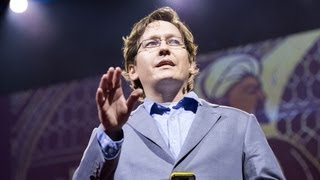
[Music] [Applause] so this game is very simple all you have to do is read what you see right so I'm going to count you so we don't all do all do it together okay 1 two 3 amazing what about this one one two three all right one two three if you were Portuguese right how about this one one two three what are you reading there are no words there I said read what you're seeing right it literally says what read right that's what you should have said right why is this it's because perception is grounded in our experience right the brain takes meaningless information and makes meaning out of it which means we never see what's there we never see information we only ever see what was useful to see in the past right which means when it comes to perception we're all like this frog right is getting information is General Behavior that's useful [Applause] and sometimes when things don't go our way we get a little bit annoyed right but we're talking about perception here right and perception underpins everything we think we know we believe our hopes our dreams the clothes we where falling in love everything begins with perception now if perception is grounded in our history it means we're only ever responding according to what we've done before but that creates a tremendous problem because how can we ever see differently now I want to tell you a story about seeing differently and all new perceptions begin in the same way they begin with a question the problem with questions is they create un un certainty now uncertainty is a very bad thing it's evolutionary a bad thing if you're not sure that's a predator it's too late okay even seasickness is a consequence of uncertainty right if you go down below in a boat your inner ears are telling you you're moving your eyes because it's moving in register with a boat say I'm standing still your brain cannot deal with the uncertainty of that information and it gets ill the question why is one of the most dangerous things you can do because it takes you into uncertainty and yet the irony is the only way we can ever do anything new is to step into that space so how can we ever do anything new well fortunately Evolution has given us an answer right and it enables us to address even the most difficult of questions the best questions are the ones that create the most uncertainty they're the ones that question the things we think to be true already right it's easy to ask questions about how did Life Begin or what extends to be on the universe but to question what you think to be true already is really stepping into that space so what is Evolution's answer to the problem of uncertainty it's Play now play is not simply a process experts in in play will tell you that actually it's a way of being play is one of the only human endeavors where uncertainty is actually celebrated uncertainty is what makes play fun right it's adaptable to change right it opens possibility and it's Cooperative it's actually how we do our social bonding and it's intrinsically motivated what that means is that we play to play play is its own reward now if you look at these five ways of being these are the exact same ways of being you need in order to be a good scientist science is not defined by the method section of a paper it's actually a way of being which is here and this is true for anything that is creative so if you add rules to play you have a a game that's actually what an experiment is so armed with these two ideas that science is a way of being and experiments are Play We asked can anyone become a scientist and who better to ask than 25 8 to 10 year old children because they're experts in play so I took my B Arena down to a small school in Devon and the aim of this was to not just get the kids to see science differently but through the process of science to see themselves differently right the first step was to ask a question now I should say that we didn't get funding for this study because the scientist said small children could make useful contribution to science and the teacher said kids couldn't do it so we did it anyway right of course so here are some of the questions I put them in small print so you wouldn't bother reading it point is that five of the questions that the kids came up with were actually the basis of science public the last 5 to 15 years right so they were asking questions that were significant to expert scientists now here I want to share the stage with someone quite special right she was one of the young people who was involved in this study and she's now one of the youngest published scientists in the world right she will now once she comes onto stage will be the youngest person to ever speak at Ted right now science and asking questions about courage now she is the personification of Courage because she's she's going to stand up here and talk to you all so Amy would you please come [Applause] [Music] up so Amy's going to help me tell the story of what we call the black OT bees project and first she's going to tell you the question that they came up with so go ahead Amy thank you B we thought that it was easy to see the link between humans and apes in the way that we think because we look alike but we wondered if there's a possible link with other animals it'd be amazing if humans and bees thought similar since they seem so different from us so we asked if humans and bees might solve complex problems in the same way really we want to know if bees can also adapt themselves to new situations using previous learn rules and conditions so what if bees can think like us well it' be amazing since we're talking about insect with only 1 million brain cells but actually makes a lot of sense they should because bees like us can recognize a good F regardless of the time of day the light the weather or from any angle it approached it from so the next step was to design an experiment which is a game so the kids went off and they designed this experiment and so the well game and so Amy can you tell us what the game was in the puzzle that you set the bees the puzzle we came up with was an if then rule we ased bees can learn not just to go to a certain color but to a certain color flower only when it's in a certain pattern they were only rewarded if they went to the yellow flowers if the yellow flowers were surrounded by the blue or if the blue flowers were surrounded by the yellow now there's a number of different rules the bees can learn to solve this puzzle the interesting question is which what was really exciting about this project was we and Bo had no idea where it was work it was completely new and no one had done it before including adults including the teachers and that was really hard for the teachers it's easy for a scientist go not have a clue what he's doing because that's what we do in the lab but for a teacher not to know what's going to happen at the end of the day so much of the credit goes to Dave strudwick who is the collaborator on this project okay so I'm not going to go through the whole details of the study because actually you can read it read about it but the next step is observation so here are some of the students doing the observations they're recording the data of where the bees fly she's finishing off that so what we're going to do is she still going up here yeah so you keep keep track M can you help me Henry can you help me Henry what good scientist says that right there [Music] right so we've got our observations we've got our data they do the simple uh mathematics averaging etc etc and now we want to share that's the next step so we're going to write this up and try to submit this for publication right so we have to write it up so we go of course to the pub all right the one on the left is mine okay now I told them a paper has four different sections an introduction of methods a results a discussion the introduction says what's the question and why methods what did you do results what was an observation and the discussion is who cares right that's a science paper basically so the kids give me the words right I put it into a narrative which means that this paper is written in kids speak it's not written by me it's written by Amy and the other students in the class as a consequence the science paper begins Once Upon a Time the results section it says training phase the puzzle d da right and the methods it says then we put the bees into the fridge and made be pie smiley face right this is a science paper we're going to try to get it published so here's the title page we have a number of authors there all the ones in bold are 8 to 10 years old the first author is blackon primary school because if it were ever referenced it would be blackon at all and not one individual so we submit it to a public access journal and it says this it said many things but it said this I'm afraid the paper fails are inial quality control checks in several different ways in other words it starts off Once Upon a Time the figures in crayon Etc so we decid we'll get it reviewed so I send it to Dale pervis who is a National Academy of Science one of the leading neuroscientists in the world and he says this is the most original scientific paper I've ever read and it certainly deserves wide exposure Larry Maloney expert in Vision says the paper is Magnificent the work would be publishable if done by adults so what do we do we send it back to to the editor they say no so we asked Larry and Natalie de hemple to write a commentary situating the findings for scientists right putting in the references and we submit it to biology letters and there it was reviewed by five independent referees and it was published okay it took four months to do the science two years years to get it published typical science actually right so this makes Amy and her friends the youngest published scientist in the world what was the feedback like well it was published two days before Christmas downloaded 30,000 times in the first day right it was the editor's choice in science which is a top Science magazine it's forever freely accessible by biolog is the only paper that will ever be freely accessible by this journal last year was the second most downloaded paper by biology letters and the feedback from not just scientists and teachers but the public as well and I'll just read one I have read black a bees recently I don't have words to explain exactly how I'm feeling right now what you guys have done is real true and amazing curiosity interest innocence and Zeal are the most basic most important things to do science who else can have these quali more than children please congratulate your children's team from my side so I'd like to include with a physical metaphor can I do it on you okay yeah yeah come on yeah yeah okay now science is about taking risks so this is incredible risk right for me not for him right because we've only done this once before and you like technology right all right so this is the this is this is the epitome of Technology right okay now okay now we're going to do a little demonstration right you have to close your eyes and you have to point where you hear me clapping all right okay how about if everyone over there shouts one two three [Applause] brilliant now open your eyes we'll do it one more time everyone over there shout where's the sound coming from thank you very much what's the point the point is what science does for us right we normally walk through life responding but if we ever want to do anything different we have to step into uncertainty when he opened his eyes he was able to see the world in a new way that's what science offers us it offers the possibility to step on uncertainty through the process of play right now true Science Education I think should be about giving people a voice and enabling to express that voice so I've asked Amy to be the last voice in this short story so Amy this project was really exciting for me because it brought the process of discovery to life and it show me that anyone and I mean anyone has the potential to discover something new and that a small question can lead into a big Discovery changing the way a person thinks about something can be easy or hard it all depends on the way the person feels about change but changeing the way I thought about science was surprisingly easy once we played the games and then started to think about the puzzle I then realized that science isn't just a boring subject and then that anyone can discover something new you just need an opportunity my opportunity came in the form of bow and the black aut B project thank you thank you very much [Music]
Original Description
What do science and play have in common? Neuroscientist Beau Lotto thinks all people (kids included) should participate in science and, through the process of discovery, change perceptions. He's seconded by 12-year-old Amy O'Toole, who, along with 25 of her classmates, published the first peer-reviewed article by schoolchildren, about the Blackawton bees project. It starts: "Once upon a time ... "
Talk by Beau Lotto and Amy O'Toole.
Watch on YouTube ↗
(saves to browser)
Sign in to unlock AI tutor explanation · ⚡30
Playlist
Uploads from TED-Ed · TED-Ed · 17 of 60
1
 2
2
 3
3
 4
4
 5
5
 6
6
 7
7
 8
8
 9
9
 10
10
 11
11
 12
12
 13
13
 14
14
 15
15
 16
16
 ▶
▶
 18
18
 19
19
 20
20
 21
21
 22
22
 23
23
 24
24
 25
25
 26
26
 27
27
 28
28
 29
29
 30
30
 31
31
 32
32
 33
33
 34
34
 35
35
 36
36
 37
37
 38
38
 39
39
 40
40
 41
41
 42
42
 43
43
 44
44
 45
45
 46
46
 47
47
 48
48
 49
49
 50
50
 51
51
 52
52
 53
53
 54
54
 55
55
 56
56
 57
57
 58
58
 59
59
 60
60

Weaving narratives in museum galleries - Thomas P. Campbell
TED-Ed
Your brain is more than a bag of chemicals - David Anderson
TED-Ed
Biofuels and bioprospecting for beginners - Craig A. Kohn
TED-Ed
Four sisters in Ancient Rome - Ray Laurence
TED-Ed
The brilliance of bioluminescence - Leslie Kenna
TED-Ed
Animation basics: Homemade special effects - TED-Ed
TED-Ed
Pros and cons of public opinion polls - Jason Robert Jaffe
TED-Ed
Excuse me, may I rent your car? - Robin Chase
TED-Ed
Could tissue engineering mean personalized medicine? - Nina Tandon
TED-Ed
The arts festival revolution - David Binder
TED-Ed
What's an algorithm? - David J. Malan
TED-Ed
Why do fingers become pruney? - Mark Changizi
TED-Ed
What is fat? - George Zaidan
TED-Ed
Reasons for the seasons - Rebecca Kaplan
TED-Ed
Mysteries of vernacular: Inaugurate - Jessica Oreck
TED-Ed
Let's pool our medical data - John Wilbanks
TED-Ed
Science is for everyone, kids included - Beau Lotto and Amy O'Toole
TED-Ed
Making a TED-Ed Lesson: Concept and design
TED-Ed
Making a TED-Ed Lesson: Creative process
TED-Ed
Making a TED-Ed Lesson: Animation
TED-Ed
Is space trying to kill us? - Ron Shaneyfelt
TED-Ed
Put those smartphones away: Great tips for making your job interview count - Anna Post
TED-Ed
What on Earth is spin? - Brian Jones
TED-Ed
Gyotaku: The ancient Japanese art of printing fish - K. Erica Dodge
TED-Ed
Mining literature for deeper meanings - Amy E. Harter
TED-Ed
What doctors don't know about the drugs they prescribe - Ben Goldacre
TED-Ed
Why architects need to use their ears - Julian Treasure
TED-Ed
How do you decide where to go in a zombie apocalypse? - David Hunter
TED-Ed
Tracking grizzly bears from space - David Laskin
TED-Ed
The emergence of drama as a literary art - Mindy Ploeckelmann
TED-Ed
Why democracy matters - Rory Stewart
TED-Ed
Ethical riddles in HIV research - Boghuma Kabisen Titanji
TED-Ed
Mysteries of vernacular: Venom - Jessica Oreck and Rachael Teel
TED-Ed
Mysteries of vernacular: Dynamite - Jessica Oreck and Rachael Teel
TED-Ed
The promise of research with stem cells - Susan Solomon
TED-Ed
What color is Tuesday? Exploring synesthesia - Richard E. Cytowic
TED-Ed
How do we experience time? - Matt Danzico
TED-Ed
The contributions of female explorers - Courtney Stephens
TED-Ed
The security mirage - Bruce Schneier
TED-Ed
Mysteries of vernacular: Window - Jessica Oreck and Rachael Teel
TED-Ed
The punishable perils of plagiarism - Melissa Huseman D'Annunzio
TED-Ed
Dare to disagree - Margaret Heffernan
TED-Ed
What we're learning from online education - Daphne Koller
TED-Ed
The rise of human-computer cooperation - Shyam Sankar
TED-Ed
The happy secret to better work - Shawn Achor
TED-Ed
Dissecting Botticelli's Adoration of the Magi - James Earle
TED-Ed
The game-changing amniotic egg - April Tucker
TED-Ed
Equality, sports, and Title IX - Erin Buzuvis and Kristine Newhall
TED-Ed
Neuroscience, game theory, monkeys - Colin Camerer
TED-Ed
Why global jihad is losing - Bobby Ghosh
TED-Ed
Want to help someone? Shut up and listen! - Ernesto Sirolli
TED-Ed
Fighting with non-violence - Scilla Elworthy
TED-Ed
Mysteries of vernacular: Gorgeous - Jessica Oreck and Rachael Teel
TED-Ed
Building unimaginable shapes - Michael Hansmeyer
TED-Ed
Behind the Great Firewall of China - Michael Anti
TED-Ed
How big is the ocean? - Scott Gass
TED-Ed
Is there a center of the universe? - Marjee Chmiel and Trevor Owens
TED-Ed
Vermicomposting: How worms can reduce our waste - Matthew Ross
TED-Ed
How to set the table - Anna Post
TED-Ed
How to fool a GPS - Todd Humphreys
TED-Ed
🎓
Tutor Explanation
 DeepCamp AI