The Ultimate Guide to Hyperparameter Tuning | Grid Search vs. Randomized Search
Key Takeaways
The video discusses hyperparameter tuning using Grid Search and Randomized Search, demonstrating their application in machine learning models such as KNN and neural networks.
Full Transcript
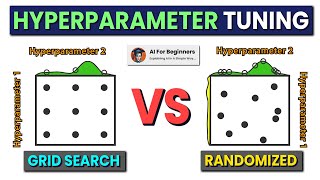
hyperparameters are the parameters of the model that are not learned during the training process but are set by the user before the training they are configuration settings that control the learning process and Model Behavior for example the maximum depth to allow the decision tree to grow number of hidden layers and nodes in neural networks or the number of nearest neighbors to consider in the K nearest neighbors algorithm the choice of hyperparameters can significantly impact model performance as they help balance the tradeoff between overfitting and underfitting let's see an example in the knnn algorithm the class of an observation is predicted by looking at the classes of its K nearest neighbors and performing a majority vote the value of K is a hyperparameter that can be tuned and it is often chosen to be an odd number to avoid ties intuitively increasing K means considering more Neighbors which can lead to underfitting conversely decreasing K may lead to overfitting I trained three models with different K to show how important the K hyperparameter is in training the algorithm often you won't just have one hyperparameter to tune but many so how do you find the best set of hyperparameters for your data set while hyperparameters are typically configured based on the data set's characteristics it's impossible to know the optimal set by simply examining the data a straightforward approach to finding a good set of hyperparameters is to choose several potential values for each hyperparameter and train separate models for every combination then you can use the validation data to determine which combination results in the highest score sometimes you'll notice that the best scores tend to be near the highest or lowest value of a given hyperparameter range in these cases you can refine the search by adjusting the range slightly while keeping other hyperparameters fixed this process is called grid search you create a grid of hyperparameters and search for the combination that produces the highest validation score however one major downside of grid search is that it can be computationally expensive especially when training complex models on large data sets having five hyperparameters with six options you will need to train the model six to the power of 5times which is equal to this number imagine the computational effort acquired to be more efficient we can do a randomized search instead of evaluating all possible combinations of hyperparameters you define a range for each hyperparameter and specify how many models you want to train the method then randomly samples from each hyperparameter range this approach is more efficient but it introduces randomization which can either help you find the optimal hyperparameter set more easily or take longer the effectiveness depends on the luck of the sampling and whether whether the specified intervals include the best set as a rule of thumb regular grid search is more suitable when you have a small number of hyperparameters with narrow ranges and when you are training a relatively simple model randomized search is used with many hyperparameters broad ranges and complex models for large neural network models where training each model takes several days the process becomes more complex different methods are designed to find a better set of hyperparameters in such scenarios [Music] if you want to learn more about artificial intelligence subscribe to our channel to be aware of the new videos press the like button and let's discuss AI in the comments section
Original Description
#ai #ml #datascience #learnai #learning #artificialintelligence #machinelearning
🔥 Hyperparameters are the parameters of the model that are not learned during the training process but are set by the user before the process starts. They control the training phase and model behavior. Different machine learning models have different hyperparameters that can have a significant affect on the performance of the model. There are two common ways for hyperparameter search. Using grid search you define potential values for each hyperparameter and train a separate model for each set. This method is computationally expensive, because you train too many models as the number of hyperparameters and number of their values increases. Using Randomized Search, on the other hand, you provide range for each hyperparameter and how many times you want to train a model. The method then samples values from the range of each hyperparameter and trains separate models (as many as you specified). Both have their advantages and disadvantages.
🔍 Key points covered:
0:00 - What are the hyperparameters?
0:25 - Why are hyperparameters important?
0:35 - Example of a hyperparameter.
1:07 - But how to find the best hyperparameters?
1:26 - Grid Search.
2:09 - One major problem of grid search.
2:31 - Randomized Search.
3:04 - Which one to choose and when?
3:19 - What about large neural networks?
3:31 - Subscribe to us!
🔔 Don't forget to like, subscribe, and hit the bell icon to stay updated with our latest videos!
🤖 Note that we use synthetic generations, such as AI-generated images and voices, to enhance the appeal and engagement of our content.
🌐 If you have any questions or topics you want us to cover, leave a comment below. Additionally, share with your thoughts about the content, how do you think we can make them better? Thanks for watching!
Watch on YouTube ↗
(saves to browser)
Sign in to unlock AI tutor explanation · ⚡30
Playlist
Uploads from AI For Beginners · AI For Beginners · 23 of 32
1
 2
2
 3
3
 4
4
 5
5
 6
6
 7
7
 8
8
 9
9
 10
10
 11
11
 12
12
 13
13
 14
14
 15
15
 16
16
 17
17
 18
18
 19
19
 20
20
 21
21
 22
22
 ▶
▶
 24
24
 25
25
 26
26
 27
27
 28
28
 29
29
 30
30
 31
31
 32
32
Artificial Intelligence Explained In Simple Words | What Is AI? | Explained On A Real World Example!
AI For Beginners
AI vs. ML vs. DL vs. DS - Difference Explained | On Real World Examples | AI For Beginners
AI For Beginners
Types Of Machine Learning Algorithms | Explained On Real World Examples | ML For Beginners
AI For Beginners
Best AI Music Generator | Music Generation Tool for FREE | MusicGen developed by Meta AI
AI For Beginners
The Ultimate Guide To Supervised Learning | Explained On Binary Classification Example | Part 1
AI For Beginners
The Ultimate Guide To Supervised Learning | Classification And Regression | Part 2
AI For Beginners
Linear Regression Explained | A Beginner's Guide To Regression | The Basics You Need to Know!
AI For Beginners
Assumptions Of Linear Regression | What To Do If The Assumptions Do Not Hold? | Part 1
AI For Beginners
Checking The Assumptions Of Linear Regression | Statistical And Visual Methods | Part 2
AI For Beginners
The Purpose of Train-Test Split in Machine Learning | How to Correctly Split Data?
AI For Beginners
The Role of Validation Sets in Model Training | Train-Test-Validation Splits | Clearly explained!
AI For Beginners
Overfitting and Underfitting | Bias and Variance Tradeoff in Machine Learning | Clearly Explained!
AI For Beginners
Gradient Descent Explained | How Do ML and DL Models Learn? | Simple Explanation!
AI For Beginners
Main Types of Gradient Descent | Batch, Stochastic and Mini-Batch Explained! | Which One to Choose?
AI For Beginners
The Role of Loss Functions | Most Common Loss Functions in Machine Learning | Explained!
AI For Beginners
How to Evaluate Your ML Models Effectively? | Evaluation Metrics in Machine Learning!
AI For Beginners
8 Best Tips For Cleaning Your Data | Data Cleaning | Machine Learning, Data Preparation.
AI For Beginners
Numerical vs. Categorical Data | Represent Your Dataset Correctly!
AI For Beginners
3 Main Types of Missing Data | Do THIS Before Handling Missing Values!
AI For Beginners
7 PROVEN Strategies To Become An AI Engineer (2025 Updated)
AI For Beginners
Easiest Guide to K-Fold Cross Validation | Explained in 2 Minutes!
AI For Beginners
Normalization and Standardization | Why to Scale the Features? | ML Basics
AI For Beginners
The Ultimate Guide to Hyperparameter Tuning | Grid Search vs. Randomized Search
AI For Beginners
How is Artificial Intelligence different from Traditional Programming?
AI For Beginners
All Machine Learning Models Clearly Explained!
AI For Beginners
6 Mistakes to Avoid When Learning Machine Learning in 2025
AI For Beginners
Best Practices for Effective Data Visualization In Machine Learning!
AI For Beginners
Central Limit Theorem Intuition Explained Like You're 5!
AI For Beginners
Which Door Would You Choose? | Monty Hall Problem Explained!
AI For Beginners
All Machine Learning Concepts Explained in 18 Minutes!
AI For Beginners
What’s the Probability That Two Randomly Drawn Chords in a Circle Intersect?
AI For Beginners
Causation vs Correlation | The Most Confused Concept in Data Science
AI For Beginners
More on: ML Pipelines
View skill →






Related Reads
📰
📰
📰
📰
Building an Unbeatable Tic-Tac-Toe AI with the Minimax Algorithm
Hackernoon
SMOTE from scratch: fixing imbalanced data without just copy-pasting rows
Dev.to · Devanshu Biswas
Building a Production Audio Separation API with Meta’s Demucs
Medium · Machine Learning
I Installed These Python Libraries Out of Curiosity. I Never Uninstalled Them.
Medium · Programming
Chapters (10)
What are the hyperparameters?
0:25
Why are hyperparameters important?
0:35
Example of a hyperparameter.
1:07
But how to find the best hyperparameters?
1:26
Grid Search.
2:09
One major problem of grid search.
2:31
Randomized Search.
3:04
Which one to choose and when?
3:19
What about large neural networks?
3:31
Subscribe to us!
🎓
Tutor Explanation

 DeepCamp AI