The Role of Validation Sets in Model Training | Train-Test-Validation Splits | Clearly explained!
Key Takeaways
The video explains the role of validation sets in model training, including train-test-validation splits and their significance in machine learning model creation, highlighting tools like data analysis and feature engineering, and techniques such as hyperparameter tuning and model selection.
Full Transcript
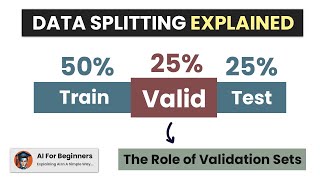
in our previous video we talked about the train test split why is it important and how to properly split the data set in this video we will refer to validation data a proportion from the overall data set that has a significant role machine learning model creation has the following steps firstly splitting the data into train validation and test sets secondly doing data analysis and feature engineering thirdly training models hyperparameter tuning and model selection and lastly final model testing training and validation sets are used for training and preparing the final model while the test set is only used for final evaluation validation data can be defined as a set that is not used for training but we use its results during the training process to select the appropriate model and configure its hyperparameters so while it can be referred to as unseen data we still used its information to select our final model eval Val ating the final model only on the validation set will provide an optimistic estimation of the performance in other words we already maximize the performance of the final model based on the validation data during the training process training performance and validation performance are evaluated to see how the performance of the model is improving if we see that both sets are improving then we are on the correct path the validation set ensures that the model does not just memorize the training data but learns patterns that apply to new data as well remember that at some point the training performance will continue to improve but we will start seeing a declining performance on the validation set this is the point that suggests we stop the training because it starts to overfit a concept we will refer to in the upcoming videos as a result you will select the model and the set of hyperparameters that provide the highest validation performance finally you evaluate the unbiased performance estimate using the test data the size of the validation set is often similar to the test size sometimes a bit less just be sure to have data large enough to provide a reliable estimate of the model's performance if you want to learn more about artificial intelligence subscribe to our channel to be aware of the new videos press the like button and let's discuss AI in the comments section
Original Description
🔥 In this video we referred to the validation set, a proportion from the overall dataset that has a very significant role! Validation dataset is used for final model selection and hyperparameter tuning, as well as to understand whether your model learns patterns or just overfits the training data. It gives a rough estimate of the performance of the model on an "unseen" data.
Remember to use test dataset for final evaluation. You can't use the results from the validation set only, as you used its feedback to tune your hyperparameters and select the best model!
🔍 Key points covered:
0:00 - Introduction.
0:15 - How different data splits are used in the model creation procedure?
0:41 - How we define the validation set?
0:52 - How is validation different from test and train?
1:00 - What if you evaluate the model based on the validation set?
1:12 - How is validation data used during the training?
1:33 - At what point the validation performance will start declining?
1:48 - How you select the best model based on the validation results?
1:54 - How to evaluate the final performance?
1:59 - The size of the validation set.
2:10 - Subscribe to us!
🔔 Don't forget to like, subscribe, and hit the bell icon to stay updated with our latest videos!
🤖 Note that we use synthetic generations, such as AI-generated images and voices, to enhance the appeal and engagement of our content.
🌐 If you have any questions or topics you want us to cover, leave a comment below. Additionally, share with your thoughts about the content, how do you think we can make them better? Thanks for watching!
Watch on YouTube ↗
(saves to browser)
Sign in to unlock AI tutor explanation · ⚡30
Playlist
Uploads from AI For Beginners · AI For Beginners · 11 of 32
1
 2
2
 3
3
 4
4
 5
5
 6
6
 7
7
 8
8
 9
9
 10
10
 ▶
▶
 12
12
 13
13
 14
14
 15
15
 16
16
 17
17
 18
18
 19
19
 20
20
 21
21
 22
22
 23
23
 24
24
 25
25
 26
26
 27
27
 28
28
 29
29
 30
30
 31
31
 32
32
Artificial Intelligence Explained In Simple Words | What Is AI? | Explained On A Real World Example!
AI For Beginners
AI vs. ML vs. DL vs. DS - Difference Explained | On Real World Examples | AI For Beginners
AI For Beginners
Types Of Machine Learning Algorithms | Explained On Real World Examples | ML For Beginners
AI For Beginners
Best AI Music Generator | Music Generation Tool for FREE | MusicGen developed by Meta AI
AI For Beginners
The Ultimate Guide To Supervised Learning | Explained On Binary Classification Example | Part 1
AI For Beginners
The Ultimate Guide To Supervised Learning | Classification And Regression | Part 2
AI For Beginners
Linear Regression Explained | A Beginner's Guide To Regression | The Basics You Need to Know!
AI For Beginners
Assumptions Of Linear Regression | What To Do If The Assumptions Do Not Hold? | Part 1
AI For Beginners
Checking The Assumptions Of Linear Regression | Statistical And Visual Methods | Part 2
AI For Beginners
The Purpose of Train-Test Split in Machine Learning | How to Correctly Split Data?
AI For Beginners
The Role of Validation Sets in Model Training | Train-Test-Validation Splits | Clearly explained!
AI For Beginners
Overfitting and Underfitting | Bias and Variance Tradeoff in Machine Learning | Clearly Explained!
AI For Beginners
Gradient Descent Explained | How Do ML and DL Models Learn? | Simple Explanation!
AI For Beginners
Main Types of Gradient Descent | Batch, Stochastic and Mini-Batch Explained! | Which One to Choose?
AI For Beginners
The Role of Loss Functions | Most Common Loss Functions in Machine Learning | Explained!
AI For Beginners
How to Evaluate Your ML Models Effectively? | Evaluation Metrics in Machine Learning!
AI For Beginners
8 Best Tips For Cleaning Your Data | Data Cleaning | Machine Learning, Data Preparation.
AI For Beginners
Numerical vs. Categorical Data | Represent Your Dataset Correctly!
AI For Beginners
3 Main Types of Missing Data | Do THIS Before Handling Missing Values!
AI For Beginners
7 PROVEN Strategies To Become An AI Engineer (2025 Updated)
AI For Beginners
Easiest Guide to K-Fold Cross Validation | Explained in 2 Minutes!
AI For Beginners
Normalization and Standardization | Why to Scale the Features? | ML Basics
AI For Beginners
The Ultimate Guide to Hyperparameter Tuning | Grid Search vs. Randomized Search
AI For Beginners
How is Artificial Intelligence different from Traditional Programming?
AI For Beginners
All Machine Learning Models Clearly Explained!
AI For Beginners
6 Mistakes to Avoid When Learning Machine Learning in 2025
AI For Beginners
Best Practices for Effective Data Visualization In Machine Learning!
AI For Beginners
Central Limit Theorem Intuition Explained Like You're 5!
AI For Beginners
Which Door Would You Choose? | Monty Hall Problem Explained!
AI For Beginners
All Machine Learning Concepts Explained in 18 Minutes!
AI For Beginners
What’s the Probability That Two Randomly Drawn Chords in a Circle Intersect?
AI For Beginners
Causation vs Correlation | The Most Confused Concept in Data Science
AI For Beginners
More on: ML Pipelines
View skill →




Related Reads
📰
📰
📰
📰
On July 1, 2026, arXiv will spin out from Cornell University, its home for the past 25 years, to become an independent nonprofit organization. Major funding support from Simons Foundation and Schmidt Sciences. Ditching the red for their website. [N]
Reddit r/MachineLearning
CS-NRRM™ Official Publications: Paper 1 and Paper 2 Are Now Available
Medium · Data Science
Found a potential mistake in an ICLR 2026 blogpost [D]
Reddit r/MachineLearning
Rebuttals Move Peer-Review Scores, but Initial-Review Structure Bounds the Movement
ArXiv cs.AI
Chapters (11)
Introduction.
0:15
How different data splits are used in the model creation procedure?
0:41
How we define the validation set?
0:52
How is validation different from test and train?
1:00
What if you evaluate the model based on the validation set?
1:12
How is validation data used during the training?
1:33
At what point the validation performance will start declining?
1:48
How you select the best model based on the validation results?
1:54
How to evaluate the final performance?
1:59
The size of the validation set.
2:10
Subscribe to us!
🎓
Tutor Explanation

 DeepCamp AI