How to Evaluate Your ML Models Effectively? | Evaluation Metrics in Machine Learning!
Key Takeaways
The video discusses evaluation metrics in machine learning, including Confusion Matrix, Accuracy, Precision, Recall, and F1-Score, with a focus on classification tasks and imbalanced datasets.
Full Transcript
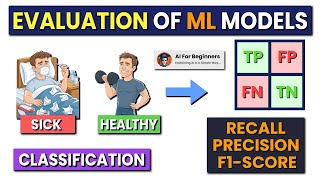
how do you evaluate your ml models evaluation is a critical step in the model development process it ensures that our model is good enough to perform well on unseen Data before diving into evaluation metrics remember that the data should be divided into train test and often validation sets more on this here let's call one class positive and the other one negative we can arrange the predictions in four possible ways either we predict the positive class correctly or we predict the negative class incorrectly and either we predict correctly the negative class or incorrectly the positive one this is called the confusion Matrix a popular metric used in classification tasks from the confusion Matrix we can extract other metrics like accuracy accuracy measures how often a model predicts correctly out of all the predictions it made if we translate that to a formula we will need to divide the total number of correct predictions by the total number of predictions let's say if a person has a certain flu we predict positive if not then negative the flu is very rare and of 100,000 people only 100 have it our model learned to classify all observations to the negative class meaning none of them has the flu when we calculate the accuracy score we get a very high score however our model is useless imagine telling a person that he has no flu when he actually has it is generally better in such cases to classify the person having the flu when he doesn't than to miss a case where someone does have the flu but the model says they don't two more formulas appear here recall and precision their difference is in the denominator in our problem terms Precision has false positives in the denominator meaning a high Precision value will mean the model does not predict flu when the person is healthy recall on the other hand targets false negatives meaning if we have very high recall the model identifies everyone who has the flu and does not miss anyone who is sick there is another measure that tries to maximize both recall and precision called F1 score it takes the harmonic mean of precision and recall meaning that you can get a high F1 score in the case you have high precision and recall thus we use recall precision and F1 score for imbalanced data sets while accuracy for balanced ones for multiclass scenarios the method is slightly different we will refer to it later there are also other important metrics such as Au and Roc curves for regression and unsupervised tasks the metrics are different they are more complex ones and we will talk about all those in the upcoming videos so stay with us if you want to learn more about artificial intelligence subscribe to our channel to be aware of the new videos press the like button and let's discuss AI in the comments section
Original Description
🔥 In this video we refer to the evaluation metrics used in machine learning. Confusion matrix, Accuracy, Precision, Recall and F1-Score are the most popular metrics for classification tasks. We explain the difference of each metric on a single example, showing that accuracy is well suited for balanced datasets, while other three for imbalanced ones. In some specific cases, we may prefer recall over precision and vice versa, or we might want to have both high using F1-Score.
Additionally, there are other important metrics like AUC and ROC. Metrics for unsupervised learning and regression tasks are different. These are more complex topics, which we will cover separately, so stay with us!
🔍 Key points covered:
0:00 - Introduction to the problem.
0:20 - Understanding the confusion matrix.
0:45 - Accuracy.
0:59 - When not to use the accuracy?
1:35 - Recall and Precision.
1:45 - Precision.
1:52 - Recall.
2:02 - F1-Score.
2:17 - How to choose between the metrics?
2:25 - Important notes.
2:45 - Subscribe to us!
🔔 Don't forget to like, subscribe, and hit the bell icon to stay updated with our latest videos!
🤖 Note that we use synthetic generations, such as AI-generated images and voices, to enhance the appeal and engagement of our content.
🌐 If you have any questions or topics you want us to cover, leave a comment below. Additionally, share with your thoughts about the content, how do you think we can make them better? Thanks for watching!
Watch on YouTube ↗
(saves to browser)
Sign in to unlock AI tutor explanation · ⚡30
Playlist
Uploads from AI For Beginners · AI For Beginners · 16 of 32
1
 2
2
 3
3
 4
4
 5
5
 6
6
 7
7
 8
8
 9
9
 10
10
 11
11
 12
12
 13
13
 14
14
 15
15
 ▶
▶
 17
17
 18
18
 19
19
 20
20
 21
21
 22
22
 23
23
 24
24
 25
25
 26
26
 27
27
 28
28
 29
29
 30
30
 31
31
 32
32
Artificial Intelligence Explained In Simple Words | What Is AI? | Explained On A Real World Example!
AI For Beginners
AI vs. ML vs. DL vs. DS - Difference Explained | On Real World Examples | AI For Beginners
AI For Beginners
Types Of Machine Learning Algorithms | Explained On Real World Examples | ML For Beginners
AI For Beginners
Best AI Music Generator | Music Generation Tool for FREE | MusicGen developed by Meta AI
AI For Beginners
The Ultimate Guide To Supervised Learning | Explained On Binary Classification Example | Part 1
AI For Beginners
The Ultimate Guide To Supervised Learning | Classification And Regression | Part 2
AI For Beginners
Linear Regression Explained | A Beginner's Guide To Regression | The Basics You Need to Know!
AI For Beginners
Assumptions Of Linear Regression | What To Do If The Assumptions Do Not Hold? | Part 1
AI For Beginners
Checking The Assumptions Of Linear Regression | Statistical And Visual Methods | Part 2
AI For Beginners
The Purpose of Train-Test Split in Machine Learning | How to Correctly Split Data?
AI For Beginners
The Role of Validation Sets in Model Training | Train-Test-Validation Splits | Clearly explained!
AI For Beginners
Overfitting and Underfitting | Bias and Variance Tradeoff in Machine Learning | Clearly Explained!
AI For Beginners
Gradient Descent Explained | How Do ML and DL Models Learn? | Simple Explanation!
AI For Beginners
Main Types of Gradient Descent | Batch, Stochastic and Mini-Batch Explained! | Which One to Choose?
AI For Beginners
The Role of Loss Functions | Most Common Loss Functions in Machine Learning | Explained!
AI For Beginners
How to Evaluate Your ML Models Effectively? | Evaluation Metrics in Machine Learning!
AI For Beginners
8 Best Tips For Cleaning Your Data | Data Cleaning | Machine Learning, Data Preparation.
AI For Beginners
Numerical vs. Categorical Data | Represent Your Dataset Correctly!
AI For Beginners
3 Main Types of Missing Data | Do THIS Before Handling Missing Values!
AI For Beginners
7 PROVEN Strategies To Become An AI Engineer (2025 Updated)
AI For Beginners
Easiest Guide to K-Fold Cross Validation | Explained in 2 Minutes!
AI For Beginners
Normalization and Standardization | Why to Scale the Features? | ML Basics
AI For Beginners
The Ultimate Guide to Hyperparameter Tuning | Grid Search vs. Randomized Search
AI For Beginners
How is Artificial Intelligence different from Traditional Programming?
AI For Beginners
All Machine Learning Models Clearly Explained!
AI For Beginners
6 Mistakes to Avoid When Learning Machine Learning in 2025
AI For Beginners
Best Practices for Effective Data Visualization In Machine Learning!
AI For Beginners
Central Limit Theorem Intuition Explained Like You're 5!
AI For Beginners
Which Door Would You Choose? | Monty Hall Problem Explained!
AI For Beginners
All Machine Learning Concepts Explained in 18 Minutes!
AI For Beginners
What’s the Probability That Two Randomly Drawn Chords in a Circle Intersect?
AI For Beginners
Causation vs Correlation | The Most Confused Concept in Data Science
AI For Beginners
More on: Supervised Learning
View skill →






Related Reads
📰
📰
📰
📰
Overfitting and Underfitting: When a Model Memorizes Too Much or Learns Too Little
Medium · AI
Overfitting and Underfitting: When a Model Memorizes Too Much or Learns Too Little
Medium · Machine Learning
Overfitting and Underfitting: When a Model Memorizes Too Much or Learns Too Little
Medium · Data Science
Overfitting and Underfitting: When a Model Memorizes Too Much or Learns Too Little
Medium · Python
Chapters (11)
Introduction to the problem.
0:20
Understanding the confusion matrix.
0:45
Accuracy.
0:59
When not to use the accuracy?
1:35
Recall and Precision.
1:45
Precision.
1:52
Recall.
2:02
F1-Score.
2:17
How to choose between the metrics?
2:25
Important notes.
2:45
Subscribe to us!
🎓
Tutor Explanation

 DeepCamp AI