Uniform Manifold Approximation and Projection (UMAP) | Dimensionality Reduction Techniques (5/5)
Key Takeaways
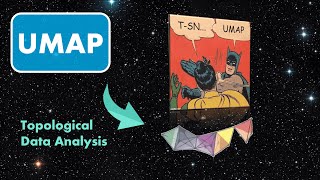
The video discusses Uniform Manifold Approximation and Projection (UMAP) as a dimensionality reduction technique, providing an introduction to Topological Data Analysis (TDA) and its applications, as well as a comparison with t-SNE, and showcasing its implementation using a Colab Notebook.
Original Description
▬▬ Papers / Resources ▬▬▬
Colab Notebook: https://colab.research.google.com/drive/1n_kdyXsA60djl-nTSUxLQTZuKcxkMA83?usp=sharing
Sources:
- TDA Introduction: https://www.frontiersin.org/articles/10.3389/frai.2021.667963/full
- TDA Blogpost: https://chance.amstat.org/2021/04/topological-data-analysis/
- TDA Applications Blogpost: https://orbyta.it/tda-in-a-nutshell-how-can-we-find-multidimensional-voids-and-explore-the-black-boxes-of-deep-learning/
- TDA Intro Paper: https://arxiv.org/pdf/2006.03173.pdf
- Mathematical UMAP Blogpost: https://topos.site/blog/2024-04-05-understanding-umap/
- UMAP Author Talk: https://www.youtube.com/watch?v=nq6iPZVUxZU&ab_channel=Enthought
- UMAP vs. t-SNE Global preservation paper: https://dkobak.github.io/pdfs/kobak2021initialization.pdf
- Fuzzy Topology Slidedeck: https://speakerdeck.com/lmcinnes/umap-uniform-manifold-approximation-and-projection-for-dimension-reduction?slide=39
- Short UMAP Tutorial: https://jyopari.github.io/umap.html
Image Sources:
- Thumbnail Image: https://johncarlosbaez.wordpress.com/2020/02/10/the-category-theory-behind-umap/
- Persistent Homology: https://orbyta.it/tda-in-a-nutshell-how-can-we-find-multidimensional-voids-and-explore-the-black-boxes-of-deep-learning/
▬▬ Support me if you like 🌟
►Link to this channel: https://bit.ly/3zEqL1W
►Support me on Patreon: https://bit.ly/2Wed242
►Buy me a coffee on Ko-Fi: https://bit.ly/3kJYEdl
►E-Mail: deepfindr@gmail.com
▬▬ Used Music ▬▬▬▬▬▬▬▬▬▬▬
Music from #Uppbeat (free for Creators!):
https://uppbeat.io/t/sulyya/weather-compass
License code: ZRGIWRHMLMZMAHQI
▬▬ Used Icons ▬▬▬▬▬▬▬▬▬▬
All Icons are from flaticon: https://www.flaticon.com/authors/freepik
▬▬ Timestamps ▬▬▬▬▬▬▬▬▬▬▬
00:00 Introduction
00:32 Local vs. Global Technqiues
1:25 Is UMAP better?
02:08 The Paper
02:40 Topological Data Analysis Primer
04:04 Simplices
05:04 Filtration
06:22 Persistent Homology
07:02 UMAP Overview
07:40 Step 1: Graph construction
08:25 Uniform distribution
09:44 Non-uniform
AI explanation not available for this lesson yet
This lesson is still being prepared for the AI tutor. In the meantime, explore lessons that are ready.
Browse explainer-ready lessons →
Playlist
Uploads from DeepFindr · DeepFindr · 56 of 56
← Previous
Next →
1
 2
2
 3
3
 4
4
 5
5
 6
6
 7
7
 8
8
 9
9
 10
10
 11
11
 12
12
 13
13
 14
14
 15
15
 16
16
 17
17
 18
18
 19
19
 20
20
 21
21
 22
22
 23
23
 24
24
 25
25
 26
26
 27
27
 28
28
 29
29
 30
30
 31
31
 32
32
 33
33
 34
34
 35
35
 36
36
 37
37
 38
38
 39
39
 40
40
 41
41
 42
42
 43
43
 44
44
 45
45
 46
46
 47
47
 48
48
 49
49
 50
50
 51
51
 52
52
 53
53
 54
54
 55
55
 ▶
▶
Understanding Graph Neural Networks | Part 1/3 - Introduction
DeepFindr
Understanding Graph Neural Networks | Part 2/3 - GNNs and it's Variants
DeepFindr
Understanding Graph Neural Networks | Part 3/3 - Pytorch Geometric and Molecule Data using RDKit
DeepFindr
Node Classification on Knowledge Graphs using PyTorch Geometric
DeepFindr
Understanding Convolutional Neural Networks | Part 1 / 3 - The Basics
DeepFindr
Understanding Convolutional Neural Networks | Part 2 / 3 - Wonders of the world CNN with PyTorch
DeepFindr
Understanding Convolutional Neural Networks | Part 3 / 3 - Transfer Learning and Explainable AI
DeepFindr
How to use edge features in Graph Neural Networks (and PyTorch Geometric)
DeepFindr
Explainable AI explained! | #1 Introduction
DeepFindr
Explainable AI explained! | #2 By-design interpretable models with Microsofts InterpretML
DeepFindr
Explainable AI explained! | #3 LIME
DeepFindr
Explainable AI explained! | #4 SHAP
DeepFindr
Explainable AI explained! | #5 Counterfactual explanations and adversarial attacks
DeepFindr
Explainable AI explained! | #6 Layerwise Relevance Propagation with MRI data
DeepFindr
Understanding Graph Attention Networks
DeepFindr
GNN Project #1 - Introduction to HIV dataset
DeepFindr
GNN Project #2 - Creating a Custom Dataset in Pytorch Geometric
DeepFindr
GNN Project #3.2 - Graph Transformer
DeepFindr
GNN Project #4.1 - Graph Variational Autoencoders
DeepFindr
GNN Project #4.2 - GVAE Training and Adjacency reconstruction
DeepFindr
GNN Project #4.3 - One-shot molecule generation - Part 1
DeepFindr
GNN Project #4.3 - Code explanation
DeepFindr
Machine Learning Model Deployment with Python (Streamlit + MLflow) | Part 1/2
DeepFindr
Machine Learning Model Deployment with Python (Streamlit + MLflow) | Part 2/2
DeepFindr
How to explain Graph Neural Networks (with XAI)
DeepFindr
Explaining Twitch Predictions with GNNExplainer
DeepFindr
Python Graph Neural Network Libraries (an Overview)
DeepFindr
Friendly Introduction to Temporal Graph Neural Networks (and some Traffic Forecasting)
DeepFindr
Traffic Forecasting with Pytorch Geometric Temporal
DeepFindr
Fraud Detection with Graph Neural Networks
DeepFindr
Fake News Detection using Graphs with Pytorch Geometric
DeepFindr
Recommender Systems using Graph Neural Networks
DeepFindr
How to handle Uncertainty in Deep Learning #1.1
DeepFindr
How to handle Uncertainty in Deep Learning #1.2
DeepFindr
How to handle Uncertainty in Deep Learning #2.1
DeepFindr
How to handle Uncertainty in Deep Learning #2.2
DeepFindr
Converting a Tabular Dataset to a Graph Dataset for GNNs
DeepFindr
Converting a Tabular Dataset to a Temporal Graph Dataset for GNNs
DeepFindr
How to get started with Data Science (Career tracks and advice)
DeepFindr
Causality and (Graph) Neural Networks
DeepFindr
Diffusion models from scratch in PyTorch
DeepFindr
Self-/Unsupervised GNN Training
DeepFindr
Contrastive Learning in PyTorch - Part 1: Introduction
DeepFindr
Contrastive Learning in PyTorch - Part 2: CL on Point Clouds
DeepFindr
State of AI 2022 - My Highlights
DeepFindr
Equivariant Neural Networks | Part 1/3 - Introduction
DeepFindr
Equivariant Neural Networks | Part 2/3 - Generalized CNNs
DeepFindr
Equivariant Neural Networks | Part 3/3 - Transformers and GNNs
DeepFindr
Personalized Image Generation (using Dreambooth) explained!
DeepFindr
Vision Transformer Quick Guide - Theory and Code in (almost) 15 min
DeepFindr
LoRA explained (and a bit about precision and quantization)
DeepFindr
Dimensionality Reduction Techniques | Introduction and Manifold Learning (1/5)
DeepFindr
Principal Component Analysis (PCA) | Dimensionality Reduction Techniques (2/5)
DeepFindr
Multidimensional Scaling (MDS) | Dimensionality Reduction Techniques (3/5)
DeepFindr
t-distributed Stochastic Neighbor Embedding (t-SNE) | Dimensionality Reduction Techniques (4/5)
DeepFindr
Uniform Manifold Approximation and Projection (UMAP) | Dimensionality Reduction Techniques (5/5)
DeepFindr
More on: ML Pipelines
View skill →




Related Reads
📰
📰
📰
📰
Research Publications, Patents & Innovation Output at Quantum University
Medium · Machine Learning
Every Researcher Should Start Managing Research Intelligence Assets™
Medium · AI
AC comment and our reply disappeared on OpenReview [D]
Reddit r/MachineLearning
Every Researcher Needs a Research Intelligence Report™
Medium · AI
Chapters (12)
Introduction
0:32
Local vs. Global Technqiues
1:25
Is UMAP better?
2:08
The Paper
2:40
Topological Data Analysis Primer
4:04
Simplices
5:04
Filtration
6:22
Persistent Homology
7:02
UMAP Overview
7:40
Step 1: Graph construction
8:25
Uniform distribution
9:44
Non-uniform
🎓
Tutor Explanation

 DeepCamp AI