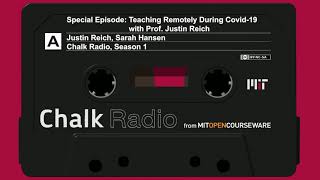
Special Episode: Teaching Remotely During Covid-19 with Prof. Justin Reich
Key Takeaways
The video discusses teaching remotely during Covid-19 with Prof. Justin Reich, covering topics such as emergency remote learning, synchronous and asynchronous learning, and the importance of partnership with students and open educational resources. The conversation highlights the challenges and opportunities of remote learning, including equity issues and the need for strategic learning.
Full Transcript
welcome to a special episode of chalk radio a podcast about inspired teaching at mit from mit open courseware i'm your host sarah hansen in this episode we want to share some insight into the many ways we can transition our traditional learning environments into remote ones we connected with someone whose work even before the pandemic hit has been deeply focused on how learning is changing our conversation started off with what's become a familiar sound for listeners with young ones at home just so you know you might hear some more of this in the background throughout the episode we're all doing the best we can working from home right hey girls anyhow let's jump right in i'm justin reich so i'm an assistant professor in comparative media studies and i run a lab called the teaching systems lab and the mission of the teaching systems lab is to design implement and research the future of teacher learning and we try to figure out new ways for teachers to learn in online and blended ways in his work justin partners with teachers and instructors curriculum designers software developers researchers and experts from across disciplines to help teachers adapt to the changing world of learning since the pandemic has shifted almost all teaching to remote instruction justin's work has adapted to the new needs of instructors i would say the bulk of my teaching energy has gone into helping k-12 educators and education policy makers across the country but most of my work has been trying to provide some guidance for schools and school leaders figuring out what distance learning can look like so for schools and teachers with little or even no experience with online instruction where do they even begin to approach remote learning with so much changing each day what are the most important things educators should be thinking about these are enormously complicated issues to deal with you know while you're trying to feed millions more meals to kids than you ever have before in large districts or big urban school systems while you're trying to help your entire faculty transition almost instantaneously into a new model of learning i mean doing all of these things at the same time is just immensely complicated so i would encourage people to keep it simple that's one principle a second principle is to really think about how you can partner with students and in k-12 with their families so the coronavirus feels like it's something being done to us it feels like something that we have very little control over but our response to the coronavirus can be something that we build together so i would encourage education leaders at every level from you know college provosts to elementary school teachers to school principals superintendents whatever it is asking and partnering with everybody in the system is a really important part of responding to remote learning what most emergency remote learning should look like is kind of a package of asynchronous materials that's coupled with lots of frequent check-ins synchronous versus asynchronous teaching or offering learning experiences at a specific time versus providing students who have the material to engage with on their own time is at the core of justin's message for teachers so in lots of circumstances synchronous learning is not going to work for people it's hard for all of us to line up our schedules in k-12 circumstances you know you've got a teacher who's got a first grader a fourth grader and a seventh grader who's trying to teach her kids who are ninth graders but they have siblings who are third graders and fourth graders and twelfth graders and trying to line up all those schedules so that people can be synchronously in front of the one computer that exists in a household or to use the amount of bandwidth because your home only you know allows one synchronous video call to happen at a time it's just too complicated so for the most part what educators should be thinking of setting up is some kind of package of curriculum that lasts about a week or two maybe with some sort of daily guides of what people might be doing each day recognizing that people might have to do two days of work in one day because they get busy with other stuff for another day or things like that and then providing frequent points of check-in so a huge part of what motivates us as learners is when we're getting feedback on what we're doing and this doesn't have to be based around grades or numbers or other things like that just that was a great idea keep that up tell me more about that wow it looks like you did more on this assignment than anyone you've done before what else could you do with this how could you take this further it seems like you're interested in this shifting so heavily toward asynchronous teaching might feel strange at first but this one change may address in a small way some of the equity issues school systems and individuals are facing right now such as differing access to dependable wi-fi there's no survey that was done in advance of the pandemic that asked questions like do you have one device for each school age child or learner in your home and a broadband connection and a printer to be able to print things out like we actually don't know how well families are equipped for this pandemic but it's pretty clear that a lot of our low-income housing is in broadband deserts or isn't networked in i mean there's lots of people in urban environments who in their typical daily lives can get by you know with having one mobile broadband device in their house and that's plenty but now if you've got three school-aged kids at home your demands have just increased substantially but i think partnering with students i think really thinking about who are the most vulnerable learners in our community there are some people who come from affluent well-equipped homes and they're able to weather this crisis in a very different way than if you're going back into a poverty impacted place that is really feeling the effects of the recession and the coronavirus i think the students that aren't reaching out i think the ones that that are not doing well i think we have a special i think we always have this responsibility but i think during a pandemic we have a special responsibility to reach out to those students and say how can i help you with this how can i keep you on track and helping students stay on track is another big part of the puzzle for a lot of educators out there especially for classes that form the foundations for later learning i mean i think the other thing that universities and other places need to do is be strategic about what it is that we want students to be able to learn so if you were to go across the ocw catalog i think you would find at least two types of courses one type of course is where to study a discipline you sample from a canon so literature is the most obvious example of this but i think it appears in stem classes and other places as well if you were to take a shakespeare class at mit you wouldn't read all of shakespeare's work you would read some selected sample of that work and we would probably be willing to say you know we read uh romeo and juliet and twelfth night and a couple sonnets before we left and we were gonna do that much work again in the fourth quarter but actually this time we're just gonna read henry v and we'll do it a little bit more slowly and that'll be fine you know that is that is a less of a sampling of the canon that we would have done previously but it's a perfectly reasonable sampling of the canon will give you your emergency pass grade everything is fine there are other courses in which there's a sequential building of material of understanding in which subsequent courses depend upon that sampling of understanding so our introduction to statistics class it's not suitable to say to a student that we're just going to do you know half of multiple regression and we're just not going to teach you the other half or figure it out on their own i mean one of the things that i think at the department level or at other levels people need to do is to say there are some courses that we strategically reduced and those young people will be fine for the rest of their lives and we don't have to worry about it there are other courses that we had to strategically reduce in a pandemic but we've got to figure out how we support students in learning that material so they don't show up at intermediate statistics in the fall without the preparation that they need to be successful and still the sort of lingering effects of the pandemic so that's a kind of strategic question it's probably best resolved at the department level you know something along the lines of who are the students in our core classes that we think missed learning materials that they really are gonna need and how are we gonna supplement over the summer or right when people come back in august or in the fall or whatever the new model looks like to identify the areas in which it's not okay to just uh strategically reduce but instead we got to figure out how we help people get the learning that they need to be successful in subsequent courses when i asked justin about putting new teaching approaches into practice and developing materials to support educators during covet 19 we got to talking about education at scale from the system as a whole to each individual participant there's such a wide range of needs and no one prescription for addressing them all and in a time when teachers should be focusing on partnering with students and families and identifying how to strategically reduce and recover content area material open educational resources may have an important role to play students differ so much from place to place you know one of the things that i'm seeing is that a lot of big districts are creating sort of sample lessons sample schedules those kinds of things but my initial evidence is that a lot of teachers aren't using them not necessarily because they're bad or wrong but just because they like aren't right for where their kids are right now and so you know a lot of teachers feel the need to be basically kind of invent you know inventing their own new distance learning curriculum as they're learning a whole series of new practices and co-inventing them with their students and you know finding the 40 of their kids who aren't answering emails or responding to phone calls and you know facilitating their own kids instruction at home i mean i think that's something that people really need to keep in mind but i would say that if schools are facing waves of closure in the fall or other kinds of challenges like this i would really encourage people to say even though it's not exactly the way i would want to teach it there may be a better comparative advantage for faculty members to focus on that check-in that facilitation role rather than trying to sort of generate original content by video you know without a studio and without all the other resources that we need or consider you know doing less of that consider saying oh i like you know in my solid state chemistry course i can find these mit open courseware videos and six of the ten lectures are great um and i'm gonna only record four for the period that we have to miss in the fall or other kinds of things like that um you know i mean i think one of the things that we've discovered is that faculty find it very difficult to identify whole online courses that they like to just take and sort of use as textbooks but it strikes me that a pandemic is exactly the sort of time in which people might want to employ that kind of thinking one of the most important factors in determining our best way forward is looking at how we actually measure the success of remote learning who do we look to for guidance and models of what is best right now it's not as simple as it might seem so we just did this report about the remote learning guidance offered by all 50 states and one of the cautions that we have in the report is there are good reasons to believe that lots of teachers are not doing what this says that educational systems are what we call loosely coupled so there are tightly coupled systems in our society like the military if a general in the military says everyone's hair should be shorter than x inches then you know within weeks there will be you know hundreds of thousands of soldiers around the world whose hair is shorter than those number of inches teaching is not like that education policy policymakers leaders all the time make edicts and teachers shift through them and they apply them as they see fit in their own context for a variety of reasons and because of the incredible granularity of teaching in a lot of cases we just don't know what's happening at the classroom level i think most of the places that we say are doing a good job of remote learning their primary characteristic is that they are affluent one way you can do a good job of remote learning is have a bunch of kids in stable homes with broadband internet connections who each have their own device and if those conditions exist then you will have a thing that looks a lot like good learning if those conditions don't exist regardless of the heroic effort of teachers you will have things that look like less effective learning the way that my colleague trustee mcmillan cotton said this is like the number one thing that education has to reduce inequality is the school the school is the thing that we've lost and there's not a mechanism to like rapidly make up uh those sort of equalizing forces so so that's a long way of saying that i don't think i know of places that i would say wow these folks are doing a really great job addressing this i think one measure that people are using to define a good job is who can do things most quickly who can get the thing that looks closest to what school looked like before up and running the fastest i'm not convinced at the end of this that that will end up being a good proxy for better and in the end it seems like better learning while we are at home simply looks different than what we're used to and the more we can embrace that the better off we as parents students and educators may be i've encouraged both families and educators to if possible not put too much stock in trying to recreate school at home there are lots of things that schools can do in their local environments that are going to be really hard to replicate in a home environment but there's lots of learning that can happen at home and what we need to do is as best we can cultivate and celebrate that learning i was interviewed recently by a reporter from the arctic sounder which is the newspaper of the north slope of alaska very bad connectivity up there and so remote learning is not going to look like what it looks like in an affluent boston suburb and what a lot of teachers there were saying is like look this is a great time for families to strengthen their connection to traditional anupiak values this is a great time for kids to learn how to cook and bake and sew and bead and repair snow machines and do all the kinds of learning that can happen really well at home so i think you know to families out there that are sort of struggling during this period it is totally normal to struggle during a pandemic if you if you feel like this is hard and is anxiety provoking that is normal and lots of people feel that way and i think our goals we can't put too much pressure on ourselves about keeping up and staying up and things like that think about what can you do to maximize the learning and the resilience that happens right now and if part of what we do to do that is like teach our kids new chores you know if it's if it's time for those nine and ten year olds to start doing their first load of laundry or their six or seven year olds to do their first sink of dishes like that's great learning too that we can do really well at the home and we could probably do some reading and some math and and some social studies and science along the way too you know and some some of that relates to the first piece of advice that i offered before which is let's partner with our learners and if those letters happen to be our own kids you know so much the better to be partnering with them [Music] if you're interested in learning more about teaching remotely during the covet 19 pandemic check out justin's wbur on point interview where he talks about how colleges and universities are teaching students virtually we've provided a link to that in our show notes justin also hosts teach lab a new podcast that explores the art and craft of teaching several of the show's recent episodes focus on teaching during covid19 that link can be found in the show notes as well if open educational resources are important in your practice of teaching or learning particularly now during covet 19 please consider supporting the work of mit open courseware there are lots of ways to do this one is simply by listening to this podcast and sharing it with a friend you can also share the ocw website with your colleagues and we really love hearing about how you use ocw materials because we use your stories to inspire others to make use of who we are or if you'd like to help fund our work please visit our website to make a gift however you can support us we thank you until next time please stay safe i'm sarah hansen from mit open courseware
Original Description
MIT Chalk Radio, Season 1
Speakers: Justin Reich, Sarah Hansen
Subscribe here _ https://chalk-radio.simplecast.com/
YouTube Playlist: https://www.youtube.com/playlist?list=PLUl4u3cNGP63YwKIMA9K08FFvdeBEl6Lo
Join us as we talk with Justin Reich, assistant professor in comparative media studies at MIT. Professor Reich runs the Teaching Systems Lab, which was founded with the mission of designing, implementing, and researching the future of teacher learning. With the emergence of the current coronavirus pandemic, Prof. Reich has been turning his attention to helping teachers and education policy makers figure out how to transition rapidly to remote learning. In this special episode of Chalk Radio, Prof. Reich discusses the need for teachers to use a balance between asynchronous materials and synchronous check-ins, the challenge of making home learning equitable for students, and the value of existing open educational resources (like the materials on OCW!) for teachers who are suddenly forced to teach their classes remotely. “It’s totally normal to struggle during a pandemic,” Reich says, but he reassures teachers and parents that effective education at home may look different from effective in-school education—we simply need to recognize and cultivate the kinds of learning that can happen best under these extraordinary circumstances.
Relevant Resources:
MIT OpenCourseWare
https://ocw.mit.edu/index.htm?utm_source=simplecast&utm_medium=shownotes&utm_campaign=chalkradio&utm_term=s1eS
The OCW Educator Portal
https://ocw.mit.edu/educator/?utm_source=simplecast&utm_medium=shownotes&utm_campaign=chalkradio&utm_term=s1eS
The Teaching Systems Lab
https://tsl.mit.edu
Professor Reich’s TeachLab podcast
https://teachlabpodcast.com
Professor Reich’s faculty page
https://cmsw.mit.edu/profile/justin-reich/
Interview with Prof. Reich on WBUR’s “On Point”
https://www.wbur.org/onpoint/2020/03/24/online-learning-colleges-educating-students-virtually
Resources, tools, an
Playlist
Uploads from MIT OpenCourseWare · MIT OpenCourseWare · 31 of 60
1
 2
2
 3
3
 4
4
 5
5
 6
6
 7
7
 8
8
 9
9
 10
10
 11
11
 12
12
 13
13
 14
14
 15
15
 16
16
 17
17
 18
18
 19
19
 20
20
 21
21
 22
22
 23
23
 24
24
 25
25
 26
26
 27
27
 28
28
 29
29
 30
30
 ▶
▶
 32
32
 33
33
 34
34
 35
35
 36
36
 37
37
 38
38
 39
39
 40
40
 41
41
 42
42
 43
43
 44
44
 45
45
 46
46
 47
47
 48
48
 49
49
 50
50
 51
51
 52
52
 53
53
 54
54
 55
55
 56
56
 57
57
 58
58
 59
59
 60
60

21. Post Trade Clearing, Settlement & Processing
MIT OpenCourseWare
10. Financial System Challenges & Opportunities
MIT OpenCourseWare
7. Technical Challenges
MIT OpenCourseWare
3. Blockchain Basics & Cryptography
MIT OpenCourseWare
19. Primary Markets, ICOs & Venture Capital, Part 1
MIT OpenCourseWare
1. Introduction for 15.S12 Blockchain and Money, Fall 2018
MIT OpenCourseWare
Chalk Radio, A Podcast about Inspired Teaching at MIT (Teaser)
MIT OpenCourseWare
Nuclear Gets Personal with Prof. Michael Short (S1:E1)
MIT OpenCourseWare
How Africa Has Been Made to Mean with Prof. Amah Edoh (S1:E2)
MIT OpenCourseWare
Making Deep Learning Human with Prof. Gilbert Strang (S1:E3)
MIT OpenCourseWare
Social Impact at Scale, One Project at a Time with Dr. Anjali Sastry (S1:E4)
MIT OpenCourseWare
Film is for Everyone with Prof. David Thorburn (S1:E5)
MIT OpenCourseWare
Lecture 12: Aircraft Performance
MIT OpenCourseWare
Lecture 3: Learning to Fly
MIT OpenCourseWare
Lecture 13: Interpreting Weather Data
MIT OpenCourseWare
Lecture 21: Weather Minimums and Final Tips
MIT OpenCourseWare
Hand-on, Minds On with Dr. Christopher Terman (S1:E6)
MIT OpenCourseWare
Part 4: Eigenvalues and Eigenvectors
MIT OpenCourseWare
Part 5: Singular Values and Singular Vectors
MIT OpenCourseWare
Part 3: Orthogonal Vectors
MIT OpenCourseWare
Part 2: The Big Picture of Linear Algebra
MIT OpenCourseWare
Part 1: The Column Space of a Matrix
MIT OpenCourseWare
Intro: A New Way to Start Linear Algebra
MIT OpenCourseWare
9. Chromatin Remodeling and Splicing
MIT OpenCourseWare
28. Visualizing Life - Fluorescent Proteins
MIT OpenCourseWare
20. Roth's theorem III: polynomial method and arithmetic regularity
MIT OpenCourseWare
8. Szemerédi's graph regularity lemma III: further applications
MIT OpenCourseWare
19. Roth's theorem II: Fourier analytic proof in the integers
MIT OpenCourseWare
12. Pseudorandom graphs II: second eigenvalue
MIT OpenCourseWare
1. A bridge between graph theory and additive combinatorics
MIT OpenCourseWare
Special Episode: Teaching Remotely During Covid-19 with Prof. Justin Reich
MIT OpenCourseWare
Spring 2020 Update from Dean Rajagopal
MIT OpenCourseWare
S1E7: Unpacking Misconceptions about Language & Identities with Prof. Michel DeGraff
MIT OpenCourseWare
Climate 101 Live
MIT OpenCourseWare
Welcome for Volunteers (for EarthDNA's Climate 101)
MIT OpenCourseWare
Learning to Fly with Drs. Philip Greenspun & Tina Srivastava (S1:E8)
MIT OpenCourseWare
Thinking Like an Economist with Prof. Jonathan Gruber (S1:E9)
MIT OpenCourseWare
2. Cyber Network Data Processing; AI Data Architecture
MIT OpenCourseWare
1. Artificial Intelligence and Machine Learning
MIT OpenCourseWare
2: Resistor Capacitor Circuit and Nernst Potential - Intro to Neural Computation
MIT OpenCourseWare
14: Rate Models and Perceptrons - Intro to Neural Computation
MIT OpenCourseWare
4: Hodgkin-Huxley Model Part 1 - Intro to Neural Computation
MIT OpenCourseWare
18: Recurrent Networks - Intro to Neural Computation
MIT OpenCourseWare
3: Resistor Capacitor Neuron Model - Intro to Neural Computation
MIT OpenCourseWare
15: Matrix Operations - Intro to Neural Computation
MIT OpenCourseWare
13: Spectral Analysis Part 3 - Intro to Neural Computation
MIT OpenCourseWare
16: Basis Sets - Intro to Neural Computation
MIT OpenCourseWare
20: Hopfield Networks - Intro to Neural Computation
MIT OpenCourseWare
8: Spike Trains - Intro to Neural Computation
MIT OpenCourseWare
7: Synapses - Intro to Neural Computation
MIT OpenCourseWare
19: Neural Integrators - Intro to Neural Computation
MIT OpenCourseWare
5: Hodgkin-Huxley Model Part 2 - Intro to Neural Computation
MIT OpenCourseWare
6: Dendrites - Intro to Neural Computation
MIT OpenCourseWare
17: Principal Components Analysis_ - Intro to Neural Computation
MIT OpenCourseWare
12: Spectral Analysis Part 2 - Intro to Neural Computation
MIT OpenCourseWare
11: Spectral Analysis Part 1 - Intro to Neural Computation
MIT OpenCourseWare
9: Receptive Fields - Intro to Neural Computation
MIT OpenCourseWare
10: Time Series - Intro to Neural Computation
MIT OpenCourseWare
1: Course Overview and Ionic Currents - Intro to Neural Computation
MIT OpenCourseWare
The Power of OER with Profs. Mary Rowe and Elizabeth Siler (S1:E10)
MIT OpenCourseWare
Related Reads
📰
📰
📰
📰
Why India’s $30 Billion EdTech Boom Failed Independent Teachers — And What Comes Next
Medium · Startup
Future of Special Education Specialists in Modern Education | USA Career Outlook 2026
Dev.to · every special child usa
School ERP Architecture Development: Building a Multi-Tenant ERP System for Modern Schools
Dev.to · jaiton bangalore
Why teachers worldwide are switching to AI lesson planning
Dev.to AI
🎓
Tutor Explanation

 DeepCamp AI