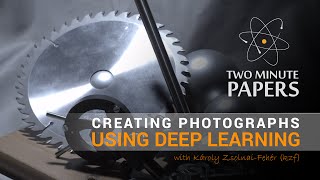
Creating Photographs Using Deep Learning | Two Minute Papers #13
Skills:
Generative CV90%
Key Takeaways
Deep learning is used to create photographs with unknown light source positions
Full Transcript
[Music] dear fellow scholar this is 2minute papers with K here in this work we place a small light source to a chosen point in a scene and record a photograph of how things look like with the given placement then we place the light source to a new position and record an image again we repeat this process several times then after we have done that we have the question what would the photograph look like if I put the light source to places I haven't seen yet this process we call Image relighting this work uses new neural networks to do relighting by learning how different light source placements behave if you haven't heard about neural networks before make sure to check out our previous episodes on the topic I have put links for you in the description box after the training this technique guesses how completely unknown light source setups would look like in reality we give the algorithm a light source position we haven't seen yet and it will generate us a photograph of how it would look like in reality and the first question is okay but how well does it do the job up I am not sure if you're going to believe this one as you will be witnessing some magnificent results on the left you'll see real photographs and on the right reconstructions that are basically the guesses of the algorithm note that it doesn't know how the photograph would look like it has to generate new photographs based on the knowledge that it has from seeing other photos and it's completely indistinguishable from reality this is especially difficult in the presence of the so-called highfrequency lighting effects The High Frequency part means that if we change the light source just a bit there may be very large changes in the output image such a thing can happen when a light source is moved very slightly but is suddenly hidden behind an object therefore our photograph changes drastically the proposed technique uses ensembles it means that multiple neural networks are trained and their guesses are averag to get better results what do you do if you go to the doctor and he says you have a very severe and very unlikely condition well you go and ask multiple doctors and see if they say the same thing it is reasonable to expect that the more doctors you ask the clearer you will see and this is exactly what the algorithm does now look at this on the left side there's a real photo and on the right the guess of the algorithm after training can you believe it you can barely see the difference and this is a failure case the success story scenarios for many techniques are not as good as the failure cases here these results are absolutely stunning the algorithm can also deal with multiple light sources of different [Music] colors as you can see machine learning techniques such as deep neural networks have opened so many doors in research lately we are starting to solve problems that everyone agreed were absolutely impossible before we are currently over 2 ,000 subscribers our club of Scholars is growing at a really rapid Pace please share the series so we can reach people that don't know about us yet let's draw them in and show them how cool research really is thanks for watching and I'll see you next time
Original Description
Machine learning techniques such as deep learning artificial neural networks had proven to be extremely useful for a variety of tasks that were previously deemed very difficult, or even impossible to solve. In this work, a deep learning technique is used to learn how different light source positions affect a scene and create ("guess") new photographs with unknown light source positions. The results are absolutely stunning. The promised links for artificial neural networks follow below.
__________________________________
The paper "Image Based Relighting Using Neural Networks" is available here:
http://research.microsoft.com/en-us/um/people/yuedong/project/neuralibr/neuralibr.htm
Disclaimer: I was not part of this research project, I am merely providing commentary on this work.
Recommended for you:
Artificial Neural Networks and Deep Learning - https://www.youtube.com/watch?v=rCWTOOgVXyE
Deep Neural Network Learns Van Gogh's Art - https://www.youtube.com/watch?v=-R9bJGNHltQ
Music: "The Place Inside" by Silent Partner
Subscribe if you would like to see more of these! - http://www.youtube.com/subscription_center?add_user=keeroyz
Splash screen/thumbnail design: Felícia Fehér - http://felicia.hu
The thumbnail background was taken from the paper "Image Based Relighting Using Neural Networks".
Károly Zsolnai-Fehér's links:
Patreon → https://www.patreon.com/TwoMinutePapers
Facebook → https://www.facebook.com/TwoMinutePapers/
Web → https://cg.tuwien.ac.at/~zsolnai/
Twitter → https://twitter.com/karoly_zsolnai
Watch on YouTube ↗
(saves to browser)
Sign in to unlock AI tutor explanation · ⚡30
Playlist
Uploads from Two Minute Papers · Two Minute Papers · 15 of 60
1
 2
2
 3
3
 4
4
 5
5
 6
6
 7
7
 8
8
 9
9
 10
10
 11
11
 12
12
 13
13
 14
14
 ▶
▶
 16
16
 17
17
 18
18
 19
19
 20
20
 21
21
 22
22
 23
23
 24
24
 25
25
 26
26
 27
27
 28
28
 29
29
 30
30
 31
31
 32
32
 33
33
![Artificial Superintelligence [Audio only] | Two Minute Papers #29](https://i.ytimg.com/vi/08V_F19HUfI/mqdefault.jpg) 34
34
 35
35
![Randomness and Bell's Inequality [Audio only] | Two Minute Papers #31](https://i.ytimg.com/vi/674DL39dOOQ/mqdefault.jpg) 36
36
 37
37
 38
38
 39
39
![Peer Review #1 [Audio only] | Two Minute Papers](https://i.ytimg.com/vi/zzwCbhI2iOA/mqdefault.jpg) 40
40
 41
41
 42
42
 43
43
 44
44
 45
45
 46
46
 47
47
 48
48
 49
49
 50
50
 51
51
 52
52
 53
53
 54
54
 55
55
 56
56
 57
57
 58
58
 59
59
 60
60

Fluid Simulations with Blender and Wavelet Turbulence | Two Minute Papers #1
Two Minute Papers
Capturing Waves of Light With Femto-photography | Two Minute Papers #2
Two Minute Papers
Artificial Neural Networks and Deep Learning | Two Minute Papers #3
Two Minute Papers
Blender Rendering - Top 7 LuxRender Features
Two Minute Papers
Simulating Breaking Glass | Two Minute Papers #4
Two Minute Papers
Time Lapse Videos From Community Photos | Two Minute Papers #5
Two Minute Papers
AI Learns Van Gogh's Art
Two Minute Papers
Hydrographic Printing | Two Minute Papers #7
Two Minute Papers
Announcing LuxRender 1.5
Two Minute Papers
Digital Creatures Learn To Walk | Two Minute Papers #8
Two Minute Papers
Manipulating Photorealistic Renderings | Two Minute Papers #9
Two Minute Papers
Adaptive Fluid Simulations | Two Minute Papers #10
Two Minute Papers
Building Bridges With Flying Machines | Two Minute Papers #11
Two Minute Papers
Reconstructing Sound From Vibrations | Two Minute Papers #12
Two Minute Papers
Creating Photographs Using Deep Learning | Two Minute Papers #13
Two Minute Papers
Adaptive Cloth Simulations | Two Minute Papers #14
Two Minute Papers
Synthesizing Sound From Collisions | Two Minute Papers #15
Two Minute Papers
Metropolis Light Transport | Two Minute Papers #16
Two Minute Papers
3D Printing a Glockenspiel | Two Minute Papers #17
Two Minute Papers
Modeling Colliding and Merging Fluids | Two Minute Papers #18
Two Minute Papers
Recurrent Neural Network Writes Music and Shakespeare Novels | Two Minute Papers #19
Two Minute Papers
Gradients, Poisson's Equation and Light Transport | Two Minute Papers #20
Two Minute Papers
Real-Time Facial Expression Transfer | Two Minute Papers #21
Two Minute Papers
Automatic Lecture Notes From Videos | Two Minute Papers #22
Two Minute Papers
Be a Part of Two Minute Papers on Patreon!
Two Minute Papers
Recurrent Neural Network Writes Sentences About Images | Two Minute Papers #23
Two Minute Papers
How Does Deep Learning Work? | Two Minute Papers #24
Two Minute Papers
Cryptography, Perfect Secrecy and One Time Pads | Two Minute Papers #25
Two Minute Papers
Terrain Traversal with Reinforcement Learning | Two Minute Papers #26
Two Minute Papers
Multiple-Scattering Microfacet BSDFs with the Smith Model
Two Minute Papers
Google DeepMind's Deep Q-Learning & Superhuman Atari Gameplays | Two Minute Papers #27
Two Minute Papers
Are We Living In a Computer Simulation? | Two Minute Papers #28
Two Minute Papers
Artificial Superintelligence [Audio only] | Two Minute Papers #29
Two Minute Papers
Automatic Parameter Control for Metropolis Light Transport | Two Minute Papers #30
Two Minute Papers
Randomness and Bell's Inequality [Audio only] | Two Minute Papers #31
Two Minute Papers
OpenAI - Non-profit AI company by Elon Musk and Sam Altman
Two Minute Papers
How Do Genetic Algorithms Work? | Two Minute Papers #32
Two Minute Papers
Painting with Fluid Simulations | Two Minute Papers #33
Two Minute Papers
Peer Review #1 [Audio only] | Two Minute Papers
Two Minute Papers
Neural Programmer-Interpreters Learn To Write Programs | Two Minute Papers #34
Two Minute Papers
9 Cool Deep Learning Applications | Two Minute Papers #35
Two Minute Papers
Designing Cities and Furnitures With Machine Learning | Two Minute Papers #36
Two Minute Papers
Designing 3D Printable Robotic Creatures | Two Minute Papers #37
Two Minute Papers
3D Printing Objects With Caustics | Two Minute Papers #38
Two Minute Papers
Interactive Editing of Subsurface Scattering | Two Minute Papers #39
Two Minute Papers
Simulating Viscosity and Melting Fluids | Two Minute Papers #40
Two Minute Papers
What Do Virtual Objects Sound Like? | Two Minute Papers #41
Two Minute Papers
How DeepMind Conquered Go With Deep Learning (AlphaGo) | Two Minute Papers #42
Two Minute Papers
Breaking Deep Learning Systems With Adversarial Examples | Two Minute Papers #43
Two Minute Papers
Extrapolations and Crowdfunded Research (Experiment) | Two Minute Papers #44
Two Minute Papers
Biophysical Skin Aging Simulations | Two Minute Papers #45
Two Minute Papers
What is Impostor Syndrome? | Two Minute Papers #46
Two Minute Papers
Should You Take the Stairs at Work? (For Weight Loss) | Two Minute Papers #47
Two Minute Papers
Artistic Manipulation of Caustics | Two Minute Papers #48
Two Minute Papers
Deep Learning Program Learns to Paint | Two Minute Papers #49
Two Minute Papers
Interactive Photo Recoloring | Two Minute Papers #50
Two Minute Papers
How To Get Started With Machine Learning? | Two Minute Papers #51
Two Minute Papers
Awesome Research For Everyone! - Two Minute Papers Channel Trailer
Two Minute Papers
10 More Cool Deep Learning Applications | Two Minute Papers #52
Two Minute Papers
How DeepMind's AlphaGo Defeated Lee Sedol | Two Minute Papers #53
Two Minute Papers
More on: Generative CV
View skill →





Related Reads
📰
📰
📰
📰
Programming Assignments: A Complete Guide to Solving Coding Problems Faster and Smarter
Medium · Programming
Design and Validation of a Lightweight 1D CNN for Affective Touch Classification in Soft Plush Companions
ArXiv cs.AI
How I Auto-Groomed 500 Jira Tickets with ML and LLM
Medium · Machine Learning
Day 161 of Learning Java & DSA: Solving the Largest Rectangle in a Histogram Using Stack
Medium · Programming
🎓
Tutor Explanation

 DeepCamp AI