Let's build the GPT Tokenizer
Key Takeaways
The video demonstrates building the GPT Tokenizer from scratch, covering the Byte Pair Encoding algorithm, tokenization issues, and implementation details. It also explores the importance of tokenization in Large Language Models and its potential problems.
Original Description
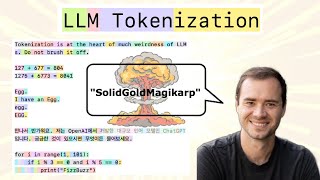
The Tokenizer is a necessary and pervasive component of Large Language Models (LLMs), where it translates between strings and tokens (text chunks). Tokenizers are a completely separate stage of the LLM pipeline: they have their own training sets, training algorithms (Byte Pair Encoding), and after training implement two fundamental functions: encode() from strings to tokens, and decode() back from tokens to strings. In this lecture we build from scratch the Tokenizer used in the GPT series from OpenAI. In the process, we will see that a lot of weird behaviors and problems of LLMs actually trace back to tokenization. We'll go through a number of these issues, discuss why tokenization is at fault, and why someone out there ideally finds a way to delete this stage entirely.
Chapters:
00:00:00 intro: Tokenization, GPT-2 paper, tokenization-related issues
00:05:50 tokenization by example in a Web UI (tiktokenizer)
00:14:56 strings in Python, Unicode code points
00:18:15 Unicode byte encodings, ASCII, UTF-8, UTF-16, UTF-32
00:22:47 daydreaming: deleting tokenization
00:23:50 Byte Pair Encoding (BPE) algorithm walkthrough
00:27:02 starting the implementation
00:28:35 counting consecutive pairs, finding most common pair
00:30:36 merging the most common pair
00:34:58 training the tokenizer: adding the while loop, compression ratio
00:39:20 tokenizer/LLM diagram: it is a completely separate stage
00:42:47 decoding tokens to strings
00:48:21 encoding strings to tokens
00:57:36 regex patterns to force splits across categories
01:11:38 tiktoken library intro, differences between GPT-2/GPT-4 regex
01:14:59 GPT-2 encoder.py released by OpenAI walkthrough
01:18:26 special tokens, tiktoken handling of, GPT-2/GPT-4 differences
01:25:28 minbpe exercise time! write your own GPT-4 tokenizer
01:28:42 sentencepiece library intro, used to train Llama 2 vocabulary
01:43:27 how to set vocabulary set? revisiting gpt.py transformer
01:48:11 training new tokens, example of prompt compression
0
Watch on YouTube ↗
(saves to browser)
Sign in to unlock AI tutor explanation · ⚡30
Playlist
Uploads from Andrej Karpathy · Andrej Karpathy · 14 of 17
1
 2
2
 3
3
 4
4
 5
5
 6
6
 7
7
 8
8
 9
9
 10
10
 11
11
 12
12
 13
13
![[1hr Talk] Intro to Large Language Models](https://img.youtube.com/vi/zjkBMFhNj_g/mqdefault.jpg) ▶
▶
 15
15
 16
16
 17
17

Stable diffusion dreams of steam punk neural networks
Andrej Karpathy
Stable diffusion dreams of "blueberry spaghetti" for one night
Andrej Karpathy
The spelled-out intro to neural networks and backpropagation: building micrograd
Andrej Karpathy
Stable diffusion dreams of tattoos
Andrej Karpathy
Stable diffusion dreams of steampunk brains
Andrej Karpathy
Stable diffusion dreams of psychedelic faces
Andrej Karpathy
The spelled-out intro to language modeling: building makemore
Andrej Karpathy
Building makemore Part 2: MLP
Andrej Karpathy
Building makemore Part 3: Activations & Gradients, BatchNorm
Andrej Karpathy
Building makemore Part 4: Becoming a Backprop Ninja
Andrej Karpathy
Building makemore Part 5: Building a WaveNet
Andrej Karpathy
Let's build GPT: from scratch, in code, spelled out.
Andrej Karpathy
[1hr Talk] Intro to Large Language Models
Andrej Karpathy
Let's build the GPT Tokenizer
Andrej Karpathy
Let's reproduce GPT-2 (124M)
Andrej Karpathy
Deep Dive into LLMs like ChatGPT
Andrej Karpathy
How I use LLMs
Andrej Karpathy
More on: LLM Foundations
View skill →






![Run Any AI LOCALLY for FREE Forever! [100% Beginner Tutorial]](https://i.ytimg.com/vi/8GFPZRgtEn8/mqdefault.jpg)
Related Reads
Chapters (21)
intro: Tokenization, GPT-2 paper, tokenization-related issues
5:50
tokenization by example in a Web UI (tiktokenizer)
14:56
strings in Python, Unicode code points
18:15
Unicode byte encodings, ASCII, UTF-8, UTF-16, UTF-32
22:47
daydreaming: deleting tokenization
23:50
Byte Pair Encoding (BPE) algorithm walkthrough
27:02
starting the implementation
28:35
counting consecutive pairs, finding most common pair
30:36
merging the most common pair
34:58
training the tokenizer: adding the while loop, compression ratio
39:20
tokenizer/LLM diagram: it is a completely separate stage
42:47
decoding tokens to strings
48:21
encoding strings to tokens
57:36
regex patterns to force splits across categories
1:11:38
tiktoken library intro, differences between GPT-2/GPT-4 regex
1:14:59
GPT-2 encoder.py released by OpenAI walkthrough
1:18:26
special tokens, tiktoken handling of, GPT-2/GPT-4 differences
1:25:28
minbpe exercise time! write your own GPT-4 tokenizer
1:28:42
sentencepiece library intro, used to train Llama 2 vocabulary
1:43:27
how to set vocabulary set? revisiting gpt.py transformer
1:48:11
training new tokens, example of prompt compression
🎓
Tutor Explanation

 DeepCamp AI