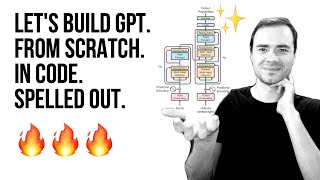
Let's build GPT: from scratch, in code, spelled out.
Key Takeaways
This video builds a Generatively Pretrained Transformer (GPT) from scratch, following the paper 'Attention is All You Need' and OpenAI's GPT-2 / GPT-3, using PyTorch and GitHub Copilot to write the code.
Original Description
We build a Generatively Pretrained Transformer (GPT), following the paper "Attention is All You Need" and OpenAI's GPT-2 / GPT-3. We talk about connections to ChatGPT, which has taken the world by storm. We watch GitHub Copilot, itself a GPT, help us write a GPT (meta :D!) . I recommend people watch the earlier makemore videos to get comfortable with the autoregressive language modeling framework and basics of tensors and PyTorch nn, which we take for granted in this video.
Links:
- Google colab for the video: https://colab.research.google.com/drive/1JMLa53HDuA-i7ZBmqV7ZnA3c_fvtXnx-?usp=sharing
- GitHub repo for the video: https://github.com/karpathy/ng-video-lecture
- Playlist of the whole Zero to Hero series so far: https://www.youtube.com/watch?v=VMj-3S1tku0&list=PLAqhIrjkxbuWI23v9cThsA9GvCAUhRvKZ
- nanoGPT repo: https://github.com/karpathy/nanoGPT
- my website: https://karpathy.ai
- my twitter: https://twitter.com/karpathy
- our Discord channel: https://discord.gg/3zy8kqD9Cp
Supplementary links:
- Attention is All You Need paper: https://arxiv.org/abs/1706.03762
- OpenAI GPT-3 paper: https://arxiv.org/abs/2005.14165
- OpenAI ChatGPT blog post: https://openai.com/blog/chatgpt/
- The GPU I'm training the model on is from Lambda GPU Cloud, I think the best and easiest way to spin up an on-demand GPU instance in the cloud that you can ssh to: https://lambdalabs.com . If you prefer to work in notebooks, I think the easiest path today is Google Colab.
Suggested exercises:
- EX1: The n-dimensional tensor mastery challenge: Combine the `Head` and `MultiHeadAttention` into one class that processes all the heads in parallel, treating the heads as another batch dimension (answer is in nanoGPT).
- EX2: Train the GPT on your own dataset of choice! What other data could be fun to blabber on about? (A fun advanced suggestion if you like: train a GPT to do addition of two numbers, i.e. a+b=c. You may find it helpful to predict the digits of c in reverse order, as the typica
Watch on YouTube ↗
(saves to browser)
Sign in to unlock AI tutor explanation · ⚡30
Playlist
Uploads from Andrej Karpathy · Andrej Karpathy · 12 of 17
1
 2
2
 3
3
 4
4
 5
5
 6
6
 7
7
 8
8
 9
9
 10
10
 11
11
 ▶
▶
 13
13
![[1hr Talk] Intro to Large Language Models](https://img.youtube.com/vi/zjkBMFhNj_g/mqdefault.jpg) 14
14
 15
15
 16
16
 17
17

Stable diffusion dreams of steam punk neural networks
Andrej Karpathy
Stable diffusion dreams of "blueberry spaghetti" for one night
Andrej Karpathy
The spelled-out intro to neural networks and backpropagation: building micrograd
Andrej Karpathy
Stable diffusion dreams of tattoos
Andrej Karpathy
Stable diffusion dreams of steampunk brains
Andrej Karpathy
Stable diffusion dreams of psychedelic faces
Andrej Karpathy
The spelled-out intro to language modeling: building makemore
Andrej Karpathy
Building makemore Part 2: MLP
Andrej Karpathy
Building makemore Part 3: Activations & Gradients, BatchNorm
Andrej Karpathy
Building makemore Part 4: Becoming a Backprop Ninja
Andrej Karpathy
Building makemore Part 5: Building a WaveNet
Andrej Karpathy
Let's build GPT: from scratch, in code, spelled out.
Andrej Karpathy
[1hr Talk] Intro to Large Language Models
Andrej Karpathy
Let's build the GPT Tokenizer
Andrej Karpathy
Let's reproduce GPT-2 (124M)
Andrej Karpathy
Deep Dive into LLMs like ChatGPT
Andrej Karpathy
How I use LLMs
Andrej Karpathy
More on: LLM Foundations
View skill →







![Run Any AI LOCALLY for FREE Forever! [100% Beginner Tutorial]](https://i.ytimg.com/vi/8GFPZRgtEn8/mqdefault.jpg)
Related Reads
📰
📰
📰
📰
AI on the Data, Human on the Judgment: Where AI Belongs in Diligence
Dev.to AI
Grounded LLM v0.3.0 shipped — and I finally drew an architecture diagram I'm proud of
Dev.to AI
LLM Series Chapter 02: Evolution of NLP - From Rule-Based Systems to Large Language Models
Medium · AI
LLM Series Chapter 02: Evolution of NLP - From Rule-Based Systems to Large Language Models
Medium · Python
🎓
Tutor Explanation

 DeepCamp AI