Multivariable Calculus Volume of a Sphere Proof - Triple Integrals
Skills:
ML Maths Basics80%
Key Takeaways
The video demonstrates how to use triple integrals in spherical coordinates to find the formula for the volume of a sphere, utilizing the technique of multivariable calculus.
Full Transcript
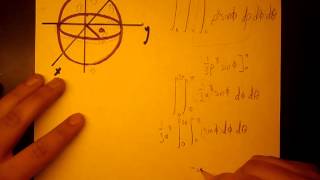
hey everyone in this video we're going to be using triple integrals to find the formula for the volume of a sphere so triple integrals are another multivariable calculus technique and in this one we're going to be using three integrals and we're going to using a full sphere to find the volume so again like in the last video when we used um polar coordinates instead of regular double integral we're going to be using spherical coordinates here instead of regular triple integral because it'll make our calculations a lot simpler so we're going to start with the form for spherical coordinates which is R3 and and our three limits so D row which is that what's side called d f or Fe and D Theta and of course we have to incre uh we have to include the interior term which is Row 2 s of five so now what are our limits for row row is going from 0 to a what are our limits for what are limits for uh F or F it's going from zero to Pi because it's going uh V is always measured from the positive z- axis to the negative z- axis so it's going the full the full angle from 0 to Pi and Theta we know goes from the it's measured from the positive x axis and it goes all the way around again so again that's 0 to 2 pi so now we're going to go ahead and try to solve this integral as it is because there's no F of XY in here because with triple integrals it's already assumed to be a volume that's what it means it's taking little individual cubes of this uh solid sphere whereas when using double integrals it was a hollow sphere and we're adding up all these little cubes over all this big region and when we add up those cubes we're going to be getting the volume so let's start so the first integral the inside integral is with respect to row so it's going to be 1/3 row cubed s of F and that's evaluated from what from 0 to a so it's going to be 1/3 a cubed s of F and now we have two more integrals to evaluate 0 to Pi 0 to 2 pi d f d Theta this 1/3 a cub we can move to the outside because it's a constant remember our radius a is a constant so we're going to move it to the outside so we don't have to deal with it all the way in there and we're going to integral from 0 to 2 pi integral from 0 to Pi S 5 d d Theta so now sin ofi uh when you take an integral that it's just going to be negative cosine of pi evaluated from what 0 to Pi so negative move the negative outside cosine of I is 1 minus um cosine of 0 is 1 so it's going to be negative quantity 1 minus one which is going to come out to a 2 again this two is a constant we're going to move it to the outside of the integral with a 1/3 a cub so it's going to be 2/3 a cubed integral of from 0 to 2 pi and just D Theta so now when we integrate this we're going to have Theta because this is actually just an imaginary one inside here and that comes out to Theta you value from 0 to 2 pi and that comes out to 2 pi and this 2 piun ultip our 2/3 a cub is 2/3 a cub * 2 piun which comes out to 43 Pi a cubed this is by far the simplest most elegant way to solve for this volume uh because it takes it uses the full advantage of how to find the volume it takes those little tiny cubes and just approximates them and finds the whole volume rather than revolving some area or using some uh region underneath the solid so now we know where that Elementary formula for the volume of sphere comes from so hopefully we all learn something thanks for watching
Watch on YouTube ↗
(saves to browser)
Sign in to unlock AI tutor explanation · ⚡30
Playlist
Uploads from ritvikmath · ritvikmath · 4 of 60
1
 2
2
 3
3
 ▶
▶
 5
5
 6
6
 7
7
 8
8
 9
9
 10
10
 11
11
 12
12
 13
13
 14
14
 15
15
 16
16
 17
17
 18
18
 19
19
 20
20
 21
21
 22
22
 23
23
 24
24
 25
25
 26
26
 27
27
 28
28
 29
29
 30
30
 31
31
 32
32
 33
33
 34
34
 35
35
 36
36
 37
37
 38
38
 39
39
 40
40
 41
41
 42
42
 43
43
 44
44
 45
45
 46
46
 47
47
 48
48
 49
49
 50
50
 51
51
 52
52
 53
53
 54
54
 55
55
 56
56
 57
57
 58
58
 59
59
 60
60

Math Team Update
ritvikmath
Single Variable Calculus Volume of a Sphere - Proof 1
ritvikmath
Single Variable Calculus Volume of a Sphere - Proof 2
ritvikmath
Multivariable Calculus Volume of a Sphere Proof - Triple Integrals
ritvikmath
Multivariable Calculus Volume of a Sphere Proof - Double Integrals
ritvikmath
The Euclidian Algorithm
ritvikmath
Proving the Chain Rule
ritvikmath
Proving the Fundamental Theorem of Calculus Part 1
ritvikmath
Proving the Fundamental Theorem of Calculus Part 2
ritvikmath
Math Puzzle - Poison Perplexity
ritvikmath
Math Puzzle - Poison Perplexity - Solution
ritvikmath
Expected Value and Variance of Continuous Random Variables (Calculus)
ritvikmath
Expected Value and Variance of Discrete Random Variables (No Calculus)
ritvikmath
Array Method
ritvikmath
Complex Power Series and their Derivatives
ritvikmath
Distributions - Intro
ritvikmath
The Poisson Distribution
ritvikmath
The Bernoulli Distribution
ritvikmath
The Binomial Distribution
ritvikmath
The Continuous Uniform Distribution
ritvikmath
The Geometric Distribution
ritvikmath
The Triangular Distribution
ritvikmath
The Exponential Distribution
ritvikmath
The Borel Distribution + Notes on Poisson Distribution
ritvikmath
The Gamma Distribution
ritvikmath
The Normal Distribution
ritvikmath
The Laplace Distribution
ritvikmath
The Chi - Squared Distribution
ritvikmath
Overfitting
ritvikmath
Vector Norms
ritvikmath
Truths Behind the Titanic : K-Nearest Neighbor
ritvikmath
The Mathematics of Breakups
ritvikmath
Sillyfish
ritvikmath
Finding Optimal Paths - Dynamic Programming
ritvikmath
HowToDataScience : Scraping Twitter Data
ritvikmath
Decision Trees
ritvikmath
Perceptron
ritvikmath
Naive Bayes
ritvikmath
K-Nearest Neighbor
ritvikmath
Evaluating Machine Learning Models
ritvikmath
Decision Tree Pruning
ritvikmath
K-Means Clustering
ritvikmath
Gaussian Mixture Model
ritvikmath
Data Science - Fuzzy Record Matching
ritvikmath
Time Series Talk : Autocorrelation and Partial Autocorrelation
ritvikmath
Time Series Talk : Autoregressive Model
ritvikmath
Time Series Talk : Moving Average Model
ritvikmath
Time Series Talk : ARMA Model
ritvikmath
Time Series Talk : ARCH Model
ritvikmath
Time Series Talk : White Noise
ritvikmath
Time Series Talk : Stationarity
ritvikmath
Time Series Talk : ARIMA Model
ritvikmath
Time Series Talk : Lag Operator
ritvikmath
Time Series Talk : What is Seasonality ?
ritvikmath
Time Series Talk : Seasonal ARIMA Model
ritvikmath
So ... What Actually is a Matrix ? : Data Science Basics
ritvikmath
Derivative of a Matrix : Data Science Basics
ritvikmath
Basics of PCA (Principal Component Analysis) : Data Science Concepts
ritvikmath
Eigenvalues & Eigenvectors : Data Science Basics
ritvikmath
The Covariance Matrix : Data Science Basics
ritvikmath
More on: ML Maths Basics
View skill →





Related AI Lessons
⚡
⚡
⚡
⚡
How to Learn a Hard Technical Skill Without Burning Out
Dev.to · Anas Kalthoum | FreeBrain
After interviewing over 100 ML Candidates. Last Week Someone Walked In and Made Me Take Notes.
Medium · Machine Learning
How AI Learns with Less Labeled Data
Medium · Machine Learning
Mastering TypeScript — Understanding the TypeScript Compiler (tsc) from Scratch — Lesson 2
Medium · JavaScript
🎓
Tutor Explanation

 DeepCamp AI