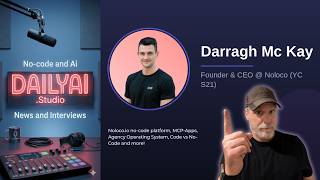
No-Code and Ai News - Interview with Noloco Founder Darragh Mc Kay
Key Takeaways
Noloco's no-code platform integrates AI for building custom software, providing an agency operating system with features like project management, CRM, and workflow automation. The platform allows users to build and customize their own solutions, with a focus on flexibility and maintainability.
Full Transcript
Welcome to the Daily AI studio, a no code and AI focused show. We'll bring you the news you need to know in the people in the industry creating and using these tools. My guest today, Darra Mccay, founder and CEO of Nol Loco, created this noode tool after years of being in the software industry to enable industries to focus on work they're trying to do instead on the tools they need to use. We'll talk about how AI is impacting no loco, how their agency operating system is a new take on what they're offering as well as what he really thinks no code is headed in a year that's moving fast. I hope you enjoy the interview. Thank you. All right, Dar, thanks for joining. Uh why don't you give me an introduction about yourself and then we'll start uh heading into the questions I got. >> Sure. Um I'm the CEO and founder of Nolokco. We help teams build custom software for their teams, their clients, or anyone else they work with really. Um, we hate help them turn those spreadsheets into or the spreadsheets that they kind of use day-to-day into an organized system that we're starting to refer to as their operating system of their business. Um, >> yeah, >> my background is in software engineering and that's what I kind of did before no loco. So I've found myself slowly but surely waiting through the no code world and then obviously now the AI powered no code world and everything that that has brought with us. So it's been an interesting journey so far. >> So you would say you started solving problems with code and in eventually saw a pattern or something and you decided to kind of organize it in no loco. >> That's exactly right. Um I was a software engineer at a big company. I'm sure you've heard of them. Um working directly with SNVs. Uh and then I stepped way into the startup world and I got a completely different perspective on how teams work and the way they the different problems they solve and uh we started using really powerful low code tools like retool and stuff to you know help us solve some problems internally help us you know operate like work with our data and I I kind of thought back to my time at HubSpot and I realized that you know the customers we were working with at HubSpot they didn't have access to to something like retool they didn't have skills to do it themselves. But I knew that, you know, the way technology was at the time that it was entirely possible to build something like like no loco now that helps um helps them build better interfaces, better apps on top of their data. And you know, four or five years later, that's kind of where we are. >> Yeah. Yeah. I'll come back to the code thing later, too, because that that reminds me of an interesting like uh ongoing uh divide right now in the industry. Um all right let's start off with what inspired this was you released the agency operating system system um it's is this you know basically why don't you explain it for a moment and then I'll ask some questions about it. >> Yeah so um you know to kind of understand what the agency operating system is you kind of have to understand quickly what no loco is. So it is fundamentally a way to build custom software on top of data with permissions and workflows. Um and in the last couple of weeks we've released the agency operating system which is a opinionated version of no loco or starting point in no loco uh designed specifically for professional services teams uh and agencies to handle the full client delivery. Uh what I mean by that is um they it has a built-in CRM to kind of prospect sales, find new clients, convert those accounts into clients. uh once they're clients, it helps you manage the life cycle of the projects of clients. Everything from project management, task management, life cycle management, time tracking on those projects, expense management on those projects, >> and then of course invoicing to do turn those time tracking and projects into billables that ultimately get paid. All the while giving agencies, professional services firms a kind of 360 view of their of their business. And the reason we >> went down this route route is that we we we kind of took stock of our customers. We took stock of uh the data we kind of saw in our system and realized that you know a very significant number of our customers were using node for knowledge management CRM and client portal um and many flavors of it but and so many of the customers we spoke to had were looking for that kind of holy grail solution um they've tried other platforms that were very rigid you know kind of traditional package management systems or traditional CRM M and they just didn't kind of have the the function the customization that they were looking for or or they ended up having to buy a CRM and a project management tool and then try to feed that data into some sort of client portal. >> You know, as we all know, once you start uh trying to sync your data here and there, it just gets messy, right? >> Yeah. >> So, we said, look, there needs to be an out-of-the-box solution that is, you know, both ready to use but also ready to customize. And that's kind of where we where we landed with the agency operating system. >> So like I think one good point you make I mean this is a big deal because you're you're going deeper than templates. I mean that was one of my questions but this is way deeper. >> Are you guys taking ownership of it where you're going to keep updating it fixing bugs or when an agency uses it do they then take ownership of it? How does that work? That's a really good question and and something we're we're figuring out, but right now in in kind of earliest iteration um we we're going to continuously update the template, but if if you signed up today, you'd get that version of the template. But the benefit of that is then you can go off and customize that as you needed to. But truly what we see as the kind of middle ground here is something that like modules or packs or some kind of out of the box uh add-ons that you can say well look I actually do want expense management I actually do want uh time tracking and my time tracking is actually like by hour instead of by by kind of >> task you know and having these kind of customization options that >> just kind of set up the building blocks but are still customizable and still flexible, you know, not just like a a rigid opinionated system. Um, and that's where we see those would be maintainable. Those would be kind of um you you'd be able to get updates to those. And then as we see those get adopted, our plan is to kind of build out more specific functionality for those because you know there's a better way to present time tracking than one of our kind of general >> uh you list component. for example, similar with like displaying an invoice or displaying a project even. You know, we we've we've got loads of people who've built really really impressive interfaces for displaying a project. But if you know there's like a a leader or an owner uh and a status and a due date, there's very interesting UX ways that you can present that better that traditional project management systems have ultimately solved or at least tried to and we can kind of learn lean on that whilst get maintaining that kind of core flexible no code environment. That's the goal. >> Yeah. Yeah. Yeah. it do you see this as an ongoing like direction for no loco where you'll provide I mean you're basically in some ways providing application level solutions right like you're do you see yourself I mean there's already a lot here PM invoicing time tracking like do you see yourself doing other type of systems like a CMS and other things >> we we'll see um we we we want to really niche into these professional services terms and you what we're trying to do over the next couple of months and weeks is listen to them, right? So, if we find that >> Yeah. >> Yeah. Okay. Yes. Most 80% of them want project management and and client portals, but they also need a CMS solution. We think that's a really good kind of addition. We could find that as a really good addition and add that functionality through like a pack or a module or some installable that just adds on to the existing apps, right? Or extends it. Um or we have different flavors of the HDCOS designed specifically for digital marketing agencies um you know consulties tech firms and that's another direction we we probably will go in pretty soon and because even though >> you know they're all kind of different there there's different starter packs that just make more sense for them as well. uh whether we do this for kind of all industries, I don't think so. At least not immediately. You know, we we we kind of >> we're really trying to let people know that, hey, we've built this for you. We at Noco understand your pain deeply. We understand the problems you're looking to solve and we're here for you. We spend a lot of time trying to do that. Um if we spread ourselves too thin with our kind of >> previous set of templates, they're they're not incredibly valuable. >> Yep. Yeah. No, it makes sense. It's it's it's it's it's an interesting evolution. Um >> it is. >> So, uh let's see. So, the next question or one of the questions down the list is is how does Nol loco see AI being integrated into the product? Uh both for the builder who's building products and for the end user and for these and for the operating systems. Um >> so, for example, you've added some great touches like AI in the table columns, uh which was just awesome. Um but there's still no vector support. like how far is AI going to go in no loco versus hey I got to go find it somewhere else and bring it in. Yeah, something we're always trying to battle with in that kind of balance of do we build it specifically ourselves? If we built it, would it be generic enough or kind of customizable enough, right? And that's something we're still trying to answer. I I think in 2026 we will have something like this. Whether it's a way to on the back end, you know, answer questions of your data or whether it's something you can kind of put on the front end that you you and your clients can access with permissions and maybe built-in kind of scope, you know. Um I think that's definitely something we will have. What I think we'll have sooner though is probably agentic type uh actions within our workflows. So we've got very powerful workflows at the moment. you can already use AI there. >> But I think what make and n are doing around having a kind of agent block that can have access to different tools. I think that aligns perfectly what what what we already have at NOLO, right? You know, let's say you you as an agency upload some client notes. You want to be able to give that to to an agent in no loco that just says, "Okay, well, you discussed this new project which has these tasks and that John is going to be the owner and you're going to kick that off in in in March. that you know doesn't need to go out to another system. We have all of those tools there. The only thing we don't have is that aentic kind of layer and I think that'll kind of come first and then the kind of question answer stuff probably later. >> Yeah. Yeah. No, it makes sense. It makes sense. And the whole authentic thing is it's it's it's just that ability to do something with the data using tools and other systems to then bring it back as data that's structured or usable or actionable. Yeah. >> Yeah. >> So just on that I do I've recently found so there are quite a lot of other options that actually make it pretty easy as well. only uh yesterday I was playing around with Zapier's MC uh MCP and I was able to like really quickly wire up an MCP that I could add to Claude or Cursor or or CHPT. >> Um and because Nolo has a a a Zapier module, you're able to kind of wire it up to one of your apps and say search these tables as one of the actions. So it can actually pull in it can pull in some of your data. It's not vectorzed. not going to be as kind of uh insightful. But if you if you wanted to be like, "Hey, given this customer email, tell me when the last time I spoke to them is," and you know, draft an email to kind of follow up. That's the type of stuff that is actually already available today if you know what you're doing. That's what we just want to make standardized and a lot more easier to access. Obviously, >> yeah. No, it makes sense. And I mean this will lead into a few other things but on that note like you mentioned opinionated but then you mentioned flexible >> right? >> So it is a funny balance for you guys because in some ways you can be opinionated and say this is how it works >> and then that's good but then some sometimes you can be too flexible and people don't know what to do with it. >> So you really got to find a balance here to say th this is how it works give it a go. Um, but I guess you still have, and that's one of my other questions too, is like with no code tools, sometimes companies come up to it wanting more. And when you work with customers in those situations, what does someone who's using Nolo code to to be the builder do? And what do you guys as a company suggest the conversation is when a customer wants more? Yeah, it's it's an everlasting battle for us really, you know. Um, it I will say it's it's rarer. It does come up more with the kind of experts in in the business than it does with the actual consumers, right? And I can understand why they're the ones trying to push these these to the limits. They're in there every single day. Um, but I do see uh a world where there's ability to kind of customize specific components a bit more with agentic stuff. we we've got a beta of that previously that we've used in the past and you know we didn't see the results we kind of wanted. Um I think ultimately people just ended up kind of presenting data in a slightly different way that they probably could have achieved with custom CSS in the first place rather than building you know uniquely different um experiences. Uh yeah >> you know once it comes to like logic and stuff you can almost do everything with like make or zap your nadn. So, is it really just about presenting the data in a different way? And if that's the case, we generally just like to kind of hear that feedback. And maybe we can there's something we can build with you or for you. Um, but that all that is to say, I think in a year's time or maybe even sooner, we will have a lot more options within the builder itself to go beyond what we already offer. H again we're just trying to >> what I don't want is for that to be the default because >> once that becomes the default because I think you give people a lot of flexibility they'll they'll they will uh reach for that first and if they reach for that first they'll end up losing a lot of the things that makes no great in the first place like the fact that we worked across all devices the fact that permissions and and are just built in >> the fact that you know it wires up to our automations and other things, you know, that's what I would like to to retain whilst also offering people flexibility. And that's a bit of an unknown for me. >> Yeah. No, it's hard. It's hard. >> Yeah. >> Um, on that note, the whole vibe coding trend uh kicking off in 2025 must have really shocked you in many ways. Um, and it's changed people's expectations of what they can do with just an idea and get it done. And so now as someone who's a a builder who's kind of moved away from coding like no loco and other tools can be intimidating because you have to learn them to just get something done. So in some ways the the learning curve can be just as much as learning how to code that. Um, so how does the the the trend of vibe coding, how does this kind of sense of um new ability for for for business owners to go from prompt to done or something impact no loco loco? How do you guys see that impacting the user experience for you guys? >> Yeah, I think the main thing that's changed is people's expectations as you alluded to. Uh, people are a lot less patient. People are kind of expected results a lot sooner. Um, and that's raised the bar across the entire industry. We're not the only ones kind of noticing that. So, like one thing I'll say, we we launched Nola, our AI assistant, in October, and you know, while she's been in beta for a couple of months, um, there's as a as a kind of assistant, she's come a long way. And now I think genuinely like if you're starting from scratch or near scratch or if you want to make a very technical change but you're not 100% sure about it, it's the best place to ask, right? Because it can make research about the different ta uh tables that you have in your app, the different views that you have in your app, the different permission layers, the different roles, and it can, you know, with confidence make a suggestion or carry out that change for you. uh it's not as kind of you're still restricted to the kind of guardrails of Noloko in terms of the interface that it produces but it can make those structural changes which is what people usually struggle with the most because in truth the only challenging part about no loco is building out the tables once you've got your tables the interface more or less exists you know you don't have that many options by design you know um >> so the challenge is how do I >> structure my tables How do I link my tables? What formula do I need? What lookups do I need? And that's what Nola is is brilliant at kind of helping. >> That's interesting. >> Yeah. >> So, with with with NOLA like and this was like one of my questions I've been thinking about or one of them that was kind of there too. Like a lot of customers are like here Al, here's a spreadsheet. We've hit our limits with it. But here I am trying to take their spreadsheet, take all the formulas, all the relationships, all the potential >> tweaks and do something right. Could Nola just take that spreadsheet, that Excel file, and figure it all out? >> The easiest way at the moment would be just like import that as a table um and then ask Nola to look at it and go, "Hey, what what are the what fields here should be turned into formula fields? What fields here should be turned into lookup fields? >> How should I break this table down into maybe multiple tables or multiple link tables?" And yeah, >> for sure she'll be able to give you, you know, point you in the right direction. One thing I think we were very early at doing as well was splitting out her functionality into both build and plan. So you can switch to plan mode if you want to just take away our ability to make your changes which >> we weren't so sure about in the beginning but the feedback we got from people was that it it just gave them a lot more confident in actually asking questions and iterating and designing because >> a lot of these other AI tools are very change happy. They're very you know they're very quick to make changes on your behalf >> which can be great. The feedback loop is fantastic. Sometimes you just want to talk through the problem and step by step so you understand it too. >> Yeah. Um being a an Excel file, it would have formulas built in. Would it be able to understand those formulas and convert those to no loco formulas? >> That's a good question. I I don't know the answer to that off the top of my head. I I think we um when you import it uh into no loco, we do we translate those formulas? I think we might, but I'd have to double check that. Yeah. >> Yeah. Be interesting because that's one of the things I think is Yeah. challenges with these spreadsheets and they're >> they're complex. >> They are. They are. But honestly, if not, what one thing that I really enjoy doing is we have our formula builder, but we have a little box underneath it that lets you >> ask the AI and that's exceptionally good. Um, >> you're right. >> Just go I need this and this. Even sometimes when I like just want to add first name and last name together, it's just like full name. you get the formula you want, right? >> And I think that's a great example of AI being used, right? Like it's like, hey, I'm here to help you for this thing. >> Yeah. No, it's perfect. >> Um, so with 2026, it's tricky. You're you're running a business in a product. How do you see Nolo uh evolving in 2026, but at the same time being ready for those aha moments like Open Claw and how it changed how we look at agents? Yeah, don't get me wrong, it's it's challenging. Like it's it's >> I I wouldn't have said we would be this far advanced maybe this time last year. And I don't know who who would have either. But I mean, all we're trying to do is like stand out on our own. I think that's one of the lessons we took from 2025 was that the the no code world as we knew it in 2024 has completely collided with the AI first no code world. and whether but the truth is the value of the tools we we build hasn't changed. You know, people still want reliable internal tools that they can customize themselves and not kind of rely on prompts and a prayer to kind of be maintained. >> But the noise in the industry has changed a lot and the expectations have changed a lot. So all we're trying to do is just kind of keep listening to customers, keep kind of understanding what they're actually trying to solve day-to-day, whether that's, you know, agentic kind of workflows, whether that's uh vector databases to answer questions >> or whether it's just a better way to manage their project than their CRM in one place because sometimes a lot of people are still just at that starting block and not able to get past it, >> right? I think if you spend as much time on Twitter or X as I do, you feel like everybody's on open claw, but >> yeah, >> reality of it is most people don't know what that means, you know? >> No, it's it's a good point 100%. Like I talked to so many people outside our industry and I realized, wow, you don't like my news is not your news at all. >> No. Yeah. I I guess the tricky part is like, hey, customer feedback's awesome and everything you do to make that part of your thought process is great. Yeah. >> But then what's that classic saying like when Ford asks his customers what they wanted, they wanted faster horses or something, right? So >> it's it's it is interesting uh how to balance the two. Um on that note like some clear trends are MCP apps web CP MCP in AGUI and and these are different ways of looking and integrating UI into chat and into the day-to-day. How does that how does Nol Loco see that? >> Yeah, I I haven't given it a lot of thought. I mean to be very frank I think >> I think they they they probably do serve a lot of value but I think for most of those they are transient or transactional perhaps right I've got a bit of data I want to present it I want to understand it and then I want to dispose of it right whereas what we build is operating systems right you you you you build something that you you and your team will spend 80% of your day in that's very different than a kind of agui or something anc rows together to just present your data better. The two have value in itself and maybe the answer is that we bring those you know you know MCP apps within no loco so that you can have throwaway interfaces that you you you use for 30 minutes to answer a specific question >> and then you don't meet again. Um because yeah there the two are separate problems in my mind and and I think that was the big shift in the industry in 2024 to maybe partway through 2025. Um these these AI tools were primarily used for both green field projects like startups and >> you know throwaway demo things that are very very presentable and very very interesting >> but you know fundamentally not that useful right because they don't plug in any they don't kind of exist in the real world they weren't hosted anywhere >> and that is slowly but surely changing so um it it's kind of hard to know where that will land I guess. >> Yeah. Yeah. No, it's interesting the um in one example for me working with a customer who had a spreadsheet putting it into a nood loco was his desire to chat with it inside of cloud and see results as he's chatting so he could discover things about his data to basically chat with it and hopefully >> and it's still kind of a dream. It's not an impossible dream of AI helping him discover stuff about his company, his business. >> Absolutely. Um so yeah I mean the MCP app aspects would have been bringing in components of uh no loco into the chat UI of cloud so he could see his data, see those tables and potentially see imagery he couldn't have imagined before in charts and whatnot. >> So >> that was the MCP app uh angle that um came up recently. >> I but on that like someone in our community has actually done super something super interesting with NAN. I don't know if you've seen that post, but >> no, >> they they uh they have some sort of action button in no loco that triggers an NAND workflow or whatever they're called in NAN. >> Um and that fetches whatever data is relevant and builds out a uses AI to build to return a a dashboard with filters and stuff and they they're kind of bridging that gap themselves. >> Yeah. And I think that's why we haven't rushed into it is because you know when we build something someone inevitably says oh but I needed to do this right >> uh oh I needed to behave like this or I needed to render this. Um and until we kind of understand all of the guardrails or all of the the kind of requirements or at least the kind of uh those that will satisfy 80 or 90% of the requests. We we try to kind of hold their hold our horses a little bit. Um, not mind you, we're late to the party, but hopefully it means we deliver something lasting versus something that we kind of >> made it together and, you know, we we discontinue within the next three, four weeks, you know. >> No, it makes sense. It makes sense. >> Um, >> unfortunately. >> Well, yeah. I mean, it's it is tricky, but because you're you on one hand, the fear of missing out versus the fear of in being late versus the Yeah. Yeah. >> You know, but you don't want to um like you said, introduce things that just kind of uh put down like don't inspire people because they just keep getting frustrated. >> Um another point we brought up earlier was code versus no code. Um I still like so it is an interesting era of like no code like no loco has been around for what four or five years. >> Yeah. >> More or less. Yep. So, I've been coding for 20. I've put off no code tools mostly because in my head code was better and no code tools were limited. But something really hit when AI became part of no code tools that I can now do more with no code but then also integrate more with AI which was obviously the future in many ways. So from your standpoint, how do you how do you deal with conversations with customers or uh just in in day-to-day with people who still go for the codeheavy solution? Like is there a way to I don't want to say right or wrong, but how to find a balance there? I think, you know, one way of thinking about it is probably, you know, why do companies not use the open source Slack alternatives or why do they not use the open-source CRM alternatives? It's because >> you've hired salespeople, not data DevOps engineers, right? like as as soon as you start building your own solutions in in code that needs to be hosted with monitoring and scaling concerns, you you quickly surpass the not the ability of the average person, but the the want and the desire I suppose to be that role uh of the average person. I I think that's where no code solutions like Meloco make sense. like we have 247 support and if you say how do I link you know my clients together so I can you know better have view their annual reports we'll help you through that right and that's not something you're going to get from one of the AI code alternatives right you're going to have to pay the developer to answer that question if if the AI if the AI can't >> um how do you host it where do you host it obviously you know you've got the likes of lovable having their cloud tier at the moment but >> that's still a bit of a mystery to people and then are you really getting the benefits of code then if you're not actually hosting the code like are you just because I I hear this all the time they're like >> I want to I want to host I want to be able to change the code I want to host the code myself but you don't realize then that >> well actually the code that's generated by some of these platforms is so you know um contingent on being run on their platforms for performance and per uh and uh for for speed re reasons that you wouldn't be able to host it anywhere. So you're not ending up at ownership of your code in the first place either. So I I think it's twofold. I but I for me there's a very clear line of like if if you don't have the in-house skills to host and and change the code yourself. >> I don't think you should rush into doing that. I think you should rely on offtheshelf tools that are customizable and can be fit made fit to your needs. >> Yeah. No, it's it is a good point like um I forget if it was Capital One or one of the banks is like hey we became a technology company that knows how to do banking like once you start coding everything you become more of a technology company than the company that was trying to solve the problem in the first place. >> Exactly. Yeah. Exactly. So it's it goes back to the the Jeff Bezos what do what you're make do whatever makes your beer taste better, right? Like if if you're running a brewery you shouldn't be improving your invoicing flow. You shouldn't be innov You shouldn't be innovating on that. You should be focusing on making your product better, your service better, >> not the parts that help you run that product or service. >> No, it's it's a good point. In the end, it really seems to come down to marketing. Like >> for some reason, companies are still reaching for code and I don't know that reason honestly. >> Yeah. >> Especially small companies. >> Yeah. On that note, >> on that note, like there in my understanding of the industry, there are different places to use uh software, web software, especially internet sites, outward-f facing static sites in heavy subscription internet sites where you got thousands of of customers. Like, >> do you see where do you see no loco fitting in? And where do you say no if you're no loco or or or looking at a problem? >> We our sweet spot is internal tooling, right? Um so if you've got >> you know you know what that means is you know you've got an app for your team your employees and you know most companies are less than 200 employees. Most most companies are less than 50 employees. You know our spot with the agency operating system is kind of five to 30 employees. Right. >> And it's not because we can't hold the scale or anything like that. We absolutely can. But the the kind of the companies that have more than that usually have a very strict IT team that want to take ownership of it. They want to >> you know they want to be able to self-host it and then you just lose half the benefits, right? Um but beyond that I think it's uh you know that we focus solely on internal tools. That's where our product roadmap was aligned around. There are countless other tools out there for helping you to build startups, helping you to build your own SAS, helping you to build your own marketplace or e-commerce. You go to Shopify, you know, we're not trying to replace any of those. Uh we're trying to exist solely to help you build better internal tooling. The only >> blurry part of that is client portals, which you very quickly start to look like >> consumerf facing apps. But to me there's a very very big difference as well. Like the client portal serves as a way >> as a portal into your business data as a way for the client to interact with your team >> to view whatever it is that you you bring to them whether it's the tasks or the projects or the products or the inventory or some reporting. Whatever it is you're doing, they're viewing a slice of that data. They're not making purchases there. They're not like that's happening with an account executive or the CEO or whatever. It's it's not a self-s served e-commerce platform. It's just a way for them to help you work dayto-day. >> Yeah. And they're the >> which fits lines we draw. >> Well, and that fits well into your like, hey, your your your client portal isn't going to support a thousand clients at once because you're still that small agency. It balances out on both ends. >> Absolutely. >> And again, it's not about scale like you said. It is about focusing. I mean, there are different focus areas. So, >> absolutely. Yeah. >> Yeah. Yeah, we we learned the lesson pretty early on. We can't be everything to every everyone. Like I didn't I skipped over this part in the history of Nolo, but our very first version of Nolo was the web app builder that is you know the the greatest web app builder of all time is what we called it. >> In truth, we were like three years early for lovable or something. But you know what we would have ended up competing with the likes of framer and we were already competing with the likes of web flow and >> you know >> even framer didn't go as far as we would we wanted to we wanted to be a better bubble right >> um but I think like the challenge there is that the feedback we got in those early days was pe people wanted you know live maps some other people wanted you know e-commerce fulfillment and >> all of a sudden you've got these 1000 you know, feature requests that each would take 20 people to build. >> Yeah. >> And there's no overlap, you know. Um >> I was going to say there's no ven diagram. It's very >> Exactly. >> Yeah. >> No, it it I I love the focus on internets. They are the there's they're they're just the unknown because no one sees them. They're internets. >> That That's exactly it, right? >> Yeah. So >> why is nobody posting about them on TikTok or >> I know they're the least exciting sexy tech thing ever, but they get jobs done for people and >> if it's done well, it brings them a little bit of like sense of I don't want to say joy, but it's is satisfaction because they're using a good tool. >> Yeah, absolutely. >> My favorite bit of feedback is, you know, once a customer replaces >> something legacy they've got with with something they've built on a loco, they feel the impact immediately. you know, they get more options, they get more flexibility. It's something they can control themselves. It's usually faster and and often more affordable. So, >> I'm not going into a sales pitch, but that's the feedback we get and that's why that's why I wake up every day and that's why I love it. >> Yeah. No, it it makes sense. Um, >> all right. That was it for the questions because we covered some of them uh the agent stuff earlier, but was there anything you want to add or >> No, I mean I think really good discussion. I think I think he got into like the the meat of why we're building what we're doing and why uh how we got here and yeah good chats on the you know the state of the world as well at least the state of >> the I'll be using the agency operating system like I said I'll uh I'll probably just get rid of base camp at this point because it's >> that's music to my ears that's kind of one of the ones we kind of looked at and go this doesn't need to exist in 26 you know. >> Yeah. Yeah.
Original Description
👉 Become a Sponsor and have me share your product
https://forms.gle/Kh1xURwDS7Y2oXTJ9
👉 Be a guest on the show
https://forms.gle/SPdiQoZAHBzrKWRHA
(THIS IS NOT A SPONSORED VIDEO)
Darragh Mc Kay | Founder & CEO of Noloco (YC S21) | The Daily AI Studio
What happens when no-code collides with the AI-first world? I sat down with Darragh Mc Kay, founder and CEO of Noloco, to find out.
Noloco helps teams ditch the spreadsheets and build custom internal tools — without needing a dev team. But in a world where vibe coding, agents, and MCP are changing expectations overnight, what does that mean for the no-code space?
We got into it all — no scripts, no pitches, just a real conversation.
In this episode:
The Agency Operating System — what it is and why Noloco built it
How AI is actually being woven into Noloco (and what's still coming)
Agentic workflows vs. vector search — what lands first
Vibe coding and why it's raised the bar for every no-code tool
The honest case for no-code over code for small businesses
Where Noloco draws the line — and why internal tooling is the unsexy sweet spot
Links:
🔗 Noloco → noloco.io
Watch on YouTube ↗
(saves to browser)
Sign in to unlock AI tutor explanation · ⚡30
Playlist
Playlist UUZa3QWzy1z1G9FIw02pytdA · DailyAi.Studio · 34 of 45
1
 2
2
 3
3
 4
4
 5
5
 6
6
 7
7
 8
8
 9
9
 10
10
 11
11
 12
12
 13
13
 14
14
 15
15
 16
16
 17
17
 18
18
 19
19
 20
20
 21
21
 22
22
 23
23
 24
24
 25
25
 26
26
 27
27
 28
28
 29
29
 30
30
 31
31
 32
32
 33
33
 ▶
▶
 35
35
 36
36
 37
37
 38
38
 39
39
 40
40
 41
41
 42
42
 43
43
 44
44
 45
45

Build an Event-Driven AI Backend with Supabase & N8N
DailyAi.Studio
Softr Vibe Coding, Docker’s AI Fix, & The Rise of Dify (Week 49)
DailyAi.Studio
Stop Manual Work: OpenAI & Zapier PDF Invoice Automation
DailyAi.Studio
N8N Tagging Execution History!
DailyAi.Studio
NoCode News - Softr Vide Coding 🤔
DailyAi.Studio
NoCode News - Docker MCP Solution 🤔
DailyAi.Studio
Tried Olares for my Local AI Server... Here is the Good and the Bad.
DailyAi.Studio
No-Code News: Private AI Infrastructure, Microsoft Foundry, & GPT 5.2
DailyAi.Studio
Softr AI Tutorial: Build a No-Code CRM & Workflow Automation
DailyAi.Studio
N8N Queue Vs Non Queue
DailyAi.Studio
No-Code 2025 Finale: Xano vs N8N, OpenAI App Store & The Rise of Agents
DailyAi.Studio
Remote Desktop TailScale!
DailyAi.Studio
NoCode News 2026: Notion AI Agents, n8n Security & On-Prem AISupport the channel and join
DailyAi.Studio
Notion the new No-Code Agentic Platform 🤔
DailyAi.Studio
No-Code News - Apple Clusters and Exo
DailyAi.Studio
On-Premise Episode 3 - Email to Ai Agent and Back!
DailyAi.Studio
🔥 Open-Source On-Prem Server Olares 🔥
DailyAi.Studio
No-Code News: Zapier Acquires Panda, N8N Security Patch, & AI Wearables (WK 2-2026)
DailyAi.Studio
No-Code News - Best Automation Platform 2026?
DailyAi.Studio
No-Code News 🔥 Agentic Desktops!
DailyAi.Studio
On-Prem: From "Stuck" to "Deployed" with AppSmith & Coolify 🚀
DailyAi.Studio
Zapier Agents: What, Why, and How! (No-Code AI Automation Tutorial)
DailyAi.Studio
Can open-source models handle real business tasks? #llm #onpremise #ai #n8n #opensource
DailyAi.Studio
Can Open Source LLMs Models Perform Common Business Tasks?
DailyAi.Studio
Private LLMs & Infra From Scratch – Episode 1: The Why, The Setup, The Stack #n8n #coolify #ollama
DailyAi.Studio
No-Code News WK 3-4 2026 #claudecode #mcp #aiagents #n8n
DailyAi.Studio
Vibe Coding a Real Business: Meal Planning App Start to Finish
DailyAi.Studio
🔥 One Prompt + My Phone = A Working Game #gaming #automobile #smartphone
DailyAi.Studio
No-Code News, Open-Source Ai and More - 2026 Week 5
DailyAi.Studio
Best AI Agents for Project Management 2026 (Zapier Builds Them All)
DailyAi.Studio
I Automated My Meeting Notes With Granola.ai — Here's How
DailyAi.Studio
Granola's AI Notepad Recipes & How It Can Easily Save You Hours A Week #granolaai #productivity
DailyAi.Studio
Stop waiting on API calls just to tweak your prompt #zapier #zapieragents
DailyAi.Studio
No-Code and Ai News - Interview with Noloco Founder Darragh Mc Kay
DailyAi.Studio
No-Code and Ai News - 2026 WK 9
DailyAi.Studio
How to Get Business Reports From a Database (No SQL Required)
DailyAi.Studio
Supabase AI Queries Your Data So You Don't Have To #supabase #businessautomation #ai
DailyAi.Studio
No-Code and AI News for Your Day to Day Work | Part 1 of 3 #AINews #nocode
DailyAi.Studio
No-Code and AI News for Your Day to Day Work | Part 2 of 3 #ainews #nocode #technologynews
DailyAi.Studio
No-Code and AI News for Your Day to Day Work | Part 3 of 3 #ainews #technologynews #nocode
DailyAi.Studio
No-Code & AI - Interview - Stuart Mason - AI and Changing with the Times #ai #developer #nocode
DailyAi.Studio
Part 1 of 3 - No-Code News and AI - Interview changing with AI
DailyAi.Studio
How I Chat With Supabase using Claude Desktop and Connections
DailyAi.Studio
Chat with your Data - Supabase and Claude Destkop #shorts #supabase #claudedesktop #ai
DailyAi.Studio
I Built an iOS App in 8 Minutes (No Code, No Developer)
DailyAi.Studio
More on: Agent Foundations
View skill →






Related AI Lessons
🎓
Tutor Explanation

 DeepCamp AI