K-Means - Explained
Key Takeaways
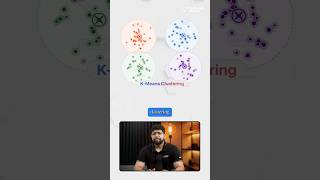
The video explains the K-Means Clustering algorithm, a type of unsupervised learning, including centroid initialization, assignment, update, convergence, and objective function minimization.
Full Transcript
You're handed a pile of data, thousands of measurements, no labels, no guidance, and yet their structure hiding in there. Clusters, groups, patterns. The question is, which points belong together? So, here's the idea. We drop in three markers, centrids, at random positions. These are our initial guesses for where the cluster centers might be. And yes, they're almost certainly wrong, but that's fine. Now comes the first real move. For each data point, we measure the distance to every centroid. Take this point for example, it's closest to the blue centrid. So, we assign it to the blue cluster. We do this for all 24 points. Each one gets colored based on its nearest centroid, blue, red, or green. But those centroidids are still sitting in their random positions. So we fix that. For each cluster, we compute the mean, the center of mass of all its assigned points. Then we slide each centrid to that new position. And now we just repeat. Assign points to the nearest centrid. Then update the centrids. Assign update. Assign update. With each iteration, the centroids drift closer to the true cluster centers and the assignment stabilize. After a few rounds, nothing changes anymore. The algorithm has converged. But here's the catch. K means is sensitive to initialization. Start with centroidids near the true centers and you get a clean result with a low objective. Start with them all bunched together on one side and you might end up with a suboptimal clustering, a higher objective, a local minimum. And that's basically C means. Thanks for watching. See you next time. Bye-bye.
Original Description
K-Means Clustering is one of the most important unsupervised learning algorithms in machine learning and data science. This video explains how k-means works step by step, including centroid initialization, the assignment step, the update step, convergence, objective function minimization, and sensitivity to initialization. Perfect for beginners learning clustering, machine learning algorithms, data analysis, and pattern recognition.
*Related Videos*
▬▬▬▬▬▬▬▬▬▬▬▬▬▬▬▬▬▬▬▬▬▬▬▬
The Hessian Matrix: https://youtu.be/9tp1kULwU2w
The Jacobian Matrix: https://youtu.be/6FesMicc844
Bayesian Optimization: https://youtu.be/Kq6_kzlwSUQ
Hyperparameters Tuning: Grid Search vs Random Search: https://youtu.be/G-fXV-o9QV8
The Kernel Trick: https://youtu.be/N_RQj4OL1mg
Cross-Entropy - Explained: https://youtu.be/Fv98vtitmiA
Dropout - Explained: https://youtu.be/FDF_Q3_98GQ
Overfitting vs Underfitting: https://youtu.be/B9rhzg6_LLw
Why Models Overfit and Underfit - The Bias Variance Trade-off: https://youtu.be/5mbX6ITznHk
Least Squares vs Maximum Likelihood: https://youtu.be/WCP98USBZ0w
*Follow Me*
▬▬▬▬▬▬▬▬▬▬▬▬▬▬▬▬▬▬▬▬▬▬▬▬
🐦 X: @datamlistic https://x.com/datamlistic
📸 Instagram: @datamlistic https://www.instagram.com/datamlistic
📱 TikTok: @datamlistic https://www.tiktok.com/@datamlistic
👔 Linkedin: https://www.linkedin.com/company/datamlistic
*Channel Support*
▬▬▬▬▬▬▬▬▬▬▬▬▬▬▬▬▬▬▬▬▬▬▬▬
The best way to support the channel is to share the content. ;)
If you'd like to also support the channel financially, donating the price of a coffee is always warmly welcomed! (completely optional and voluntary)
► Patreon: https://www.patreon.com/datamlistic
► Bitcoin (BTC): 3C6Pkzyb5CjAUYrJxmpCaaNPVRgRVxxyTq
► Ethereum (ETH): 0x9Ac4eB94386C3e02b96599C05B7a8C71773c9281
► Cardano (ADA): addr1v95rfxlslfzkvd8sr3exkh7st4qmgj4ywf5zcaxgqgdyunsj5juw5
► Tether (USDT): 0xeC261d9b2EE4B6997a6a424067af165BAA4afE1a
#machinelearning #svm #artificialintelligence #datascience #classification
More on: Unsupervised Learning
View skill →





🎓
Tutor Explanation
 DeepCamp AI