Unsupervised Learning
Cluster data, reduce dimensions, and discover hidden patterns.
0%
Confidence · no data yet
After this skill you can…
- Apply k-means and DBSCAN clustering
- Reduce dimensions with PCA and UMAP
- Use autoencoders for representation learning
Prerequisites
Watch (10 videos)
StatQuest: Random Forests Part 2: Missing data and clustering
→ Use a random forest model for clustering→ Interpret the results of a random forest model
K-Means Clustering Explained Simply 🤖
→ Implement K-Means clustering algorithm→ Choose the optimal number of clusters using the elbow method→ Handle outliers and non-spherical clusters

Stanford CS224R Deep Reinforcement Learning | Spring 2025 | Lecture 17: Advancing Robot Intelligence
→ Train models with reinforcement learning→ Apply reinforcement learning to robotics→ Use imitation learning for pre-training vision language models
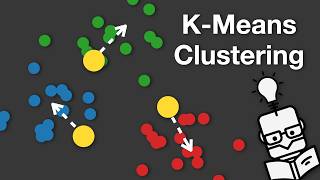
K-Means - Explained
→ Apply K-Means Clustering to datasets→ Understand the importance of centroid initialization→ Identify clusters in unlabeled data
Machine Learning In 60 Seconds | Machine Learning Explained For Beginners | #Shorts | Simplilearn
→ Apply unsupervised learning techniques→ Cluster data using unsupervised algorithms→ Visualize high-dimensional data
The Physics of Diffusion Models
→ Use diffusion models for generative tasks→ Sample new data from trained models
What are Neural Nework AutoEncoders ?
→ Apply autoencoders to real-world problems→ Use autoencoders for dimensionality reduction and feature extraction
Machine Learning vs Deep Learning Explained in 10 Minutes 🧠 (Beginner Friendly!)
→ Identify patterns in data→ Cluster similar data points→ Reduce dimensionality
Stanford CS221 | Autumn 2025 | Lecture 13: Bayesian Networks and Gibbs Sampling
→ Understand the limitations of rejection sampling and Gibbs sampling→ Optimize Gibbs sampling using the Markov blanket concept

Lecture 15 - PCA and ICA | Stanford CS229: Machine Learning Andrew Ng - Autumn 2018
→ Apply clustering algorithms→ Use density estimation techniques→ Visualize high-dimensional data
 DeepCamp AI