Friction Between Data Scientists and Software Engineers
Key Takeaways
The video discusses the friction points between data scientists and software engineers, highlighting the need for collaboration and integration of roles, similar to the DevOps movement, with a focus on MLOps and Data DevOps.
Full Transcript
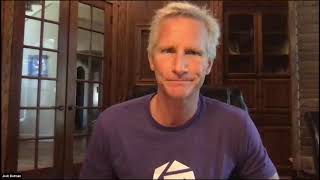
so my question is and by the way I'm also coming from electronics so hackle okay so my question is what are the main main fiction points between data scientist in software engineer because as operations as a operations engineer with with background I see this fight again between software engineers and operations yeah what's new yeah well nothing's new it's the same old same old story totally agree so so just to paint the picture you know ten years ago maybe not even ten years maybe less than that there was a big divide between operations staff and developers developers would develop software I mean you've all had this before right it's the whole reason why DevOps became a thing was to try and attempted to smash down that wall between the developers and the operations teams and that has worked somewhat I've seen larger companies there are still very big Operations teams so they still exist in they're still there primarily because there's also a lot of old software still running so they don't need to keep running that software so they see it and so went out when I sort of started doing data science ml more full time which that kind of about 2010 the same thing was emerging with ml I would write algorithms I would develop you know did science solutions and then I would hand it off to a software engineer and expect the software engineer to implement that properly because data scientist can't write proper software and then that would then go off to do the operations and so you had these you know multiple jumps and it was a daily a daily exercise of complaining about the other person so the software engineer would complain to the data scientist saying you know I don't understand this what's going on here is crazy it's too complicated and the data scientist is going to the software engineer so it's not complicated it's dead easy how can you not understand it so I fully agree with the push of devops up into data science as well and I guess that's that kind of falls under the banner of ml ops or data DevOps or whatever you want to call it but basically trying to bring the the data scientists into the software team into the operations team so all together as a team they can actually they can they can be responsible for and they can deliver good ml solutions the the downside is is that in many in many sort of roles that scope falls towards a single person it's becoming more and more expected that a single person would be skilled at doing all of these things and so that makes the the stack the full stack is becoming fuller like the word full stack is is pretty funny because it implies that there's nothing else to add but in fact this stuff being added all the time so it's we're going you know uber full now if you're adding data science on the top of that and there's there's obviously a limit to that there's only so much that someone can learn and yeah so that's an organizational challenge yeah the the full stack is now overflowing stack [Laughter]
Original Description
What kind of friction can you find between data scientists and software engineers?
Phil Winder of Winder Research joined us for the 3rd installment of our MLOps community meetup. In this clip taken from the longer conversation, he speaks about why or why not he sees companies automating the retraining of Machine Learning Models. You can find the whole conversation here: https://www.youtube.com/watch?v=MRES5IxVnME
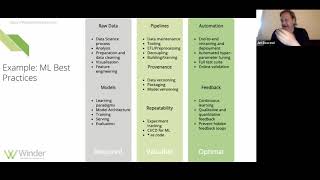
The topic of conversation for our virtual meetup was an in-depth look at a pyramid of software engineering best practices that built-up to incorporate data science best practices. That is to say, we analyzed “the essentials”, "nice to have" and "optimal" ways of doing data science.
Machine Learning/Data Science/AI is an extension of the technical stack. So you can't really talk about Data science best practices without accidentally talking about software engineering best practices. For example, model provenance doesn't count for anything if you don't have code or container provenance.
Just as Maslow has the basic human needs so too do we have basic MLOps needs. Where does "MLOps", as a "thing", starts and end? For example, the four very reasonable best practices of the operation of models, but these are usually consumed into higher-level abstractions because there is a lot more to do than "just" provenance.
This was a virtual fireside chat between Phil Winder and Demetrios Brinkmann. relevant links can be found below.
Join our MLOps slack community: https://bit.ly/3aOTwgR
Connect with Demetrios on LinkedIn: https://www.linkedin.com/in/dpbrinkm/
Connect with Phil on LinkedIn:
Follow Phil on Twitter: https://twitter.com/DrPhilWinder
Learn more about Phil's company Winder research: https://winderresearch.com/
Playlist
Uploads from MLOps.community · MLOps.community · 16 of 60
1
 2
2
 3
3
 4
4
 5
5
 6
6
 7
7
 8
8
 9
9
 10
10
 11
11
 12
12
 13
13
 14
14
 15
15
 ▶
▶
 17
17
 18
18
 19
19
 20
20
 21
21
 22
22
 23
23
 24
24
 25
25
 26
26
 27
27
 28
28
 29
29
 30
30
 31
31
 32
32
 33
33
 34
34
 35
35
 36
36
 37
37
 38
38
 39
39
 40
40
 41
41
 42
42
 43
43
 44
44
 45
45
 46
46
 47
47
 48
48
 49
49
 50
50
 51
51
 52
52
 53
53
 54
54
 55
55
 56
56
 57
57
 58
58
 59
59
 60
60

Our 1st MLOps Meetup // Luke Marsden // MLOps Meetup #1
MLOps.community
Remote Collaboration as a Data Scientist
MLOps.community
MLOps Manifesto with Luke Marsden from Dotscience
MLOps.community
MLOps lifecycle description
MLOps.community
What Does Best in Class AI/ML Governance Look Like in Fin Services? // Charles Radclyffe // MLOps #2
MLOps.community
Life purpose and too many spreadsheets
MLOps.community
Explainability, Black boxes and EU white paper on reproducibility
MLOps.community
Hierarchy of Machine Learning Needs // Phil Winder // MLOps Meetup #3
MLOps.community
Automatically Retrain Machine Learning Models? Are best practices worth it?
MLOps.community
Building an MLOps Team? Key ideas to keep in mind
MLOps.community
Hierarchy of MLOps Needs
MLOps.community
Bare necessities for getting an ML model into production
MLOps.community
MLOps and Monitoring
MLOps.community
How Phil Winder got into Data Science and Software Engineering
MLOps.community
Provenance and Reproducibility in Machine Learning; what is it and why you need it?
MLOps.community
Friction Between Data Scientists and Software Engineers
MLOps.community
MLOps Problems in different size companies
MLOps.community
ML tooling in large companies
MLOps.community
ML Platforms - The build vs buy question
MLOps.community
ML Services Gateway at SurveyMonkey
MLOps.community
Message buses, Async and sync architecture
MLOps.community
MLOps #4: Shubhi Jain - Building an ML Platform @SurveyMonkey
MLOps.community
Hybrid Data Science Teams @SurveyMonkey
MLOps.community
How do you handle ML version control at SurveyMonkey
MLOps.community
Doing ML with Personal Information
MLOps.community
Evolution of the ML feature store @SurveyMonkey
MLOps.community
Developing a Machine Learning Feature Store
MLOps.community
Auto retrain ML models is not the question
MLOps.community
3 key parts to Machine Learning monitoring
MLOps.community
MLOps Meetup #6: Mid-Scale Production Feature Engineering with Dr. Venkata Pingali
MLOps.community
MLOps meetup #5 High Stakes ML: Active Failures, Latent Factors with Flavio Clesio
MLOps.community
MLOps: Airflow Pros and Cons
MLOps.community
Specific challenges in Machine Learning
MLOps.community
Current State Of Machine Learning
MLOps.community
Humans in the Loop are a defining factor in Machine Learning
MLOps.community
Learning from real life Machine Learning failures
MLOps.community
Survivorship Bias in machine learning tutorials
MLOps.community
Swiss Cheese model in Machine Learning
MLOps.community
Resume driven development in Machine learning & software engineering
MLOps.community
Who has the highest standards in ML?
MLOps.community
Venkata Pingali of Scribble Data Thoughts on the Current State of Machine Learning
MLOps.community
Dependable data and being able to Trust in your Data with Venkata Pengali of Scribble Data
MLOps.community
Speed, Trust, Evolution and Scale in MLOps
MLOps.community
More difficult transition for data scientists to become ML engineers
MLOps.community
How many models in prod til I need a dedicated ML platform?
MLOps.community
Deeper thinking from data scientists around platform blackholes
MLOps.community
Checkpointing, metadata, and confidence in your data
MLOps.community
Adjacent usecases and multistep feature engineering
MLOps.community
Standardization of Machine Learning tools like in Software Engineering with Venkata Pingali
MLOps.community
Reproducability flaws in end to end Machine Learning debugging
MLOps.community
3rd wave of data scientists
MLOps.community
MLOps meetup #7 Alex Spanos // TrueLayer 's MLOps Pipeline
MLOps.community
MLOps Meetup #8 Optimizing Your ML Workflow with Kubeflow 1.0
MLOps.community
Are Kubeflow and Airflow complementary?
MLOps.community
Why Kubeflow gained so much traction=open community
MLOps.community
Who decides the dirrection of Kubeflow
MLOps.community
What do Kubeflow and Arrikto do and how do they work together?
MLOps.community
Versioning your ML steps with Kubeflow
MLOps.community
Machine Learning Lifecycles//Perception vs Reality
MLOps.community
Kubeflow vs SageMaker in Machine Learning
MLOps.community
More on: LLMOps
View skill →






Related Reads
📰
📰
📰
📰
Detailed explanation of how to create a text-to-image model from scratch. [R]
Reddit r/MachineLearning
I Asked an LLM to Search My Own Papers for Hypotheses I Had Missed
Medium · AI
Claude Fable 5.1: What Actually Changed, and Why It Matters
Medium · AI
What Happened When I Asked AI to Find Hidden Patterns in What I Read
Medium · AI
🎓
Tutor Explanation

 DeepCamp AI