What's so special about Euler's number e? | Chapter 5, Essence of calculus
Skills:
ML Maths Basics90%
Key Takeaways
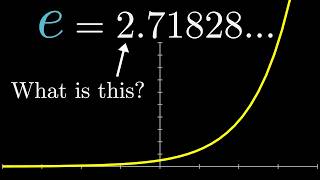
The video explains the concept of Euler's number e and its significance in calculus, particularly in exponential functions and their derivatives. It highlights the unique property of e^t being equal to its own derivative, making it a fundamental constant in mathematics.
Full Transcript
[Music] I've introduced a few derivative formulas but a really important one that I left out was exponentials so here I want to talk about the derivatives of functions like 2 the x 7 to the X and also to show why e to the x is arguably the most important of the exponentials first of all to get an intuition let's just focus on the function 2 to the X and let's think of that input as a Time T maybe in days and the output 2 to the T as a population size perhaps of a particularly fertile band of P creatures which doubles every single day and actually instead of population size which grows in discreet little jumps with each new baby pie creature maybe let's think of 2 to the T as the total mass of the population I think that better reflects the continuity of this function don't you so for example at time T equals 0 the total mass is 2 0 = 1 for the mass of one creature at tal 1 day the population has grown to 2 to the 1 = 2 Creature masses at day tal 2 it's t^2 or 4 and in general it just keeps doubling every day for the derivative we want dmdt the rate at which this population mass is growing thought of as a tiny change in the mass divided by a tiny change in time and let's start by thinking of the rate of change over a full day say between day three and day four well in this case it grows from 8 to 16 so that's eight new creature masses added over the course of one day and notice that rate of growth equals the population size at the start of the day between day four and day five it grows from 16 to 32 so that's a rate of 16 new creature masses per day which again equals the population size at the start of the day and in general this rate of growth over a full day equals the population size at the start of that day so it might be tempting to say that this means the derivative of 2 to the T equals itself that the rate of change of this function at a given time T is equal to well the value of that function and this is definitely in the right direction but it's not quite correct what we're doing here is making comparisons over a full day considering the difference between 2 to the t plus 1 and 2 to the T but for the derivative we need to ask what happens for smaller and smaller changes what's the growth over the course of a tenth of a day a hundredth of a day one one billionth of a day this is why I had us think of the function as representing population mass since it makes sense to ask about a tiny change in mass over a tiny fraction of a day but it doesn't make as much sense to ask about the tiny change in a discrete population size per second more abstractly for a tiny change in time DT we want to understand the difference between 2 the t plus DT and 2 the T all divided by DT the change in the function per unit time but now we're looking very narrowly around a given point in time rather than over the course of a full day and here's the thing I would love if there was some very clear geometric picture that made everything that's about to follow just pop out some diagram where you could point to one value and say see that part that is the derivative of 2 to the T and if you know of one please let me know and while the goal here as with the rest of the series is to make maintain a playful spirit of Discovery the type of play that follows will have more to do with finding numerical patterns rather than visual ones so start by just taking a very close look at this term 2 to the t + DT a core property of exponentials is that you can break this up as 2 to the T * 2 to the DT that really is the most important property of exponents if you add two values in that exponent you can break up the output as a product of some kind this is what lets you relate additive ideas things like Tiny Steps in time to multiplicative ideas things like rates and ratios I mean just look at what happens here after that move we can factor out the term 2 to the T which is now just multiplied by 2 DT minus 1 all divid DT and remember the derivative of 2 to the t is whatever this whole expression approaches as DT approaches zero and at first glance that might seem like an unimportant manipulation but a tremendously important fact is that this term on the right where all of the DT stuff lives is completely separate from the T term itself it doesn't depend on the actual time where we started you can go off to a calculator and plug in very small values for DT here for example maybe typing in 2 0.001 minus1 ID 0.001 what you'll find is that for smaller and smaller choices of DT this value approaches a very specific number around 0.6931 don't worry if that number seems mysterious the central point is that this is some kind of constant unlike derivatives of other functions all of the stuff that depends on DT is separate from the value of T itself so the derivative of 2 to the t is just itself but multiplied by some constant and that should kind of make sense because earlier it felt like the derivative for 2 to the T should be itself at least when we were looking at changes over the course of a full day and evidently the rate of change for this function over much smaller time scales is not quite equal to itself but it's proportional to itself with this very peculiar proportionality constant of 0.6931 and there's not too much special about the number two here if instead we had dealt with the function 3 to the T the exponential property would also have led us to the conclusion that the derivative of 3 to the t is proportional to itself but this time it would have had a proportionality constant 1.0986 and for other bases to your exponent you can have fun trying to see what the various proportionality constants are maybe seeing if you can find a pattern in them for example if you plug in 8 to the power of a very tiny number minus one and divide by that same tiny number what you'd find is that the relevant proportionality constant is around 2.79 and maybe just maybe you would notice that this number happens to be exactly three times the constant associated with the base for two so these numbers certainly aren't random there is some kind of pattern but what is it what does two have to do do with the number 0.6931 and what does 8 have to do with the number 2.79 well a second question that is ultimately going to explain these mystery constants is whether there's some base where that proportionality constant is one where the derivative of a to the^ T is not just proportional to itself but actually equal to itself and there is it's the special constant e around 2.71828 in fact it's not just that the number e happens to show up here this is in a sense what defines the number e if you ask why does e of all numbers have this property it's a little like asking why does Pi of all numbers happen to be the ratio of the circumference of a circle to its diameter this is at its heart what defines this value all exponential functions are proportional to their own derivative but e alone is the special number so that that proportionality constant is one meaning e to the T actually equals its own derivative one way to think of that is that if you look at the graph of e to the T it has the peculiar property that the slope of a tangent line to any point on this graph equals the height of that point above the horizontal axis the existence of a function like this answers the question of the mystery constants and it's because it gives a different way to think about functions that are proportional to their own derivative the key is to use the chain rule for example what is the derivative of e to 3 T well you take the derivative of the outermost function which due to this special nature of e is just itself and then multiply by the derivative of that inner function 3T which is the constant 3 or rather than just applying a rule blindly you could take this moment to practice the intuition for the chain rule that I talked through last video thinking about how a slight nudge to T changes value of 3T and how that intermediate change nudges the final value of e to 3T either way the point is e to the power of some constant time T is equal to that same constant times itself and from here the question of those mystery constants really just comes down to a certain algebraic manipulation the number two can also be written as e to the natural log of two there's nothing fancy here this is just the definition of the natural log it asks the question e to the what equals 2 so the function 2 to the t is the same as the function e to the power of the natural log of 2 * T and from what we just saw combining the facts that e to the t is its own derivative with the chain rule the derivative of this function is proportional to itself with a proportionality constant equal to the natural log of two and indeed if you go plug in the natural log of two to a calculator you'll find that it's 0.6931 the mystery constant that we ran into earlier and the same goes for all of the other bases the mystery proportionality constant that pops up when taking derivatives is just the natural log of the base the answer to the question e to the what equals that base in fact throughout applications of calculus you rarely see exponentials written as some base to a power T instead you almost always write the exponential as e to the power of some constant time T it's all equivalent I mean any function like 2 to the T or 3 to the T can also be written as e to some constant time T at the risk of staying overfocused on the symbols here I really want to emphasize that there are many many ways to write down any particular exponential function and when you see something written as e to some constant time T that's a choice that we make to write it that way and the number e is not fundamental to that function itself what is special about writing exponentials in terms of e like this is that it gives that constant in the exponent a nice readable meaning here let me show you what I mean all sorts of natural phenomena involve some rate of change change that's proportional to the thing that's changing for example the rate of growth of a population actually does tend to be proportional to the size of the population itself assuming there isn't some limited resource slowing things down and if you put a cup of hot water in a cool room the rate at which the water cools is proportional to the difference in temperature between the room and the water or said a little differently the rate at which that difference changes is is proportional to itself if you invest your money the rate at which it grows is proportional to the amount of money there at any time in all of these cases where some variable's rate of change is proportional to itself the function describing that variable over time is going to look like some kind of exponential and even though there are lots of ways to write any exponential function it's very natural to choose to express these functions as e to the power of some constant time T since that constant carries a very natural meaning it's the same as the proportionality constant between the size of the changing variable and the rate of change and as always I want to thank those who've made the series possible [Music]
Original Description
What is e? And why are exponentials proportional to their own derivatives?
Help fund future projects: https://www.patreon.com/3blue1brown
An equally valuable form of support is to simply share some of the videos.
Special thanks to these supporters: http://3b1b.co/lessons/eulers-number#thanks
Home page: https://www.3blue1brown.com
Timestamps
0:00 - Motivating example
3:57 - Deriving the key proportionality property
7:36 - What is e?
8:48 - Natural logs
11:23 - Writing e^ct is a choice
Corrections:
9:40 - I meant to say "*the derivative of* e to the power of some constant..."
12:30 - What's written as "(1 + r)" should really just be r, by any usual convention for how to write an interest rate.
Thanks to these viewers for their contributions to translations
Hebrew: Omer Tuchfeld
Italian: ang
Vietnamese: @ngvutuan2811
------------------
3blue1brown is a channel about animating math, in all senses of the word animate. And you know the drill with YouTube, if you want to stay posted about new videos, subscribe, and click the bell to receive notifications (if you're into that).
If you are new to this channel and want to see more, a good place to start is this playlist: http://3b1b.co/recommended
Various social media stuffs:
Website: https://www.3blue1brown.com
Twitter: https://twitter.com/3Blue1Brown
Patreon: https://patreon.com/3blue1brown
Facebook: https://www.facebook.com/3blue1brown
Reddit: https://www.reddit.com/r/3Blue1Brown
Watch on YouTube ↗
(saves to browser)
Sign in to unlock AI tutor explanation · ⚡30
Playlist
Uploads from 3Blue1Brown · 3Blue1Brown · 38 of 60
1
 2
2
 3
3
 4
4
 5
5
 6
6
 7
7
 8
8
 9
9
 10
10
 11
11
 12
12
 13
13
 14
14
 15
15
 16
16
 17
17
 18
18
 19
19
 20
20
 21
21
 22
22
 23
23
 24
24
 25
25
 26
26
 27
27
 28
28
 29
29
 30
30
 31
31
 32
32
 33
33
 34
34
 35
35
 36
36
 37
37
 ▶
▶
 39
39
 40
40
 41
41
 42
42
 43
43
 44
44
 45
45
 46
46
 47
47
 48
48
 49
49
 50
50
 51
51
 52
52
 53
53
 54
54
 55
55
 56
56
 57
57
 58
58
 59
59
 60
60

e to the pi i, a nontraditional take (old version)
3Blue1Brown
Euler's Formula Poem
3Blue1Brown
Euler's Formula and Graph Duality
3Blue1Brown
What does it feel like to invent math?
3Blue1Brown
How to count to 1000 on two hands
3Blue1Brown
Music And Measure Theory
3Blue1Brown
Fractal charm: Space filling curves
3Blue1Brown
The Brachistochrone, with Steven Strogatz
3Blue1Brown
Snell's law proof using springs
3Blue1Brown
Triangle of Power
3Blue1Brown
Essence of linear algebra preview
3Blue1Brown
Vectors | Chapter 1, Essence of linear algebra
3Blue1Brown
Linear combinations, span, and basis vectors | Chapter 2, Essence of linear algebra
3Blue1Brown
Linear transformations and matrices | Chapter 3, Essence of linear algebra
3Blue1Brown
Matrix multiplication as composition | Chapter 4, Essence of linear algebra
3Blue1Brown
Three-dimensional linear transformations | Chapter 5, Essence of linear algebra
3Blue1Brown
The determinant | Chapter 6, Essence of linear algebra
3Blue1Brown
Inverse matrices, column space and null space | Chapter 7, Essence of linear algebra
3Blue1Brown
Nonsquare matrices as transformations between dimensions | Chapter 8, Essence of linear algebra
3Blue1Brown
Dot products and duality | Chapter 9, Essence of linear algebra
3Blue1Brown
Cross products in the light of linear transformations | Chapter 11, Essence of linear algebra
3Blue1Brown
Cross products | Chapter 10, Essence of linear algebra
3Blue1Brown
Change of basis | Chapter 13, Essence of linear algebra
3Blue1Brown
Eigenvectors and eigenvalues | Chapter 14, Essence of linear algebra
3Blue1Brown
Abstract vector spaces | Chapter 16, Essence of linear algebra
3Blue1Brown
Who cares about topology? (Old version)
3Blue1Brown
3blue1brown channel trailer
3Blue1Brown
Binary, Hanoi and Sierpinski, part 1
3Blue1Brown
Binary, Hanoi, and Sierpinski, part 2
3Blue1Brown
But what is the Riemann zeta function? Visualizing analytic continuation
3Blue1Brown
Tattoos on Math
3Blue1Brown
Fractals are typically not self-similar
3Blue1Brown
Euler's formula with introductory group theory
3Blue1Brown
The essence of calculus
3Blue1Brown
The paradox of the derivative | Chapter 2, Essence of calculus
3Blue1Brown
Derivative formulas through geometry | Chapter 3, Essence of calculus
3Blue1Brown
Visualizing the chain rule and product rule | Chapter 4, Essence of calculus
3Blue1Brown
What's so special about Euler's number e? | Chapter 5, Essence of calculus
3Blue1Brown
Implicit differentiation, what's going on here? | Chapter 6, Essence of calculus
3Blue1Brown
Limits, L'Hôpital's rule, and epsilon delta definitions | Chapter 7, Essence of calculus
3Blue1Brown
Integration and the fundamental theorem of calculus | Chapter 8, Essence of calculus
3Blue1Brown
What does area have to do with slope? | Chapter 9, Essence of calculus
3Blue1Brown
Higher order derivatives | Chapter 10, Essence of calculus
3Blue1Brown
Taylor series | Chapter 11, Essence of calculus
3Blue1Brown
Pi hiding in prime regularities
3Blue1Brown
All possible pythagorean triples, visualized
3Blue1Brown
But how does bitcoin actually work?
3Blue1Brown
How secure is 256 bit security?
3Blue1Brown
Hilbert's Curve: Is infinite math useful?
3Blue1Brown
Thinking outside the 10-dimensional box
3Blue1Brown
Some light quantum mechanics (with minutephysics)
3Blue1Brown
But what is a neural network? | Deep learning chapter 1
3Blue1Brown
Gradient descent, how neural networks learn | Deep Learning Chapter 2
3Blue1Brown
Backpropagation, intuitively | Deep Learning Chapter 3
3Blue1Brown
Backpropagation calculus | Deep Learning Chapter 4
3Blue1Brown
The hardest problem on the hardest test
3Blue1Brown
Q&A #2 + Net Neutrality Nuance
3Blue1Brown
Why this puzzle is impossible
3Blue1Brown
But what is the Fourier Transform? A visual introduction.
3Blue1Brown
The more general uncertainty principle, regarding Fourier transforms
3Blue1Brown
More on: ML Maths Basics
View skill →




Related Reads
Chapters (7)
Motivating example
3:57
Deriving the key proportionality property
7:36
What is e?
8:48
Natural logs
11:23
Writing e^ct is a choice
9:40
I meant to say "*the derivative of* e to the power of some constant..."
12:30
What's written as "(1 + r)" should really just be r, by any usual convention f
🎓
Tutor Explanation

 DeepCamp AI