How secure is 256 bit security?
Skills:
RAG Basics80%
Key Takeaways
The video explains the security of 256-bit hashes by demonstrating the impracticality of guessing and checking, using examples of computational power and large numbers, specifically referencing the SHA-256 hash function and Bitcoin mining.
Full Transcript
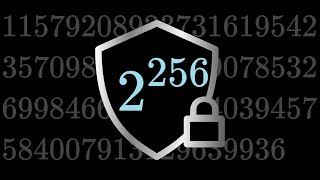
in the main video on cryptocurrencies I made two references to situations where in order to break a given piece of security you would have to guess a specific string of 256 bits one of these was in the context of digital signatures and the other in the context of a cryptographic hash function for example if you want to find a message whose sha 256 hash is some specific string of 256 bits you have no better method than to just guess and check random messages and this would require on average 2 to the 256 guesses now this is a number so far removed from anything that we ever deal with that it can be hard to appreciate its size but let's give it a try 2 to 256 is the same as 2 to 32 multiplied by itself 8 times now what's nice about that split is that 2 32 is 4 billion which is at least a number we can think about right it's the kind of thing you might see in headline so all we need to do is appreciate what multiplying 4 billion times itself eight successive times really feels like as many of you know the GPU on your computer can let you run a whole bunch of computations in parallel incredibly quickly so if you were to specially program a GPU to run a cryptographic hash function over and over a really good one might be able to do a little less than a billion hashes per second and let's say that you just take a bunch of those and cram your computer full of extra gpus so that your computer can run 4 billion hashes per second so the first 4 billion here is going to represent the number of hashes per second per computer now picture 4 billion of these GPU packed computers for comparison even though Google does not at all make their number of servers public estimates have it somewhere in the singled digigit millions in reality most of those servers are going to be much less powerful than our imagined GPU packed machine but let's say that Google replaced all of its millions of servers with a machine like this then 4 billion machines would mean about a thousand copies of this souped up Google let's call that one kilog Google worth of computing power there's about 7.3 billion people on Earth so next Imagine giving a little over half of every individual on Earth their own personal killer Google Now imagine 4 billion copies of this Earth for comparison the Milky Way has somewhere between 100 and 400 billion stars we don't really know but the estimates tend to be in that range so this would be akin to a full 1% of every star in the galaxy having a copy of Earth where half the people on that Earth have their own personal killer Google next try to imagine 4 billion copies of the Milky Way and we're going to call this your Giga Galactic supercomputer running about 2 to the 160 gu every second now 4 billion seconds that's about 126.80 7 billion years which is about 37 times the age of the universe so even if you were to have your GPU packed kilog Google perp person multiplanetary Giga Galactic computer guessing numbers for 37 times the age of the universe it would still only have a 1 in4 billion chance of finding the correct guess by the way the state of Bitcoin hashing these days is that all of the miners put together guess and check at a rate of about 5 billion billion hashes per second that corresponds to 1/3 of what I just described as a kilog gooogle this is not because there are actually billions of GPU packed machines out there but because miners actually use something that's about a thousand times better than a GPU application specific integrated circuits these are pieces of hard Ware specifically designed for Bitcoin mining for running a bunch of shot 256 hashes and nothing else turns out there's a lot of efficiency gains to be had when you throw out the need for General computation and design your integrated circuits for one and only one task also on the topic of large powers of two that I personally find it hard to get my mind around this channel recently surpassed 2 to the 18th subscribers and to engage a little more with some sub portion of those two to to the 18 people I'm going to do a Q&A session I've left a link in the description to a Reddit thread where you can post questions and upload the ones that you want to hear answers to and probably in the next video or on Twitter or something like that I'll announce the format in which I'd like to give answers see you then [Music] [Music]
Original Description
How hard is it to find a 256-bit hash just by guessing and checking?
Help fund future projects: https://www.patreon.com/3blue1brown
An equally valuable form of support is to simply share some of the videos.
Home page: https://www.3blue1brown.com/
Several people have commented about how 2^256 would be the maximum number of attempts, not the average. This depends on the thing being attempted. If it's guessing a private key, you are correct, but for something like guessing which input to a hash function gives the desired output (as in bitcoin mining, for example), which is the kind of thing I had in mind here, 2^256 would indeed be the average number of attempts needed, at least for a true cryptographic hash function. Think of rolling a die until you get a 6, how many rolls do you need to make, on average?
Music by Vince Rubinetti:
https://vincerubinetti.bandcamp.com/album/the-music-of-3blue1brown
Thanks to these viewers for their contributions to translations
Dutch: @bvdeijzen
Hebrew: Omer Tuchfeld
Italian: retr00h
------------------
3blue1brown is a channel about animating math, in all senses of the word animate. And you know the drill with YouTube, if you want to stay posted on new videos, subscribe, and click the bell to receive notifications (if you're into that).
If you are new to this channel and want to see more, a good place to start is this playlist: http://3b1b.co/recommended
Various social media stuffs:
Website: https://www.3blue1brown.com
Twitter: https://twitter.com/3Blue1Brown
Patreon: https://patreon.com/3blue1brown
Facebook: https://www.facebook.com/3blue1brown
Reddit: https://www.reddit.com/r/3Blue1Brown
Watch on YouTube ↗
(saves to browser)
Sign in to unlock AI tutor explanation · ⚡30
Playlist
Uploads from 3Blue1Brown · 3Blue1Brown · 48 of 60
1
 2
2
 3
3
 4
4
 5
5
 6
6
 7
7
 8
8
 9
9
 10
10
 11
11
 12
12
 13
13
 14
14
 15
15
 16
16
 17
17
 18
18
 19
19
 20
20
 21
21
 22
22
 23
23
 24
24
 25
25
 26
26
 27
27
 28
28
 29
29
 30
30
 31
31
 32
32
 33
33
 34
34
 35
35
 36
36
 37
37
 38
38
 39
39
 40
40
 41
41
 42
42
 43
43
 44
44
 45
45
 46
46
 47
47
 ▶
▶
 49
49
 50
50
 51
51
 52
52
 53
53
 54
54
 55
55
 56
56
 57
57
 58
58
 59
59
 60
60

e to the pi i, a nontraditional take (old version)
3Blue1Brown
Euler's Formula Poem
3Blue1Brown
Euler's Formula and Graph Duality
3Blue1Brown
What does it feel like to invent math?
3Blue1Brown
How to count to 1000 on two hands
3Blue1Brown
Music And Measure Theory
3Blue1Brown
Fractal charm: Space filling curves
3Blue1Brown
The Brachistochrone, with Steven Strogatz
3Blue1Brown
Snell's law proof using springs
3Blue1Brown
Triangle of Power
3Blue1Brown
Essence of linear algebra preview
3Blue1Brown
Vectors | Chapter 1, Essence of linear algebra
3Blue1Brown
Linear combinations, span, and basis vectors | Chapter 2, Essence of linear algebra
3Blue1Brown
Linear transformations and matrices | Chapter 3, Essence of linear algebra
3Blue1Brown
Matrix multiplication as composition | Chapter 4, Essence of linear algebra
3Blue1Brown
Three-dimensional linear transformations | Chapter 5, Essence of linear algebra
3Blue1Brown
The determinant | Chapter 6, Essence of linear algebra
3Blue1Brown
Inverse matrices, column space and null space | Chapter 7, Essence of linear algebra
3Blue1Brown
Nonsquare matrices as transformations between dimensions | Chapter 8, Essence of linear algebra
3Blue1Brown
Dot products and duality | Chapter 9, Essence of linear algebra
3Blue1Brown
Cross products in the light of linear transformations | Chapter 11, Essence of linear algebra
3Blue1Brown
Cross products | Chapter 10, Essence of linear algebra
3Blue1Brown
Change of basis | Chapter 13, Essence of linear algebra
3Blue1Brown
Eigenvectors and eigenvalues | Chapter 14, Essence of linear algebra
3Blue1Brown
Abstract vector spaces | Chapter 16, Essence of linear algebra
3Blue1Brown
Who cares about topology? (Old version)
3Blue1Brown
3blue1brown channel trailer
3Blue1Brown
Binary, Hanoi and Sierpinski, part 1
3Blue1Brown
Binary, Hanoi, and Sierpinski, part 2
3Blue1Brown
But what is the Riemann zeta function? Visualizing analytic continuation
3Blue1Brown
Tattoos on Math
3Blue1Brown
Fractals are typically not self-similar
3Blue1Brown
Euler's formula with introductory group theory
3Blue1Brown
The essence of calculus
3Blue1Brown
The paradox of the derivative | Chapter 2, Essence of calculus
3Blue1Brown
Derivative formulas through geometry | Chapter 3, Essence of calculus
3Blue1Brown
Visualizing the chain rule and product rule | Chapter 4, Essence of calculus
3Blue1Brown
What's so special about Euler's number e? | Chapter 5, Essence of calculus
3Blue1Brown
Implicit differentiation, what's going on here? | Chapter 6, Essence of calculus
3Blue1Brown
Limits, L'Hôpital's rule, and epsilon delta definitions | Chapter 7, Essence of calculus
3Blue1Brown
Integration and the fundamental theorem of calculus | Chapter 8, Essence of calculus
3Blue1Brown
What does area have to do with slope? | Chapter 9, Essence of calculus
3Blue1Brown
Higher order derivatives | Chapter 10, Essence of calculus
3Blue1Brown
Taylor series | Chapter 11, Essence of calculus
3Blue1Brown
Pi hiding in prime regularities
3Blue1Brown
All possible pythagorean triples, visualized
3Blue1Brown
But how does bitcoin actually work?
3Blue1Brown
How secure is 256 bit security?
3Blue1Brown
Hilbert's Curve: Is infinite math useful?
3Blue1Brown
Thinking outside the 10-dimensional box
3Blue1Brown
Some light quantum mechanics (with minutephysics)
3Blue1Brown
But what is a neural network? | Deep learning chapter 1
3Blue1Brown
Gradient descent, how neural networks learn | Deep Learning Chapter 2
3Blue1Brown
Backpropagation, intuitively | Deep Learning Chapter 3
3Blue1Brown
Backpropagation calculus | Deep Learning Chapter 4
3Blue1Brown
The hardest problem on the hardest test
3Blue1Brown
Q&A #2 + Net Neutrality Nuance
3Blue1Brown
Why this puzzle is impossible
3Blue1Brown
But what is the Fourier Transform? A visual introduction.
3Blue1Brown
The more general uncertainty principle, regarding Fourier transforms
3Blue1Brown
More on: RAG Basics
View skill →









Related Reads
📰
📰
📰
📰
AnswerSurvivalRAG: What Happens When RAG Finds the Answer, Then Drops It?
Medium · Machine Learning
A RAG evaluator that admits what it can't judge
Dev.to · Melissa D. Ellison
RAG on Google Cloud in Regulated Environments: A Lifecycle Playbook from Inception to…
Medium · Machine Learning
Solving One of the Hardest Problems in Code RAG: Context Retrieval
Medium · RAG
🎓
Tutor Explanation

 DeepCamp AI