PyTorch Summer Hackathon Winners - Joe Spisak, Sebastien Arnold, Tristan Deleu
Key Takeaways
The PyTorch Summer Hackathon showcased innovative projects built with PyTorch, including livestock disease detection and AI-powered financial assistants, with a focus on meta learning and research challenges. The hackathon utilized various tools such as PyTorch, Meta Learning Framework, and Torch Meta Library to simplify the process of benchmarking and improve reproducibility in meta learning research.
Full Transcript
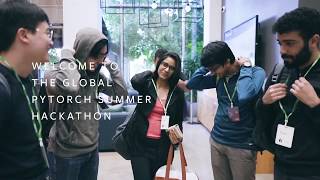
[Music] okay we're gonna switch gears and talk summer hack so we're all the summer hackers got some here all right whoo so we basically decided to do some summer hacks this year it was it was a new experience for us I'd never actually run one and actually never ran it whoo Kim did all the work Thank You whoo but we hosted two summer hacks we did one in Menlo Park that was smaller more intimate and then we did one that was global which was more of a virtual hack and to give an idea here some statistics we had 74 participants in Menlo Park it was 28 straight hours and I mean 28 straight hours like basically no one slept most of our team didn't sleep especially Francisco masa whoever he is it was incredible we have 13 submissions in the global hack we had almost 1500 submissions and it was a five week long hack with 74 submissions and excited to share the actual winners here so it was the it was the year of metal earning let me just preface it by saying that so learn to learn and metal learning framework took first place and Sebastian will will jump out and give a talk here shortly second place was hello world that this was actually a really interesting project about discovering extrasolar planets with PI torch as we actually had someone from NASA Ames in the in the group which is really cool and then the third project was mine torqued which is really bringing a building block like approach allowing essentially kids maybe even my five-year-old daughter to to be able to to put blocks together it's great deep neural nets in kind of an easy way so that was the the one envelop arc again continuing the theme of meta-learning torch meta so Tristan will go up and talk in in a few minutes again really impressive meta learning framework and then second place was this end-to-end music D mixing platform on PI torch that also leveraged torch audio so Vincente wherever you are very proud of that and then Artie was the last project and Artie was by far the most polish actually felt like a product so essentially you can go today to RTA I actually order your own t-shirt that actually is generated using a style Gann so this is actually really really interesting so a couple of pictures from from the hack and we're gonna kick things off so Sebastian from learn to learn is gonna give us a short talk followed by Tristan from torch Metta thank you so thank you for the introduction and good afternoon everyone today I'm gonna talk about our submission to the PI torch summer hackathon which took place in Menlo Park and our submission focused on learn to learn which is a PI torch meta learning library we believe that meta learning might be might enable the next wave of AI applications however to do so it needs to resolve two big challenges the first one sorry the first one is is a research challenge because meta learning algorithms currently don't work that well the second challenge is an engineering challenge and it's that meta learning algorithms are difficult to currently implement and so we decided to tackle the second challenge and that's what this presentation is gonna be about let's start with a short definition what is meta learning metal the goal of meta learning is to endow agents with the ability of learning to learn what this means is that as the agent sees more and more tasks you should be able to learn how to solve new tasks faster and better for example a meta learning agent might be able to learn how to optimize or how to trade-off exploration for exploitation in this presentation we're going to focus on a specific kind of meta learning which is called few short meta learning here we want the agent to be able to learn from a limited amount of data the left side of the slide provides an example we have a task which consists of classifying five characters from the Latin alphabet a B e M and Z a second task might be to classify Greek characters by confining the agent to more and more tasks our hope is that when presented with new unseen characters in this case Chinese characters the agent will be able to learn to robustly classify them despite being given only one data sample per class all right let's have a look at an example from the reinforcement learning literature here we've got a cheetah who starts to run forwards or backwards at a desired target velocity again we confirm the cheetah to many many tasks and we observe the following behavior post meta learning at first we see that the cheetah hops forwards and backwards trying to identify what the unknown task is about after one gradient step the magic happens the cheetah is able to infer what the task is about as well as solving the task by running in the desired direction and at the desired speed now those results are impressive however there is a caveat and the caveat is that the algorithms to obtain those results are particularly tricky to implement enters learn to learn learn to learn provide implementation to many in state-of-the-art algorithms and we're constantly growing the number of supported algorithms in the library we also provide standardized benchmark tasks for the supervised and reinforcement learning domains that enable researchers and practitioners alike to compare the performance of meta learning algorithms last but not least we strive to follow software engineering best practices by continuously testing our implementation and tasks now learn to learn love's by torch in fact we strive to maintain compatibility with the entire PI torch ecosystem that means that you can use any data set any module or any library as long as they're compatible with the core pipe or library second we follow a similar design philosophy we provide a high level API to practitioners that enable them to use existing meta learning algorithms for their task at hand for researchers we provide low level API that enable them to implement new and hopefully better meta learning algorithms if you would like to learn more about learn to learn visit learn to run net or come talk to us at the end of this day I would like to conclude by thanking my teammates pratik Deb and Ian without whom this whole project would not have been possible I would also like to thank the PI torch hackathon organizers for an awesome event and to thank you for your attention thank you [Applause] [Music] Tristan and I'm a graduate student at Mira and today I'm very excited to be here to talk about torch meta library for future learning and meta learning in pi torch so the main motivation behind torch Mira is to simplify the process of benchmarking and improve reduce reproducibility in meta learning research it was inspired by a bunch of different libraries such as open a gem which has now become a standard interface for reinforcement learning environments as well as torch vision which provides a variety of data routers for computer vision tasks in pi torch torch model features data loaders for future learning benchmarks with helper functions with best practices from the literature it also features extensions of pipe of Pi torch to simplify the creation of meta learning models now the data loaders will build on top of pi torch data loader specifically for meta learning so they should look very familiar to you it provides a unified interface for both future classification as well as fuschia regression problems so that switching between datasets is as seamless as possible storage media currently features eight different data sets three toil regression problems and five image classification problems and because some meta learning algorithms have specific needs and cept awk about that before torch meta also features a thin extension of Pi torch modules called meta modules and this allows you to create models compatible with gradient-based meta learning methods with minimal changes to your existing models for example let's say you have a model such as the one on the right using torch meta and just a few updates to your model it is ready to be used for gradient based methods where you need to back propagate through learning rule like gradient descent thanks to this additional parameter argument to the forward function parents you can try torch MIT and now and we are welcoming contributions for new datasets for future learning and also for meta learning finally I would like to thank everyone at Mira for their incredible support for this project and all the students that helped testing the library during the early stages of development I would like to also thank the PI torch team for organizing this great a cotton and inviting me today to talk about torch meta thank you [Applause] [Music]
Original Description
The in-person and online Global PyTorch Summer Hackathon brought together researchers and developers around the world to build innovative new projects with PyTorch. Developers submitted creative projects ranging from livestock disease detection to AI-powered financial assistants.
Watch on YouTube ↗
(saves to browser)
Sign in to unlock AI tutor explanation · ⚡30
Playlist
Uploads from PyTorch · PyTorch · 34 of 60
1
 2
2
 3
3
 4
4
 5
5
 6
6
 7
7
 8
8
 9
9
 10
10
 11
11
 12
12
 13
13
 14
14
 15
15
 16
16
 17
17
 18
18
 19
19
 20
20
 21
21
 22
22
 23
23
 24
24
 25
25
 26
26
 27
27
 28
28
 29
29
 30
30
 31
31
 32
32
 33
33
 ▶
▶
 35
35
 36
36
 37
37
 38
38
 39
39
 40
40
 41
41
 42
42
 43
43
 44
44
 45
45
 46
46
 47
47
 48
48
 49
49
 50
50
 51
51
 52
52
 53
53
 54
54
 55
55
 56
56
 57
57
 58
58
 59
59
 60
60

What is PyTorch?
PyTorch
PyTorch Tutorial: A Quick Preview
PyTorch
PyTorch Summer Hackathon 2019
PyTorch
Tips and Tricks on Hacking with PyTorch: A Quick Tutorial by Brad Heintz
PyTorch
PyTorch 1.2 and PyTorch Hub: A Quick Introduction by Soumith Chintala and Ailing Zhang
PyTorch
Torchtext 0.4 with Supervised Learning Datasets: A Quick Introduction by George Zhang
PyTorch
Torchaudio 0.3 with Kaldi Compatibility, New Transforms: A Quick Introduction by Jason Lian
PyTorch
Torchvision 0.4 with Support for Video: A Quick Introduction by Francisco Massa
PyTorch
Introduction to Machine Learning for Developers at F8 2019
PyTorch
Powered by PyTorch at F8 2019
PyTorch
Developing and Scaling AI Experiences at Facebook with PyTorch at F8 2019
PyTorch
New Approaches to Image and Video Reconstruction Using Deep Learning at Facebook at F8 2019
PyTorch
PyTorch Developer Conference 2018: Recap
PyTorch
PyTorch Developer Conference 2018: Keynote & Deep Dive
PyTorch
PyTorch Developer Conference 2018: Production & Research Sessions
PyTorch
PyTorch Developer Conference 2018: Cloud & Academia Sessions
PyTorch
PyTorch Developer Conference 2018: Enterprise, Education, & Future of AI Panel
PyTorch
PyTorch Developer Conference 2019 | Full Livestream
PyTorch
PyTorch Developer Conference 2019: Recap
PyTorch
PyTorch Developer Conference Keynote - Mike Schroepfer
PyTorch
What’s new in PyTorch 1.3 - Lin Qiao
PyTorch
PyTorch Front-End Features: Named Tensors and Type Promotion - Gregory Chanan
PyTorch
Research to Production: PyTorch JIT/TorchScript Updates - Michael Suo
PyTorch
Quantization - Dmytro Dzhulgakov
PyTorch
PyTorch ONNX Export Support - Lara Haidar, Microsoft
PyTorch
Apex - Michael Carilli, NVIDIA
PyTorch
Dataloader Design for PyTorch - Tongzhou Wang, MIT
PyTorch
Linear Algebra in PyTorch - Vishwak Srinivasan, CMU
PyTorch
PyTorch Mobile - David Reiss
PyTorch
Model Interpretability with Captum - Narine Kokhilkyan
PyTorch
Detectron2 - Next Gen Object Detection Library - Yuxin Wu
PyTorch
Speech Extensions to Fairseq - Dmytro Okhonko
PyTorch
PyTorch on Google Cloud TPUs - Google, Salesforce, Facebook
PyTorch
PyTorch Summer Hackathon Winners - Joe Spisak, Sebastien Arnold, Tristan Deleu
PyTorch
PyTorch in Robotics - Yisong Yue, Caltech
PyTorch
StanfordNLP - Yuhao Zhang, Stanford
PyTorch
Sotabench for Reproducible Research - Robert Stojnic, Papers with Code
PyTorch
Collaborative Natural Language Inference - Sasha Rush, Cornell
PyTorch
Privacy Preserving AI - Andrew Trask, OpenMined
PyTorch
CrypTen - Laurens van der Maaten
PyTorch
PyTorch at Uber - Sidney Zhang, Uber
PyTorch
PyTorch at Tesla - Andrej Karpathy, Tesla
PyTorch
PyTorch at Microsoft - Saurabh Tiwary, Microsoft
PyTorch
PyTorch at Dolby Labs - Vivek Kumar, Dolby Labs
PyTorch
PyTorch Developer Conference 2019 - Panel Discussion
PyTorch
Using deep learning and PyTorch to power next gen aircraft at Caltech
PyTorch
Named Tensors, Model Quantization, and the Latest PyTorch Features - Part 1
PyTorch
TorchScript and PyTorch JIT | Deep Dive
PyTorch
Announcing the PyTorch Global Summer Hackathon 2020
PyTorch
Opening Up the Black Box: Model Understanding with Captum and PyTorch
PyTorch
PyTorch Mobile Runtime for Android
PyTorch
Torchvision in 5 minutes
PyTorch
3D Deep Learning with PyTorch3D
PyTorch
What is Torchtext?
PyTorch
TorchAudio: A Quick Intro
PyTorch
PyTorch Mobile Runtime for iOS
PyTorch
PySlowFast: Deep learning with Video
PyTorch
PyTorch Pruning | How it's Made by Michela Paganini
PyTorch
Measuring Fairness in Machine Learning Systems
PyTorch
PyTorch for Hackathons
PyTorch
More on: Research Methods
View skill →







Related Reads
📰
📰
📰
📰
Follow-up: The ArxivLens Protocol: Transforming Research Nois
Dev.to AI
On July 1, 2026, arXiv will spin out from Cornell University, its home for the past 25 years, to become an independent nonprofit organization. Major funding support from Simons Foundation and Schmidt Sciences. Ditching the red for their website. [N]
Reddit r/MachineLearning
CS-NRRM™ Official Publications: Paper 1 and Paper 2 Are Now Available
Medium · Data Science
Found a potential mistake in an ICLR 2026 blogpost [D]
Reddit r/MachineLearning
🎓
Tutor Explanation

 DeepCamp AI