WaveGAN Explained!
Key Takeaways
The video explains the WaveGAN architecture, which adapts Generative Adversarial Networks (GANs) to generate audio data, and discusses the paper 'Adversarial Audio Synthesis' by Chris Donahue et al.
Full Transcript
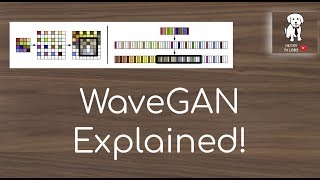
[Music] thanks for watching Henry AI labs this video will explain adversarial audio synthesis using generative adversarial networks to produce audio data rather than the heavily studied image data this is done using the wave gain architecture and the spec can model the motivation is a generative modeling is taking off thus becoming much more popular and deep learning research this describes a set of techniques that has a dataset and learns to produce new samples that might belong to that dataset so in this example in the big Gann model they amad they have a data set of dog images and the model learns what to produce novel dogs that sort of a line with the data set but then aren't too similar to any other sample so this is really amazing giving deep learning and artificial intelligence the power to create data so generative adversarial networks are the most dominant way of doing this right now and from a quick explanation of how this works there is a generator network that learns and up sampling procedure from random noise into images and then the discriminator learns to tell if this image belongs to the data set or it was created by the generator and then in this way they optimize each other until the generator is eventually able to produce images that resemble the data set so this technique of Ganz has been enormous ly successful with images it originally was developed using multi-layer perceptrons from Ian Goodfellow in 2014 and then it was improved by using transpose convolutional layers by Alec Radford and others and then it took off with things like self attention spectrum normalization and now we have these state-of-the-art results like the big and model which uses self attention spectral normalization class conditional projection and tons of parameters and we have the style Gann which uses progressive growing and an interesting technique with conditional Batchelor ization so transitioning to audio data the first question that we should try to figure out is what is audio data as data scientists were interested in the structure of data how it's stored like what are the dimensions of the matrices vectors tensors that store our data so an image is represented as this height by width by channels tensor or if it's a grayscale it could just be a matrix so in the image matrices each pixel takes on 256 values it's like 8-bit color so an audio what you have is a flat time-series vector that has 44,100 samples per second in audio quality but we're not gonna operate on audio quality it's gonna be about 16,000 samples per second in in this paper so each sample has a much larger range of values as well compared to images as you usually use the 16 bits to represent audio compared to 8 bits additionally audio is very different from image data in the inherent structure of it it's really psychical because it really consists of a bunch of sine waves compared to images which have like a global global relationship but they're not quite as you know sequence align like this showing this further is the principal components analysis when you analyze audio versus image data so the principal components of image data usually have some kind of edge features it's it's kind of hard to make any sense of this but the audio principal component analysis shows these cyclic old patterns you see cycles and each of the principal components of the audio data the dcen was an enormous step forward for applying generative adversarial networks to image data Lisa ganas pictured here the idea behind the DCN is you take your random noise input vector and you up sample it using transposed convolutions so transpose convolutions look like this they would have like a dense image like this four by four and then they would spread it out and then convolve over this to up sample it from the height width spatial resolution from four by four to eight by eight to sixteen by sixteen thirty-two and then the output target of a 64 by 64 RGB image so in wave again this is the big idea it's actually a really simple idea they use a similar transposed convolution operation but theirs is one-dimensional so they take the same thing like this is a series of sampled values from that sine wave thing and then you know compared to this which is like a feature map or they stretch it out into you know this kind of structure to do the up sampling convolution so this is the overall architecture it takes in this 100 by this 256 and then D is the channel parameter that they used to hyper tune their event a hyper parameter to tune their network so they take in the random vector and they transpose the one-dimensional convolution series of times until they end up with their final target of the 16,000 samples which is which is this parameter right here for the target output of the audio clip so these are some of the hyper parameters used in the way again like their number of channels batch size the dimensionality parameter that controls the dimensionality of the intermediate feature maps of the architectures in the generator and discriminator and then this phase shuffle thing which we will discuss next and then other things like they use the Wasserstein gamma which will be covered in the future video of this channel so the authors don't describe that they use like a Bayesian optimization or if they use some kind of a technique they just sort of give you these as a set of recommendations so phase shuffle is one of the interesting techniques that they present in the paper and if you have better insight of this than I do then please share it on the comments but the way that I interpreted it is just that it's a technique to regularize the discriminator so that it doesn't just focus on really low-level details in the generator like having a certain sine wave be off by like four frames and use that to discriminate the generated and real audio samples so the spec can also it wasn't something that I was that interested in but basically suspected grams are transformations with Fourier transforms into a time frequency domain and so they're like these images that are really useful for doing like classification tasks with audio with speech data but they are difficult to invert like convert this back to an audio sample like a waveform without losing a ton of information so they do present a technique in this paper to go from spective grands back to waveforms but I wasn't interested in it so this is the data simply used speech commands zero through nine and so the generated samples from the wave Dan are able to be classified correctly sixty-six percent of times showing that the wave Dan has done a good job of capturing some of the semantics of the data set so one of the interesting thing to think about these samples is the dimensionality so the samples per second of the audio sample has this 16,000 16,000 dimensions on the vector for each data point compared to something like m-miss which would be 32 by 32 because it's a matrix Amanah 28 by 28 I think is in this so these are the results that they present using the inception score showing that their phase shuffle technique significantly improves the performance compared to not using it this is another funny results of visualization they did showing that when they played their bird vocalization to a cat how it responds to the different different sound synthesized by the model so now we're going to present the results the audio samples that they host on the way on their website five six seven thank you for watching this explanation of adversarial audio synthesis and the waveguide architecture please leave any comments if you have additional insight as to how these models work and the future of audio generation in general please subscribe to Henry AI labs for more deep learning and artificial intelligence videos thanks for watching
Original Description
This video explains how WaveGAN adapts Generative Adversarial Networks (More specifically the DCGAN architecture) to generate Audio data rather than heavily studied Image data.
Thanks for watching! Please Subscribe!
Paper Link: https://arxiv.org/abs/1802.04208
(Book Recommendation) Generative Deep Learning: https://www.amzn.to/31tQCJc
Watch on YouTube ↗
(saves to browser)
Sign in to unlock AI tutor explanation · ⚡30
Playlist
Uploads from Connor Shorten · Connor Shorten · 50 of 60
1
 2
2
 3
3
 4
4
 5
5
 6
6
 7
7
 8
8
 9
9
 10
10
 11
11
 12
12
 13
13
 14
14
 15
15
 16
16
 17
17
 18
18
 19
19
 20
20
 21
21
 22
22
 23
23
 24
24
 25
25
 26
26
 27
27
 28
28
 29
29
 30
30
 31
31
 32
32
 33
33
 34
34
 35
35
 36
36
 37
37
 38
38
 39
39
 40
40
 41
41
 42
42
 43
43
 44
44
 45
45
 46
46
 47
47
 48
48
 49
49
 ▶
▶
 51
51
 52
52
 53
53
 54
54
 55
55
 56
56
 57
57
 58
58
 59
59
 60
60

DenseNets
Connor Shorten
DeepWalk Explained
Connor Shorten
Inception Network Explained
Connor Shorten
StackGAN
Connor Shorten
StyleGAN
Connor Shorten
Progressive Growing of GANs Explained
Connor Shorten
Improved Techniques for Training GANs
Connor Shorten
Word2Vec Explained
Connor Shorten
Must Read Papers on GANs
Connor Shorten
Unsupervised Feature Learning
Connor Shorten
Self-Supervised GANs
Connor Shorten
Embedding Graphs with Deep Learning
Connor Shorten
Transfer Learning in GANs
Connor Shorten
ReLU Activation Function
Connor Shorten
AC-GAN Explained
Connor Shorten
SimGAN Explained
Connor Shorten
DC-GAN Explained!
Connor Shorten
ResNet Explained!
Connor Shorten
Graph Convolutional Networks
Connor Shorten
Neural Architecture Search
Connor Shorten
Henry AI Labs
Connor Shorten
Video Classification with Deep Learning
Connor Shorten
BigGANs in Data Augmentation
Connor Shorten
Introduction to Deep Learning
Connor Shorten
EfficientNet Explained!
Connor Shorten
Self-Attention GAN
Connor Shorten
Curriculum Learning in Deep Neural Networks
Connor Shorten
Deep Learning Podcast #1 | Edward Dixon | Stochastic Weight Averaging
Connor Shorten
Deep Compression
Connor Shorten
Skin Cancer Classification with Deep Learning
Connor Shorten
Deep Learning Podcast #2 | Edward Peake | Deep Learning in Medical Imaging
Connor Shorten
The Lottery Ticket Hypothesis Explained!
Connor Shorten
SqueezeNet
Connor Shorten
GauGAN Explained!
Connor Shorten
AutoML with Hyperband
Connor Shorten
DL Podcast #3 | Yannic Kilcher | Population-Based Search
Connor Shorten
Weakly Supervised Pretraining
Connor Shorten
Image Data Augmentation for Deep Learning
Connor Shorten
Unsupervised Data Augmentation
Connor Shorten
Wide ResNet Explained!
Connor Shorten
RevNet: Backpropagation without Storing Activations
Connor Shorten
GANs with Fewer Labels
Connor Shorten
BigBiGAN Unsupervised Learning!
Connor Shorten
Self-Supervised Learning
Connor Shorten
Multi-Task Self-Supervised Learning
Connor Shorten
Self-Supervised GANs
Connor Shorten
Population Based Training
Connor Shorten
Show, Attend and Tell
Connor Shorten
Siamese Neural Networks
Connor Shorten
WaveGAN Explained!
Connor Shorten
VAE-GAN Explained!
Connor Shorten
Evolution in Neural Architecture Search!
Connor Shorten
AI Research Weekly Update August 18th, 2019
Connor Shorten
Weight Agnostic Neural Networks Explained!
Connor Shorten
AI Research Weekly Update August 25th, 2019
Connor Shorten
Neuroevolution of Augmenting Topologies (NEAT)
Connor Shorten
CoDeepNEAT
Connor Shorten
AI Research Weekly Update September 1st, 2019
Connor Shorten
Randomly Wired Neural Networks
Connor Shorten
Genetic CNN
Connor Shorten
More on: Reading ML Papers
View skill →







Related AI Lessons
⚡
⚡
⚡
⚡
I Spent Weeks Looking for a Research Gap Before I Realized I Was Searching the Wrong Way
Medium · AI
ICMI 2026 Reviews [D]
Reddit r/MachineLearning
Workshop submission for main conference paper under review [D]
Reddit r/MachineLearning
Kept context-switching between arxiv, OpenReview, GitHub, and HuggingFace for every paper, so I built this. Chrome extension + website with everything inline, plus citation graph + SPECTER2 neighbors. 3M papers, free, feedback welcome [P]
Reddit r/MachineLearning
🎓
Tutor Explanation

 DeepCamp AI