Must Read Papers on GANs
Skills:
Generative Models80%
Key Takeaways
The video discusses key papers on Generative Adversarial Networks (GANs), including DC-GAN, Improved Techniques for Training GANs, Conditional GAN, Progressive Growing of GANs, BigGAN, StyleGAN, and the original GAN paper by Ian Goodfellow.
Full Transcript
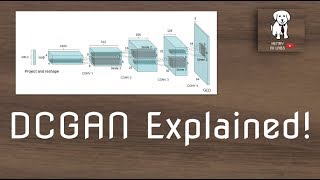
this is a deep learning video on must read papers on ganz from Henry AI labs generative adversarial networks from one of the most interesting ideas in deep learning showing you how you can generate never-seen-before images from completely random vectors the first paper in the list is DC Ganz from Alec Radford at all this paper builds in the original gun idea by showing how you can use up sampling convolutional layers in the generator and regular convolutional layers and discriminator this extends the architectural and like the you know neural network complexity of the gann models individually as well as proposing these additional guidelines for building convolutional jenner of adversarial networks these include things like using batch normalization as well as Braille ooh and leaky random of activation functions following DC GN paper second paper and our list has improved techniques for training ganz from Tim Salomon's at all.this this paper proposes some heuristic ways of improving the dcen training these include feature matching where instead of just trying to directly the generator instead of just directly minimizing the error on the real first fake - from discriminate it tries to match the internal activations and the discriminator of real images the minimap discrimination is the idea of having some kind of additional feature map that corresponds to the batch statistics of the generated and real images historical averaging just make sure that you know one faulty parameter the signal from the like radiance signal from the discriminator doesn't change the parameters of the generator too much and vice-versa one side label smoothing is just to prevent overconfident predictions and discriminator and then virtual bachelor emulation is use a reference bash for the games and bias parameters of bachelor musician and this is done to reduce the internal influence that batches might have on each other during generation so third paper in this list is conditional Ganz conditional Ganz is one of the most interesting ideas and Ganz showing how you can use supervised learning in this framework so you do is you would concatenate the one hot class label such as if it's see fart n you know like the one zero zero zero indicating that it's a truck image and then zero one zero zero zero indicating it's a car image you discriminate this into the intermediate Meishan can control the output of the game it's falling this is the progressive growing of Gans this is a really interesting paper that became really popular because it showed how you could generate high-resolution celebrity faces which is a really unprecedented thing that some people couldn't believe that the paper the faces don't really exist and they're completely generated by these deep learning models so the idea here is that you can take the high-resolution problem and you can decompose it to the sub structures of low resolution because as a ton of correlation between a 1024 by 1024 image and its downsampled low resolution counterpart so they do is they progressively fade in the layers use and then they use other tricks such as a mini bash standard deviation layer a future map equalized learning rate and pixelize feature normalization so next waiver is big game began as one of the state-of-the-art models taking ideas such as spectral normalization class projection in discriminator and self attention and scaling it up and making you know doing things like doubling the filter Maps increasing the batch size and other things to create these really incredible image made image net generated images following this another paper those regard that's when the state of the art style game salgan uses the same progressive growing model but they switch from mapping from the latent code directly and it said they start from a constant learned value so the way they used the latent code is borrowed from style transfer literature and this idea that you can use adaptive instance normalization to control the style of generated images and this has some really amazing results in the latent space interpolation the next paper in the list is psychic and so I began builds on the idea that if you go from French to English and then English to French you should be at the same sentence so they applied the same concept to further structure the adversarial loss and image to image translation tasks such as a zebra a horse following this is pics depicts another really popular paper in image translation they have other interesting ideas like little india idiosyncrasies for doing image damage translations such as using 70 by 70 windows in discriminator and then another idea is stat get stuck in follows the same multiscale philosophy of you know breaking down the high resolution tasks into 64 by 64 up to 256 by 256 in addition to the stage 1 stage 2 process they also apply they add this multivariate Gaussian to smoothen out the discontinuous text embedding space this overall is really influential for stabilizing Gantt rank and then finally in the list is general adversarial networks the original paper from Ian Goodfellow this paper provides a fundamental understanding of the algorithm as well as other interesting ideas such as non saturating loss functions just thanks for watching please subscribe to this YouTube channel and check out Henry AI labs comm for more deep learning papers
Original Description
Generative Adversarial Networks are one of the most popular ideas in Deep Learning! This video will explain some of the most worthwhile papers to check out on GANs. Thanks for watching!
Watch on YouTube ↗
(saves to browser)
Sign in to unlock AI tutor explanation · ⚡30
Playlist
Uploads from Connor Shorten · Connor Shorten · 9 of 60
1
 2
2
 3
3
 4
4
 5
5
 6
6
 7
7
 8
8
 ▶
▶
 10
10
 11
11
 12
12
 13
13
 14
14
 15
15
 16
16
 17
17
 18
18
 19
19
 20
20
 21
21
 22
22
 23
23
 24
24
 25
25
 26
26
 27
27
 28
28
 29
29
 30
30
 31
31
 32
32
 33
33
 34
34
 35
35
 36
36
 37
37
 38
38
 39
39
 40
40
 41
41
 42
42
 43
43
 44
44
 45
45
 46
46
 47
47
 48
48
 49
49
 50
50
 51
51
 52
52
 53
53
 54
54
 55
55
 56
56
 57
57
 58
58
 59
59
 60
60

DenseNets
Connor Shorten
DeepWalk Explained
Connor Shorten
Inception Network Explained
Connor Shorten
StackGAN
Connor Shorten
StyleGAN
Connor Shorten
Progressive Growing of GANs Explained
Connor Shorten
Improved Techniques for Training GANs
Connor Shorten
Word2Vec Explained
Connor Shorten
Must Read Papers on GANs
Connor Shorten
Unsupervised Feature Learning
Connor Shorten
Self-Supervised GANs
Connor Shorten
Embedding Graphs with Deep Learning
Connor Shorten
Transfer Learning in GANs
Connor Shorten
ReLU Activation Function
Connor Shorten
AC-GAN Explained
Connor Shorten
SimGAN Explained
Connor Shorten
DC-GAN Explained!
Connor Shorten
ResNet Explained!
Connor Shorten
Graph Convolutional Networks
Connor Shorten
Neural Architecture Search
Connor Shorten
Henry AI Labs
Connor Shorten
Video Classification with Deep Learning
Connor Shorten
BigGANs in Data Augmentation
Connor Shorten
Introduction to Deep Learning
Connor Shorten
EfficientNet Explained!
Connor Shorten
Self-Attention GAN
Connor Shorten
Curriculum Learning in Deep Neural Networks
Connor Shorten
Deep Learning Podcast #1 | Edward Dixon | Stochastic Weight Averaging
Connor Shorten
Deep Compression
Connor Shorten
Skin Cancer Classification with Deep Learning
Connor Shorten
Deep Learning Podcast #2 | Edward Peake | Deep Learning in Medical Imaging
Connor Shorten
The Lottery Ticket Hypothesis Explained!
Connor Shorten
SqueezeNet
Connor Shorten
GauGAN Explained!
Connor Shorten
AutoML with Hyperband
Connor Shorten
DL Podcast #3 | Yannic Kilcher | Population-Based Search
Connor Shorten
Weakly Supervised Pretraining
Connor Shorten
Image Data Augmentation for Deep Learning
Connor Shorten
Unsupervised Data Augmentation
Connor Shorten
Wide ResNet Explained!
Connor Shorten
RevNet: Backpropagation without Storing Activations
Connor Shorten
GANs with Fewer Labels
Connor Shorten
BigBiGAN Unsupervised Learning!
Connor Shorten
Self-Supervised Learning
Connor Shorten
Multi-Task Self-Supervised Learning
Connor Shorten
Self-Supervised GANs
Connor Shorten
Population Based Training
Connor Shorten
Show, Attend and Tell
Connor Shorten
Siamese Neural Networks
Connor Shorten
WaveGAN Explained!
Connor Shorten
VAE-GAN Explained!
Connor Shorten
Evolution in Neural Architecture Search!
Connor Shorten
AI Research Weekly Update August 18th, 2019
Connor Shorten
Weight Agnostic Neural Networks Explained!
Connor Shorten
AI Research Weekly Update August 25th, 2019
Connor Shorten
Neuroevolution of Augmenting Topologies (NEAT)
Connor Shorten
CoDeepNEAT
Connor Shorten
AI Research Weekly Update September 1st, 2019
Connor Shorten
Randomly Wired Neural Networks
Connor Shorten
Genetic CNN
Connor Shorten
More on: Generative Models
View skill →





Related Reads
📰
📰
📰
📰
Want to get started with deep learning
Reddit r/deeplearning
Building a Deepfake Detector From Scratch — What Nobody Tells You
Medium · Deep Learning
Unfolding the Meandering Path: High-Dimensional Invariance and the Flat 2D Plane of Neural…
Medium · Deep Learning
Implementing Neural Style Transfer from Scratch: The Project That Started It All
Medium · Deep Learning
🎓
Tutor Explanation
 DeepCamp AI