Encoder Decoder Architectures for RNNs #deeplearning #machinelearning
Key Takeaways
This video covers the Encoder Decoder Architectures for RNNs, specifically designed for sequence-to-sequence models with unequal input and output sizes, using techniques such as encoding input sequences into vectors and decoding vectors into output sequences.
Full Transcript
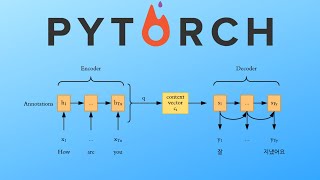
this sequence to sequence model had equal siiz inputs and outputs most applications out there don't have equal size inputs and outputs though like in the case of language translation a 10-word sentence in English may not have a 10-word German translation even in the case of text summarization the input is a set of sentences but the output by definition is a reduced set of sentences clearly to deal with this new set of problems we need another type of architecture that takes in an input sequence but outputs a sequence of different length from the input it exists and it's called the encoder decoder architecture I'm pretty sure you can predict the two parts of this architecture the first is the encoder it converts the sequence to a vector and the second part is the decoder that converts the vector to a sequence
Watch on YouTube ↗
(saves to browser)
Sign in to unlock AI tutor explanation · ⚡30
Playlist
Uploads from CodeEmporium · CodeEmporium · 0 of 60
← Previous
Next →
1
 2
2
 3
3
 4
4
 5
5
 6
6
 7
7
 8
8
 9
9
 10
10
 11
11
 12
12
 13
13
 14
14
 15
15
 16
16
 17
17
 18
18
 19
19
 20
20
 21
21
 22
22
 23
23
 24
24
 25
25
 26
26
 27
27
 28
28
 29
29
 30
30
 31
31
 32
32
 33
33
 34
34
 35
35
 36
36
 37
37
 38
38
 39
39
 40
40
 41
41
 42
42
 43
43
 44
44
 45
45
 46
46
 47
47
 48
48
 49
49
 50
50
 51
51
 52
52
 53
53
 54
54
 55
55
 56
56
 57
57
 58
58
 59
59
 60
60

Linear Regression and Multiple Regression
CodeEmporium
Logistic Regression - THE MATH YOU SHOULD KNOW!
CodeEmporium
Generative Adversarial Networks - FUTURISTIC & FUN AI !
CodeEmporium
Deep Learning on the Cloud - GPU TO LEARN FASTER
CodeEmporium
Deep Mind's AlphaGo Zero - EXPLAINED
CodeEmporium
Mask Region based Convolution Neural Networks - EXPLAINED!
CodeEmporium
Attention in Neural Networks
CodeEmporium
Depthwise Separable Convolution - A FASTER CONVOLUTION!
CodeEmporium
One Neural network learns EVERYTHING ?!
CodeEmporium
Neural Voice Cloning
CodeEmporium
AI creates Image Classifiers…by DRAWING?
CodeEmporium
Unpaired Image-Image Translation using CycleGANs
CodeEmporium
K-Means Clustering - EXPLAINED!
CodeEmporium
Random Forest Classification
CodeEmporium
Data Science in Finance
CodeEmporium
Hypothesis testing with Applications in Data Science
CodeEmporium
A/B Testing - Simply Explained
CodeEmporium
The Kernel Trick - THE MATH YOU SHOULD KNOW!
CodeEmporium
Support Vector Machines - THE MATH YOU SHOULD KNOW
CodeEmporium
Principal Component Analysis (PCA) - THE MATH YOU SHOULD KNOW!
CodeEmporium
History of Calculus - Animated
CodeEmporium
Curiosity in AI
CodeEmporium
DropBlock - A BETTER DROPOUT for Neural Networks
CodeEmporium
Autoencoders - EXPLAINED
CodeEmporium
Recurrent Neural Networks - EXPLAINED!
CodeEmporium
LSTM Networks - EXPLAINED!
CodeEmporium
Building an Image Captioner with Neural Networks
CodeEmporium
10 Machine Learning Questions - ANSWERED!
CodeEmporium
How do neural networks work?
CodeEmporium
Evolution of Face Generation | Evolution of GANs
CodeEmporium
How does Google Translate's AI work?
CodeEmporium
How to keep up with AI research?
CodeEmporium
How does YouTube recommend videos? - AI EXPLAINED!
CodeEmporium
Variational Autoencoders - EXPLAINED!
CodeEmporium
Logistic Regression - VISUALIZED!
CodeEmporium
Gradient Descent - THE MATH YOU SHOULD KNOW
CodeEmporium
Boosting - EXPLAINED!
CodeEmporium
Transformer Neural Networks - EXPLAINED! (Attention is all you need)
CodeEmporium
Loss Functions - EXPLAINED!
CodeEmporium
Optimizers - EXPLAINED!
CodeEmporium
NLP with Neural Networks & Transformers
CodeEmporium
Batch Normalization - EXPLAINED!
CodeEmporium
Activation Functions - EXPLAINED!
CodeEmporium
Data Scientist Answers Interview Questions
CodeEmporium
Why use GPU with Neural Networks?
CodeEmporium
How do GPUs speed up Neural Network training?
CodeEmporium
BERT Neural Network - EXPLAINED!
CodeEmporium
ConvNets Scaled Efficiently
CodeEmporium
Transformer Neural Net makes music! (JukeboxAI)
CodeEmporium
What do filters of Convolution Neural Network learn?
CodeEmporium
We're hosting a Machine Learning Conference!
CodeEmporium
MLconfEU 2020: Machine Learning Conference for Software Engineers
CodeEmporium
Are Neural Networks Intelligent?
CodeEmporium
Time Series Forecasting with Machine Learning
CodeEmporium
Few Shot Learning - EXPLAINED!
CodeEmporium
How does a Data Scientist Fight FRAUD?
CodeEmporium
How would a Data Scientist analyze Customer Churn?
CodeEmporium
Expectations with Machine Learning
CodeEmporium
Why Logistic Regression DOESN'T return probabilities?!
CodeEmporium
How you SHOULD code Machine Learning
CodeEmporium
More on: Sequence Models
View skill →



Related AI Lessons
⚡
⚡
⚡
⚡
What OOP Actually Buys You (And Why “Real World Modeling” Is a Lie)
Medium · Programming
Data Partitioning in System Design: Why Every Scalable Application Depends on It
Medium · Programming
Why Realtime Collaboration Is Harder Than It Looks?
Medium · JavaScript
Podcast: Architectural Patterns: Moving Beyond Cloud-Native to Local-First - Insights from Adam Wiggins
InfoQ AI/ML
🎓
Tutor Explanation

 DeepCamp AI