BigTool: Agents with large number of tools
Skills:
Tool Use & Function Calling90%Agent Foundations80%Multi-Agent Systems70%Autonomous Workflows70%ML Maths Basics60%
Agents dynamically direct their own processes and tool usage. But how many tools can agents reliably use? A large number of tools can introduce cognitive burden, making it challenging for agents to select the right one. BigTool is a prebuilt LangGraph agent that works with large numbers of tools using a simple idea: use a search to retrieve and bind only the *most relevant* tools to the agent for a given task. We show this working with a simple vectorstore that embeds tool descriptions and uses semantic search to fetch the most relevant tools based upon the user's request. We show this works well even with low capacity local models, like Qwen-14-b.
Video notes:
https://mirror-feeling-d80.notion.site/BigTool-1c1808527b178010a10fd2d7d708f4e4?pvs=4
Chapters:
0:00 - Introduction to Tool Calling in Agents
0:47 - Setting Up a Local Agent Demo
1:00 - Running the Agent and Observing Tool Calls
1:27 - The Problem with Traditional Tool Binding
2:00 - The Big Tool Approach
2:27 - How Tool Retrieval Works
3:27 - Benefits of This Approach
3:40 - Big Tool vs. Multi-Agent Architecture
4:58 - Local Model Performance
5:20 - Technical Implementation Details
6:10 - Setting Up the Vector Store
7:00 - Tracing Through the Execution
9:00 - Conclusion and Benefits
Watch on YouTube ↗
(saves to browser)
Sign in to unlock AI tutor explanation · ⚡30
Playlist
Uploads from LangChain · LangChain · 0 of 60
← Previous
Next →
1
 2
2
 3
3
 4
4
 5
5
 6
6
 7
7
 8
8
 9
9
 10
10
 11
11
 12
12
 13
13
 14
14
 15
15
 16
16
 17
17
 18
18
 19
19
 20
20
 21
21
 22
22
 23
23
 24
24
 25
25
 26
26
 27
27
 28
28
 29
29
 30
30
 31
31
 32
32
 33
33
 34
34
 35
35
 36
36
 37
37
 38
38
 39
39
 40
40
 41
41
 42
42
 43
43
 44
44
 45
45
 46
46
 47
47
 48
48
 49
49
 50
50
 51
51
 52
52
 53
53
 54
54
 55
55
 56
56
 57
57
 58
58
 59
59
 60
60

Chat With Your Documents Using LangChain + JavaScript
LangChain
LangChain SQL Webinar
LangChain
LangChain "OpenAI functions" Webinar
LangChain
LangSmith Launch
LangChain
LangChain x Pinecone: Supercharging Llama-2 with RAG
LangChain
LangChain Expression Language
LangChain
Building LLM applications with LangChain with Lance
LangChain
Benchmarking Question/Answering Over CSV Data
LangChain
LangChain "RAG Evaluation" Webinar
LangChain
Fine-tuning in Your Voice Webinar
LangChain
Tabular Data Retrieval
LangChain
Building an LLM Application with Audio by AssemblyAI
LangChain
Superagent Deepdive Webinar
LangChain
Lessons from Deploying LLMs with LangSmith
LangChain
Shortwave Assistant Deepdive Webinar
LangChain
Cognitive Architectures for Language Agents
LangChain
Effectively Building with LLMs in the Browser with Jacob
LangChain
Data Privacy for LLMs
LangChain
"Theory of Mind" Webinar with Plastic Labs
LangChain
LangChain Templates
LangChain
Using Natural Language to Query Postgres with Jacob
LangChain
Building a Research Assistant from Scratch
LangChain
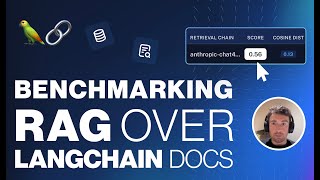
Benchmarking RAG over LangChain Docs
LangChain
Skeleton-of-Thought: Building a New Template from Scratch
LangChain
Benchmarking Methods for Semi-Structured RAG
LangChain
LangSmith Highlights: Getting Started
LangChain
LangSmith Highlights: Debugging
LangChain
LangSmith Highlights: Datasets
LangChain
LangSmith Highlights: Evaluation
LangChain
LangSmith Highlights: Human Annotation
LangChain
LangSmith Highlights: Monitoring
LangChain
LangSmith Highlights: Hub
LangChain
SQL Research Assistant
LangChain
Getting Started with Multi-Modal LLMs
LangChain
Build a Full Stack RAG App With TypeScript
LangChain
Auto-Prompt Builder (with Hosted LangServe)
LangChain
LangChain v0.1.0 Launch: Introduction
LangChain
LangChain v0.1.0 Launch: Observability
LangChain
LangChain v0.1.0 Launch: Integrations
LangChain
LangChain v0.1.0 Launch: Composability
LangChain
LangChain v0.1.0 Launch: Streaming
LangChain
LangChain v0.1.0 Launch: Output Parsing
LangChain
LangChain v0.1.0 Launch: Retrieval
LangChain
LangChain v0.1.0 Launch: Agents
LangChain
Build and Deploy a RAG app with Pinecone Serverless
LangChain
Hosted LangServe + LangChain Templates
LangChain
LangGraph: Intro
LangChain
LangGraph: Agent Executor
LangChain
LangGraph: Chat Agent Executor
LangChain
LangGraph: Human-in-the-Loop
LangChain
LangGraph: Dynamically Returning a Tool Output Directly
LangChain
LangGraph: Respond in a Specific Format
LangChain
LangGraph: Managing Agent Steps
LangChain
LangGraph: Force-Calling a Tool
LangChain
LangGraph: Multi-Agent Workflows
LangChain
Streaming Events: Introducing a new `stream_events` method
LangChain
Building a web RAG chatbot: using LangChain, Exa (prev. Metaphor), LangSmith, and Hosted Langserve
LangChain
OpenGPTs
LangChain
Open Source RAG with Nomic's New Embedding Model (and ChromaDB and Ollama)
LangChain
LangGraph: Persistence
LangChain
More on: Tool Use & Function Calling
View skill →









Related AI Lessons
⚡
⚡
⚡
⚡
How 6 AI agents write a single blog post (and why
Dev.to AI
PII Redaction for AI Agents: Why It Can't Be an Afterthought
Dev.to AI
Why I Built a $5/Month Alternative to ChatGPT (After Getting Burned by $20/Month Subscriptions)
Dev.to AI
After AI Healthcare, Medical World Models May Be the Next Life-Science AI Platform
Dev.to · JXIONG
Chapters (13)
Introduction to Tool Calling in Agents
0:47
Setting Up a Local Agent Demo
1:00
Running the Agent and Observing Tool Calls
1:27
The Problem with Traditional Tool Binding
2:00
The Big Tool Approach
2:27
How Tool Retrieval Works
3:27
Benefits of This Approach
3:40
Big Tool vs. Multi-Agent Architecture
4:58
Local Model Performance
5:20
Technical Implementation Details
6:10
Setting Up the Vector Store
7:00
Tracing Through the Execution
9:00
Conclusion and Benefits
🎓
Tutor Explanation
 DeepCamp AI