Q-Learning Explained - Reinforcement Learning Tutorial
Key Takeaways
The video explains Reinforcement Learning, specifically Q-Learning and Deep Q-Learning, covering concepts such as states, actions, rewards, and the Q-table, as well as the Bellman equation and exploration vs exploitation trade-off
Full Transcript
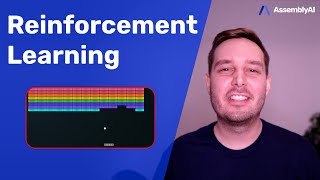
hi everyone i'm patrick from the assembly ai team and in this video we learn about reinforcement learning in the previous two videos we already covered supervised and unsupervised learning and now reinforcement learning is the third area in the field of machine learning so today you will learn about the definition of reinforcement learning of states actions and rewards and then we dive into q-learning and deep q-learning with neural networks this area has gotten a lot of popularity in recent years especially with video games so maybe you have seen how an ai learns to play snake or chess or the breakout game but now you're wondering how this works so the idea behind reinforcement learning is that a so-called software agent will learn from the environment by interacting with it and then receiving rewards for performing actions and then the agent tries to improve its behavior so essentially it teaches itself how to get better this idea is inspired from our natural experiences imagine you're a child and you see a fireplace for the first time you like that it's warm it's positive so you get a positive reward but then you reach out with your hand and try to touch it and now it's too warm so it hurts so you get a negative reward or a punishment so to say but now you might have understood this and learned that fire can be a good thing but that you should be careful and not get too close and this is exactly how reinforcement learning works it's the computational approach of learning from actions in an environment through rewards and punishments one specific implementation of this approach is the q-learning algorithm it's a value-based approach based on a so-called queue table the q table calculates the maximum expected future reward for each action at each state and with this information we can then choose the action with the highest reward let's look at a concrete example to make this more clear let's say we want to teach an ai how to play the snake game in this game the snake tries to reach and eat the food without hitting the wall or itself we can list the actions and states in a queue table the columns will be the four possible actions the snake can do turning left right up and down and the state can be the current direction so also left right up and down these are the rows but of course we can add more states to describe the current situation for example we can describe the location of the food and at the states food is left of the snake right up or down we could also do the same thing with the walls and describe the danger but for simplicity i leave this out here but you see the more states we add here the more information we have about the environment but also the more complex our system will get okay so now we have all rows and columns and now the value of each cell will be the maximum expected future reward for that given state and action we call this the q value so far so good but how do we calculate this q value here's the interesting part we do not implement this q value calculation in a fixed way instead we improve this q table in an iterative approach this is basically our training or learning process the q learning algorithm works like this first we initialize all q values for example with a 0 then we choose an action a in the current state s this is based on the current best q value we perform this action and observe the outcome so we get a new state we also measure their reward after this action and then we update q with an update formula that is called the bellman equation and then we repeat steps 2 to 5 until the learning no longer improves and we get a nice q table in the end now a few questions may appear first how can we choose the best action in the beginning when all our values are zero this is where the exploration versus exploitation trade-off comes into play in the beginning we choose the action randomly so that our agent can explore the environment but the more training steps we get the more we reduce this random exploration and use exploitation instead so we make use of the information we have this trade-off is controlled in the calculations by a parameter that is usually called the epsilon parameter now the next question is how the rewards are measured this is actually up to us so we can come up with a good reward system for the game in case of the snake game for example we can give a reward of 10 points if the snake eats an apple and a reward of -10 points if the snake dies and zero for every other normal move now with all these elements we can inspect the bellman equation the idea here is to update our q value like this the new q value is calculated by the current q value plus a learning rate times a reward plus a discount rate times the highest q value between possible actions from the new state and then minus the current q value the discount rate is a value between 0 and 1 and determines how much the agent cares about rewards in the distant future relative to those in the immediate future so now we have everything we need and coming back to our iterative learning approach we can now come up with a good q table by using this q learning algorithm now deep q learning takes the q learning idea and takes it one step further instead of using a q table we use a neural network that takes a state and approximates the q values for each action based on that state and we do this because using a classic q table is not very scalable it might work for a simple game but let's imagine a more complex game with dozens of possible actions and game states then the q table will soon get far too complex and cannot be solved efficiently anymore so now we use a deep neural network that gets the state as input and produces different q values for each action and then again we can choose the action with the highest q value the learning process is still the same with this iterative update approach but instead of updating the queue table here we update the weights in the neural network so that the outputs get better and this is how deep q learning works if you're interested to see a concrete coding tutorial with deep q learning let us know in the comments and then we can try to create a future video about this alright i hope i could give you a good introduction to reinforcement learning if you enjoyed the video then please leave us a thumbs up and consider subscribing to our channel for more content like this also if you want to try assembly ai for free then grab your free api token using the link in the description below and then i hope to see you in the next video bye
Original Description
In this video we learn about Reinforcement Learning and (Deep) Q-Learning.
You will learn:
- What is Reinforcement Learning
- What are States / Actions / Rewards
- Q-Learning
- Q-Learning Example
- Deep Q-Learning with Neural Networks
Supervised Learning explained: https://youtu.be/Mu3POlNoLdc
Unsupervised Learning explained: https://youtu.be/yteYU_QpUxs
Get your Free Token for AssemblyAI Speech-To-Text API 👇https://www.assemblyai.com/?utm_source=youtube&utm_medium=referral&utm_campaign=yt_pat_10
The idea behind Reinforcement Learning is that software agents learn from the environment by interacting with it and then receiving rewards for performing actions.
Reinforcement Learning With (Deep) Q-Learning Explained
Resources:
https://www.freecodecamp.org/news/diving-deeper-into-reinforcement-learning-with-q-learning-c18d0db58efe/
https://www.freecodecamp.org/news/an-introduction-to-deep-q-learning-lets-play-doom-54d02d8017d8
Playlist
Uploads from AssemblyAI · AssemblyAI · 52 of 60
1
 2
2
 3
3
 4
4
 5
5
 6
6
 7
7
 8
8
 9
9
 10
10
 11
11
 12
12
 13
13
 14
14
 15
15
 16
16
 17
17
 18
18
 19
19
 20
20
 21
21
 22
22
 23
23
 24
24
 25
25
 26
26
 27
27
 28
28
 29
29
 30
30
 31
31
 32
32
 33
33
 34
34
 35
35
 36
36
 37
37
 38
38
 39
39
 40
40
 41
41
 42
42
 43
43
 44
44
 45
45
 46
46
 47
47
 48
48
 49
49
 50
50
 51
51
 ▶
▶
 53
53
 54
54
 55
55
 56
56
 57
57
 58
58
 59
59
 60
60

Python Speech Recognition in 5 Minutes
AssemblyAI
Python Click Part 1 of 4
AssemblyAI
Python Click Part 2 of 4
AssemblyAI
Python Click Part 3 of 4
AssemblyAI
Python Click Part 4 of 4
AssemblyAI
Deep learning in 5 minutes | What is deep learning?
AssemblyAI
How to make a web app that transcribes YouTube videos with Streamlit | Part 1
AssemblyAI
How to make a web app that transcribes YouTube videos with Streamlit | Part 2
AssemblyAI
Batch normalization | What it is and how to implement it
AssemblyAI
Real-time Speech Recognition in 15 minutes with AssemblyAI
AssemblyAI
Regularization in a Neural Network | Dealing with overfitting
AssemblyAI
Add speech recognition to your Streamlit apps in 5 minutes
AssemblyAI
Transformers for beginners | What are they and how do they work
AssemblyAI
Automatic Chapter Detection With AssemblyAI | Python Tutorial
AssemblyAI
Deep Learning Series Part 1 - What is Deep Learning?
AssemblyAI
Deep Learning Series part 2 - Why is it called “Deep Learning”?
AssemblyAI
Activation Functions In Neural Networks Explained | Deep Learning Tutorial
AssemblyAI
Deep Learning Series part 3 - Deep Learning vs. Machine Learning
AssemblyAI
Deep Learning Series part 4 - Why is Deep Learning better for NLP?
AssemblyAI
Intro to Batch Normalization Part 1
AssemblyAI
Intro to Batch Normalization Part 2
AssemblyAI
Intro to Batch Normalization Part 3 - What is Normalization?
AssemblyAI
Intro to Batch Normalization Part 4
AssemblyAI
Intro to Batch Normalization Part 5
AssemblyAI
Sentiment Analysis for Earnings Calls with AssemblyAI
AssemblyAI
Summarizing my favorite podcasts with Python
AssemblyAI
Introduction to Regularization
AssemblyAI
How/Why Regularization in Neural Networks?
AssemblyAI
Getting Started With Torchaudio | PyTorch Tutorial
AssemblyAI
Types of Regularization
AssemblyAI
Tuning Alpha in L1 and L2 Regularization
AssemblyAI
Dropout Regularization
AssemblyAI
What is GPT-3 and how does it work? | A Quick Review
AssemblyAI
Backpropagation For Neural Networks Explained | Deep Learning Tutorial
AssemblyAI
Jupyter Notebooks Tutorial | How to use them & tips and tricks!
AssemblyAI
Best Free Speech-To-Text APIs and Open Source Libraries
AssemblyAI
Regularization - Early stopping
AssemblyAI
Regularization - Data Augmentation
AssemblyAI
Bias and Variance for Machine Learning | Deep Learning
AssemblyAI
Recurrent Neural Networks (RNNs) Explained - Deep Learning
AssemblyAI
What is BERT and how does it work? | A Quick Review
AssemblyAI
Introduction to Transformers
AssemblyAI
Transformers | What is attention?
AssemblyAI
Transformers | how attention relates to Transformers
AssemblyAI
Transformers | Basics of Transformers
AssemblyAI
Supervised Machine Learning Explained For Beginners
AssemblyAI
Transformers | Basics of Transformers Encoders
AssemblyAI
Transformers | Basics of Transformers I/O
AssemblyAI
How to evaluate ML models | Evaluation metrics for machine learning
AssemblyAI
Unsupervised Machine Learning Explained For Beginners
AssemblyAI
Weight Initialization for Deep Feedforward Neural Networks
AssemblyAI
Q-Learning Explained - Reinforcement Learning Tutorial
AssemblyAI
Should You Use PyTorch or TensorFlow in 2022?
AssemblyAI
What is Layer Normalization? | Deep Learning Fundamentals
AssemblyAI
I created a Python App to study FASTER
AssemblyAI
How to create your FIRST NEURAL NETWORK with TensorFlow!
AssemblyAI
Neural Networks Summary: All hyperparameters
AssemblyAI
Getting Started with OpenAI API and GPT-3 | Beginner Python Tutorial
AssemblyAI
Convert Speech-To-Text In Python in 60 seconds!
AssemblyAI
Gradient Clipping for Neural Networks | Deep Learning Fundamentals
AssemblyAI
More on: RL Foundations
View skill →






Related Reads
🎓
Tutor Explanation

 DeepCamp AI