AI Agents Improve Your Code Step-by-Step | Groq + Gradio Demo
Key Takeaways
The video demonstrates a Sequential Agent Chat UI powered by Groq hardware and Gradio interface, showcasing a collaborative coding system that leverages specialized agents to improve code quality.
Full Transcript
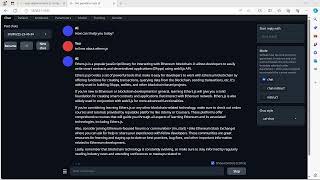
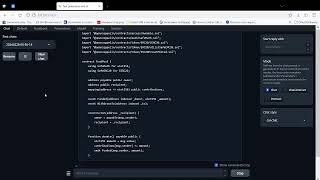
hello everyone today I'm going to show you a repository I built uh where you can use grock the Swarms framework and gradio um as kind of like a chat GPT substitute so how does it work essentially um the code uh launches a gradio interface and the gradio interface uh sends the input of your chat to a first agent that writes a draft of your code the code is the input and when you click submit it runs it with that first agent it sends it to a revision agent and then finally a senior code agent that uh does some more anotations about features compatibility and things like that so essentially it is slower than using a normal chat interface um whether you are running the models locally or using grock but um it might give some extra features as far as um revising your code and making sure that um it is higher quality and exposing some features that you might have not thought of to add to your code so I hope this uh example is helpful to you you do not need a GPU to run it uh it's quick and easy to run uh and have a nice day thank for
Original Description
🚀 Building Better Code with Sequential Agent Chat UI using Groq and Gradio
In this video, we showcase an innovative Sequential Agent Chat UI powered by Groq hardware and the intuitive Gradio interface. This system redefines collaborative coding by leveraging a series of specialized agents to iteratively improve the code based on your input prompt.
💡 What’s Inside?
How it Works: Discover how the system processes your coding task through sequential agents:
1️⃣ Code Writer Agent: Drafts the initial implementation based on the task description.
2️⃣ Code Reviser Agent 1: Reviews the draft for functionality, correctness, and adherence to best practices.
3️⃣ Code Reviser Agent 2: Optimizes the code for performance, scalability, and resource efficiency.
How Groq Accelerates Performance: Learn how Groq hardware handles the computational load for rapid model inference and ensures seamless interaction between agents.
Gradio Interface in Action: See how the Gradio-based UI allows you to input prompts, visualize the improvement stages, and download final code versions.
Benefits of Sequential Agent Systems:
✅ Iterative code refinement.
✅ Specialized expertise at each stage.
✅ Scalable and adaptable for various programming tasks.
🌟 Why It’s Revolutionary
This system transforms the way we approach coding, making it collaborative, systematic, and more efficient. Whether you're a developer, a researcher, or an enthusiast, this approach can enhance your productivity and code quality.
🎥 Watch Now and Explore:
Setting up the system.
Sending prompts and analyzing outputs.
Real-world examples of code refinement.
🔗 Links:
Code Repository: github.com/patrickbdevaney/chain-react
Groq Cloud: console.groq.com/playground
Gradio: gradio.app
👉 Don’t forget to like, subscribe, and hit the notification bell for more content on cutting-edge AI-powered systems!
Watch on YouTube ↗
(saves to browser)
Sign in to unlock AI tutor explanation · ⚡30
Playlist
Playlist UUY0xk_A4qJTQWcV2_3sqvJw · Patrick Devaney · 15 of 15
← Previous
Next →
1
 2
2
 3
3
 4
4
 5
5
 6
6
 7
7
 8
8
 9
9
 10
10
 11
11
 12
12
 13
13
 14
14
 ▶
▶

Penn Blockchain Hackathon Demo Oracle NFT Minter
Patrick Devaney
Demo Lionhacks NFT Based Content Authentication
Patrick Devaney
Aleo: Zero Knowledge Dapps - Blockchain at FIU
Patrick Devaney
Demoing a Large Language Model running locally on my laptop
Patrick Devaney
WizardCoder-1B Demo: Powerful Responsive Coding LLM at Home
Patrick Devaney
laser dolphin mixtral 2x7b dpo Q3 K M
Patrick Devaney
mixtral 2x7b Quantized 2 K prompt on machine learning
Patrick Devaney
biomistral q2k q3km q8 comparison
Patrick Devaney
SQLV2 Q4 demo
Patrick Devaney
Initializing a Hyperledger Fabric Blockchain with Docker and Ubuntu
Patrick Devaney
Finetune LLaMa 7b on RTX 3090 GPU - Tutorial
Patrick Devaney
Local InstantMesh Tiger
Patrick Devaney
groq swarms demo
Patrick Devaney
Rustifying My Repo With Swarms
Patrick Devaney
AI Agents Improve Your Code Step-by-Step | Groq + Gradio Demo
Patrick Devaney
More on: Tool Use & Function Calling
View skill →









Related Reads
📰
📰
📰
📰
A lightweight workflow for keeping up with AI conference papers
Dev.to · Daniel
Why CitedEvidence Believes Great Researchers Read Less Than You Think
Medium · AI
How to Write a Literature Review That Actually Argues Something
Medium · Machine Learning
I Built a Personal Paper Engine to Stop Losing Research Papers
Dev.to · Ethan
🎓
Tutor Explanation

 DeepCamp AI