Cracking passwords using ONLY response times | Secure Python
Key Takeaways
This video demonstrates a timing attack on a server to crack a 20-character password using Python's timeit.repeat function, exploiting the server's response time to gather information about the password length and characters. The video also introduces Anvil, a free web-based IDE for developing and deploying Python web apps, which handles user authentication and cloud deployment with a single click.
Full Transcript
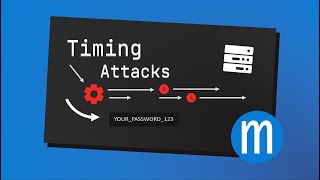
hello and welcome i'm james murphy and in this video we're going to crack some passwords thanks to this video's sponsor anvil a browser-based full stack development platform allowing you to make web apps with nothing but python more about anvil at the end of the video sorry to disappoint any wannabe hackers in the crowd but this is not going to be a hacking tutorial after watching this video you're not going to be able to just go out and hack your friends or your colleagues or government databases what you are going to get from this video is a quick dip into the deep end what are some of the things that make it so incredibly difficult to write secure software in my opinion the biggest difference between the way that code is modeled in the theoretical world and how it actually is in the real world is the amount of time that code takes to execute well in the real world there's an entire class of attacks that exploit the physical amount of time that an algorithm took to execute these are called timing attacks that's what we're going to investigate in this video we'll be able to crack a password that's 20 characters long in no time okay so let's get started what's the system that we're going to hack in this video well i have a server which is really just a function and all this does is i pass in a user and my guest for the password and it's going to look up the password in the database which is actually just a dictionary up here and after it looks it up in the database all it does is tell you whether or not your guess was equal to the actual password in this video we're going to be taking the attacker's perspective so we don't get to see the check password function check password is just a black box we plug in the username and the guess and we either get you got it correct or you didn't we don't get to see anything else i know this is silly check password is just a function in the same file this is totally ridiculous but think about check password as actually going out to the internet and trying to log into a server this is a pretty bad server because it's going to allow us to make many many many guesses and it's not going to ban us for spamming or anything like that too many wrong attempts but i think it gets the point across okay let's get to cracking at first glance it might seem completely hopeless passwords can be extremely long 30 characters or more and all we're getting out of this is is the password correct or not if we get even a single bit wrong then we basically gain no information right well not completely the whole theme of this video is that we do get one extra piece of information that the server didn't tell us about we can measure how much time it took to respond if we suspected that the server was using a bad implementation like this just equality checking the actual password against the guess which by the way the server shouldn't even store your actual password then we might be able to exploit something about how long it takes to compute the answer when the guess is closer to correct in pretty much every programming language the first thing that happens when you compare two strings for equality is it checks to see if their lengths are the same if the lengths are different then you can pretty quickly return false so if we query the server with a guess if the length of the password is wrong then the server will respond faster let's see if we can use that to crack the length of this password okay here's what we'll do we'll take the user and the maximum possible length that we think the password could be then we'll just loop over the different lengths and use the timeit.repeat method to time how long each password attempt takes the statement that we're timing is this check password of the user and a guess x where here the user is inputted as whatever the argument was and x is a random string generated by this function repeat returns a list and we just take the fastest time from that list to use as the server response time we take the fastest time here because the server might have just lagged for some unknown reason and we don't want that to slow down our timing we want to measure its performance assuming it didn't lag at all to recap all i do is guess passwords of a bunch of different lengths and then return the length that takes the longest to respond and here's what we see when we run it passwords that were randomly guessed of length 20 took a little bit longer than the rest notice that the second longest choice was 93 percent as fast and what you know the length of the actual password is 20 and this is not a fluke if i change the length of the string so that now it's length 19 instead of 20 and run the program again now we see that the most likely length is 19. of course if you have other things on your machine going on that are affecting the timing like recording video then it's going to make it a lot less likely to give you the right answer when i ran it again i got that 25 is the most likely length which is not correct but 19 was still in the top three so if you were a real hacker trying to do a real timing attack you would probably be doing this on a dedicated machine that doesn't have lots of random programs executing at the same time that might mess up the timing okay finding out the length of the password is one thing but guessing the actual password is something entirely different so can the timing attack do that as well well if the implementation was one of these simple equality checks then yes because here's what an equality check for strings looks like under the hood as we mentioned before first it does a length check and that's what we use to crack the length of the password but after it does the length check it goes character by character and if any of them are not equal then it will return immediately because string comparison will return early if the password is incorrect at an earlier position again we find that the more correct the password is the longer the server will take to respond this is exactly the same thing that we can use to exploit as with the length so here's the code that i came up with in order to crack a password using a timing attack given that you've already cracked the length of the password it's similar to cracking the length itself except we have to go position by position and get each character right in turn we start with just a completely random guess of the correct length we don't know how much of the password that we've guessed so far is correct so we're just going to repeatedly loop over the entire string try to get the first character correct then the second then the third and so on until the end and then start back at the beginning we'll just keep repeating until we get the right password for each position in the password we try every possible character that can be in the password and then we see what happens when we put that character in that position we'll time how long it takes for our new guess we'll time how long it takes for our old guess and then whichever one took more time we keep as the old guess for the next iteration notice that by random chance we could have a more correct guess get replaced with a less correct guess i'm sure that we'll see that happen when we actually run it but nevertheless the more correct guess is more likely to take longer and so eventually we will build up the correct password here we check to see if our new guess is the correct password and if it is then we're done we return otherwise what we do is we take the one that took longer and use that as the guess for the next iteration and that's it all we have to do now is try it so first we will crack the length of the password and then use that length pass it into the cracked password function and see how long it takes to find the actual password all right let's just see how well it [Music] does so just on the first iteration it's gotten a lot of the characters right already let's see if it can finish off the last few in the next one [Music] and there you go it finished password cracked subscribe to encoding so there you have it we just cracked a password that was 20 characters long using nothing but timing information this was just one example of one timing attack and timing attacks themselves are just a single class of examples in a huge sea of things that you can mess up and if you mess up anything then you're going to get yourself hacked don't trust the security of your customer data or of your web app in general to something that's not extremely well tested and proven and speaking of writing web apps if you're interested in that kind of thing be sure to stick around and hear about our sponsor anvil that's all i've got for now see you in the next one anvil has everything you need to develop and deploy a web app written completely in python including the front end so no javascript or html required and it's free to try create your user interface by dragging and dropping components anvil's web-based ide allows you to develop in your browser no need to install anything you can use anvil's built-in database and let anvil handle the tricky parts like user authentication when you're ready deploy your app to the cloud with a single click check out the link in the description to get started with anvil today
Original Description
Security in programming is difficult to achieve.
Try Anvil: https://anvil.works/mcoding
In this video, we take a look at a class of attacks called "Timing Attacks" that use the amount of time that it takes a server to respond in order to gather secret information from the server. Not all servers are susceptible (common popular ones are not when properly configured), but if you don't know about timing attacks, one you write might be! Any secure Python code must be resistant to timing attacks. You don't need to worry, popular Python web frameworks like Flask and Django are safe to use.
Note: For those wondering why I did not include discussion of a slow_equals to thwart the attack, I decided not to because this is a bandaid on the larger problem that the server shouldn't have even stored your password in the first place. Only hashes should be stored.
― mCoding with James Murphy (https://mcoding.io)
Source code: https://github.com/mCodingLLC/VideosSampleCode
SUPPORT ME ⭐
---------------------------------------------------
Patreon: https://patreon.com/mCoding
Paypal: https://www.paypal.com/donate/?hosted_button_id=VJY5SLZ8BJHEE
Other donations: https://mcoding.io/donate
BE ACTIVE IN MY COMMUNITY 😄
---------------------------------------------------
Discord: https://discord.gg/Ye9yJtZQuN
Github: https://github.com/mCodingLLC/
Reddit: https://www.reddit.com/r/mCoding/
Facebook: https://www.facebook.com/james.mcoding
CHAPTERS
---------------------------------------------------
0:00 Intro
1:08 Background and setup
3:03 Cracking the length
5:19 Cracking the characters
7:22 Try it
8:08 Outro
Watch on YouTube ↗
(saves to browser)
Sign in to unlock AI tutor explanation · ⚡30
Playlist
Uploads from mCoding · mCoding · 35 of 60
1
 2
2
 3
3
 4
4
 5
5
 6
6
 7
7
 8
8
 9
9
 10
10
 11
11
 12
12
 13
13
 14
14
 15
15
 16
16
 17
17
![[April Fools 2021] Python 4.0! New old print, mandatory static typing, StackOverflow integration](https://i.ytimg.com/vi/lC6JtoSN-KQ/mqdefault.jpg) 18
18
 19
19
 20
20
 21
21
 22
22
 23
23
 24
24
 25
25
 26
26
 27
27
 28
28
 29
29
 30
30
 31
31
 32
32
 33
33
 34
34
 ▶
▶
 36
36
 37
37
 38
38
 39
39
 40
40
 41
41
 42
42
 43
43
 44
44
 45
45
 46
46
 47
47
 48
48
 49
49
 50
50
 51
51
 52
52
 53
53
 54
54
 55
55
 56
56
 57
57
 58
58
 59
59
 60
60

Goodbye, List! Type hinting standard collections - New in Python 3.9
mCoding
Python's comma equals ,= operator?
mCoding
Finding Primes in Python with the Sieve of Eratosthenes
mCoding
Find the First Missing Positive Int | Hard Interview Question on LeetCode
mCoding
JSON Tutorial Python | Basic Python Recipes
mCoding
Simulating Brownian Motion in Python
mCoding
The Single Most Useful Decorator in Python
mCoding
The Fastest Way to Loop in Python - An Unfortunate Truth
mCoding
Numpy Array Broadcasting In Python Explained
mCoding
Brownian Motion Single Path Zoom
mCoding
Brownian Motion Fractal Zoom
mCoding
Magic Methods - Making Python builtins work with your classes
mCoding
50 Million Primes In 5 Seconds - Segmented Sieve of Eratosthenes
mCoding
The Hottest New Feature Coming In Python 3.10 - Structural Pattern Matching / Match Statement
mCoding
How Fast is Python's Sort? Performance Testing
mCoding
C++ First Missing Int, faster than 100%!
mCoding
[April Fools 2021] Python 4.0! New old print, mandatory static typing, StackOverflow integration
mCoding
Python dataclasses will save you HOURS, also featuring attrs
mCoding
C++ Sudoku Solver in 7 minutes using Recursive Backtracking
mCoding
Every PROOF you've seen that .999... = 1 is WRONG
mCoding
Python's sharpest corner is ... plus equals? (+=)
mCoding
Binary Search - A Different Perspective | Python Algorithms
mCoding
The Best Way to Check for Optional Arguments in Python
mCoding
Local and Global Variable Lookup Weirdness in Python
mCoding
Efficient Exponentiation
mCoding
How To Install Python for Data Science
mCoding
0.1 + 0.2 is NOT 0.3 in Most Programming Languages
mCoding
Python 3.10's new type hinting features
mCoding
Python 3.10's Quality of Life improvements
mCoding
Introducing mZips! Python Zip and Zip Longest
mCoding
Match statement tips
mCoding
Using except: is a HUGE mistake
mCoding
Python + YouTube API | Automating descriptions
mCoding
Anaphones, phonetic anagrams
mCoding
Cracking passwords using ONLY response times | Secure Python
mCoding
Python f-strings can do more than you thought. f'{val=}', f'{val!r}', f'{dt:%Y-%m-%d}'
mCoding
Diagnose slow Python code. (Feat. async/await)
mCoding
Python MD5 implementation
mCoding
Salting, peppering, and hashing passwords
mCoding
x to bool conversion in Python, C++, and C
mCoding
You should put this in all your Python scripts | if __name__ == '__main__': ...
mCoding
Find the Skyline Problem with C++ Solution Explained
mCoding
The ONLY C keyword with no C++ equivalent
mCoding
Should you use "not not x" instead of "bool(x)" in Python? (NO!)
mCoding
Multiple Assignments in Python
mCoding
Why I don't like Python's chained comparisons
mCoding
Automated Testing in Python with pytest, tox, and GitHub Actions
mCoding
You can pip install directly from GitHub
mCoding
__new__ vs __init__ in Python
mCoding
Metaclasses in Python
mCoding
The easy way to keep your repos tidy.
mCoding
Which Python @dataclass is best? Feat. Pydantic, NamedTuple, attrs...
mCoding
Python __slots__ and object layout explained
mCoding
C++ cache locality and branch predictability
mCoding
Avoiding import loops in Python
mCoding
25 nooby Python habits you need to ditch
mCoding
Python staticmethod and classmethod
mCoding
Building a Python app with Anvil to email me if my website goes down (includes paid features)
mCoding
31 nooby C++ habits you need to ditch
mCoding
Interviewing the creator of C++, Bjarne Stroustrup
mCoding
More on: Security Basics
View skill →







Related AI Lessons
⚡
⚡
⚡
⚡
Applying Scalability in Backend (CodeBuddy)
Medium · LLM
Why Every Backend Developer Should Learn Nginx Before Going to Production
Medium · DevOps
Connecting Frontend to Backend: A Backend Engineer’s Reality Check
Medium · Programming
Build Secure Authentication System Using Access and Refresh Tokens
Medium · Python
Chapters (6)
Intro
1:08
Background and setup
3:03
Cracking the length
5:19
Cracking the characters
7:22
Try it
8:08
Outro
🎓
Tutor Explanation

 DeepCamp AI