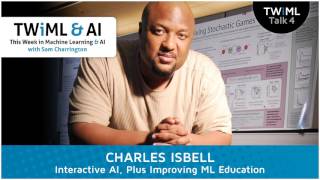
Interactive AI, Plus Improving ML Education with Charles Isbell - #4
Key Takeaways
Interactive AI and improving ML education with Charles Isbell
Full Transcript
[Music] hello everyone and welcome to twiml talk the podcast where I interview interesting people doing interesting things in machine learning and artificial intelligence I'm your host Sam charington we've got another great interview for you this time around but first a quick update on the drawing we've been running in conjunction with our O'Reilly media as you know if you've listened previously O'Reilly media is holding their first ever AI conference on Monday and Tuesday September 26th and 27th in New York City the conference will span both low-level talks on implementing Ai and highle talks on the impact of AI in society and I'm personally looking forward to speeches by AI luminaries such as Google's Peter norvig Facebook's Yan laon and Intel Nirvana's raal and we are giving away a ticket to one lucky winner here today in addition right after the AI conference on Wednesday and Thursday the 28th and 29th is the O'Reilly strata plus Hado World Big Data conference which is one that I've been attending for years now you may have heard me mention this one before Strat is a much bigger event and while it's not strictly focused on AI there are tons of really interesting AI a machine learning talks at strata as well along with talks focusing on what I consider to be the core topics of the of that event data infrastructure and data engineering and O'Reilly has been kind enough to offer us a ticket to strata as well which we'll be giving away today so about that giveaway if you went ahead and entered into the contest via either Twitter or the twiml ai.com website before the cuto off date your name or Twitter ID went into a spreadsheet and you actually had a pretty good chance of winning as far as giveaways go I chose winners using a random number generator to Pick Four numbers in the range of my spreadsheet rows the first winner who was lucky number 17 is Lance P who entered via Twitter Lance gets to choose either conference ticket for his prize the second prize winner is yena also from Twitter and he gets the ticket remaining after Choice I've also chosen two runner-ups who may be called upon to fulfill the duties of one of our winners if either of them can attend the event our first runnerup is Samuel W and our second runnerup is Dennis a who both happen to have entered via the twim lei.com site if you hear this any of you please reach out to me to claim your prize now if you didn't win it's not too late to save 20% on your registration for either conference you can do that by using the registration code PCT wi ml when registering and I'll include a link to the registration page in the show notes on behalf of the podcast and our partner O'Reilly thank you to everyone who entered and now on to the [Music] show all right folks I am super excited to bring you this interview my guest this time is Charles Isbell Jr professor and Senior associate Dean in the College of computing at Georgia Institute of Technology Charles and I go back a bit and in fact he's the first AI researcher I ever met his research focus is what he calls interactive artificial intelligence a discipline of AI specifically focused on the interactions between AIS and humans Charles and I spent a good chunk of time in our interview exploring what this means and some of the interesting research results in this field one part of the discussion I found particularly interesting was the intersection between his AI research and the related fields of marketing and behavioral economics Beyond his research Charles is well known in the ML and AI worlds for his popular machine learning course on Udacity which he teaches with Brown University Professor Michael Litman in addition Charles helped launch the online masters of computer science program at Georgia Tech we spend quite a bit of time talking about what's really missing in machine learning education and how to make it more accessible of course I'll be linking to Charles and the resources we mentioned in the show notes which you'll be able to find at twiml ai.com talk4 and now on to the interview all right everyone so I'm here with uh Charles isbel Charles is senior associate Dean and professor at Georgia Tech and actually Charles and I go way back so this has been a weird conversation because we're already like 20 minutes in and just getting started with the interview uh Charles say what's up to everyone and uh we'll get started what's up everyone how are you doing I'm happy to be here happy to be having this conversation awesome well thank you so much for uh joining us for this interview now I think we figured out that that it's been like 20 something years since uh we met and that uh was pretty interesting in that we uh were roommates during a I guess summer internships at Bell Labs um and that was when you were at MIT and studying AI tell us a little about your experience at MIT and and what you stud you were in the famous uh AI lab there right I was although the AI lab no longer exists it merged with the laboratory for computer science and is now known as seale so I loved my time at MIT and I love loved my time at Bell labs and eventually you know AT&T Labs uh sort of my journey through through AI is a I don't know it's it's a bit of a a Wandering one so here I'll just give you my entire history up to now in like 15 seconds and we'll we'll we'll see how that goes so uh as you can tell by my accent I was born in Chattanooga Tennessee but my earliest memory is arriving in a moving truck at the age of three and a half in Atlanta so I think of myself as being from Atlanta from very very early on I cared a lot about computers and computer science and I knew when I was 8 years old that I was going to do computer science although I didn't know what it was I knew I was going to be a professor although I didn't know what it was and I knew I was going to do AI even though I had no idea what that was something about building robots yeah at eight years old um you know it took me a very long time to realize that not everybody thought they knew what they wanted to do when they were eight years old uh I think I was probably a senior in college before I realized this but I had always sort of wanted to to build intelligent things although I I couldn't have articulated it that way when I was 8 years old but I always wanted to build smart things I always thought I thought the computers were great at least what I thought computers were and I basically just wanted to build you know an intelligent friend that's basically what I I was into at the time and so everything I kind of did from at that point on was about that my actual first uh encounter with bell Labs long before we met I was think it was the summer before 9th grade so I was 13 years old or so and I built a computer at Bell Labs as a part of this the summer Science Program when I say I built a computer I mean there was was a kit and another engineer did all of the work while I stood there and watched him but you know it felt like I was building the thing it was a Timex and Clair um T1000 and I think I had one of those yeah it was a little chicklet thing and it didn't have an onoff switch so when you turned it off you had to unplug it was great uh and uh the first program I ever wrote uh was uh a piece of code that would fill up the screen with inverse spaces and it ran out of memory before it could finish doing it and that was my introduction to real computer so you know that that's I figured I needed to fix that uh and so that whole summer we we spent well the two or so weeks that I was there for that program uh I spent a lot of time trying to figure out how how to make computers smart and how to make them do what you wanted to do and it just verified for me that that's what I wanted to do for for all of my life so I kind of dove in from there and I kept getting you know bigger and better computers and convincing my mom that you know an apple 2gs was the right thing and it was the best thing she could do from education she kind of nodded politely and eventually gave me the things that I wanted and I sort of moved through and one of the advantages of knowing what you want to do with your life is that you uh sort of move towards it there's some disadvantages uh we can talk about those but really admit that you know I knew I wanted to go to Georgia Tech because I wanted to stay in Atlanta uh and I thought that it was the best place for me to be so I went to Georgia Tech as an undergrad I completely dove into to AI uh didn't do a lot of research at the time because that you know in the the 1980s it was a little there weren't as many places where you could do the kind of uh research that you can do now as an undergrad no matter sort of what you're into uh and then decided Well there was basically one place for me to go to grad school uh and I applied to MIT and I I went to MIT and I wrote this long essay about building robots and and trying to make them smart and and and trying to make certain that uh they wouldn't run out of memory and it was a it was a lot of fun so I ended up going to to MIT um immediately started diving into machine learning which at the time was sort of new for me I knew about Ai and I knew I wanted to to build robots but it didn't occur to me that you needed to do something separate to make machines learn and I decided almost immediately once I was exposed to it that that this was the central question you couldn't be smart unless you could learn right and our machines were never going to be able to do the interesting things that I wanted them to do when I was 8 n years old unless they were smart enough to learn how to do them on their own uh and so I dove into that became a part of the AI lab uh went through a couple of advisers I'm I'm still good friends with with all of them uh and eventually ended up where I was the Side Story where we met uh is I at the same time that I was going through grad school I got to uh go to Bill Labs every summer it's a part of this this fellowship program you know all about this of course and there I did a lot of really interesting things in AI that had absolutely nothing to do with what I was doing in grad school but it was so interesting what they were doing they're trying to build these knowledge representations and kind of really understand how it is you could think and you could represent thought that I I just you know at the time it felt okay that I wasn't making progress in grad school because I was still getting to do these cool things and so by the time we met I was doing six months out of the year at Bell labs and six months out of the year at MIT more or less oh wow I don't think I realized that at the time yeah because I I take four and a half months over the summer I start before everyone else and I would end after everyone else and I would go back during the winter breaks okay okay uh so the I think the time that you kind of came up in AI was during the quote unquote AI winter is that right more or less we were just sort of at the tail end of the AI winter nobody told me that I didn't figure that out until much later so how has that impacted your and uh your contemporaries perspective on Ai and and the work you've done and uh how do you like what do you think about the current popularity of of AI and where it's all going so the I think basically what it's mainly done is it the people who are about my age and a little bit older who live through the AI winter I think basically spend a lot of their time wondering when the next AI winter is going to come so a lot of us are very very sort of naturally and reflexively worried that we're overhyping what's going on right it was it wasn't that it was difficult to get funding it wasn't that it wasn't it was difficult to do work it wasn't that there were weren't people interested in the problem that we were interested in it's that any minute now the federal government would take away all of the funding and we would you know we would go from having 10 graduate students to having two graduate students and I kind of think that little fear is always there in in the in the back of our heads and we find ourselves thinking please stop overhyping deep neural networks or you know getting people convinced that we're going to uh we're going to build the next data or the you know the next Android and self-driving cars and any minute it could all kind of go wrong so I think it's probably made us somewhat more cautious at least it's made me somewhat more cautious and trying to think a little bit about the hype that's sort where where it's kind of driven me uh but you know the other advantage of being a part part of sort of AI when it was during the AI winter is that you knew that you and the people you were talking to were in it because you were truly passionate and motivated about solving the problem as opposed to starting a company that would make you really rich or you know this is the hot thing you were doing it because you you actually cared about it and and I think that you know that's important right certainly when you're when you're doing research you have to be passionate about the the things that you you're you're doing and really believe that somehow it's going to get you someplace interesting and so do you think fear notwithstanding do you feel like the is the industry structured in the same way such that the risk is the same or uh is it different and in particular I'm thinking about is there uh you know are there funding sources more distributed now is the level of industrial activity you know more greater now um or is it all you know from a research perspective all still fundamentally the government funding everything and you know when they decide to change there when the winds change there it all uh collapses well I think structurally uh two things have happened one is computers Computing and and that sort of way of of crunching things and data are now ubiquitous they're they're everywhere so industry is deeply into this it's not going away uh Google exists right and everything is driven by data and it turns out that the parts of AI the parts of computer vision the all the sort of pieces of of building intelligent things they're driven by data now and since we everyone has access to data and everyone has access to Computing everyone has access to really fast machines I don't I'm not worried about sort of it structurally going away in fact the the problem is sort of the the opposite it's that everyone has a piece of it now it's it's driven as much by commercial interest as it is by sort of pure research and so really the difficult thing in some ways is that uh there's so many opportunities to do what I would have thought of as AI what we would talk about as machine learning and those kinds of related things that it's easy for things to become diffuse uh in a way that wasn't true 25 years ago I I don't think this is a bad thing I mean the the fact that Facebook exists the fact that uh Google exists the fact that everything is about your about data and about you know sort of modeling what people are doing and what things are happening is definitely a good thing and it does mean that there's always going to be funding uh for some piece of it even if it's not being called AI or it's not being called machine learning the kind of idea is metastasized so I'm not really worried about it going away the only thing that worries me is that people are concerned that bad things will happen because of what we're doing and for good reasons right they're concerned about their privacy we now have all these ability this ility to track everything that you do I guarantee you Google is well aware that you and I are having this conversation right now they probably know what we're going to say before we say it uh you know they've got more data on us than you can possibly imagine and truthfully we I'm not entirely sure that we mind um Facebook knows everything about us uh there are companies out there neither of us have heard of who know kind of everything about it so people worried about privacy they're also worried about cars running off the road and and killing other people um they're worried about robots you know rising up in Terminator style uh killing us all so the the the the kind of fear is is the hype has actually gotten to the point of not well you haven't given us what we promised it's that you've given us more than what we asked for I think that's where the danger is coming from now but in terms of funding in terms of people being interested in these problems no that that's driving everything even things you don't think of as being AI or being machine learning um yeah it's interesting that in in some ways it's uh in some ways the the industry is given more in some ways like we're still waiting like you know if you if you survey uh sci-fi and uh you know even the Jetson you know where where sci-fi thought we would be in you know 2016 in a lot of ways where we're not there yet right like a lot of movies would have had uh the self self-driving cars all over the street um but some of this stuff it takes longer uh it takes longer to develop than you think and some of the stuff is happening quicker than you think no I think well and some of the things are happening that nobody ever thought about I mean you go back and you start thinking about sci-fi it wasn't self-driving cars just self-driving jetpacks right I still haven't gotten my Jetpack yet I'm still waiting for that um and it's true uh we we we haven't gotten the flying machines we haven't gotten the the really the smart uh Butlers that are that are taking us everywhere on the other hand we've gotten a lot of other things right we've got access to information uh that we've never had access to before we can ask question questions and we'll get the answers back we can look up anything we want to we can teach ourselves we've gotten a lot more of things we never thought about than we thought we would and we've gotten less of the kind of obvious things that that I think people sort of hoped that we would one day get so you know it's a mix I I'm okay with that I mean I I people ask me all the time you know when are the computers going to achieve censits and and and take over the world and I think the answer is probably never or at least probably not for a very very long time not not in the way that people think about it but we're going to have very smart machines and we already do doing a whole lot of things for us that uh we never sort of expected them to do and the interesting thing is we won't even notice and it won't seem like that big of a deal I mean for example with the Tesla and the the autonomous cars Uber and all the things that that they're doing that's amazing have have you ever been in one of these cars have you ever LED do this that's amazing that you can sit in that car and it can drive you through traffic on a highway at 65 mph that's that's amazing I if you had asked me how you would do something like that 25 years ago and like I don't even I can barely figure out how human beings do it and in fact being on the road it's pretty clear to me lots of human beings don't do a very good job of it but that's a Mir that's a miracle and we barely notice right every time you get an airplane right the Pilot's not flying the airplane's flying itself right and and we just take this everyday Miracle as just another little thing in fact you know one of the big complaints if you're into AI right is that you never actually get credit for the cool things that you do right AI is kind of the the science and the engineering of making computers act the way they do in the movies right but one of the things that sort of tied into that is if it's got to be intelligent then it's got to be like humans and if it's got to be like humans it has to be mysterious and something we can't understand so the problem is every time we do something even if it's amazing once once we know how to do it and we understand it well that can't be real intelligence and so we don't give the credit to AI so AI sort of has this problem where you you can't ever win because anything interesting you do well we understand that and that's not real intelligent so it's no longer AI That's Just machine learning yeah or or it's just this it's just computers right it's never this thing where you succeeded it's just oh that's not the real part the real intelligent part is this thing and then when you can suddenly do beat you know people at Jeopardy well that's that's not really intelligence the real intelligence is this other thing so you basically just keep you know innovating your way out of out of business and so AI gets sort of smaller and smaller and smaller and what it's allowed to to call itself because the mystery gets smaller and smaller is it smaller smaller or further further well it's always sort of infinitely far away right right it's it's it's something that we can always look for but we can never quite get to sort of zenos paradox of AI but there's not like a uh you know there's not some finite set of things that we need to do to figure out Ai and we're chipping away at it and it's getting smaller and smaller it's like the the goalpost is moving yeah well so I think both those or both I think that's accurate I think both of those things are true I think there are finite number of things we need to do we're definitely chipping away at it and uh so the stuff we need to do sort of gets smaller and smaller though it's still really big but the goal posts keep moving right we've got cars that can drive themselves more or less and now now that's no longer amazing so it's got to be something else but that's that's amazing and by the way it's not just amazing it has an amazing impact on the world have have you seen this I know you're on Facebook you remember this map that was going around for a while that showed the the most common jobs uh in every state do you remember this around about a year or so ago and do you remember what the most common job is in almost every state in the US truck driver right yeah truck driver delivery person taxi driver right that's something like 42 or 44 this I don't remember the right number but it's over 40 uh for some reason in other states it's Elementary School teacher I don't know why but but mostly it's it's truck driver well you know we're five years away from all the cars delivering uh driving themselves right right Uber is is not going to have people involved anymore um my old adviser my one of my PhD advisers you know is heading the work at at prime a right so things are going to be delivered to us by drones and people aren't going to be involved anymore well that's the most common job in the country and it's going away MH right so the the goal post are moving the the things we have to do are getting smaller or not and people have this sort of feeling what AI is but whether or not you want to call it AI or not it's going to have a massive impact on our day-to-day lives it's going to have a massive impact on the economy it's going to have a massive impact on sort of how we see ourselves and how how we interact with one another and whether you decide that it's a or not or it's intelligent or not and whether you move the goalpost or not it's changing ing everything around us in deep and profound ways yeah absolutely absolutely um so I want to talk about a couple of of really specific things uh with you uh and we'll take these in in turn the first is in the the realm of education and the second is in the realm of uh your research Focus area and reinforcement learning but let's start with the first of those we got we got through your grad school experience in MIT then you went back to uh Georgia Tech and most recently you've been doing a lot of work in uh online education around machine learning um maybe walk us through what you're doing there and in particular I'm curious uh and maybe as as a bit of background here I I I didn't uh go through your entire course but I took a look at the uh uh the course that you did with Michael Litman and it was I really enjoyed the the presentation um having gone through a number of uh ML mukes and it made me wonder like what you know what unique views do you bring to you know teaching Andor learning uh machine learning and AI that um you surfaced in the the coursework as well as you know which are the you know are there any views you have that you think kind of go against the grain uh of the way people are other people are approaching it yeah so so I'm glad you enjoyed the the the classes Michael and I had a ball just a total blast doing it and if you haven't you should watch the the Michael Jackson parody video we did about machine learning you get to see uh get to see Michael dressed up as Michael Jackson and dancing which is well worth the price of admission uh which is free uh so the you talk about this kind of interaction we had one of the things that Michael and I I tried to do is we decided that we've been wanting to do things for a long together for a long time but you know he's on one part of the country I'm in another part of the country we wanted to do this this machine learning Muk and and this gave us the the opportunity to do it and the way we decided to come at it it was it's much like we're doing this now we said you know what education like this uh should be more like a podcast you should have a conversation uh so every time we did one of these these lectures one of us would be the professor who would try to present the material and the other person would try to be the student so the professor would do all the preparation and and come up with the sort of lesson and get everything together and the student would do no preparation at all and would come in cold so you know in that way it's just like regular school uh and we would just talk and of course he's an expert I'm an expert and this is what we do all day so it's not like we didn't really kind of understand what was going on but it turned out and I think this really does come out in the the conversations that we had that we actually have very different views of what's important right so Michael is much more of a theoretician uh if you asked him what Ai and machine learning is he might say something like computational statistics I'm much more interested in thinking about it it's kind of practical applications and you know sort of what you can do as a practitioner to to to use these tools to to make them work and get synthesis I want people to see that this thing over here is just like that thing over there it's is just like this thing over there and they're all tied together and I'm much less interested in proving in the abstract what it is that that you actually can learn and what you actually can't learn it's not that these things aren't important I just you know I'm just less interested in them than than Michael is and so we would spend all of these times kind of arguing some of that sometimes obviously sometimes not about what's going on and what I hope came out of that you can tell me if you if you think it's true or not is that the student was drawn into this conversation and at least got the feeling that not only were they learning some equation or getting ready for some test or doing some assignment but that they're really is a deep conversation going on about Ai and machine learning and there's lots of different ways to think about it um and and really that kind of gets to my larger philosophy about the way Education Works and why I'm so excited about the online education that that we've been able to do to me what's really missing in education is access right you know the ability for people to really to participate in the in the Commons that is uh education that is research that that is learning and one thing that I think is important for people to understand is that when you say access some people turn that into affordability you know is it cheap enough you know tuition's too high you know and that is a part of access but access is actually very different access is just the ability to be able ble to participate in the conversation um and that if you're capable of of getting through it being able to have the real opportunity to get through it for Ability is only a small part of that so one of the things that we've been doing and uh and I'm I'm actually quite proud of this over the the last three years is we decided that we wanted to push on this idea of access and affordability and that online education and mukes were one way of doing it and while we were working on this this machine learning class we wanted to make it a part of something bigger and so Georgia Tech when when when I was there in my senior soci Dean role I guess I still am and in my professor role we wanted to build an entire degree a graduate level degree that anyone uh who could get access to the internet and then who had the time and had the desire uh would be able to get through an actual full-fledged course full-fledged and not just a course a full-fledged degree a real program and so we created this online MS program um it's exactly the same as our on campus program uh same requirements same degree you get through this you get a you get a master of science computer science from a top 10 Department um and it's indistinguishable from the the one that you get on campus and here's the thing that we we did two things uh to sort of push on this notion of Access One is we decided to make it as inexpensive as possible so the entire the cost of the entire degree uh is something around $6,600 wow depending upon how fast you you get through the program so somewhere between $6,000 and $8,000 sort of depending upon what you do uh you can get an entire degree that's pretty inexpensive if you came on campus and you were out of State student it would cost you more like $46,000 so that was the first thing that we did make it affordable but the other thing that we decided to do is we decided to admit every single student we believed who could succeed this is a pretty big deal right if you if if we think about our oncampus degree we accept about 10% of our applicants why do we accept 10% of our applicants because it's all the space we have right I'd estimate somewhere between 60 and 70% of the student students who apply to our graduate program are above bar but we've only got room for 10% of them so only 10% of them get in and by the way it's it's it's basically a lottery right I mean you know when when you've got you're a place like Stanford and you're accepting four or five% of the people coming into undergraduate program there's no way that that four or 5% really better than the next four or five% the four or 5% after that you're you're almost closing your eyes and just picking people right and this is but what we were doing at The Graduate level we don't like that for our online degree which again is the same degree as our on campus degree at this point we're accepting about 60% of applicants okay we have gone from zero students three years ago to 4,000 students this term uh 4,000 currently enrolled students or is that a cumulative 4,000 currently enrolled students okay wow wow and comp to how many on campus uh about two or 300 okay in fact I by the way it's not just that we've got 4,000 students students they're performing as well as the oncampus students oh by the way it's not just that we have 4,000 students who are behaving who are performing as well as the oncampus students they look very different so if you look at our oncampus degree about 85% of the applicants are far Nationals vast majority of whom are from India uh following behind China so about 15% are US citizens for an online degree it's the compliment about 85 80 to 85% of the applicants are US citizens or permanent res okay right they're in their early 30s early mid-30s not in their earlyer mid 20s uh most of them are working full-time they've got uh you know uh jobs mostly in it though not all of them uh they've got mortgages they've got kids and they're trying to sort of get through their day but they can't uh take the time to get further education or to do the thing they want to do because again they've got mortgages and kids they' got responsibilities right so what's interesting is we've done studies of this we we partnered with Harvard and looked at it we think that of the people who are coming through our program almost none of them would have pursued an advanced degree otherwise they weren't be they because they just simply didn't have the option they couldn't take two years off from their lives uh to go and pursue a degree because they had too many other responsibilities and things that they had to do but this gives them the option of doing that and so in fact the overlap between them and the people who normally would get education is almost zero current estimate is that we'll add between 8 and 10% every year to the number of graduate um IT workers uh in the United States than we otherwise would have seen and have you looked at what what they're doing afterward how long has the program been in place uh and how long have you been tracking that and to what degree so it's been about three years uh in fact I think we're beginning our we'll be we're just ending our third year now we'll be starting our fourth year so people have just begun to graduate we had uh 20 people graduate uh two terms ago um and this semester we're expecting this closer to about 250 and we're expecting to see a steady state of closer to a th000 people graduating a year um most of them already had jobs so you know usually the way you measure success you say okay did people get jobs when they graduate well most of these people already had jobs so they didn't lose their jobs I guess that's a good thing but um it's hard it's hard to know what that what that impact is because the usual measures uh don't really make sense but they're all they all seem to be happy 97% of them said that they would you know recommend this to to other people uh many of them do get jobs while they're in the middle of the program a lot of them get promotions and they move through so you'll have to ask me in five years what the what the real impact is but right now it appears that people are happy they're getting a lot out of it some of them are able to change careers get promotions and to to do things they wouldn't otherwise be able to do because they just couldn't take the time off to do it so I'm very happy with that and happy with the the sort of impact it appears to be having on students uh let me ask you this a lot of people who listen to the podcast are you know somewhere along the progression of learning and and and entering uh machine learning as a a field as a as a profession and I'm wondering what what do you think the right set of uh set of educational tools to take advantage of right mukes are a piece of that um but there's obviously other pieces that go into making a full kind of a a well-rounded student of machine learning in AI how do you recommend that students approach that or do you have a philosophy around that well so I sort of do and I do think it comes out in my in my class um if you actually take the class as opposed to watch the lectures you get my assignments and I'll just describe my first assignment to you because I think it actually captures a lot of at least what I believe matters uh in becoming a um either a machine learning researcher or a machine learning practitioner or even AI more broadly speaking so here's my first assignment the first assignment is go find two data sets uh I don't care what they are so long as they're interesting they have to be interesting by themselves and they have to be interesting together and you have to convince me that they're interesting um then I want you to implement these five or six algorithms and when I say Implement I mean still the code I don't really care you don't get any credit whatsoever for implementing and running the code you steal libraries you know go get your your favorite implementation of KNN or boosting from somewhere else I don't really care um and I want you to run all of those algorithms on those two data sets and I want you to do an analysis and explain to me why you got the behavior that you did why did some of those algorithms which should all work why did some of them behave better on some dat on one of the data sets than the other what sort of things did you learn uh by applying those algorithms and doing the data analysis convince me that you've thought about it convince me of what experiments you would need to run in order to really um get the answers to the questions and then run those experiments do all of that and then write it up in 12 Pages not 13 Pages not 14 pages 12 Pages why do I have an assignment like that I have an assignment like that because I think much about machine learning much about the field that we're in is really about the practice of doing it you know theoretically all of these algorithms is particularly in supervised learning they're all very similar they all can learn the same kinds of things you know but there's no free lunch right so there has to be built into what you're doing deep assumptions about your data what is you're trying to accomplish and you have to be able to surface those things so if somebody want asked me if I wanted to really do machine learning what do I need to learn I give them two answers one you need to learn the foundations and the fundamentals yes you need to know the math you need to understand information Theory you need to understand you know what linear algebra is you need to not flinch if somebody mentions an igen vector or an igen problem to you you need to get the math yes and you need to get the Computing because it's a fundamentally Computing P discipline and Computing is not math Computing is not engineering Computing is not science you need to internalize the Computing part of machine learning but just as important and in many ways more important I believe is you have to really dive deeply into the empirical side of it you have to get dirty with data you have to understand what the difficulties are in in answering the questions you want to answer and you have to really realize that the questions you're asking aren't necessarily the right ones most of what traps Us in machine learning and in lots of other the things we do are the unspoken assumptions you have to surface what those things are and I think that the best way of doing that is by getting your hands and your feet dirty so my classes are designed to do that to force you to get into a messy illd defined situation and to work your way out of it so if you want to do data analysis if you want to do machine learning that's great it's wonderful I can think of nothing more interesting to do but you have to get out of the textbooks you have to play through the data and understand why it works the way that it does why the algorithms have the effect that they do why you can learn some things you can't seem to learn other things and that I think is actually really missing I think people either dive down the empirical side and just try to get stuff working but with no understanding of the fundamentals so they don't even know how to ask the questions or they get so caught up in the fundamentals they don't worry about whether it actually works in practice or how you would actually apply your ideas and you have to do both especially in a field like machine learning they use all the to the social media tools that are out there to build community to talk to each other to talk to the faculty to talk to advisers they really build an entire Community around what they're doing and really the people who are in that Community do well and the people who are not a part of that Community do poorly so one of the things that's important about the trips that I've been taking and the traveling around the world I've been doing is making certain that we provide the tools so that people can build local community that makes sense to them because that's how the Learning Happens at least that's what I believe you guys might be single-handedly propping up Google Plus I'm about helping Google Plus I I think people haven't been nice enough to Google Plus I've never heard of anyone else saying they're using it well there's no lag because no one else is using it so you got that oh nice nice nice uh so let's switch gears a little bit and talk about your research your research uh is your research Focus as I understand it anyways primarily around reinforcement learning or uh maybe you tell me uh tell us what your research focus is nowadays and uh how you think of uh that area yeah so I I I you know like I said earlier I really have been into AI machine learning for a very long time um and it took me a while to figure out what it was about it that I I really cared about um and it was it was easier to see when I was reflecting back on it what it is that you know I found interesting what I didn't the kind of machine learning that I care about uh the name that we we kind of give it in the field is interactive machine learning and or interactive AI um I I sometimes refer to as interactive AI because I care about the AI problem as much as I do the the machine learning problem and what it really is is about what happens when you instead of just saying oh look here's some data and I'm going to look at that data and then I'm going to build a function and now I can do some prediction you know that you're going to have a fundamentally incremental and interactive process so I want to model human beings because I actually care about messy data and and there's nothing messier than people so I want human beings to be a part of the story of how I learn and when I say that I think that people learn um only through social communities or they learn best through social communities I think that's actually true for our machines as well so that ends up looking a lot like and I spend most of my time worrying about reinforcement learning so you're right about that and the reason I care about reinforcement learning is that reinforcement learning is really I think trying to do something big and hairy which is actually model what it means to be an autonomous agent so when people ask me for the one sentence description of what it is that I what it is that I do I say I care about interactive machine learning I care about building intelligent agents that have to interact with other intelligent agents perhaps hundreds of thousands of them at a time and some of those intelligent agents might be human they don't all have to be human but some of them will be and since some of them are human you can't just go around sending XML packets back and forth you have to actually engage in conversation you have to worry about the fact that human beings change over time they're inconsistent they're arrone they're highly non-markovian there's all kinds of interesting things about people and you need to be partners with people and you need to be longlived uh in order for you to make progress in the area so that's what I really care about I care about building a system that doesn't just predict whether you know a car is going to run into the side of the road or not but actually deals with the fact that there are several million other people on the road at the same time and you have to interact with those other people and you have to learn by talking to them and interacting with them and so reinforcement learning is a a subset of that yes and that's right I spend a lot of my time worrying about Game Theory I spend a lot of my time worrying about um marketing Believe It or Not uh about social behavior and people tend to to interact and and work with one another and how you can convince them to to work with you um or how you can deal with them if they're trying to work against you so it's the whole gamut of what it means to to interact with other intelligent beings that have their own set of goals and and interest that might not be the same as yours um so tell me you mentioned marketing tell me more about how that plays into your research or or um maybe even give us an example of some of the research topics you've been looking into recently so I like the marketing question so so so I spent a lot of time with a friend of my with one of my students who's now a professor in North Carolina um on something called Drama management so the short version of drama management is uh well you know you've played video games right uh yep and you know the thing about video games is the interesting ones are ones where you're you know involved in an entire world and an entire story so what's actually going on is that you're the person building the system for you is trying to build a story but most stories you just read and you're a passive participant of and things like games you're actually an active participant which means there's this trade-off between your sense of autonomy and agency on the one hand and me making certain that you have a good experience or a good story so you can actually think of lots and lots of things like this you could think about conversations that you have in interviews and a podcast as like a story where you're negotiating back and forth and trying to trying to figure out how to tell the the story that you want to tell while still allowing people to say the things that they that they need to say or that that they want to say you can think about all kinds of examples like that kind of go on for a while but the the thing that the thing there is that it turns out that because your player or the person who's participating and building the story with you has their own ideas they might take your ideas off track they might turn your murder mystery into a horror story they might turn your interview where you're supposed to be going back and forth and having a conversation into a series of you ask me a questions and I say yes or no and it's not much of an interview for you right so you have to influence what the player is doing what the human participant is doing um or otherwise uh you don't end up with the good story that you want to have so there are two ways of doing that one and I think you know you and most of your listeners have you ever heard the expression um a game that's on Rails uh sure so you know that's where well I'm sorry I'm just not going to let you go through this door because if you do it breaks the video game or it breaks the story and so you're on Rails and the thing about being on Rails is it takes you out of the story takes you out of the experience and that's what a lot of people do and a lot of the drama management stuff is is about that as well but there's another way of doing it in fact the right way of doing it if you can make it work is you get the other person the person you're you're interacting with you're trying to learn with the story you're trying to get to participate in the story to actually accept your goals as his or her own and it turns out marketing is very good at this so we built this kind of system where um you get people to do the things that you want them to do by putting them in situations where it's just natural for them to do those things so rather than uh lock every door except one door in a room so you go through it I make something happen maybe some noise or something interesting that makes you want to go through that door right so um kind of like themes of Behavioral economics and incentives and things like that coming into play here right oh that's exactly right so in fact the the example of this that everyone's familiar with is one called scarcity uhuh so that's where it turns out that people if they believe that something is going away suddenly find it more valuable right right so anybody with kids knows certainly anyone with kids 10 years ago know that Disney has this habit of saying oh we're going to release on DVD Beauty and the Beast and then we're never going to release it again uhuh and so everybody buys it right because it's about to go away or I mean black Friday's like this right you're going to every year at the day after Thanksgiving you go to the store to buy a bunch of stuff it doesn't make any sense whatsoever they're not even things you want to have but they're going away you're going to get a price right now it's on sale and so people react to that they can't help themselves uh so scarcity is just one of is one of the particular things very easy to understand there's tons of others of these there's something called liking which as it turns out people will do things for you if they if they like you uh people react to Authority actually my favorite example is something called consistency where if you can get someone to say something out loud that they believe something they have an almost pathological need to be consistent with it over time so uh you know do you have anybody in your neighborhood who won't mow their lawn um here's the way you get them to mow the lawn you wait till it's winter right and so all the grass is you know kind of dead and it's all the the same height and you start up a conversation and you say man you know it really looks great around here when it's like this you know everything's the same color everything's the same height if you get the person to agree with that yeah it looks really nice when it's like this the next summer they'll mow the lawn because they basically believe that's the way it's supposed to be and you know what's really nice about it it's not that got them to M the lawn it's that they believe that they are in complete control of that idea that they're the on Who U made the decision are in charge so that's a long story but the the short version is we built systems like this uh that basically convinced people uh to do the things that we wanted them to do we influenced them so I'm not using machine learning just to predict your behavior I'm using machine learning to figure out how to intervene to get you to do something and what I really want to happen is for you to believe it's your own idea so we built this little story just a quick example we built this little story uh where the whole goal was to get you to buy a fish at a market not the most exciting story in the world and there are lots of ways we can influence you to do this with scarcity and various other things and it and so we had people play this game and uh the people we tried to influence were much more likely than the people we didn't um in buying the fish and doing the things that we tried to get done sure sure now that's interesting but what's more interesting is that when you ask the people whether they felt manipulated or not the people who were not man manipulated were much more likely to say they felt they were being manipulated than the people who actually were manipulated that's interesting why is that because the whole the whole way this works the whole way the kind of psychology works is you feel as if you have agency that you're making the decision when something goes on sale and you decide you're going to buy it you don't feel that you've been tricked into buying it you made the decision to do it right and so what's really and this is why it's not just running the day and doing machine learning it's actually understanding about human behavior it's understanding behavioral economics it's understanding the way marketing tricks work it's it's all about getting the person to make the decision you know themselves that they want to do this thing and then they have agency they have control and they're much more likely to see it through the fact that you kind of tricked them into doing it is neither here nor there so a quick note uh for listeners anyone that's interested in digging deeper into some of these ideas uh there's a great book called influence by Robert chalini that um is super accessible and is covers all the things that you you talked about consistency and scarcity things like that um but this brings up a a question for me and that is a lot of the a lot of the work we read about reinforcement learning nowadays is you're training these agents to uh navigate world right and then the work you're describing is you've got this world that's essentially training the human to navigate it and there's an interesting complementariness to it and I'm wondering if if that compliment has been explored at all like I'm the things that I'm thinking around like adversarial networks like can you have the one training the other thinking it's training the other does that make any sense is anything happening there oh yeah that's actually very common way of doing it so the way so the thing that really got me into reinforcement learning when I was a a young graduate student a couple hundred years ago uh was actually playing games so there was this a guy named tsaro who had built something called TD gamon which was a particular way of doing uh reinforcement learning to to learn how to play back gamon and the way it learned to play back gamon was through self-play so it it played both sides of the game uh and it learned by playing itself how to get better uh and this is a well I think a pretty well understood sort of technique for learning right you it's difficult to if it's too hard you can't learn if it's too easy you can't learn you needed to be just about a little beyond your current level of understanding and so yeah this kind of thing happens all the time now it is true that a lot of people who worry about machine learning do not think about the kind of complimentary nature that rather than they're being an agent that's training in an environment the environment could be in fact training the agent and people don't always see that um in fact my biggest complaint or complaint is not the right word but my biggest um I don't know let's say complaint my biggest complaint about the way machine learning is portrayed is that it's portrayed as a supervised learning problem you know I'm going to give you a bunch of input output examples and you're going to learn the function that Maps input to output and that's interesting but I think reinforcement learning is more interesting because it's this bigger problem you don't have inputs and outputs all you've got is actions you can take and feedback you get from the world and then from that you have to figure out how to behave that feels richer to me even though in some sense they're equivalent unsupervised learning is a very different way of thinking about the world even though again sort of mathematically they're they're all kind of equivalent and that kind of breadth of what machine learning and AI is is something that I don't think we spend enough time really thinking about I think people tend to focus on the supervised learning part instead of the reinforcement learning and the unsupervised learning part at least in the kind of popular press okay so maybe taking a step back how do you think about the current state of reinforcement learning like can you characterize the the major research efforts or even is it possible to characterize the major research efforts into a handful of um directions and kind of who's doing what so I think there's kind well so the answer is no it's it's way too broad but there's a couple of things that I think are really interesting one is all this work on um deep networks and deep neural networks which you know is the the current thing that everybody's really into and by the way it's really good work you know I know the people who who've been pushing on that for years and years and years and and they've really been able to to do a lot of interesting things they they got the kind of fundamentals right with the math and they're taking advantage of the fact that we have insane amounts of data uh so that we can actually sort of take advantage of those algorithms to do cool things a lot of what's going on at least in my world that people are paying a lot of attention to is figuring out how to use the stuff that we know from Deep networks from Deep learning and applying it to reinforcement learning okay and and rather than doing the supervised learning take where you say well okay here's the state of the world tell me what to do you're actually treating it the way you treat a reinforcement learning problem you're talking about building value functions over what the states are in the world and what things are better and then using that um to figure out how to make a decision and use what you learn from making the decision to affect your view of what's valuable in the world and kind of having each one feed into one another and so recognizing that there's at least two parts of that problem instead of one part of that problem is a really big deal and being able to marry the kind of math that's come out of supervisor learning has been I think um really important uh that I think has has been really interesting has pushed forward a lot of a lot of of what we've been able to to learn in the last couple of years for sure the second thing which I think is interesting in part because it's it's my own work and and placees where I lived is very related to what we just got through talking about and it's this interactive machine learning it turns out you know I I mentioned earlier that there's no free lunch right so for those of you who don't know the no free lunch theorem basically just says that all algorithms are equally good and in fact not only are all algorithms equally good but none of them are any better than behaving randomly and the reason that's true is because over all the infinite number of problems uh that one could encounter you know any algorithm has just as good a chance of doing well as that as any other algorithm but it turns out in practice we don't care about every possible problem in the universe we care about a small set of problems in the universe and what allows us to get leverage over that small set are built in assumptions about the about that world so the problem of learning is difficult and in some ways impossible but it turns out people are really good at solving the problems that people are really good at what they're really bad about is explaining to you how they do what they do but they're really good at solving these problems so a lot of what's been going on um in the reinforcement learning World in particular is taking advantage of people learning from getting people to tell you something or to demonstrate something to you about how to do something so that you can learn much much faster than you ever would and really what you're getting out of it is you're getting human beings the human beings assumptions about the way the world works and you're taking advantage of those assumptions to narrow down the to narrow down the search space so I'll give you a really I'll give you a really quick example so it turns out that people um do not think about um things in in in uh uh Atomic actions they tend to think about them in these big temporally extended views of the world so like take something like Pac-Man right if if you ask if I asked you to explain Pac-Man to me you wouldn't be describing in terms of up down left right or you would say things like oh well look you need to get the power pellet you need to avoid the G you need to you know you need to do these four or five things and we run experiments on this where we ask people to to to create buttons that they would use if to to make Pacman go faster and they come up with these interesting buttons these sort of long-term things but dividing the world up like that not from up down left right but into get the power pellet avoid the ghost is something that is very difficult to learn from scratch but people have already figured this out so you build systems where people are able to express to you those tricks those shortcuts those assumptions about the world and then you can learn so much faster uh than you would ever be able to do on your own um and that's kind of where we're getting a lot basically taking assumptions from the world and getting them automatically from humans I think that's incredibly important and one of the reasons I think it's important by the way is because um so many of the problems that we actually care about involve people right they involve other people they involve interacting with people and so you have to understand the fundamental assumptions that people are living in and and you have to take advantage of them if you're ever going to learn so those are two areas that I happen to think are are really cool in the reinforcement learning space right now are we also learning how to enable the machines to make the Assumption them assumptions themselves like what's happening there yeah but the way they do it is they they kind of do it they do it by Dent of observing the world right there's a Michael Litman always says a couple of things that I really like and one is that you know if the person who's doing the program in is doing all the learning and writing down the data structures then you're stuck right you you need the machine itself to be able to learn its own data structures through observation it needs to be able to to build its own assumptions and its own models if you're always giving it the model then it's always depending upon you to give it the model it has to be able to to build its its own model so fundamental to that is this idea that that you're going to learn the you're going to build in your own assumptions you're going to learn new assumptions and you're going to build models that you're you're willing to adapt um and so yes yes that that's definitely built into it it's it's definitely a part of what's going on but the problem is absent nothing or absent anything you you can't know where to start and so this gets us back full circle to this idea that learning is a a social exercise right as human beings we interact with other human beings that have a bunch of assumptions they built the world together and they kind of know how it works and a lot of your job is to figure out what it is they've built into the world as assumption so that you can begin to learn and our machines have to be able to do the same thing otherwise they're not actually living in the same world that we're living in h interesting interesting one of the uh one of the papers that I pulled up of yours uh on archive is uh paper perceptual reward functions which is pretty recently published and that goes into I think the the former of these two areas that you mentioned uh where you're trying to map kind of the deep learning to you know a broader set of problems um can you describe that the the paper that is relatively new stuff there's a bunch of new things that are coming coming out about that the student Min Ashley Edwards is really buying into the fundamental uh idea there is that you know people have people's reward function so if you're a machine learning guy right particularly reinforcement learning guy you start talking about rewards and you start talking about States and and you divide the world up into the abstract space and you go that's how you solve problems but we spend most of our time never actually worrying about where these things come from they're just given to us um and this paper is a part of actually a larger body of work that that U I've been I've been paying a little bit of attention to the last couple of years of trying to figure out where those things come from are there principles about where reward functions come from there principles about where State comes from at least with respect to the way human beings deal with it so that you can actually solve these problems in general and be more robust to small changes in the environment one of the things that that that's true about uh reinforcement learning is you know there's a nice little math equation uh that you need in order to figure out how to learn and determine value and it's very nice and it's very elegant but it's actually quite fragile so if I were to build a system let's say a robot and I wanted this robot to get from one end of a hallway to another and uh along the way it might do some other interesting things I can construct all my little alphas and my my learning rates and I can put everything together so that eventually it will learn and that it will do exactly what you want it to do and won't get um so scared that something bad will happen that it won't move and it won't get so distracted by some interesting thing over here to the left that it'll never get to the end of the hallway I can actually do that pretty well but then if I take that robot and all that it's learned and then I make the hallway five inches longer it will stop working right because the math is very brittle everything is set up just right so that everything kind of touches one another um and what you want to do is you want to build systems that are robust to that you want to build systems that adapt to that and turns out that human beings are very good I mean in fact optimized in some ways for dealing with you it's still a niche environment right we we do pretty well on Earth we don't we won't do pretty well on Mars right we don't do pretty well in space but but you know it's still a rich environment that we're in and you want to build systems that can do that and so the perceptual um reinforcement learning stuff is about using uh what we get from our perceptions directly as the as the notion of state and as our notion of reward that we try to get things to look like what we see we try to imitate the things that we see through through our perceptions rather than you know build simple uh or actually complex optimization uh functions that tell us you know whether this thing actually is like that thing no you just think about what it is that you see what it is that you're P what it is you're perceiving and there's this sort of larger philosophy around that I'm actually quite excited about the work I think what it allows us to do is to stop thinking about reinforcement learning as five you know a five tupal where you have to set the values and start thinking about it as a larger programming problem yeah where the whole thing is it's reinforcement learning is not the thing that you start with it's the mechanism by which you happen to solve the problem it is itself a programming language is itself a way of of viewing the world and you've got to step back to the level of task and problem instead of thinking about solving this particular equation interesting yeah I thought the example that was provided in the introduction to the paper was a a a good one uh that was training a robot to to fold origami like what you know what's the state of an origami and how do you how would you represent that traditionally you know whereas the what's natural for us as humans is to see a picture of the final result and you how do you define a you know a score metric or a distance metric from you know a given current origami to this target yeah it's it's and it's a rich problem too because as soon as if I asked you to explain to me how to do origami which by the way I have absolutely no idea how to do something magic with your hands paper you do a flurry of things and then suddenly there's a dragon I I really know how it happens but you know you start saying oh well you you start thinking about folding and you start talking at this very high level just like with with Pac-Man right and the way of dividing up that world is actually important because if you don't divide up the world in the right way you will never in a million years a billion years in the lifetime of the universe actually solve the problem because there's just too many possibilities right this goes all the way back to to language learning and um you know it turns out that people do not actually correct their children M right so you don't get any negative examples hardly at all when you're a kid and yet somehow children learn to speak their particular language even though nobody's telling them when they're you think you are but you don't actually correct your children and we can prove to you mathematically that you can't learn under those circumstances so the only way it can be happening is if the world has been divided up in the nice little ways and there's only a few possibil and you're searching over those few possibilities because the world's already been divided up for you if you have to go through the trouble of dividing up the world yourself then you're just there isn't enough time there aren't enough examples there isn't enough time yeah yeah yeah so at the RIS oh go ahead no I I was just going to say so to me if if you pop up to the AI level instead of the machine learning level right uh that's really the interesting thing right that what's really exciting about AI right now what's really exciting about machine learning right now is that we finally have enough computing power we finally have enough mathematical sophistication uh and we finally have enough data that we can actually start solving really hard problems where we're going to be forced to move Beyond you know the equation that we wrote down in 1965 that hasn't changed to thinking about bringing in all of these other things whether it's marketing and behavioral economics whether whether it's Game Theory whether it's well engineering whether it's control you know we actually going to have to bring in tons of other things in order to solve the problems we're now at the point where we can actually do that so we're actually meeting in the middle so that so this is why this is an exciting time for me nice nice so at the risk of asking uh question that we've kind of touched on in a couple different ways already uh for someone who wants to dig deeper into the kind of stuff we're just talking about interactive uh machine learning in Ai and reinforcement learning are there any places that you would Point them to get started well I would start with just a basic uh machine learning class particularly one that covers reinfor learning if you really are interested in reinforcement learning as a a a topic I mean you know Rich Sutton's book is freely available online it's a great place to start to kind of understand what's going on uh the class that I teach with Michael Litman is freely online there's lots and lots of lots and lots and lots of examples out there um I would actually start with that and get the basics there's uh survey papers I mean Google is your friend in this case but if you're the if you're the kind of person who wants to uh have someone give you a nice brief overview of what's going on then you know hey start with my class just pick Michael Litman you can go to Udacity you can get it for free just sort of skim through it and watch through it and you'll you'll figure out from there where to go uh and I would really um I would really encourage people to pick a problem that they find interesting if games are the things for you then start looking up um uh the Deep learn the Deep reinforcement learning work on on games there's a there's a bunch of work done recently on solving most of the Atari games MH uh using deep learning that really interesting stuff the problem with starting there though is that oh now you have to know what convolution Nets are and you know you you're going to find yourself distracted for nine months while you learn enough math to figure out what's going on I would actually start top down I would start thinking about the problems what the issues are before I get so deep into the to the math that I get lost you don't want to lose the farest for the trees here and it is very easy to lose the farest for the trees because there's so much kind of interesting and very difficult math that's um underneath all of this but really you want to keep sight of the goal right which is the build something that can learn over time can adapt over year can live for 20 years and continually learn and adapt and think about what that would mean think about what it would mean to you as a person and then start asking what kind of background you would need to have in order to build a system that does that that's great and I'll include links to uh a bunch of the things that you mentioned in the show notes um I think oh I I would let me add one thing to you should throw in the show notes uh you mentioned uh the the book influence I I would also recommend the media equation it's a media equation that is a fantastic book it's one of these it's a short book about how human beings actually behave uh and how it turns out that M people will treat machines as if they're humans even though they know better uh because they'll treat anything that acts like it has intention as if it has intention and I think that fact alone uh should influence everyone who's thinking about Building Systems that have to interact with humans interesting we're not even all that good at ascribing intention other people the thought of applying it to machines is uh and we're going to have to work on that I actually think it's the other way around I think the problem is we're incredibly good at ascribing intentions to other people it's just not always the right intentions ah yeah yeah yeah um great so I think we uh this has been a great discussion um I appreciate you getting together with me for it especially on a Saturday morning and don't want to monopolize your Saturday so we'll wrap things up here anything else you'd like to uh toss out no I just I really enjoy this and we should have this conversation again absolutely absolutely um and then for folks that want to get in touch with you how they find you on Google Plus well if you go to Google Plus I'm the one guy who's still there so that's easy to find me no just send me an email it may take me a while to respond but I'm more than happy to respond just Google me iSell cc. tech.edu okay and are you on Twitter or any of the the the Lesser used social networks I have a I have a Twitter account uh and occasionally I even use it uh but really email is the only way to really get to me unless you have my Cale number and I'm not giving you my cell number nice nice all right great uh well thanks so much Charles really appreciate it um and uh next time absolutely awesome all right everyone that's our show for today thanks so much for listening if you're one of our lucky winners or Runners up please reach out to me at Sam twiml ai.com a bunch of you have asked hey what's up with the newsletter no you haven't missed anything I've just been crazy busy and haven't had a chance to get one out I'm so sorry about that I'm still working on it and I'll keep you posted thank you so much for your support and catch you next time [Music] m
Original Description
My guest this time is Charles Isbell, Jr., Professor and Senior Associate Dean in the College of Computing at Georgia Institute of Technology. Charles and I go back a bit… in fact he’s the first AI researcher I ever met. His research focus is what he calls “interactive artificial intelligence,” a discipline of AI focused specifically on the interactions between AIs and humans. We explore what this means and some of the interesting research results in this field. One part of this discussion I found particularly interesting was the intersection between his AI research and marketing and behavioral economics.
Beyond his research, Charles is well known in the ML and AI worlds for his popular Machine Learning course sequence on Udacity, which he teaches with Brown University professor Michael Littman, and for the Online Master’s of Science in Computer Science program that he helped launch at Georgia Tech. We also spend quite a bit of time talking about what’s really missing in machine learning education and how to make it more accessible.
The notes for this show can be found at https://twimlai.com/talk/4.
Subscribe!
iTunes ➙ https://itunes.apple.com/us/podcast/this-week-in-machine-learning/id1116303051?mt=2
Soundcloud ➙ https://soundcloud.com/twiml
Google Play ➙ http://bit.ly/2lrWlJZ
Stitcher ➙ http://www.stitcher.com/s?fid=92079&refid=stpr
RSS ➙ https://twimlai.com/feed
Lets Connect!
Twimlai.com ➙ https://twimlai.com/contact
Twitter ➙ https://twitter.com/twimlai
Facebook ➙ https://Facebook.com/Twimlai
Medium ➙ https://medium.com/this-week-in-machine-learning-ai
Watch on YouTube ↗
(saves to browser)
Sign in to unlock AI tutor explanation · ⚡30
Playlist
Uploads from The TWIML AI Podcast with Sam Charrington · The TWIML AI Podcast with Sam Charrington · 4 of 60
1
 2
2
 3
3
 ▶
▶
 5
5
 6
6
 7
7
 8
8
 9
9
 10
10
 11
11
 12
12
 13
13
 14
14
 15
15
 16
16
 17
17
 18
18
 19
19
 20
20
 21
21
 22
22
 23
23
 24
24
 25
25
 26
26
 27
27
 28
28
 29
29
 30
30
 31
31
 32
32
 33
33
 34
34
 35
35
 36
36
 37
37
 38
38
 39
39
 40
40
 41
41
 42
42
 43
43
 44
44
 45
45
 46
46
 47
47
 48
48
 49
49
 50
50
 51
51
 52
52
 53
53
 54
54
 55
55
 56
56
 57
57
 58
58
 59
59
 60
60

Engineering Practical Machine Learning Systems with Xavier Amatriain - #3
The TWIML AI Podcast with Sam Charrington
How to Build Confidence as an ML Developer with Siraj Raval - #2
The TWIML AI Podcast with Sam Charrington
Open Source Data Science Masters, Hybrid AI, Algorithmic Ethics & More with Clare Corthell - #1
The TWIML AI Podcast with Sam Charrington
Interactive AI, Plus Improving ML Education with Charles Isbell - #4
The TWIML AI Podcast with Sam Charrington
Machine Learning for the Stars & Productizing AI with Joshua Bloom - #5
The TWIML AI Podcast with Sam Charrington
Generating Labeled Training Data for Your ML/AI Models with Angie Hugeback - #6
The TWIML AI Podcast with Sam Charrington
Explaining the Predictions of Machine Learning Models with Carlos Guestrin - #7
The TWIML AI Podcast with Sam Charrington
Deep Learning: Modular in Theory, Inflexible in Practice with Diogo Almeida - #8
The TWIML AI Podcast with Sam Charrington
Emotional AI: Teaching Computers Empathy with Pascale Fung - #9
The TWIML AI Podcast with Sam Charrington
Statistics vs Semantics for Natural Language Processing with Francisco Webber - #10
The TWIML AI Podcast with Sam Charrington
Building AI Products with Hilary Mason - #11
The TWIML AI Podcast with Sam Charrington
Reprogramming the Human Genome with AI, w/ Brendan Frey - #12
The TWIML AI Podcast with Sam Charrington
Understanding Deep Neural Networks with Dr. James McCaffery - #13
The TWIML AI Podcast with Sam Charrington
Scaling Deep Learning: Systems Challenges & More with Shubho Sengupta - #14
The TWIML AI Podcast with Sam Charrington
Domain Knowledge in Machine Learning Models for Sustainability with Stefano Ermon - #15
The TWIML AI Podcast with Sam Charrington
Machine Learning in Cybersecurity with Evan Wright - #16
The TWIML AI Podcast with Sam Charrington
Interactive Machine Learning Systems with Alekh Agarwal - #17
The TWIML AI Podcast with Sam Charrington
Location-Based Intelligence for Smarter Marketing with Klustera - #18
The TWIML AI Podcast with Sam Charrington
AI-Powered Customer Support with HelloVera - #18
The TWIML AI Podcast with Sam Charrington
Using AI to Simplify the Programming of Robots with Cambrian Intelligence - #18
The TWIML AI Podcast with Sam Charrington
Increasing Efficiency of Healthcare Insurance Billing with NLP, w/ Behold.ai - #18
The TWIML AI Podcast with Sam Charrington
Creating a Worldwide Financial Knowledge Graph with AlphaVertex - #18
The TWIML AI Podcast with Sam Charrington
From Particle Physics to Audio AI with Scott Stephenson - #19
The TWIML AI Podcast with Sam Charrington
Selling AI to the Enterprise with Kathryn Hume - #20
The TWIML AI Podcast with Sam Charrington
Engineering the Future of AI with Ruchir Puri - #21
The TWIML AI Podcast with Sam Charrington
Deep Neural Nets for Visual Recognition with Matt Zeiler - #22
The TWIML AI Podcast with Sam Charrington
Introducing Psycholinguistics into AI with Dominique Simmons- #23
The TWIML AI Podcast with Sam Charrington
Reinforcement Learning: The Next Frontier of Gaming with Danny Lange - #24
The TWIML AI Podcast with Sam Charrington
Offensive vs Defensive Data Science with Deep Varma - #25
The TWIML AI Podcast with Sam Charrington
Global AI Trends with Ben Lorica - #26
The TWIML AI Podcast with Sam Charrington
Intelligent Autonomous Robots with Ilia Baranov - #27
The TWIML AI Podcast with Sam Charrington
Reinforcement Learning Deep Dive with Pieter Abbeel - #28
The TWIML AI Podcast with Sam Charrington
Robotic Perception and Control with Chelsea Finn - #29
The TWIML AI Podcast with Sam Charrington
Natural Language Understanding for Amazon Alexa with Zornitsa Kozareva - #30
The TWIML AI Podcast with Sam Charrington
The Power of Probabilistic Programming with Ben Vigoda - #33
The TWIML AI Podcast with Sam Charrington
Intel Nervana Update + Productizing AI Research with Naveen Rao and Hanlin Tang - #31
The TWIML AI Podcast with Sam Charrington
Video Object Detection at Scale with Reza Zadeh - #34
The TWIML AI Podcast with Sam Charrington
Enhancing Customer Experiences with Emotional AI, w/ Rana el Kaliouby - #35
The TWIML AI Podcast with Sam Charrington
Expressive AI-Generated Music With Google's Performance RNN with Doug Eck - #32
The TWIML AI Podcast with Sam Charrington
Smart Buildings & IoT with Yodit Stanton - #36
The TWIML AI Podcast with Sam Charrington
Deep Robotic Learning with Sergey Levine - #37
The TWIML AI Podcast with Sam Charrington
Deep Learning for Warehouse Operations with Calvin Seward - #38
The TWIML AI Podcast with Sam Charrington
Cognitive Biases in Data Science with Drew Conway - #39
The TWIML AI Podcast with Sam Charrington
Data Pipelines at Zymergen with Airflow, w/ Erin Shellman - #41
The TWIML AI Podcast with Sam Charrington
Web Scale Engineering for Machine Learning with Sharath Rao - #40
The TWIML AI Podcast with Sam Charrington
Marrying Physics-Based and Data-Driven ML Models with Josh Bloom - #42
The TWIML AI Podcast with Sam Charrington
Machine Teaching for Better Machine Learning with Mark Hammond - #43
The TWIML AI Podcast with Sam Charrington
LSTMs, Plus a Deep Learning History Lesson with Jürgen Schmidhuber - #44
The TWIML AI Podcast with Sam Charrington
Learning From Simulated & Unsupervised Images through Adversarial Training - TWiML Online Meetup
The TWIML AI Podcast with Sam Charrington
Jennifer Prendki Interview - Agile Machine Learning - TWiML Talk #46
The TWIML AI Podcast with Sam Charrington
Evolutionary Algorithms in Machine Learning with Risto Miikkulainen - #47
The TWIML AI Podcast with Sam Charrington
Learning Long-Term Dependencies with Gradient Descent is Difficult - TWiML Online Meetup
The TWIML AI Podcast with Sam Charrington
Word2Vec & Friends with Bruno Gonçalves -#48
The TWIML AI Podcast with Sam Charrington
Symbolic and Subsymbolic Natural Language Processing with Jonathan Mugan - #49
The TWIML AI Podcast with Sam Charrington
Bayesian Optimization for Hyperparameter Tuning with Scott Clark - #50
The TWIML AI Podcast with Sam Charrington
Intel Nervana DevCloud with Naveen Rao & Scott Apeland - #51
The TWIML AI Podcast with Sam Charrington
AI-Powered Conversational Interfaces with Paul Tepper - #52
The TWIML AI Podcast with Sam Charrington
Topological Data Analysis with Gunnar Carlsson - #53
The TWIML AI Podcast with Sam Charrington
ML Use Cases at Think Big Analytics with Mo Patel & Laura Frølich - #54
The TWIML AI Podcast with Sam Charrington
Ray:A Distributed Computing Platform for Reinforcement Learning with Ion Stoica -#55
The TWIML AI Podcast with Sam Charrington
More on: Staying Current in AI
View skill →








🎓
Tutor Explanation

 DeepCamp AI