Knuth–Morris–Pratt (KMP) Pattern Matching Substring Search - First Occurrence Of Substring
Skills:
Algorithm Basics90%
Key Takeaways
This video teaches the Knuth-Morris-Pratt pattern matching substring search algorithm for finding the first occurrence of a substring
Original Description
Free 5-Day Mini-Course: https://backtobackswe.com
Try Our Full Platform: https://backtobackswe.com/pricing
📹 Intuitive Video Explanations
🏃 Run Code As You Learn
💾 Save Progress
❓New Unseen Questions
🔎 Get All Solutions
Question: Given a string s and a pattern p, determine if the pattern exists in the string. Return the index of where the first occurrence starts.
Further Explanation From Tuschar Roy: https://www.youtube.com/watch?v=GTJr8OvyEVQ
The Brute Force
The naive approach to solving this is looking in s for the first character in p.
If a match is found we begin a search from that index, call it i (for intersect).
We compare the 2nd character of p with index i + 1 of s
We compare the 3rd character of p with index i + 2 of s
...and so on until we have matched to all of p without either having overrun s or having found a mismatch between characters being compared.
We can then return i as our answer.
It doesn’t work well in cases where we see many matching characters followed by a mismatching character.
Complexities:
Time: O( len(s) * len(p) )
In a simple worst case we can have
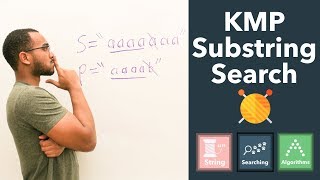
s = "aaaaaab"
p = "aaab"
The problem is that for each first character match we have the potential to naively go into a search on a string that would never yield a correct answer repeatedly.
Other Algorithms
There are three linear time string matching algorithms: KMP (nuth–Morris–Pratt), Boyer-Moore, and Rabin-Karp.
Of these, Rabin-Karp is by far the simplest to understand and implement
Analysis
The time complexity of the KMP algorithm is O(len(s) + len(p)) "linear" in the worst case.
The key behind KMP is that it takes advantage of the succesful character checks during an unsuccessful pattern comparison subroutine.
We may have a series of many comparisons that succeed and then even if one fails at the end, we should not repeat the comparison work done since we already saw that a series matched.
What we will do is very similar to the naive algorithm, it
AI explanation not available for this lesson yet
This lesson is still being prepared for the AI tutor. In the meantime, explore lessons that are ready.
Browse explainer-ready lessons →
Playlist
Uploads from Back To Back SWE · Back To Back SWE · 16 of 60
1
 2
2
 3
3
 4
4
 5
5
 6
6
 7
7
 8
8
 9
9
 10
10
 11
11
 12
12
 13
13
 14
14
 15
15
 ▶
▶
 17
17
 18
18
 19
19
 20
20
 21
21
 22
22
 23
23
 24
24
 25
25
 26
26
 27
27
 28
28
 29
29
 30
30
 31
31
 32
32
 33
33
 34
34
 35
35
 36
36
 37
37
 38
38
 39
39
 40
40
 41
41
 42
42
 43
43
 44
44
 45
45
 46
46
 47
47
 48
48
 49
49
 50
50
 51
51
 52
52
 53
53
 54
54
 55
55
 56
56
 57
57
 58
58
 59
59
 60
60

4 Tips To Learn Java Programming As Fast As Possible As A Beginner
Back To Back SWE
3 Mistakes Beginners Make When First Learning Java and Android Development
Back To Back SWE
How To Get A Job At Google | The Ultimate Guide To Algorithmic/Coding Interviews
Back To Back SWE
The Ultimate Big O Notation Tutorial (Time & Space Complexity For Algorithms)
Back To Back SWE
Total Occurrences Of K In A Sorted Array (Facebook Software Engineering Interview Question)
Back To Back SWE
The N Queens Problem using Backtracking/Recursion - Explained
Back To Back SWE
Compute All Mnemonics For A Phone Number (Recursion/Backtracking Problem)
Back To Back SWE
How To Reverse A Singly Linked List | The Ultimate Explanation (Iteratively & Recursively)
Back To Back SWE
Depth First & Breadth First Graph Search - DFS & BFS Graph Searching Algorithms
Back To Back SWE
The 0/1 Knapsack Problem (Demystifying Dynamic Programming)
Back To Back SWE
The Dutch National Flag Problem (The Quicksort "Band-Aid")
Back To Back SWE
Test If A Binary Tree Is Symmetric ("Symmetric Tree" on Leetcode)
Back To Back SWE
The IP Address Decomposition Problem - Compute All Valid IP Addresses From Raw IP String
Back To Back SWE
How To Permute A String - Generate All Permutations Of A String
Back To Back SWE
The Balanced Parentheses Problem - Classic Stack Problem ("Valid Parentheses" on Leetcode)
Back To Back SWE
Knuth–Morris–Pratt (KMP) Pattern Matching Substring Search - First Occurrence Of Substring
Back To Back SWE
Implement An LRU Cache - The LRU Cache Eviction Policy ("LRU Cache" on LeetCode)
Back To Back SWE
Find The Longest Increasing Subsequence - Dynamic Programming Fundamentals
Back To Back SWE
Generate All Palindromic Decompositions Of A String ("Palindrome Partitioning" on Leetcode)
Back To Back SWE
Implement A Sudoku Solver - Sudoku Solving Backtracking Algorithm ("Sudoku Solver" on LeetCode)
Back To Back SWE
Merge K Sorted Arrays - Min Heap Algorithm ("Merge K Sorted Lists" on LeetCode)
Back To Back SWE
Partition To K Equal Sum Subsets From An Array of Integers - The Backtracking Approach
Back To Back SWE
Edit Distance Between 2 Strings - The Levenshtein Distance ("Edit Distance" on LeetCode)
Back To Back SWE
Total Ways To Decode A String - Recursive Dynamic Programming Approach ("Decode Ways" on LeetCode)
Back To Back SWE
The Change Making Problem - Fewest Coins To Make Change Dynamic Programming
Back To Back SWE
Compute The Next Permutation of A Numeric Sequence - Case Analysis ("Next Permutation" on Leetcode)
Back To Back SWE
Count Total Unique Binary Search Trees - The nth Catalan Number (Dynamic Programming)
Back To Back SWE
Generate All Strings With n Matched Parentheses - Backtracking ("Generate Parentheses" on LeetCode)
Back To Back SWE
Implement A Max Stack - A Stack With A .max() API (Similar To "Min Stack" on LeetCode)
Back To Back SWE
The Recursive Staircase - Top Down & Bottom Up Dynamic Programming ("Climbing Stairs" on LeetCode)
Back To Back SWE
Search A Maze For Any Path - Depth First Search Fundamentals (Similar To "The Maze" on Leetcode)
Back To Back SWE
Total Unique Ways To Make Change - Dynamic Programming ("Coin Change 2" on LeetCode)
Back To Back SWE
Test If A Binary Tree Is Height Balanced ("Balanced Binary Tree" on LeetCode)
Back To Back SWE
Find The Second Largest Item - Heap & Tracking Approach (Beginner Big N Interview Question)
Back To Back SWE
Increment An Integer Represented As An Array ("Plus One" on LeetCode)
Back To Back SWE
Merge 2 Sorted Lists - A Fundamental Merge Sort Subroutine ("Merge Two Sorted Lists" on LeetCode)
Back To Back SWE
Clone An Undirected Graph - The Utility of Hashtable Mappings ("Clone Graph" on Leetcode)
Back To Back SWE
Clone A Linked List (With Random Pointers) - Linear Space Solution & Tricky Constant Space Solution
Back To Back SWE
Deeply Understanding Logarithms In Time Complexities & Their Role In Computer Science
Back To Back SWE
Implement A Binary Heap - An Efficient Implementation of The Priority Queue ADT (Abstract Data Type)
Back To Back SWE
Max Contiguous Subarray Sum - Cubic Time To Kadane's Algorithm ("Maximum Subarray" on LeetCode)
Back To Back SWE
Binary Tree Bootcamp: Full, Complete, & Perfect Trees. Preorder, Inorder, & Postorder Traversal.
Back To Back SWE
What Is Asymptotic Analysis? And Why Does It Matter? A Deeper Understanding of Asymptotic Notation.
Back To Back SWE
An In-Depth Algorithmic Analysis of Bubble Sort. Best Case, Average Case, & Worst Case.
Back To Back SWE
Maximum Sum Rectangle In A 2D Matrix - Kadane's Algorithm Applications (Dynamic Programming)
Back To Back SWE
A Detailed Algorithmic Analysis of Insertion Sort. Best Case & Worst Case.
Back To Back SWE
Binary Tree Level Order Traversal - Drawing The Parallel Between Trees & Graphs
Back To Back SWE
Implement A Queue Using Stacks - The Queue ADT ("Implement Queue Using Stacks" on LeetCode)
Back To Back SWE
All Nodes Distance K In A Binary Tree - Performing Bidirectional Search On A Tree Using A Hashtable
Back To Back SWE
Longest Common Subsequence (2 Strings) - Dynamic Programming & Competing Subproblems
Back To Back SWE
Egg Dropping Problem: Dynamic Programming Fundamentals & Understanding Subproblem Decomposition
Back To Back SWE
Minimum Window Substring: Utilizing Two Pointers & Tracking Character Mappings With A Hashtable
Back To Back SWE
Reverse Polish Notation: Types of Mathematical Notations & Using A Stack To Solve RPN Expressions
Back To Back SWE
Asymptotic Notations 101: Big O, Big Omega, & Theta (Asymptotic Analysis Bootcamp)
Back To Back SWE
The Backtracking Blueprint: The Legendary 3 Keys To Backtracking Algorithms
Back To Back SWE
Fast Multiplication: From Grade-School Multiplication To Karatsuba's Algorithm
Back To Back SWE
Search A 2D Sorted Matrix - Fundamentals of Search Space Reduction
Back To Back SWE
The Quicksort Sorting Algorithm: Pick A Pivot, Partition, & Recurse
Back To Back SWE
Lowest Common Ancestor Between 2 Binary Tree Nodes (A Recursive Approach)
Back To Back SWE
Sort A K Sorted Array - Investigating Applications of Min/Max Heaps
Back To Back SWE
More on: Algorithm Basics
View skill →







Related Reads
📰
📰
📰
📰
Blind 75 | Arrays & Hashing — 04 Group Anagrams
Medium · AI
Finding the Longest Increasing Path in a Matrix: From a Simple DFS Idea to an Optimized Solution
Medium · Python
LeetCode 24: Swap Nodes in Pairs
Medium · Python
What I learned writing 1,096 tests for algorithm animations
Dev.to · Nav
🎓
Tutor Explanation
 DeepCamp AI