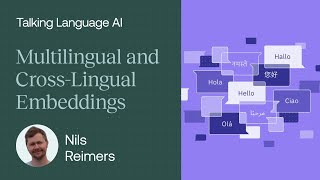
Multilingual and cross lingual embeddings - Nils Reimers
Key Takeaways
Nils Reimers discusses multilingual and cross-lingual embeddings, highlighting the limitations of traditional search methods like BM25 and the benefits of using multilingual embeddings for handling multiple languages with a single pipeline. He also talks about the importance of preserving country-language specific properties and addressing language bias in models.
Full Transcript
so final topic or second final topic is like multilingual search and so that's the most recent project I've been working on at at kohir to work on a multilingual embedding approach so far the dominant method in searches like lexical search bm25 but if you go and have like a multilingual data set let's say you create like some platform I don't know you you create Reddit people post in all types of languages on Reddit or Twitter and you want to provide like search function for all these languages it's like really really ugly to build this first you need to do language identification on docs and queries because every language needs a different tokenizer so in English you can't just tokenize on white spaces and then indexes but this does not work for Chinese so for Chinese you need a different tokenizer than for English and so on also stock worthless must be different so in English you have certain stock words but these stock words are different for French German Chinese Russian Turkish Arabic also what you often do is like stemmer where you reduce words to the stem like docs plural docs goes to Dock and that's also like language specific so every document has like a different pipeline different tokenizer different stock words different stamma for every language you need a different index so you have an index for all the Arabic documents or the Chinese documents or the English document and then if I enter a search query I first need to know what search what language is this query in and this can also be challenging because there are words which it's like a beak if you take the English word die in Germany the word b written the same way as an article so just from the word you don't know what's the language and so you don't know which index do I need to hit do I have to search the English index or the German index so you might need to query like multiple indices and out of the box systems like an elasticsearch only support few languages because it's like really really painful to create these tokenizer stockwards demo for every language with multilingual embeddings it's quite easy so you take the model you take the text path through Transformer Network you get an embedding out of it you don't need to do any language identification you don't need to have like any stemming stop words and so on so everything can be the same pipeline but however there have been previous work on multilingual embeddings but a big challenge was the the lack of training data so what people did before is they used from the neural machine translation Community translate sentences and train models on this or light models English models on this but here we see that models only work well on the sentence level another line of researchers like people use machine translation like Google Translate to translate query answer pairs to other languages but here the models don't learn language and Country specific properties so that people have been using Ms macro which has like a lot of questions how to do taxes in the yes and how to file certain forms and then translated this to German so now the model knows in German how I could find my taxes in the yes but the model has absolutely no idea how to do taxes in Germany and how to file all the forms that's required in Germany to do my taxes and as mentioned before models are really bad and out of domain settings so if I hit the model and ask some German specific question how do I do how do I file taxes or how do I get a tax refund the model has like absolutely no idea how to do it and how to learn it so what we did at here we say Okay data as is the key so we collected large quantities of training data not from machine learning translation but actually written by people of that language so for example Germans asking questions how to file the taxes in Germany together with the answers written from Germans how to do the taxes or how to fast certain forms in Germany and overall we close collected up to like 500 million non-english pairs and which we carefully created cleaned extended augmented and so on which covers like a lot of different topics and so we hope that the models are really broadly applicable and can find relevant information across all these languages to minimize the Gap we see in these models have on unknown words and unknown domains and of course we we put it also to a test in different settings first was like clustering and search in English search on non-english languages and cross-lingual classification we have training data just in English and I want to do classification in other languages and here the biggest Improvement we saw for search in non-english where previous methods they all worked like on a sentence level and here we see like a really big boost of performance on the non-english languages and one approach which is absolutely amazing was these embedding approaches it's like cross-lingual search so you can type the query in any of the 100 languages so here it's Arabic I'm not speaking Arabic my colleague Amer was so kind to provide this but he said supposed to ask the question what's the capital of the United States yeah you search the English Wikipedia on this and obviously elasticsearch has no idea what this Arabic garbage is but if you do semantic search it has like no idea no problem to match this because this text is matched to a vector the vector is really close to the English what is the capital of the United States and then you get the perfect match to like Washington DC is the capital of the United States foreign aspect here's in terms of like language bias if you create these models so either some models they have like a strong language bias meaning they prefer certain language combinations so for example if you take the libse model you see all the Russian points are in the left corner or the English points and the right corner for other models it's more like mixed together and there's like no strong separation between languages foreign ERS like is language bias good or not or not good so side effects with language bias is that same language results are ranked higher just because of the language so if I search what's the capital of the United States in Arabic I preferably find Arabic search results in a multilingual Corpus even such that maybe the English hit is it's a better answer to my question um but so so you could think that a model was odd language bias is nicer that it finds you the perfect document the perfect information without language but here the challenge becomes in things that are specific to languages where languages are also really tightly coupled with countries so for example if I search in English for wedding in an image search system some happy picture like this so you know that's the traditional Western picture how a wedding should look like the the bright and the white dress and the man and the smoking will suit black suit uh white skin if I if the model does not know about the language I'm searching in and I search in the Hindi word for weddings exactly I'm not speaking Hindi but Google translate told me that's the only word for wedding and the the vector spaces does not have like any information about the language so it just sees the content in terms of wedding it will retrieve the same result and here it's like doubtful if people that search in Hindi for wedding would be really interested to get like a western picture of a wedding presumably such person would be more interested to get like some weddings how they are typically celebrated in India similar who's the president here we assume Joe Biden links to president but if you ask in in French who's the president you probably not so much interested in the US president but you're probably more interested in the French president or maybe I don't know you used to speak there are a lot more french-speaking countries maybe you're interested in in a in the president of the respective countries so there's the question like how can you still preserve these country language specific properties if you don't have a language bias in the model
Original Description
Sentence Transformers and Embedding Evaluation - Talking Language AI Ep#3 Full episode:
https://youtu.be/apuDeylm1uE
About The Speaker:
Nils is the creator of Sentence-BERT and has authored several well-known research papers, including Sentence-BERT and the popular Sentence Transformers library. He’s also worked as a Research Scientist at HuggingFace, (co-)founded several web companies, and worked as an AI consultant in the area of investment banking, media, and IoT.
===
In our conversation, Nils gives us an introduction to the Sentence-BERT package and the large language models provided in it. He also shares some lessons from his experience in open-source development of such a popular package. Finally, Nils touches on his research collaborations on how to evaluate embeddings through works like MTEB: Massive Text Embedding Benchmark and BEIR.
To go deeper into these tools, and other concepts around embeddings, watch the video and join the conversation on Discord. Stay tuned for more episodes in our Talking Language AI series!
===
Join the Cohere Discord: https://discord.gg/co-mmunity
Discussion thread for this episode (feel free to ask questions):
https://discord.com/channels/954421988141711382/1052547510910062624
Watch more episodes of Talking Language AI: https://www.youtube.com/playlist?list=PLLalUvky4CLJ9ZgtZguDJ7dAYuI1bfaYW
===
Resources:
Bonjour. مرحبا. Guten tag. Hola. Cohere's Multilingual Text Understanding Model is Now Available: https://txt.cohere.ai/multilingual/
SBERT: https://www.sbert.net/
SBERT Paper: https://arxiv.org/abs/1908.10084
MTEB: Massive Text Embedding Benchmark: https://arxiv.org/abs/2210.07316
BEIR: A Heterogeneous Benchmark for Zero-shot Evaluation of Information Retrieval Models: https://openreview.net/forum?id=wCu6T5xFjeJ
SetFit - Efficient Few-shot Learning with Sentence Transformers https://github.com/huggingface/setfit
Playlist
Uploads from Cohere · Cohere · 52 of 60
1
 2
2
 3
3
 4
4
 5
5
 6
6
 7
7
 8
8
 9
9
 10
10
 11
11
 12
12
 13
13
 14
14
 15
15
 16
16
 17
17
 18
18
 19
19
 20
20
 21
21
 22
22
 23
23
 24
24
 25
25
 26
26
 27
27
 28
28
 29
29
 30
30
 31
31
 32
32
 33
33
 34
34
 35
35
 36
36
 37
37
 38
38
 39
39
 40
40
 41
41
 42
42
 43
43
 44
44
 45
45
 46
46
 47
47
 48
48
 49
49
 50
50
 51
51
 ▶
▶
 53
53
 54
54
 55
55
 56
56
 57
57
 58
58
 59
59
 60
60

Andreas Madsen on Independent Research and Interpretability
Cohere
Plex: Towards Reliability using Pretrained Large Model Extensions
Cohere
Independent Research Panel Discussion
Cohere
The Future of ML Ops: Open Challenges and Opportunities
Cohere
C4AI Special - Grad School Applications
Cohere
Cohere For AI Fireside Chat: Samy Bengio
Cohere
Cohere For AI - Scholars Program Information Session
Cohere
Modular and Composable Transfer Learning with Jonas Pfeiffer
Cohere
Jay Alammar Presents Large Language Models for Real World Applications
Cohere
Catherine Olsson - Mechanistic Interpretability: Getting Started
Cohere
How To Prompt Engineer a Tech Interview App | TOHacks 2022 Winners
Cohere
C4AI Sparks: Samy Bengio
Cohere
BERTopic for Topic Modeling - Maarten Grootendorst - Talking Language AI Ep#1
Cohere
Exploring News Headlines With Text Clustering | Jay Alammar
Cohere
Scale TransformX | Fireside Chat: Aidan Gomez and Alexandr Wang
Cohere
Making Large Language Models Accessible | Scale AI Fireside chat with Bill MacCartney
Cohere
Intro to KeyBERT - BERTopic for Topic Modeling
Cohere
Intro to PolyFuzz - BERTopic for Topic Modeling
Cohere
API Design Philosophy - BERTopic for Topic Modeling
Cohere
Code demo of BERTopic - BERTopic for Topic Modeling
Cohere
Short texts vs long texts in BERTopic- BERTopic for Topic Modeling
Cohere
How People can help BERTopic - BERTopic for Topic Modeling
Cohere
Cohere For AI: Training Sensorimotor Agency in Cellular Automata with Bert Chan
Cohere
Cohere API Community Demos | October 2022
Cohere
Perfect Prompt Demo By Arjun Patel
Cohere
Project Idea Generator Demo By Tobechukwu Okamkpa
Cohere
SuperTransformer Demo By Amir Nagri and Team Megatron
Cohere
Cohere For AI Fireside Chat: Pablo Samuel Castro
Cohere
How Startups Can Use NLP to Build a Competitive Moat
Cohere
Build Chatbots Faster with Large Language Models
Cohere
Tools to Improve Training Data - Vincent Warmerdam - Talking Language AI Ep#2
Cohere
Utku Evci - Sparsity and Beyond Static Network Architectures
Cohere
Adding human intelligence to ML models with human-learn #shorts #machinelearning #nlp
Cohere
Iterating on your data with doubtlab - Tools to Improve Training Data
Cohere
Adding Human Intelligence to ML models with Human learn - Tools to Improve Training Data
Cohere
Scikt Learn embeddings helpers with Embetter - Tools to Improve Training Data
Cohere
Building Cohere API Demo App With Streamlit | Adrien Morisot
Cohere
Rosanne Liu - career creation for non-standard candidates
Cohere
Giving computers many human languages with Cohere's multilingual embeddings
Cohere
Learning by Distilling Context with Charlie Snell
Cohere
Sentence Transformers and Embedding Evaluation - Nils Reimers - Talking Language AI Ep#3
Cohere
Reflecting on for.ai...
Cohere
Create a Custom Language Model with Surge AI and Cohere
Cohere
Cohere API Community Demos | November 2022
Cohere
Cohere API Community Demos | December 2022
Cohere
Cohere For AI Presents: Colin Raffel
Cohere
Lucas Beyer - FlexiViT: One Model for All Patch Sizes
Cohere
What is Neural Search? Nils Reimers - Sentence Transformers and Embedding Evaluation
Cohere
Evaluating Information Retrieval with BEIR
Cohere
Evaluating Embeddings with MTEB Massive text embeddings benchmark - Nils Reimers
Cohere
High quality text classification with few training examples with SetFit
Cohere
Multilingual and cross lingual embeddings - Nils Reimers
Cohere
Developing open-source software: lessons, benefits, and challenges - Nils Reimers
Cohere
Ask Me Anything with Ed Grefenstette, Head of Machine Learning at Cohere
Cohere
HyperWrite Powers Its Generative AI Service with Cohere
Cohere
EMNLP 2022 Conference Special Edition - Talking Language AI #4
Cohere
Cohere API Community Demos | January 2023
Cohere
C4AI Sparks: Rosanne Liu on Career Creation for Non-Standard Candidates
Cohere
Michael Tschannen - Image-and-Language Understanding from Pixels Only
Cohere
How to Add AI to your App
Cohere
More on: Research Methods
View skill →








Related Reads
📰
📰
📰
📰
Don’t Read Another 30-Page Paper Until You Try This
Medium · AI
6.5% of the Neuro-Symbolic Literature Can Be Reproduced from Its Published Artifacts, a Six-Stage Audit Framework and First Instantiation
ArXiv cs.AI
Research Publications, Patents & Innovation Output at Quantum University
Medium · Machine Learning
Every Researcher Should Start Managing Research Intelligence Assets™
Medium · AI
🎓
Tutor Explanation

 DeepCamp AI