SQL Mathematical Functions
Key Takeaways
Uses SQL Mathematical Functions like CEIL(), FLOOR(), and ROUND() to manipulate tables in a database
Original Description
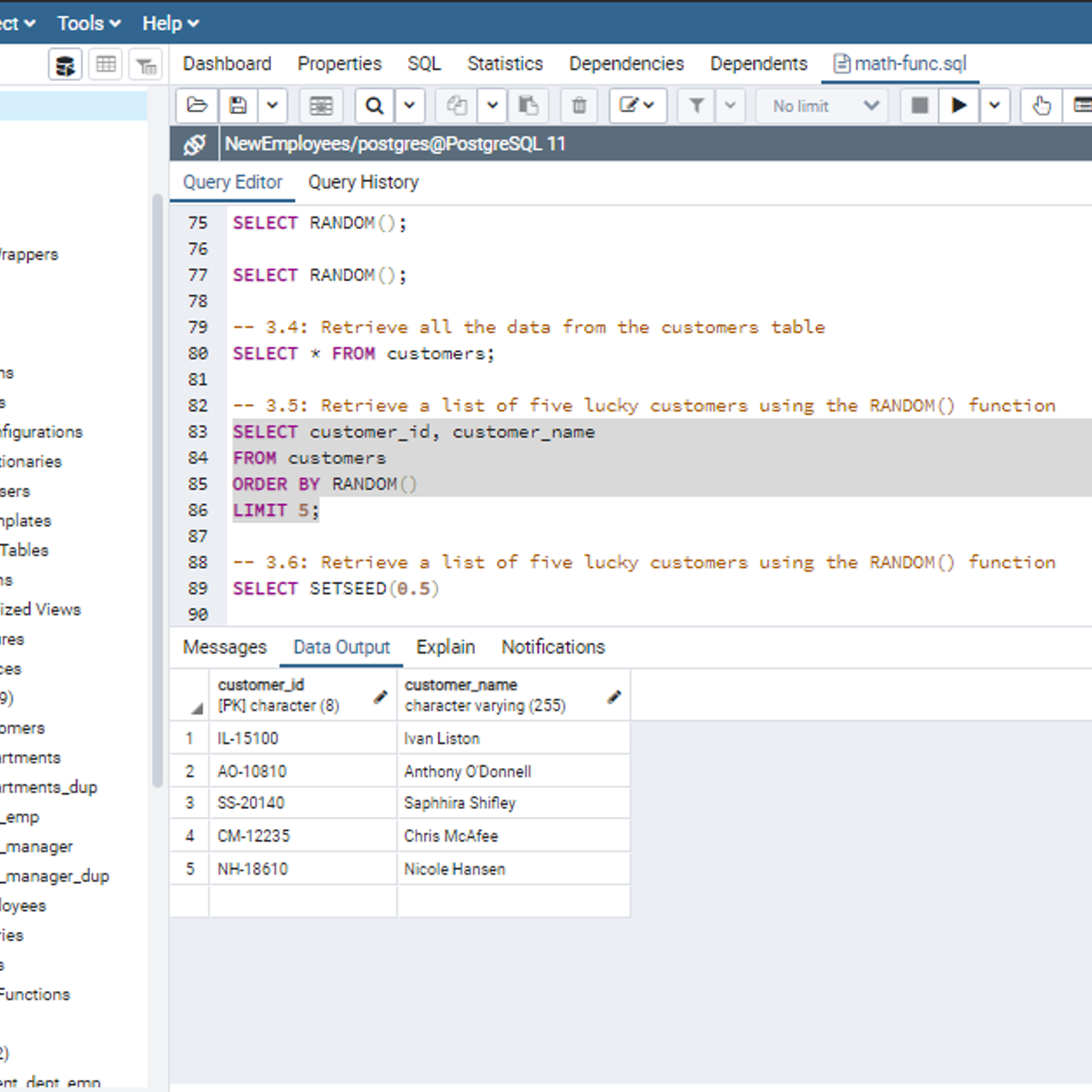
Welcome to this project-based course, SQL Mathematical Functions. In this project, you will learn how to use SQL Mathematical Functions to manipulate tables in a database.
By the end of this 2-hour-long project, you will be able to use different Mathematical Functions to retrieve the desired result from a database. In this project, you will learn how to use SQL Mathematical Functions like CEIL(), FLOOR(), RANDOM(), SETSEED(), ROUND(), TRUNC(), SQRT(), CBRT(), and POWER() to manipulate data in the employees database. In this project, we will move systematically by first introducing the functions using a simple example. Then, we will write slightly complex queries using the Mathematical Functions in real-life applications.
Also, for this hands-on project, we will use PostgreSQL as our preferred database management system (DBMS). Therefore, to complete this project, it is required that you have prior experience with using PostgreSQL. Similarly, this project is an intermediate SQL concept; so, a good foundation for writing SQL queries is vital to complete this project.
If you are not familiar with writing queries in SQL and want to learn these concepts, start with my previous guided projects titled “Querying Databases using SQL SELECT statement," and “Performing Data Aggregation using SQL Aggregate Functions.” I taught these guided projects using PostgreSQL. So, taking these projects will give the needed requisite to complete this SQL Mathematical Functions project. However, if you are comfortable writing queries in PostgreSQL, please join me on this wonderful ride! Let’s get our hands dirty!
Watch on External: Coursera ↗
(saves to browser)
Sign in to unlock AI tutor explanation · ⚡30
More on: SQL Analytics
View skill →







Related Reads
📰
📰
📰
📰
Exploratory Data Analysis: Asking Good Questions of Your Data
Medium · Machine Learning
Exploratory Data Analysis: Asking Good Questions of Your Data
Medium · Data Science
Exploratory Data Analysis: Asking Good Questions of Your Data
Medium · Programming
Automating Source-to-Target Mapping
Medium · Python
🎓
Tutor Explanation

 DeepCamp AI