Math Jokes Explained - Numberphile
Skills:
Maths for ML50%
Key Takeaways
Dissects and explains math jokes in a forensic fashion
Full Transcript
[Music] is this thing on so a man walks into a bar he asks for 10 times more drinks than everyone else the barman says now that is an order of magnitude actually quite a good joke because order of magnitude is how big a number is a speed of light is is 3 * 10 8 m/s and that's the order of magnitude it's 3 with 8 Zer after it and something like a kilometer is 10 3 m so light in 1 second goes five orders of magnitude further than a kilometer and so when he says I want 10 times as many drinks he's actually ordering one order of magnitude more than anyone else which is of course an order of magnitude so an infinite number of mathematicians walk into a bar the first one he orders a pint the second one half a pint then a quarter then an eighth eventually the barman hands over two pints and says you mathematicians you just don't know your limits okay so if you start with one and then you add a half and then you add a quarter and then you add an e and each time you're getting smaller and smaller what we're actually doing is we're summing all the 1 over two to the NS some n and we start with n equal Z and we go all the way up to a correctly drawn infinity sign and if you carry this on infinitely it's limit equals two which is why the bman gave them two points and he said you don't know your limits cuz that's a limit so why is six afraid of seven because 789 not strictly a math joke but okay the thing here is that numbers appear in order they go 1 2 3 4 5 6 7 8 9 why is six scared of seven well when you say 789 the uh word eight in English sounds a bit like the word eight so it sounds like 7 89 so eight is in this case a word and seven then eats I don't know it's the I mean I personally would say that uh seven is a six offender but I'm not the one doing the jokes here am I how do you make seven even remove the s that was promised number jokes but I guess another English one is fine so the number seven if you write it out in this language called English which you may have heard of you spell it seven and then if you remove the S you're left with the English word even no actual maths involved two cats are standing on a roof which one falls off first the one with the smaller Mew okay bear with me here uh I'm going to uh represent the roof like uh this the front door and chimney are optional and then I'm going to approximate the cat as a uh rectangle uh gravity is forcing the cat uh directly down but of course it can't go straight down because it's on a sloped roof and so you're going to split this into a normal vector which comes off this way and then the vector going down the roof what stops it from falling off the roof is friction and friction would be a force coming back this way and friction is proportional to how hard the box is being press down into the roof and so we have the coefficient of friction which is the Greek letter mu times whatever that normal force is and so the bigger the coefficient of friction the less likely it is to fall off and if there were two BO is the one with the smaller coefficient of friction would fall off first and that is the Greek letter mu which uh if we're talking about cats the cats make the sound meow what did the number zero say to the number eight nice belt all right okay I guess so so uh zero looks a bit like this and if you imagine putting a belt around uh zero and then tightening it it would squeeze the middle of zero in like uh like that and if you tighten it enough it would pinch off and would form an eight and so an eight is a bit like a zero wearing a belt why is a nice belt I'm not [Music] sure what do you get if you cross a mosquito with a mountain climber nothing you can't cross a vector in a scaler okay there's a lot going on here we'll start with what we mean by cross and it's a way of saying multiply when you multiply numbers together it's easy there's one thing you do you multiply one by the other when you multiply vectors it gets a bit more complicated so let's say I've got one vector uh U which has U component uy component and u z component because it's in 3D and then I've got another Vector uh I'm going to call V so I've got VX component v y component v z component and then I want to multiply these two vectors and there's more than one way to do that you can dot multiply which gives you a scalar which is just a normal number out as an answer or you can cross multiply using our traditional cross multiply symbol which gives you out another Vector now cross multiplying is a little bit complicated okay let's do the first one so it's u y normal multiply v z minus u z normal multi VY then the next compon okay and you keep going and you get three new components out this way the trouble is you can only cross multiply vectors you can't can't do the same thing for normal numbers or scalers as we call them and someone who climbs a mountain is scaling it so I guess you could call him a scaler and a mosquito and we're going right outside maths here a mosquito can transmit diseases which in biology you would call a vector as a way of transmitting diseases and so you can't do a cross multiplication between a vector and a scaler and so that's that's that's the joke did you hear the one about the constipated mathematician he worked it out with a pencil no we're aware that there are other Mass jokes we've not covered we're also aware that some of you have discovered the comment section underneath YouTube videos so if you have your own Mass joke you'd like to contribute I mean it's not like we're going be a to stop you it's definitely going to happen and we will endeavor if we get enough interesting ones to explain the math behind more math jokes
Original Description
Some of your favourite maths jokes are dissected in forensic fashion.
More links & stuff in full description below ↓↓↓
It is YouTube Comedy Week: http://yt.be/comedyweek
Animation by Pete McPartlan - http://www.petemcpartlan.co.uk
Explanations by Matt Parker - http://www.standupmaths.com
More jokes explained at: http://youtu.be/Fmb3TCvlET
Leave more joke suggestions in the comment section.
NUMBERPHILE
Website: http://www.numberphile.com/
Numberphile on Facebook: http://www.facebook.com/numberphile
Numberphile tweets: https://twitter.com/numberphile
Subscribe: http://bit.ly/Numberphile_Sub
Videos by Brady Haran
Patreon: http://www.patreon.com/numberphile
Brady's videos subreddit: http://www.reddit.com/r/BradyHaran/
Brady's latest videos across all channels: http://www.bradyharanblog.com/
Sign up for (occasional) emails: http://eepurl.com/YdjL9
Numberphile T-Shirts: https://teespring.com/stores/numberphile
Other merchandise: https://store.dftba.com/collections/numberphile
Watch on YouTube ↗
(saves to browser)
Sign in to unlock AI tutor explanation · ⚡30
Playlist
Uploads from Numberphile · Numberphile · 47 of 60
1
 2
2
 3
3
 4
4
 5
5
 6
6
 7
7
 8
8
 9
9
 10
10
 11
11
 12
12
 13
13
 14
14
 15
15
 16
16
 17
17
 18
18
 19
19
 20
20
 21
21
 22
22
 23
23
 24
24
 25
25
 26
26
 27
27
 28
28
 29
29
 30
30
 31
31
 32
32
 33
33
 34
34
 35
35
 36
36
 37
37
 38
38
 39
39
 40
40
 41
41
 42
42
 43
43
 44
44
 45
45
 46
46
 ▶
▶
 48
48
 49
49
 50
50
 51
51
 52
52
 53
53
 54
54
 55
55
 56
56
 57
57
 58
58
 59
59
 60
60
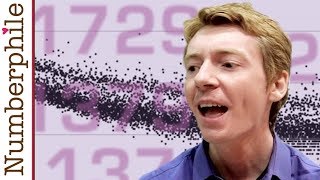
Numberphile Preview
Numberphile
31 and Mersenne Primes - Numberphile
Numberphile
17 and Sudoku Clues - Numberphile
Numberphile
Root 2 - Numberphile
Numberphile
3/4 and Kleiber's Law - Numberphile
Numberphile
7 and Happy Numbers - Numberphile
Numberphile
23 and Football Birthdays - Numberphile
Numberphile
Googol and Googolplex - Numberphile
Numberphile
Special Magic Square - Numberphile
Numberphile
998,001 and its Mysterious Recurring Decimals - Numberphile
Numberphile
42 and Douglas Adams - Numberphile
Numberphile
Pi and Bouncing Balls - Numberphile
Numberphile
6,000,000 and Abel Prize - Numberphile
Numberphile
Sunflowers and Fibonacci - Numberphile
Numberphile
8848 - Numberphile
Numberphile
What is a lucky number? - Numberphile
Numberphile
Base 60 (sexagesimal) - Numberphile
Numberphile
How big is a billion? - Numberphile
Numberphile
I washed my passport - Numberphile
Numberphile
Golden Ratio - Making a Math Metal Anthem - Numberphile
Numberphile
Golden Ratio Song - Numberphile
Numberphile
The LONGEST time - Numberphile
Numberphile
Dyscalculia - Numberphile
Numberphile
Problematic Sunflower - Numberphile
Numberphile
Batman Equation - Numberphile
Numberphile
The Most Mathematical Flag - Numberphile
Numberphile
Did Usain Bolt REALLY run 100m in 9.63 seconds?
Numberphile
Brown Numbers - Numberphile
Numberphile
43,252,003,274,489,856,000 Rubik's Cube Combinations - Numberphile
Numberphile
Amazing Old Calculator (Curta) - Numberphile
Numberphile
abc Conjecture - Numberphile
Numberphile
Message from Numberphile
Numberphile
Keith Numbers - Numberphile
Numberphile
Tau of Phi - Numberphile
Numberphile
Encryption and HUGE numbers - Numberphile
Numberphile
Kids get their money - Numberphile
Numberphile
Number 1 and Benford's Law - Numberphile
Numberphile
Brady's Videos and Benford's Law - Numberphile
Numberphile
Anatomy of a Goal - Numberphile
Numberphile
The problem in Good Will Hunting - Numberphile
Numberphile
Calculating Pi with Real Pies - Numberphile
Numberphile
How Pi was nearly changed to 3.2 - Numberphile
Numberphile
Pi with Pies (director's slice) - Numberphile
Numberphile
Problems with French Numbers - Numberphile
Numberphile
Statistics on Match Day - Numberphile
Numberphile
Squaring the Circle - Numberphile
Numberphile
Math Jokes Explained - Numberphile
Numberphile
Base Number Jokes Explained - Numberphile
Numberphile
Gaps between Primes - Numberphile
Numberphile
Mathematical Music - Numberphile Interview
Numberphile
Is it Math or Maths? - Numberphile
Numberphile
One minus one plus one minus one - Numberphile
Numberphile
Infinity Paradoxes - Numberphile
Numberphile
British Numbers confuse Americans - Numberphile
Numberphile
Can Fish Count? - Numberphile
Numberphile
WARNING: Contains Numbers
Numberphile
Fibonacci Mystery - Numberphile
Numberphile
Fermat's Last Theorem - Numberphile
Numberphile
Politics and Numbers - Numberphile
Numberphile
Sloane's Gap - Numberphile
Numberphile
More on: Maths for ML
View skill →






Related Reads
📰
📰
📰
📰
Follow-up: The ArxivLens Protocol: Transforming Research Nois
Dev.to AI
On July 1, 2026, arXiv will spin out from Cornell University, its home for the past 25 years, to become an independent nonprofit organization. Major funding support from Simons Foundation and Schmidt Sciences. Ditching the red for their website. [N]
Reddit r/MachineLearning
CS-NRRM™ Official Publications: Paper 1 and Paper 2 Are Now Available
Medium · Data Science
Found a potential mistake in an ICLR 2026 blogpost [D]
Reddit r/MachineLearning
🎓
Tutor Explanation

 DeepCamp AI