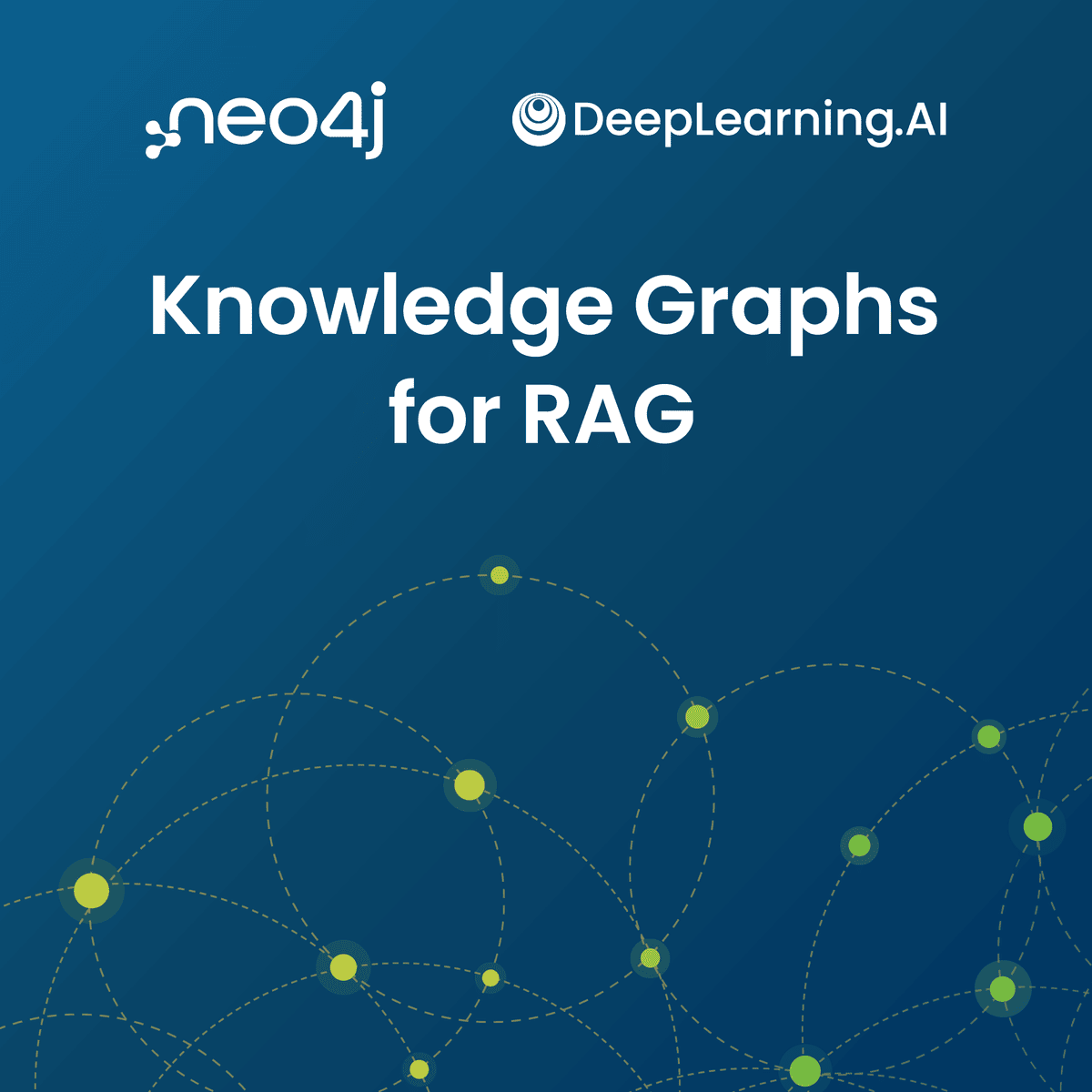
Knowledge Graphs for RAG
Key Takeaways
Constructs knowledge graphs for RAG to structure complex data relationships
Original Description
Knowledge graphs are used in development to structure complex data relationships, drive intelligent search functionality, and build powerful AI applications that can reason over different data types. Knowledge graphs can connect data from both structured and unstructured sources (databases, documents, etc.), providing an intuitive and flexible way to model complex, real-world scenarios.
Unlike tables or simple lists, knowledge graphs can capture the meaning and context behind the data, allowing you to uncover insights and connections that would be difficult to find with conventional databases. This rich, structured context is ideal for improving the output of large language models (LLMs), because you can build more relevant context for the model than with semantic search alone.
This course will teach you how to leverage knowledge graphs within retrieval augmented generation (RAG) applications. You’ll learn to:
1. Understand the basics of how knowledge graphs store data by using nodes to represent entities and edges to represent relationships between nodes.
2. Use Neo4j’s query language, Cypher, to retrieve information from a fun graph of movie and actor data.
3. Add a vector index to a knowledge graph to represent unstructured text data and find relevant texts using vector similarity search.
4. Build a knowledge graph of text documents from scratch, using publicly available financial and investment documents as the demo use case
5. Explore advanced techniques for connecting multiple knowledge graphs and using complex queries for comprehensive data retrieval.
6. Write advanced Cypher queries to retrieve relevant information from the graph and format it for inclusion in your prompt to an LLM.
After course completion, you’ll be well-equipped to use knowledge graphs to uncover deeper insights in your data, and enhance the performance of LLMs with structured, relevant context.
AI explanation not available for this lesson yet
This lesson is still being prepared for the AI tutor. In the meantime, explore lessons that are ready.
Browse explainer-ready lessons →
More on: RAG Basics
View skill →
![Build a RAG Agent in n8n | Vector DB Pinecone + WhatsApp + Gmail [2026]](https://i.ytimg.com/vi/4eJsZBgwFJ4/mqdefault.jpg)



🎓
Tutor Explanation
 DeepCamp AI