Introduction to Deep Learning | Represent Any Function Using Sigmoid Neuron | Beginners | in Tamil
Key Takeaways
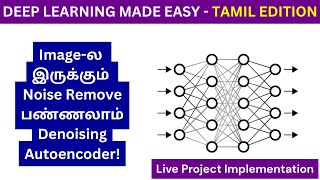
Explains the sigmoid neuron and its ability to approximate any arbitrary function using deep learning concepts
Original Description
In this video, we dive deep into the fascinating world of sigmoid neurons and explore their ability to approximate any arbitrary function. Understanding how neural networks learn complex patterns begins with mastering the behavior of individual neurons. The sigmoid neuron, one of the fundamental building blocks of deep learning, plays a crucial role in transforming raw inputs into meaningful outputs. But how can a simple sigmoid function be used to represent any complex function? That’s exactly what we uncover in this video.
A major challenge in deep learning is approximating any function, no matter how complicated. One of the most powerful approaches to solving this problem is using tower functions—a method that enables sigmoid neurons to approximate arbitrary functions with high accuracy. In this tutorial, we break down the concept of tower functions, how they are constructed, and why they are essential in deep learning. By stacking sigmoid neurons strategically, we can create a neural network capable of learning and mimicking any function.
To truly grasp this concept, we first look at the sigmoid activation function, its mathematical formulation, and its properties. The sigmoid function squashes input values into a range between 0 and 1, introducing non-linearity into neural networks. This non-linearity is crucial because it allows neural networks to learn complex patterns instead of just linear transformations. We explore how combining multiple sigmoid neurons helps in approximating step functions and other complex mathematical functions, setting the foundation for deeper architectures like multi-layer perceptrons and deep neural networks.
One of the most exciting aspects of this video is the practical breakdown of how sigmoid neurons form tower functions. By stacking multiple neurons, we can progressively refine the output of the network, improving its ability to approximate any target function. We demonstrate this with intuitive visualizations and examples,
Watch on YouTube ↗
(saves to browser)
Sign in to unlock AI tutor explanation · ⚡30
More on: Neural Network Basics
View skill →







Related Reads
📰
📰
📰
📰
How to Choose the Best Deep Learning Model for Medical Imaging
Medium · Deep Learning
Another Way to Read Neural Geometry
Medium · Data Science
Another Way to Read Neural Geometry
Medium · Deep Learning
Building My First Neural Network From Scratch with PyTorch: A Journey on the Dry Bean Dataset
Medium · Deep Learning
🎓
Tutor Explanation
 DeepCamp AI