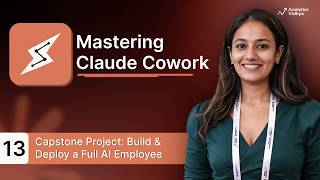
How to Design an AI Employee: The Blueprint for Autonomous AI Agents
Stop thinking like a user and start thinking like a manager. In this video, we move beyond simple chatbots to design a true AI Employee—a persistent, digital team member that manages tasks, remembers your preferences, and takes action across your favorite apps.
What you will learn in this blueprint session:
- The 5 Pillars of an AI Employee: Persona, Skills, Workflows, Memory, and Tools.
- The Mindset Shift: Why you need to treat AI configuration like a hiring process.
- Defining Scope: How to set boundaries for autonomous tasks vs. tasks requiring human approval.
- The Handoff Protocol: Designing escalation triggers so your AI knows when to ask for help.
- Practical Demo: Watch us build an AI Executive Assistant blueprint inside Claude Co-work to handle inbox triage, scheduling, and operational coordination.
The Gap Between Chatbots and AI Employees:
While a chatbot gives a one-off response, an AI employee is persistent, context-aware, and connected to your actual tools like Gmail, Calendar, Slack, and Notion.
Whether you are a founder, a CEO, or an operations manager, this framework will help you reclaim hours of your week by building a digital workforce that actually works.
Watch on YouTube ↗
(saves to browser)
Sign in to unlock AI tutor explanation · ⚡30
More on: Agent Foundations
View skill →





Related AI Lessons
⚡
⚡
⚡
⚡
Agentic Context Engineering (ACE) Explained: Why Your AI Agents Need a Playbook, Not a Prompt
Dev.to · Amit Ben-Ari
Scaling AI Pub/Sub for Agent Messaging: Real Patterns That Survived Production
Dev.to · hamza qureshi
I Asked 3 Claude Code Sub-agents to Review the Same PR. They Disagreed on 41% of the Comments.
Dev.to AI
OpenAI Outlines WebRTC Architecture for Low-Latency Voice AI at Scale
InfoQ AI/ML
🎓
Tutor Explanation
 DeepCamp AI