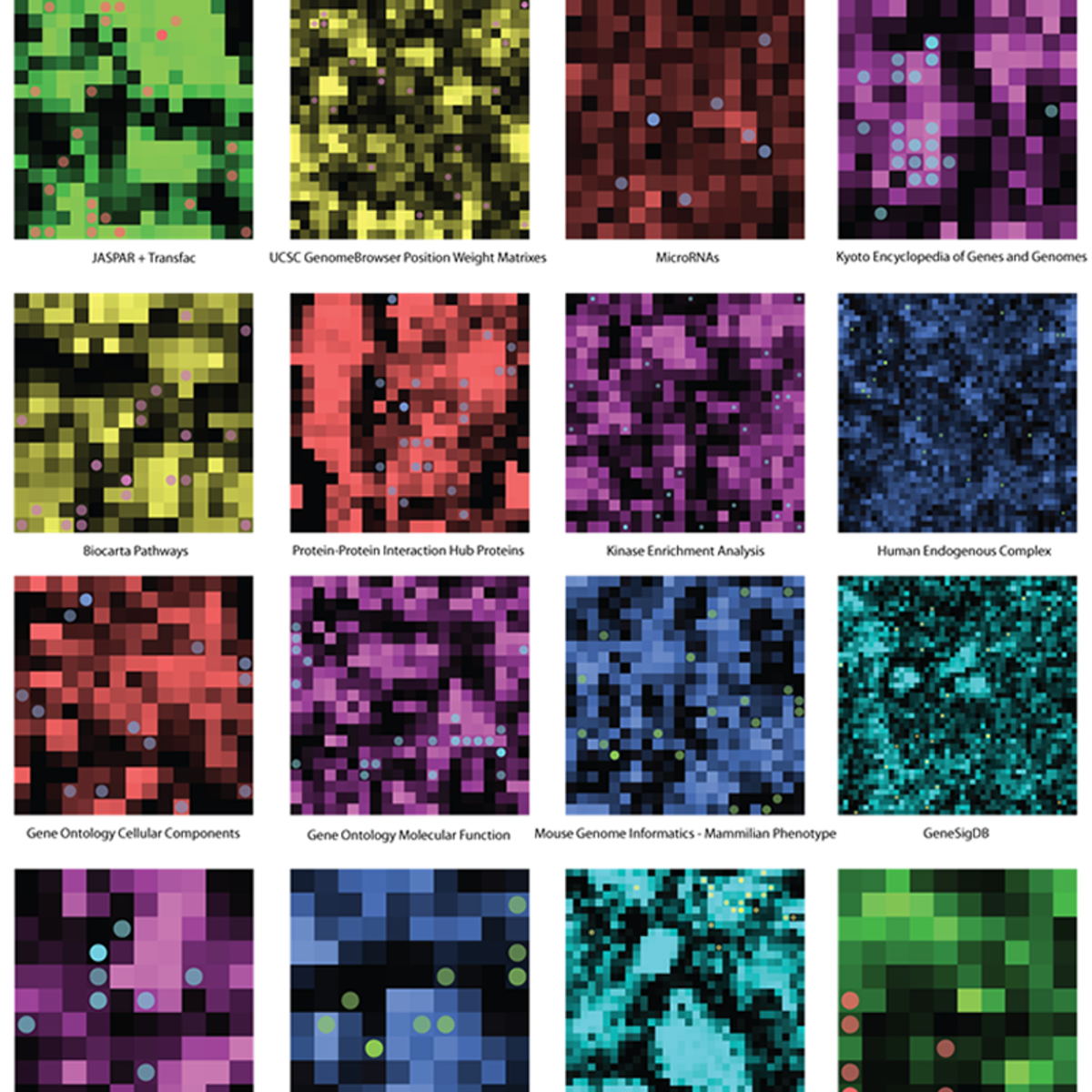
Big Data Science with the BD2K-LINCS Data Coordination and Integration Center
The Library of Integrative Network-based Cellular Signatures (LINCS) was an NIH Common Fund program that lasted for 10 years from 2012-2021. The idea behind the LINCS program was to perturb different types of human cells with many different types of perturbations such as drugs and other small molecules, genetic manipulations such as single gene knockdown, knockout, or overexpression, manipulation of the extracellular microenvironment conditions, for example, growing cells on different surfaces, and more. These perturbations are applied to various types of human cells including cancer cell lines or induced pluripotent stem cells (iPSCs) from patients, differentiated into various lineages such as neurons or cardiomyocytes. Then, to better understand the molecular networks that are affected by these perturbations, changes in levels of many different molecules within the human cells were measured including: mRNAs, proteins, and metabolites, as well as cellular phenotypic changes such as cell morphology. The BD2K-LINCS Data Coordination and Integration Center (DCIC) was commissioned to organize, analyze, visualize, and integrate this data with other publicly available relevant resources. In this course, we introduce the LINCS DCIC and the various Data and Signature Generation Centers (DSGCs) that collected data for LINCS. We then cover the LINCS metadata, and how the metadata is linked to ontologies and dictionaries. We then present the data processing and data normalization methods used to clean and harmonize the LINCS data. This follows by discussions about how the LINCS data is served with RESTful APIs. Most importantly, the course covers computational bioinformatics methods that can be applied to other multi-omics datasets and projects including dimensionality reduction, clustering, gene-set enrichment analysis, interactive data visualization, and supervised learning. Finally, we introduce crowdsourcing/citizen-science projects where students can work together in tea
Watch on Coursera ↗
(saves to browser)
Sign in to unlock AI tutor explanation · ⚡30
More on: Data Literacy
View skill →






Related AI Lessons
⚡
⚡
⚡
⚡
Excel untuk Data Analytics: Cara Mudah Mengolah Data untuk Pemula
Medium · Data Science
I Tried to Find Out How Close I Am to the CEO of Roblox. The Answer Was Three.
Medium · Data Science
The Dying Symphony of Nature :
How climate change silences Cultures, Species, and Nature.
Medium · Data Science
Student Mental Health Analytics: An Interactive Dashboard in R Shiny
Medium · Data Science
🎓
Tutor Explanation
 DeepCamp AI