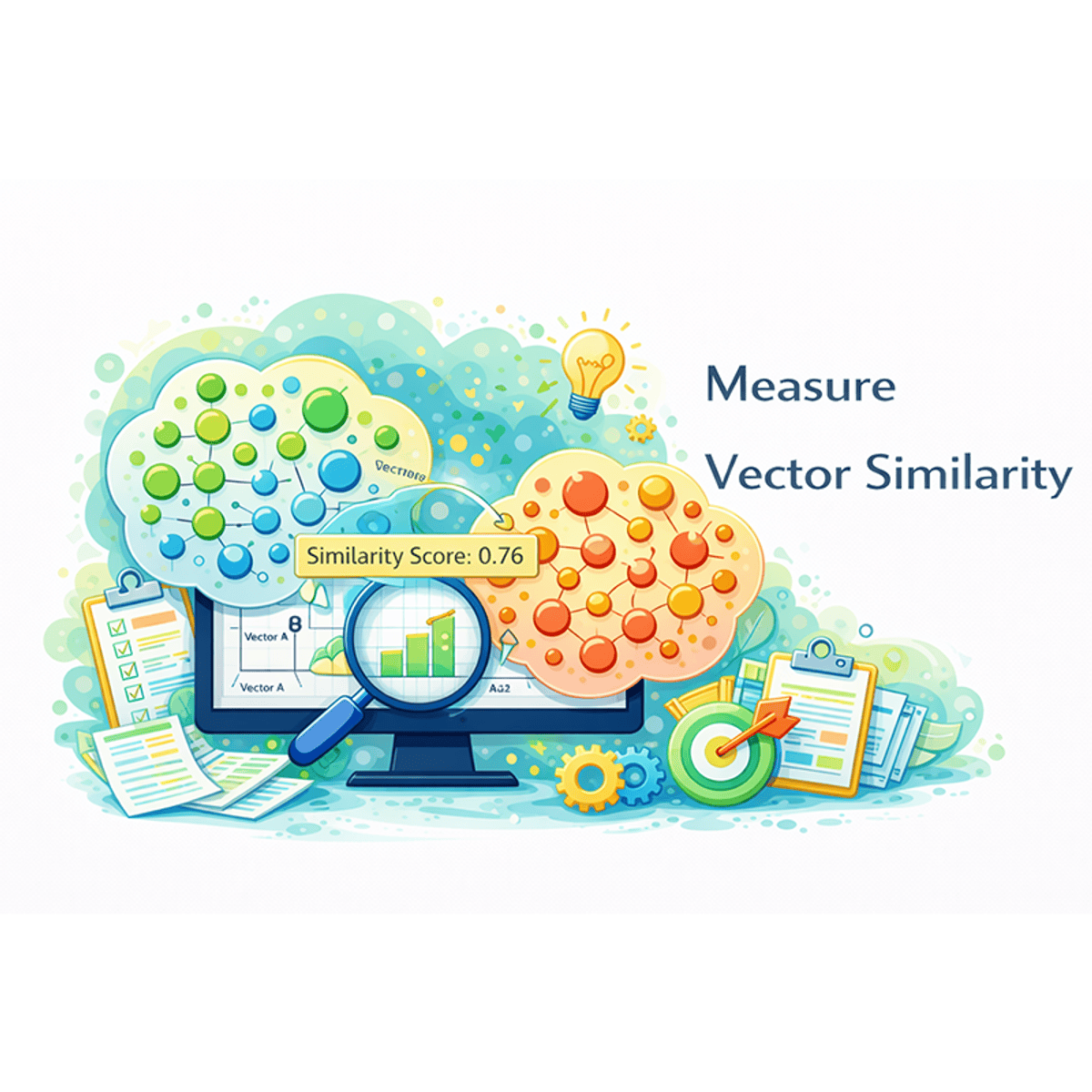
Measure Vector Similarity
Key Takeaways
Measure vector similarity using cosine, dot-product, and Euclidean distance
Original Description
Measure Vector Similarity: Cosine, Dot-Product, and Euclidean Distance is an intermediate course for machine learning engineers and data scientists looking to master how similarity metrics impact information retrieval, recommendation systems, and classification tasks. In a world where the right comparison can mean the difference between a successful product recommendation and a flawed medical insight, choosing the correct metric is critical.
This course moves beyond theory and provides direct, hands-on experience. You will learn to calculate and implement cosine similarity, dot-product, and Euclidean distance using Python and NumPy. Through practical examples inspired by real-world applications at companies like Amazon and in healthcare research, you will analyze how each metric uniquely influences vector ranking and search precision. The course culminates in a capstone project where you will build a benchmark notebook to rigorously compare the performance of these metrics on a sample dataset—a portfolio-ready project that proves your ability to make informed, data-driven decisions in machine learning applications.
You will need to have basic Python programming skills, familiarity with NumPy, and foundational knowledge of linear algebra (vectors, dot products).
Watch on External: Coursera ↗
(saves to browser)
Sign in to unlock AI tutor explanation · ⚡30
More on: ML Maths Basics
View skill →



🎓
Tutor Explanation

 DeepCamp AI